
Life, 1908-08-06 · page 33 of 54
Life — August 6, 1908 — page 33: what you’re looking at
What you’re looking at
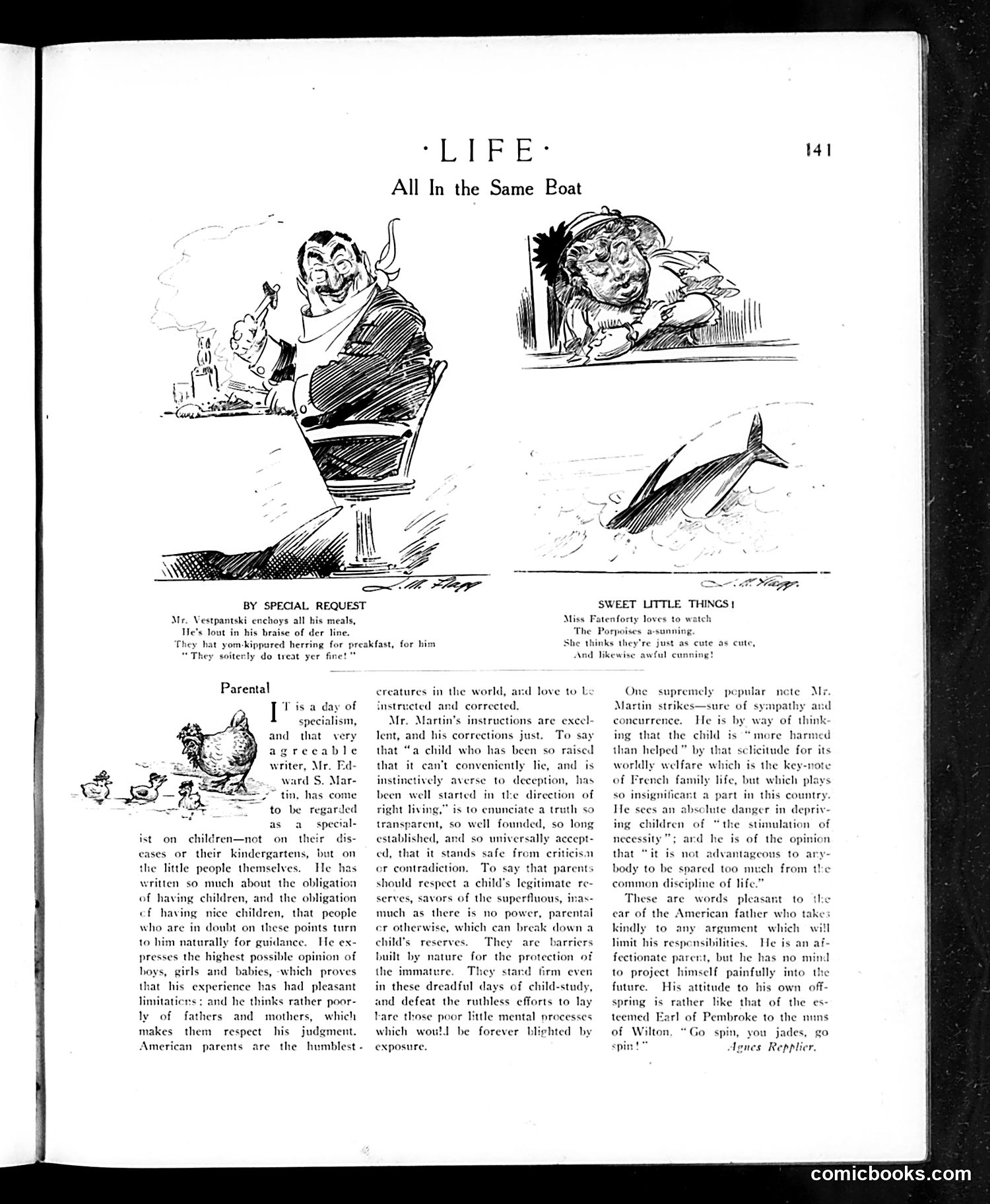
This page satirizes parenting philosophies and social pretension. The top cartoon mocks Mr. Vestpantski, who "enjoys all his meals" in luxurious style while claiming humble origins ("lout in his braise of der line")—a joke about false modesty or ethnic affectation. The main article praises Edward S. Martin, a writer and supposed expert on child-rearing, who advocates for minimal parental coddling and discipline. The satire is subtle: while praising Martin's sensible views (children need moral training, not excessive protection), the closing joke reveals the hypocrisy. The American father agrees with Martin's philosophy about not indulging children—but only because he himself wants to avoid the effort and responsibility of parenting. The final quote from the Earl of Pembroke ("Go spin, you jades") suggests dismissive indifference toward those under one's care. The "Sweet Little Things" cartoon appears to show a woman watching dolphins or porpoises, ironically captioned about cuteness—possibly mocking sentimentality about nature while ignoring human children's welfare.
📄 Transcribed text from this page (OCR, searchable)
Machine-transcribed from the original scan — historical spelling and the odd misread are preserved.
BY SPECIAL REQUEST Mr. Vestpantski enchoys all his meals, He's lout in his braise of der line. They hat yo “They. soite: y do treat yer fine Parental T is a day of pecialism, and that very agreeable writer, Mr. Ed- ward S. Mar- ~ tin, has come to be regarded as a specia on children—not on their dis- ‘ases or their kindergartens, but on he little people themselves. He has written so much about the obligati of having children, and the obligation ef having nice children, that people who are in doubt on these points turn to him naturally for guidance. He ex- presses the highest possible opinion of hoys, girls and babies, which proves that his experience has had pleasant limitatiers : and he thinks rather poor- and mothers, which respect are ly of fathers his the makes them judgment. American parents humblest - ippured herring for preakfast, for him *LIFE- All In the Same Boat The She SWEET LITTLE THINGS! Miss Fatenf ty loves to watch nks they're just as cute as cute, And likewise awful cunniny creatures in the world, ard love to | instructed and corrected, Mr. Martin's instructions are excel lent, and his corrections just. To say that “a child who has been so raised that it can't conveniently lic, and is instinctively averse to deception, been well started in the direction of right living,” is to enunciate a truth so transparent, so well founded, so long established, and so universally ed, that it stands safe from criticisa cr contradiction. To say that parents should respect a child's legitimate re- serves, savors of the superfluous, inas- much as there is no power, parental er otherwise, which can break down a child's reserves. They are barriers built by nature for the protection of the immature. They stand firm even in these dreadful days of child-study, and defeat the ruthless efforts to lay bare those poor little mental processes which woull be forever blighted by exposure, has One supremely pepular Mr. Martin strikes—sure of sympathy and concurrence. He is by way of think: ing that the child is “more harmed than helped” by that sclicitude for its worldly welfare which is the key family life, but which plays so insignificant a part in this country. He sees an absolute danger in depriv- of “the stimulation of ard he is of the opinion nete of French ing children necessity that “it is not advantageous to ary- body to be spared too much from the common discipline of life.” These are words pleasant to the ear of the American father who takes kindly to any argument which will limit his respensibilit He is an af- fectionate parent, but he has no mind to project himself painfully into the future. His attitude to his own off- spring is rather like that of the es- tcemed Earl of Pembroke to the nuns of Wilton “Go spin, you jades, go comicbooks.com