
Life, 1908-08-06 · page 28 of 54
Life — August 6, 1908 — page 28: what you’re looking at
What you’re looking at
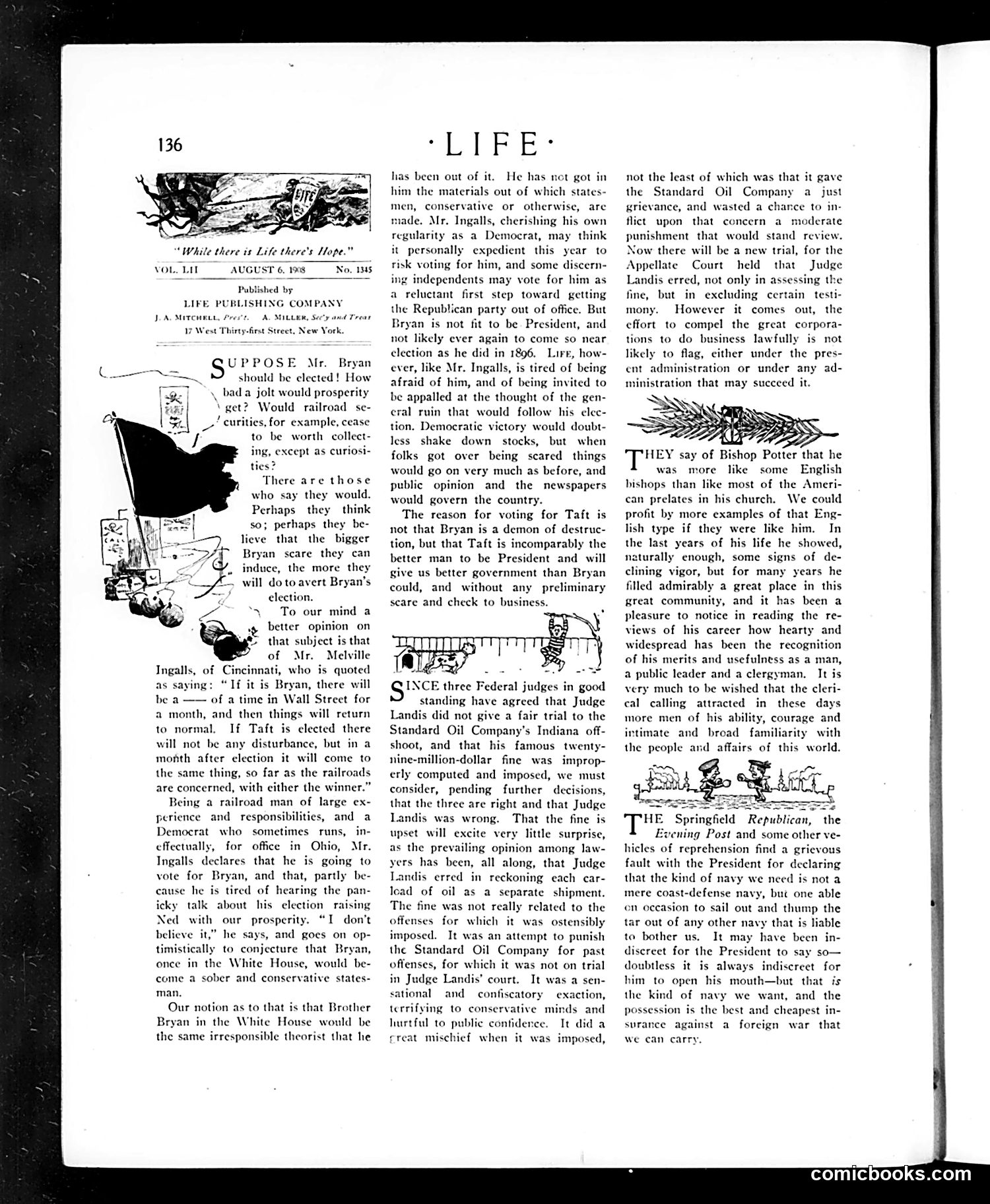
This *Life* magazine page satirizes the 1908 U.S. presidential race between William Jennings Bryan (Democrat) and William Howard Taft (Republican). **The main cartoon** (left side) depicts a figure cowering in fear—likely representing business interests or prosperity—supposedly threatened by Bryan's candidacy. The satire mocks Republicans who use "Bryan scare tactics" to frighten voters about economic disaster if Bryan wins. **The argument:** Life presents railroad executive Melville Ingalls's view that Bryan's election wouldn't cause lasting economic harm—disruption would be temporary. However, Life disagrees with his endorsement of Bryan, arguing Taft is the better presidential choice despite Bryan not being the destructive threat Republicans claim. **The secondary item** criticizes Judge Landis's $29-million fine against Standard Oil, arguing it was improperly calculated and punitive rather than legally justified—reflecting Progressive-era debates over corporate regulation. The tone is characteristically *Life*: politically engaged but skeptical of partisan fearmongering.
📄 Transcribed text from this page (OCR, searchable)
Machine-transcribed from the original scan — historical spelling and the odd misread are preserved.
‘While there is Life there's Hope.” Vou. LI AUGUST 6. N Published by LIFE PUBLISHING COMPANY AL MILLEN, Seety and Prear JA MITCHELL, Pree 17 West Thirty-first Street, New Vor UPPOSE Mr. Bryan should be elected! How bad a jolt would prosperity ‘get? Would railroad se- v ‘ curities, for example, cease to be worth collect- ing, except as curiosi- ties? There are those who say they would. Perhaps they think so; perhaps they be- lieve that the bigger Bryan scare they can induce, the more they will do to avert Bryan’s election. To our mind a w better opinion on t that subject is that of Mr. Melville Ingalls, of Cincinnati, who is quoted as saying: “If it is Bryan, there will be a —— of a time in Wall Street for a month, and then things will return to normal. If Taft is elected there will not be any disturbance, but in a mofth after election it will come to the same thing, so far as the railroads are concerned, with cither the winner.” Being a railroad man of large ex- perience and responsibilities, and a Democrat who sometimes runs, in- effectually, for office in Ohio, Mr. Ingalls declares that he is going to vote for Bryan, and that, partly be- cause he is tired of hearing the pan- icky talk about his election raising Ned with our prosperity. “I don't believe it,” he says, and goes on op- timistically to conjecture that Bryan, once in the White House, would be- come a sober and conservative states- man, Our notion as to that is that Brother Bryan in the White House would be the same irresponsible theorist that he *LJFE* has been out of it. He has not got in him the materials out of which states- men, conservative or otherwise, are miade. Mr. Ingalls, cherishing his own regularity as a Democrat, may think it personally expedient this year to risk voting for him, and some discern- ing independents may vote for him as a reluctant first step toward getting the Republican party out of office. But Bryan is not fit to be President, and not likely ever again to come so near election as he did in 1896. Lire, how- ever, like Mr. Ingalls, is tired of being afraid of him, and of being invited to be appalled at the thought of the gen- eral ruin that would follow his clec- tion. Democratic victory would doubt- less shake down stocks, but when folks got over being scared things would go on very much as before, and public opinion and the newspapers would govern the country. The reason for voting for Taft is not that Bryan is a demon of destruc- tion, but that Taft is incomparably the better man to be President and will give us better government than Bryan could, and without any preliminary scare and check to business. s* 2 three Federal judges in good standing have agreed that Judge Landis did not give a fair trial to the Standard Oil Company's Indiana off- shoot, and that his famous twenty- nine-million-dollar fine was improp- erly computed and imposed, we must consider, pending further decisions, that the three are right and that Judge Landis was wrong. That the fine is upset will excite very little surprise, as the prevailing opinion among law- yers has been, all along, that Judge Landis erred in reckoning each car- load of oil as a separate shipment. The fine was not really related to the offenses for which it was ostensibly imposed. It was an attempt to punish the Standard Oil Company for past offenses, for which it was not on trial in Judge Landis’ court. It was a sen- sational and confiscatory action, terrifying to conservative minds and hurtful to public confidence. It did a creat mischief when it was imposed, not the least of which was that it gave the Standard Oil Company a just grievance, and wasted a chance to in- flict upon that concern a moderate punishment that would stand review. Now there will be a new trial, for the Appellate Court held that Judge Landis erred, not only in assessing the fine, but in excluding certain testi- mony. However it comes out, the effort to compel the great corpora- tions to do business lawfully is not likely to flag, cither under the pres- ent administration or under any ad- ministration that may succeed it. HEY say of Bishop Potter that he was more like some English bishops than like most of the Ameri- can prelates in his church. We could profit by more examples of that Eng- lish type if they were like him. In the last years of his life he showed, naturally enough, some signs of de- clining vigor, but for many years he filled admirably a great place in this great community, and it has been a pleasure to notice in reading the re- views of his career how hearty and widespread has been the recognition of his merits and usefulness as a man, a public leader and a clergyman. It is very much to be wished that the cleri- cal calling attracted in these days more men of his ability, courage and intimate and broad familiarity with the people and affairs of this world. the Evening Post and some other ve- hicles of reprehension find a grievous fault with the President for declaring that the kind of navy we need is not a mere coast-defense navy, but one able on occasion to sail out and thump the tar out of any other navy that is liable to bother us. It may have been in- discreet for the President to say so— doubtless it is always indiscreet for him to open his mouth—but that is the kind of navy we want, and the possession is the best and cheapest in- surance against a foreign war that we can carry. comicbooks.com