
A complete issue · 22 pages · 1908
Life — March 26, 1908
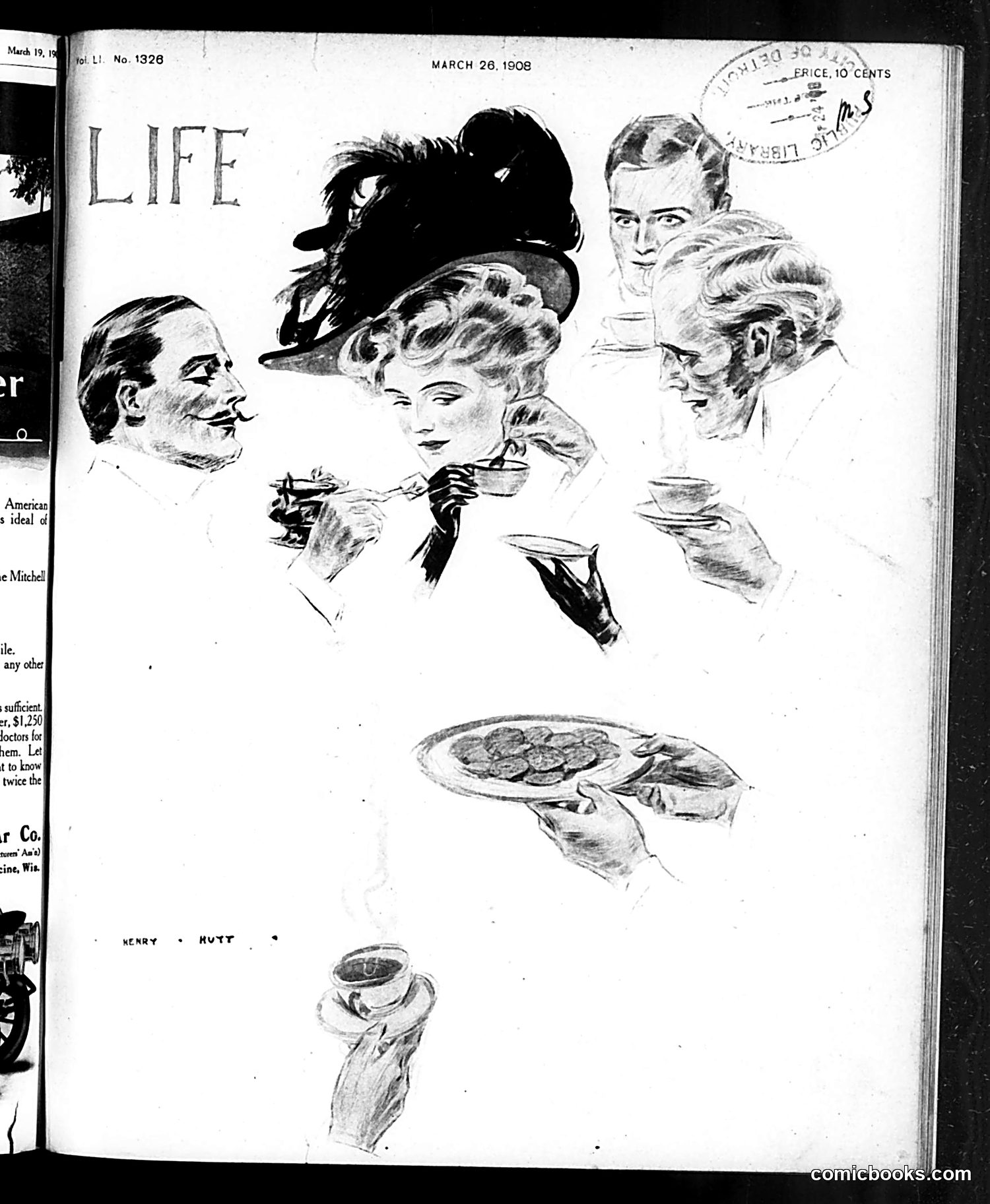
This page features illustrations by Henry Hutt, a prominent illustrator of the era. The artwork shows character sketches—profiles and three-quarter views of fashionably dressed figures from early 1900s high society. The drawings depict women in elaborate hats with feathers and bows, and men in formal attire, accompanied by studies of hands holding teacups and serving food on a plate. The content appears to be **social satire about upper-class dining and fashion** rather than political commentary. The exaggerated attention to accessories, poses, and refined mannerisms mocks the pretensions of wealthy society's elaborate etiquette and conspicuous display during the Edwardian era. The sketches capture the satirical magazine's commentary on contemporary class-conscious social conventions.
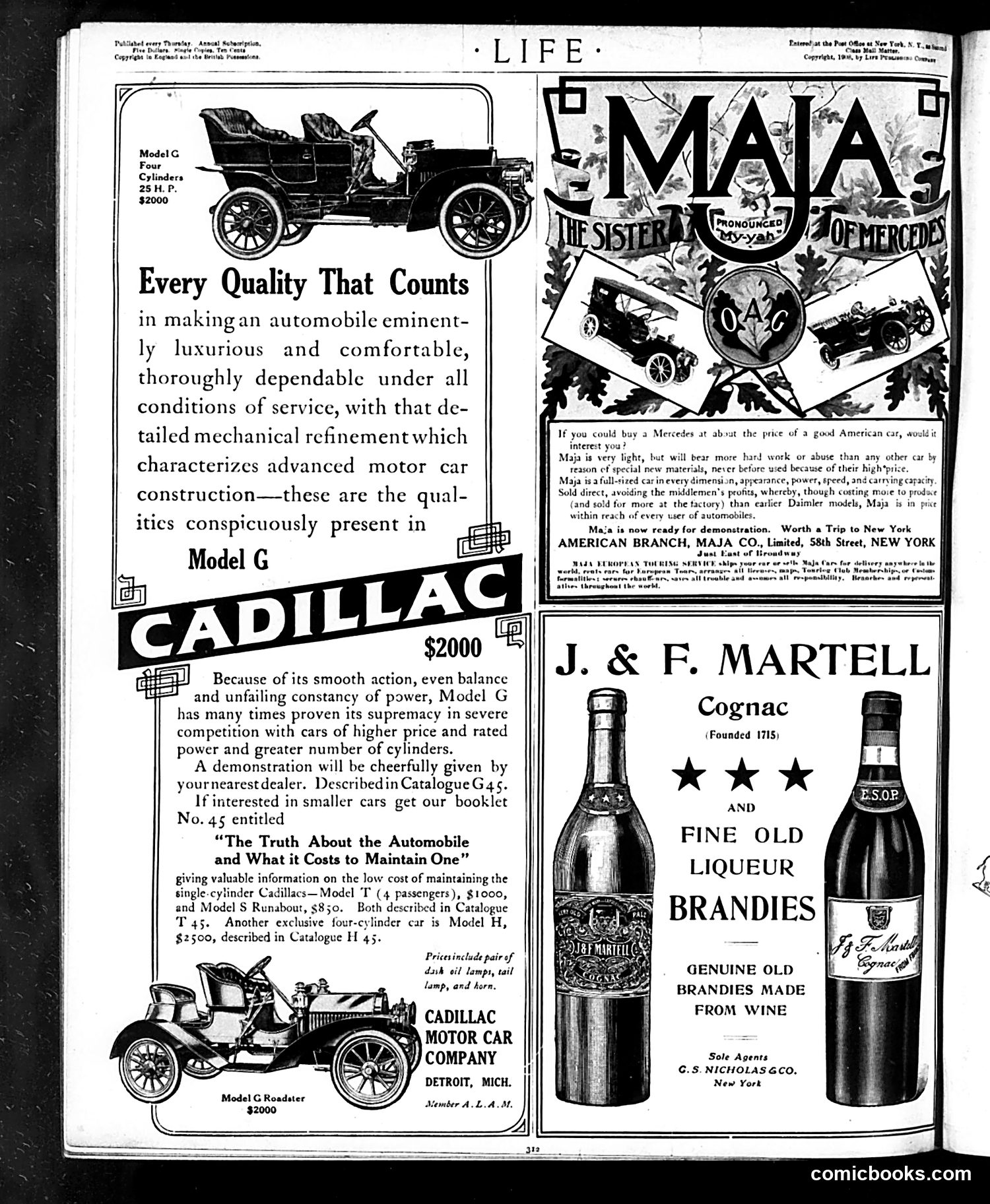
This page is primarily **advertising rather than satirical content**. The left side features a Cadillac Model G automobile advertisement ($2000), emphasizing luxury, reliability, and mechanical refinement. It includes comparison text and catalog information. The right side contains two ads: a Maja automobile advertisement (described as "the sister of Mercedes," positioned as a luxury European car at American pricing) and a J. & F. Martell Cognac advertisement featuring brandy bottles. There is **no political cartoon or satire** visible on this page. The layout and content are characteristic of early 20th-century Life magazine, which mixed editorial content with upscale advertising targeting wealthy readers interested in automobiles, spirits, and luxury goods.
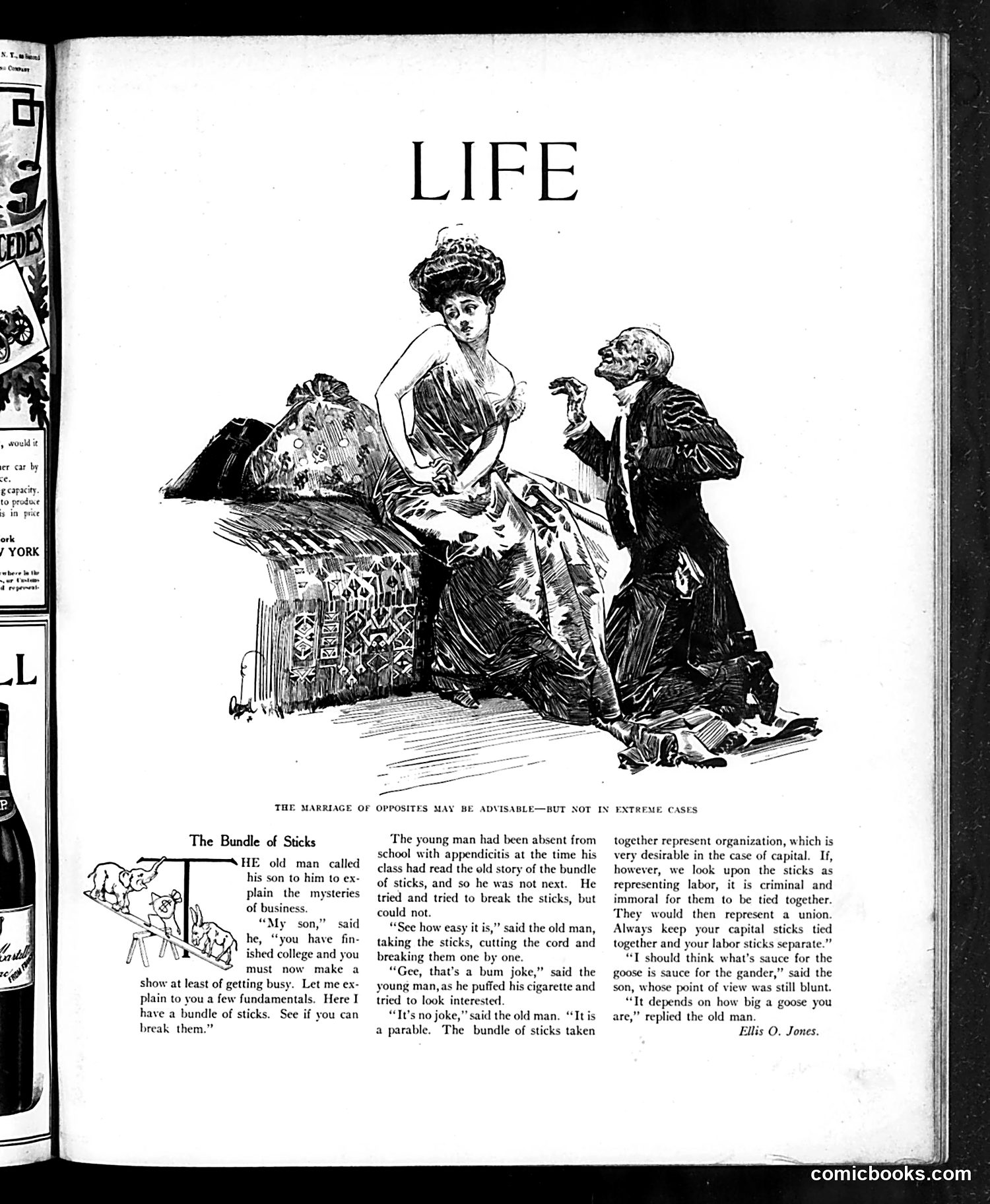
This page presents an illustrated moral lesson about unity and cooperation. An old man demonstrates to his son that individual sticks can be easily broken, but a bundle of sticks bound together cannot be broken—teaching that "there is strength in unity." The accompanying illustration shows three figures: a well-dressed woman and young man (representing the privileged classes) observing an elderly poor man demonstrating his lesson. The caption notes that marriage of opposites may be advisable but not in extreme cases, suggesting this fable comments on class divisions and social hierarchy in early 20th-century America. The moral promotes organizational labor and capital working together, though the satirical framing implies skepticism about such harmony actually occurring across class lines.
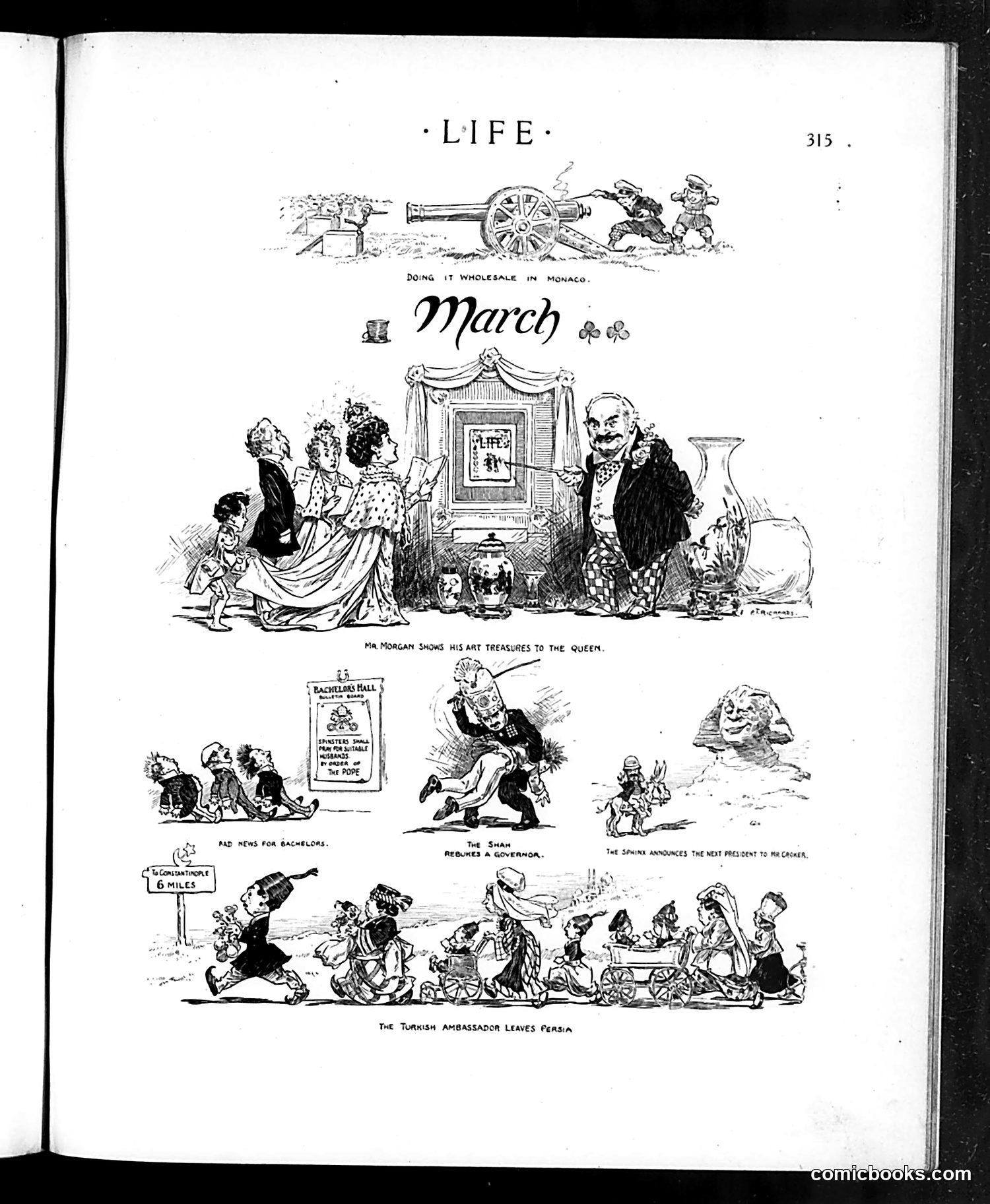
This page presents satirical sketches about March events. The top illustration shows "Mr. Morgan shows his art treasures to the Queen," likely referencing J.P. Morgan, the wealthy banker and famous art collector, presenting acquisitions to royalty. Below are several vignettes: "Bad news for bachelors," "The Shah performs a governor," and "The Sphinx announces the next president" offer commentary on contemporary social and political topics. The bottom scene, "The Turkish Ambassador leaves Persia," depicts diplomatic tensions, likely referencing early 20th-century Middle Eastern politics and Ottoman Empire relations. The cartoons employ caricature and situational humor typical of Life's satirical style, targeting wealthy elites, political figures, and international affairs that would interest educated American readers of the era.
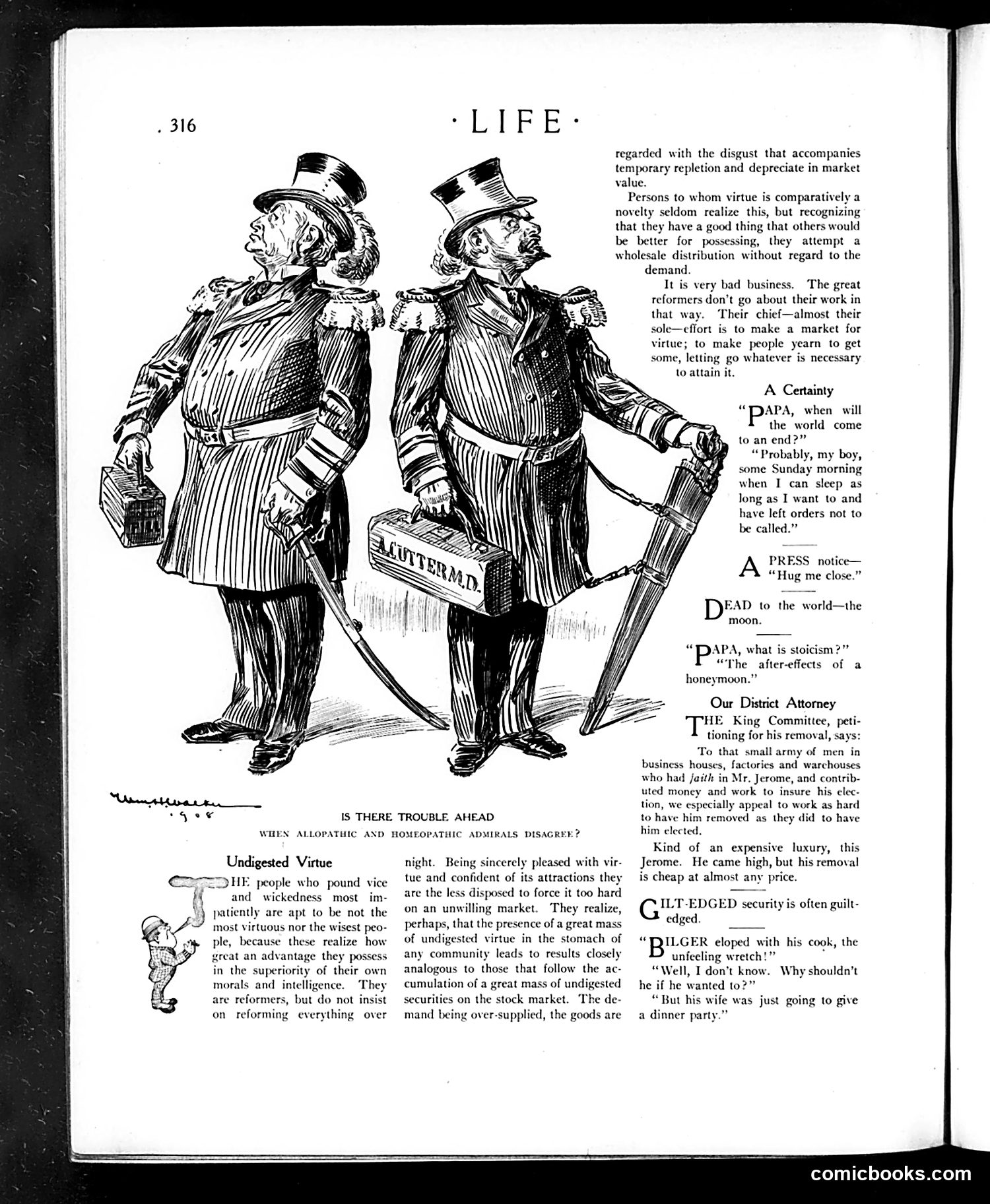
The main cartoon depicts two military or naval officers in elaborate uniforms labeled "WHEN ALLOPATHIC AND HOMEOPATHIC DISAGREE?" — a satirical visual pun comparing disagreement between officers to conflicting medical philosophies. The text below, titled "Undigested Virtue," critiques self-righteous reformers. It argues that virtuous people who constantly promote morality and reform are actually harmful to society, creating an "undigested" mass of unwanted virtue in the public stomach. The piece sarcastically suggests these reformers should distribute their virtue wholesale without "regard to the demand" — implying nobody wants their unsolicited moral superiority. The scattered quotes and brief items mock various social figures and situations, typical of Life's satirical humor format.
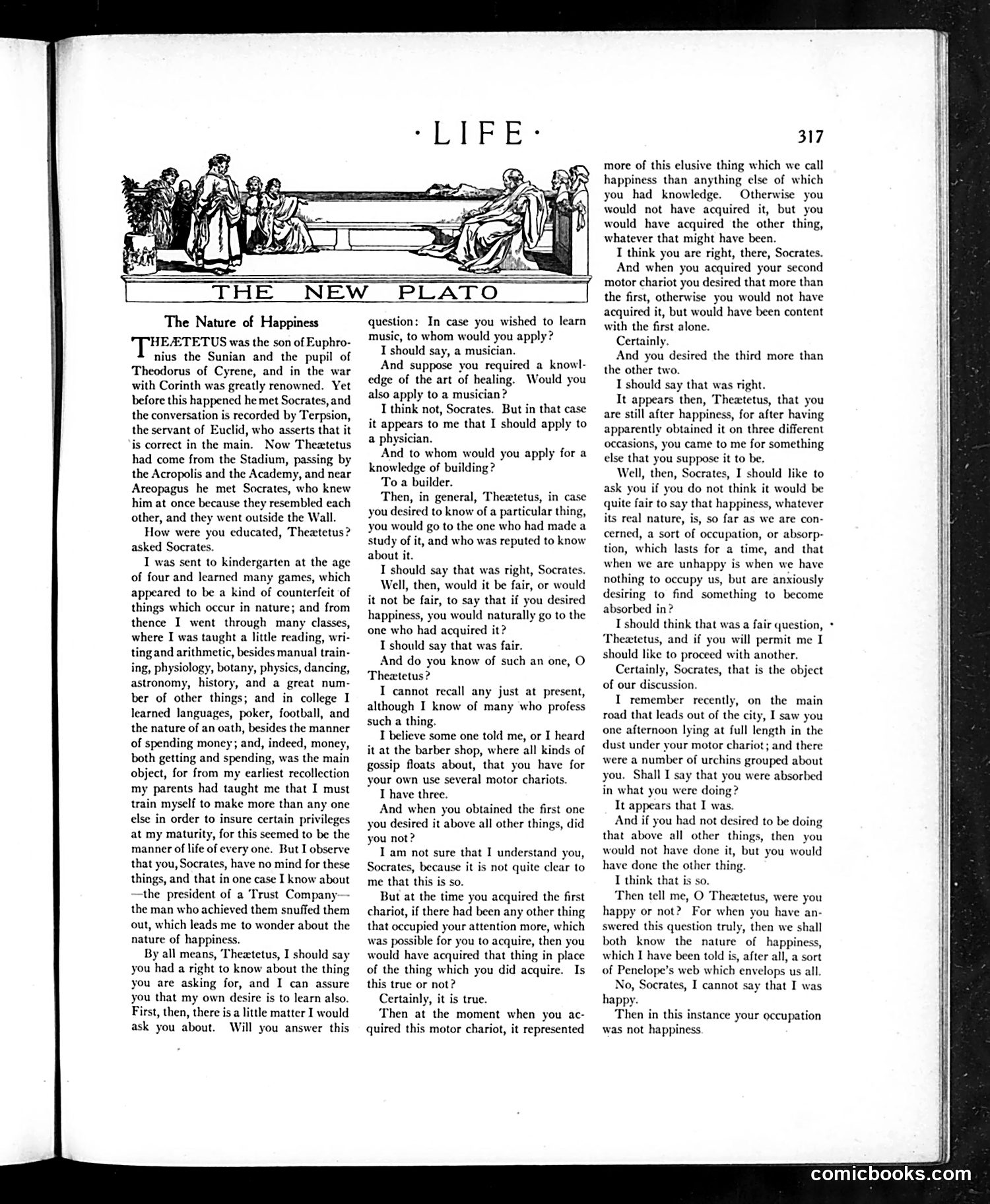
This page presents a philosophical dialogue titled "The Nature of Happiness," structured as a Socratic conversation between Socrates and Thaetetus. The illustration shows classical figures in robes arranged in a formal debate setting. The dialogue explores whether happiness comes from knowledge or desire fulfillment. Socrates argues that true happiness involves occupation and purpose rather than passive contentment. The discussion references acquiring motor chariots (automobiles) as an example of desired possessions. This appears to be satirical commentary on early-20th-century American materialism and the then-novel automobile industry. By framing consumer desire through classical philosophy, Life magazine likely critiques the notion that purchasing modern goods—particularly cars—brings genuine happiness, suggesting instead that meaningful occupation matters more.
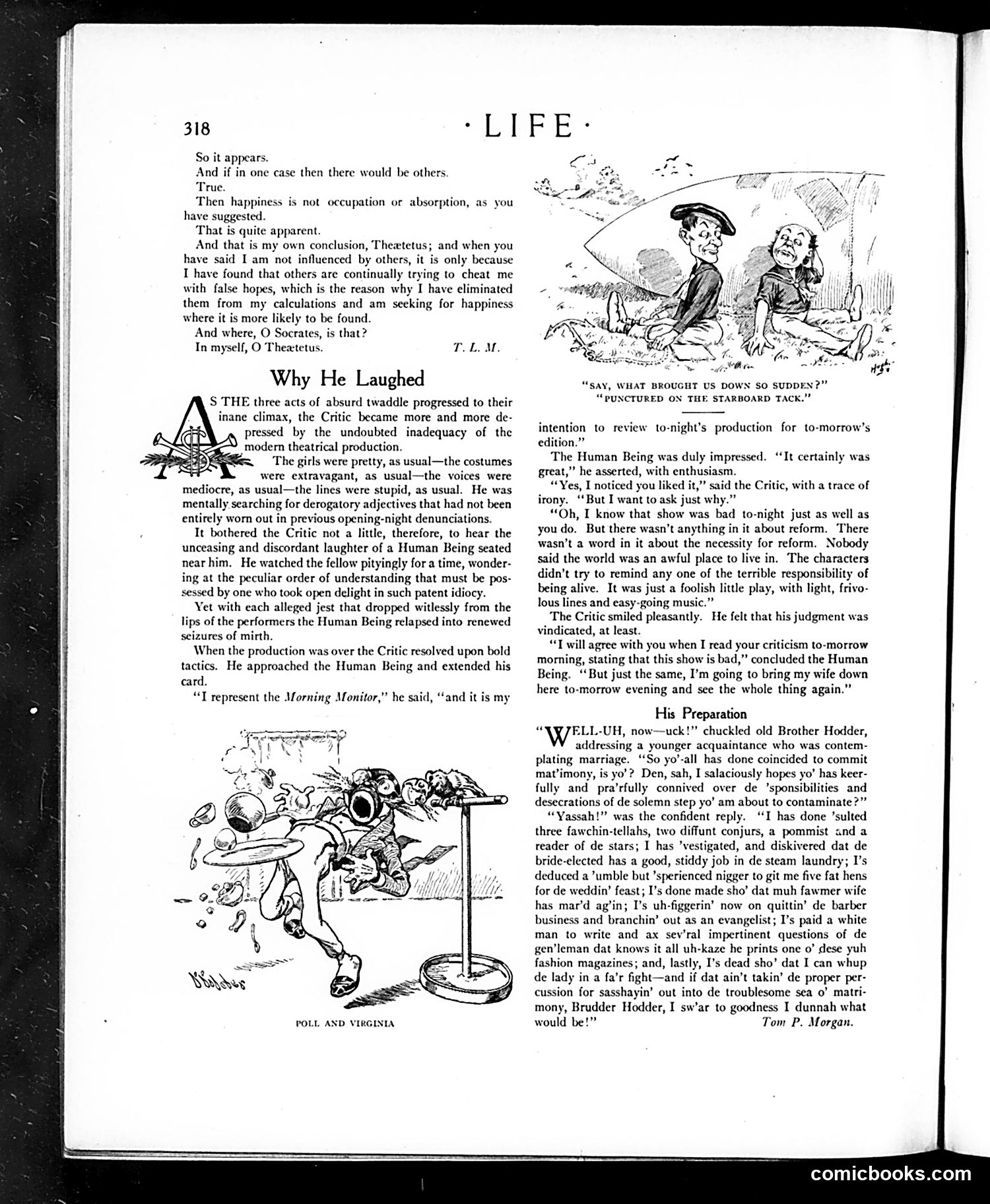
This page contains a satirical theater review titled "Why He Laughed." The critic mocks a contemporary theatrical production called "The Morning Monitor" for its absurd incompetence: poor costumes, mediocre acting, and pretentious dialogue. The accompanying illustrations ridicule the play's ineptitude—one shows performers in exaggerated chaos. The critic finds dark humor in the production's awfulness, suggesting the playwright unintentionally entertains through failure rather than skill. The lower section, "His Preparation," features a humorous monologue (credited to Tom P. Morgan) about arranging a marriage, written in exaggerated dialect. It satirizes overly verbose, self-important speech and pretentious literary affectation. Overall, the page satirizes theatrical mediocrity and pompous writing styles of the era.
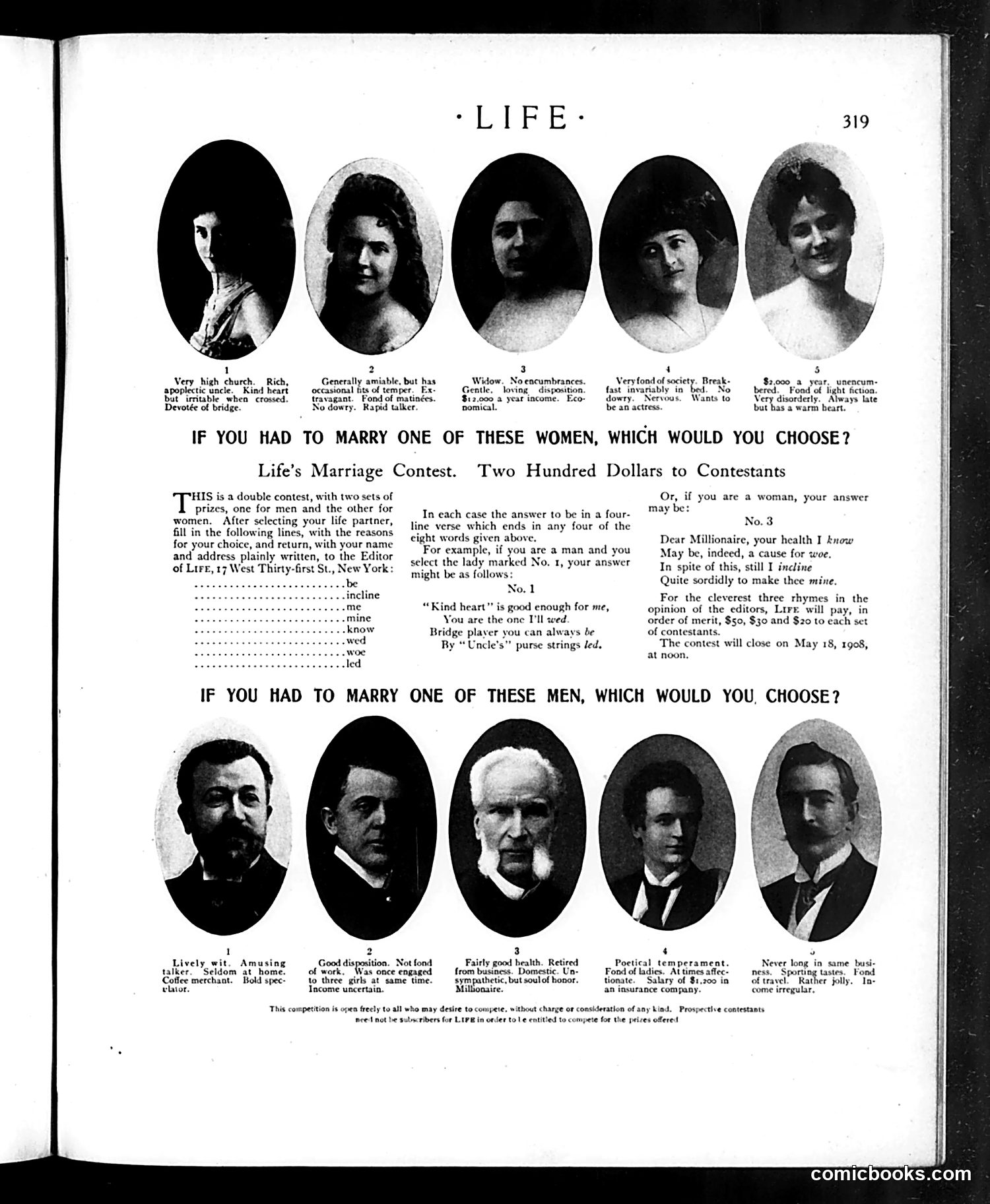
This is a satirical "marriage contest" where readers choose which woman or man they'd most want to marry based on brief character descriptions. The humor relies on stereotypical female and male archetypes of the era. The women are described by wealth and marital desirability (a "very high church" wealthy woman, a "widow," actresses, etc.). The men include a "lively wit" coffee merchant, a man with "good disposition" but unemployed, a retired businessman, and others with various professional or character traits. The satire mocks how both genders were evaluated as marriage prospects based on superficial traits—women primarily by looks and social standing, men by financial security and temperament. The $200 prize suggests this was a genuine reader-participation contest, not purely satirical commentary.
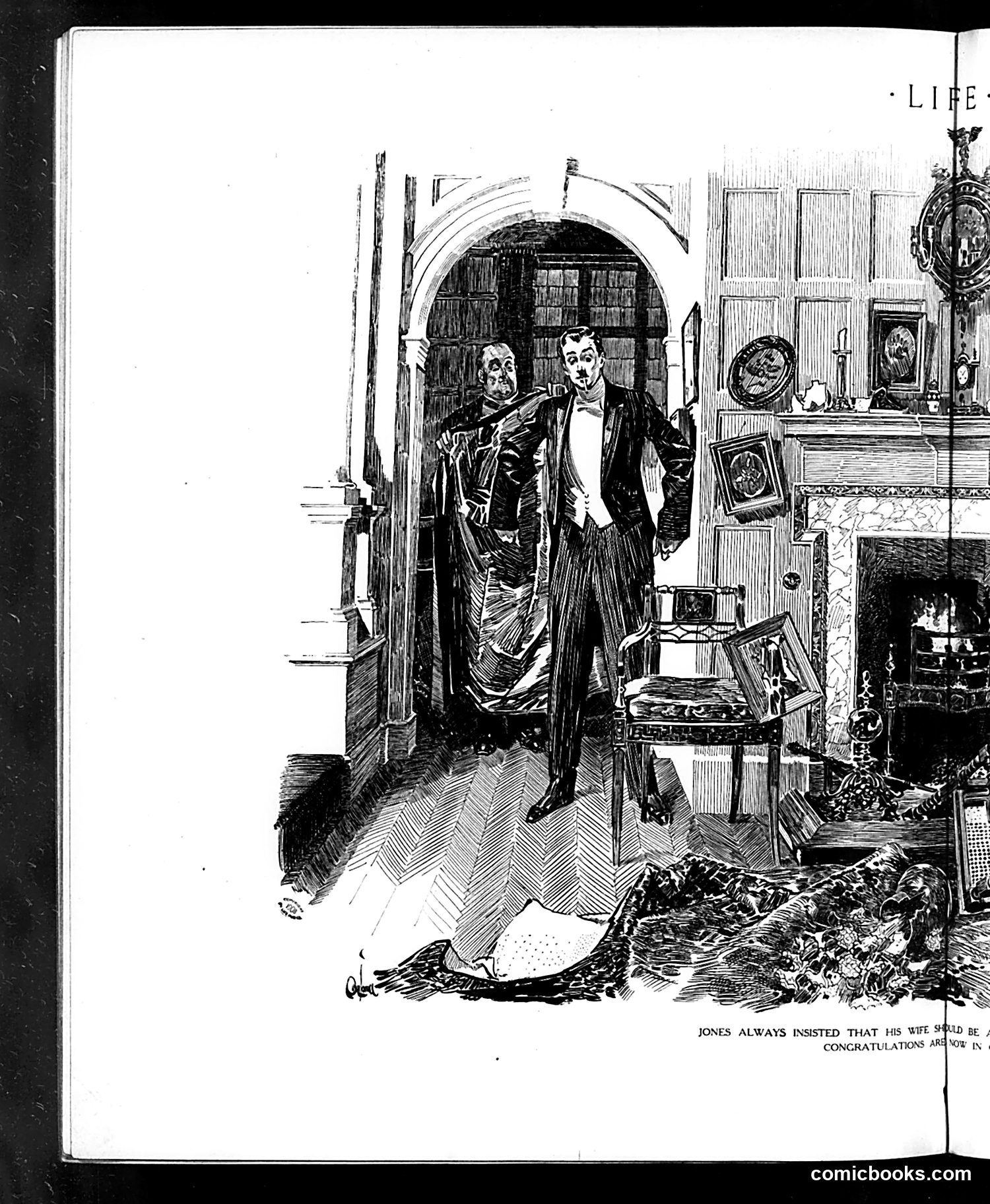
This is a satirical cartoon from *Life* magazine showing two men in formal evening wear entering what appears to be an elegant parlor. The visible caption reads: "JONES ALWAYS INSISTED THAT HIS WIFE SHOULD BE CONGRATULATIONS ARE NOT IN—" The joke appears to satirize social pretension and marital dynamics. "Jones" apparently insisted his wife should receive congratulations for something (likely a social achievement or appearance), but the caption's abrupt cutoff suggests the punchline involves ironic reversal—perhaps the wife has failed to meet expectations, or the congratulations are notably absent despite Jones's insistence. The ornate interior with fireplace, decorative items, and formal attire establishes an upper-class setting, making the humor turn on bourgeois vanity and social embarrassment. The specific context of what Jones expected remains unclear without the complete caption.
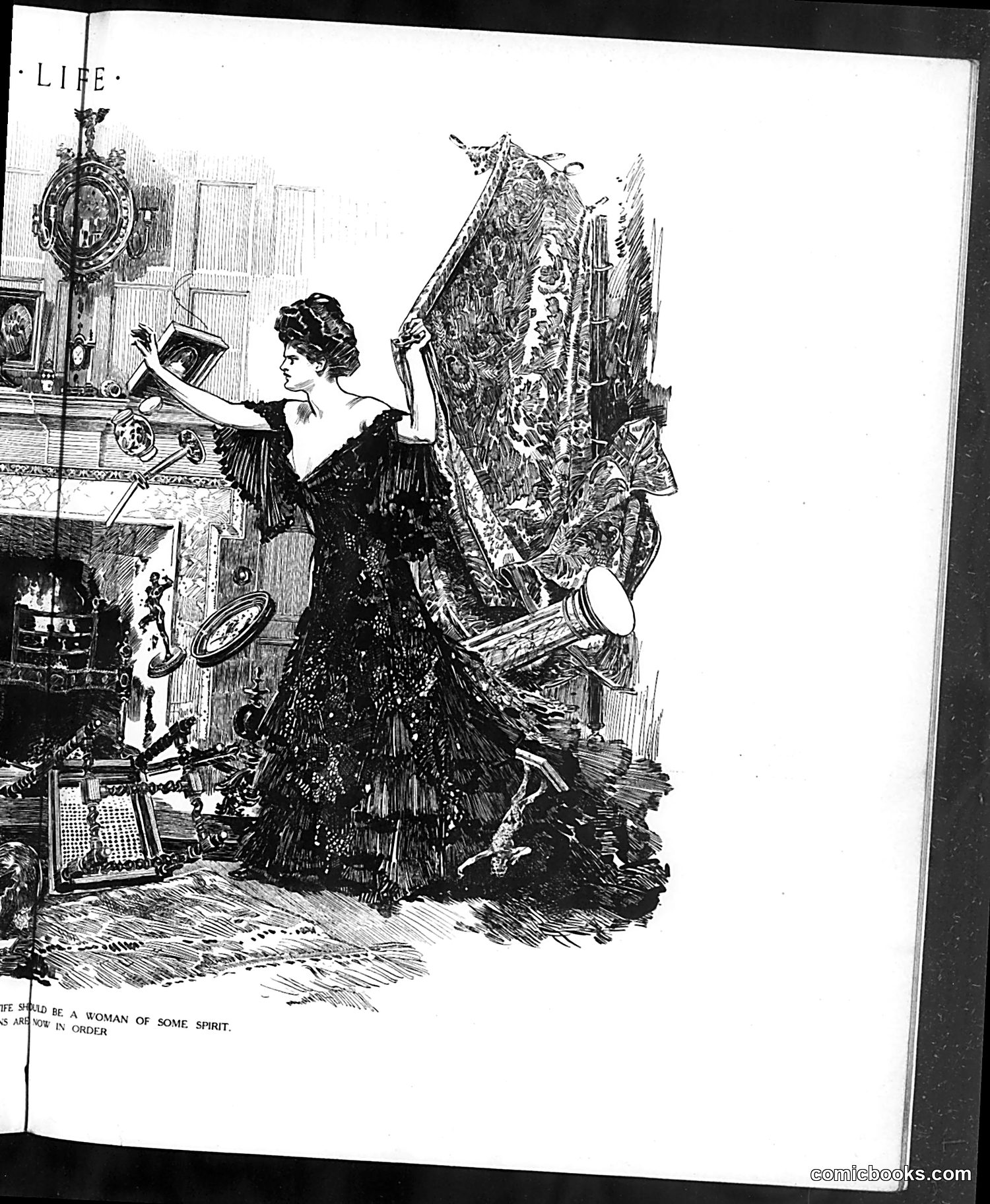
This appears to be a satirical illustration from *Life* magazine depicting a fashionably dressed woman in an ornate interior, surrounded by elaborate decorative objects and furnishings. The visible caption fragment reads: "...IFE SHOULD BE A WOMAN OF SOME SPIRIT. ...IS ARE NOT IN ORDER." The illustration satirizes **wealthy or aspirational women of the era**, likely mocking their preoccupation with material possessions, fashion, and domestic display. The woman's elaborate black dress with decorative details, her fashionable upswept hairstyle, and the crowded accumulation of ornamental objects around her suggest satire of conspicuous consumption and superficiality among upper-class women. The incomplete caption suggests moral critique—the "spirit" reference likely implies these women lack substance or purpose beyond material concerns. This reflects common early-20th-century satirical themes about idle wealthy women and consumer culture.
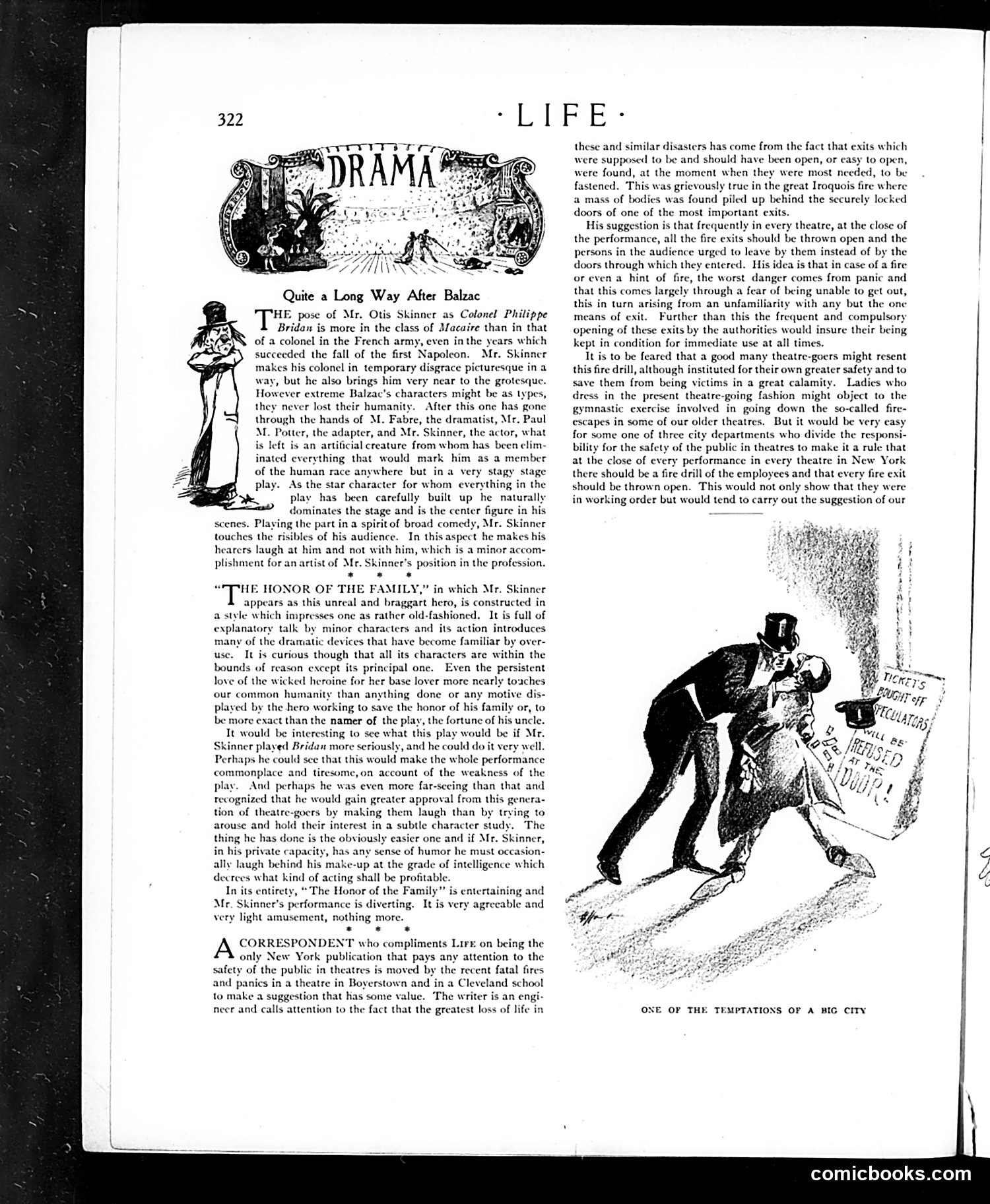
This page discusses theatrical drama reviews, focusing on Mr. Otis Skinner's performances in plays including "Colonel Philippe Bridau" and "The Honor of the Family." The illustration captioned "ONE OF THE TEMPTATIONS OF A BIG CITY" depicts a well-dressed man in a top hat being approached by a woman on a street corner with posted notices. This appears to be social commentary on urban vice and moral temptation—likely referencing solicitation or street-level seduction that was a recognized urban social problem of the era. The text also addresses theater safety concerns, discussing fire exits and audience evacuation procedures following recent deadly theater fires in Boyerstown and Cleveland. The writer advocates for mandatory fire drills in theaters to prevent panic-related fatalities.
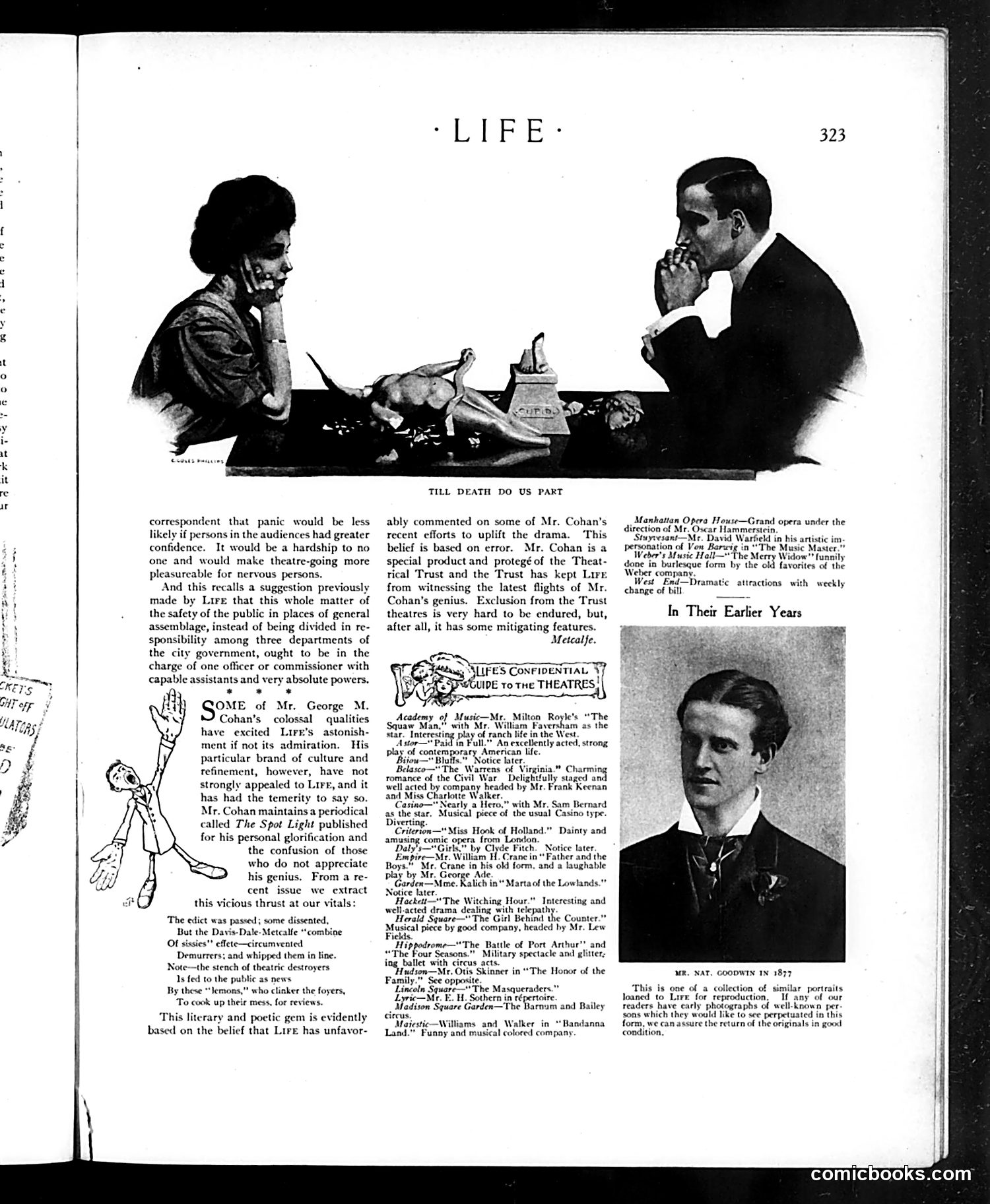
This page features a cartoon showing two figures at a desk in what appears to be a marital dispute or negotiation. The title "Till Death Do Us Part" is a play on traditional marriage vows, suggesting the relationship depicted is contentious or trapped. The accompanying text discusses George M. Cohan's theatrical work and dramatic talents. The satire appears to critique either Cohan's personal life or his theatrical productions, using the marriage vow reference ironically. The page also includes "Life's Confidential Guide to the Theatres," reviewing various stage productions. A portrait of "Mr. Nat Goodwin in 1877" appears on the right side. The overall tone is characteristically satirical toward theatrical personalities and their dramatic (sometimes off-stage) antics.
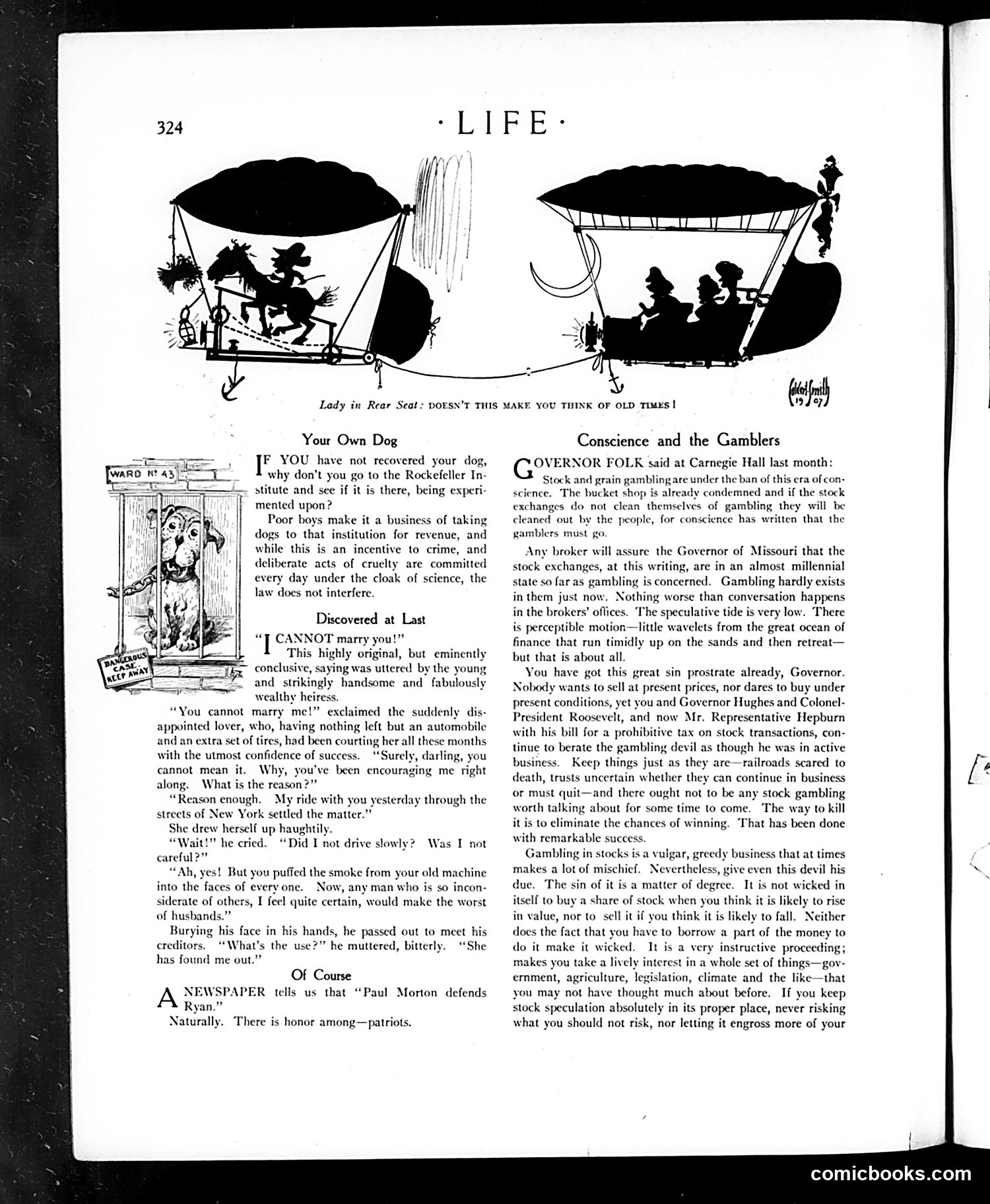
**Top Cartoon**: Two hot-air balloons carrying passengers. Caption suggests nostalgia for "old times"—likely satirizing early automobile culture by contrasting it with older forms of transportation, mocking both progress and those who romanticize the past. **"Your Own Dog"**: Critiques the Rockefeller Institute's animal experimentation. The piece argues that poor boys steal dogs to sell them for research revenue, enabling animal cruelty under the guise of science while law enforcement ignores it—a reform-era complaint about unregulated scientific ethics. **"Discovered at Last"**: A romantic comedy exposing a wealthy heir's character flaw: his inconsiderate behavior (smoking in others' faces while driving) reveals moral unfitness for marriage, despite his wealth and automobile. Social satire on what truly matters in character. **"Conscience and the Gamblers"**: Sarcastically defends stock-market gambling against Governor Folk's moral crusade. The author argues the market is already "dying" due to economic fear, making anti-gambling rhetoric pointless—ironic commentary on politicians taking credit for problems already solved by circumstance rather than reform.
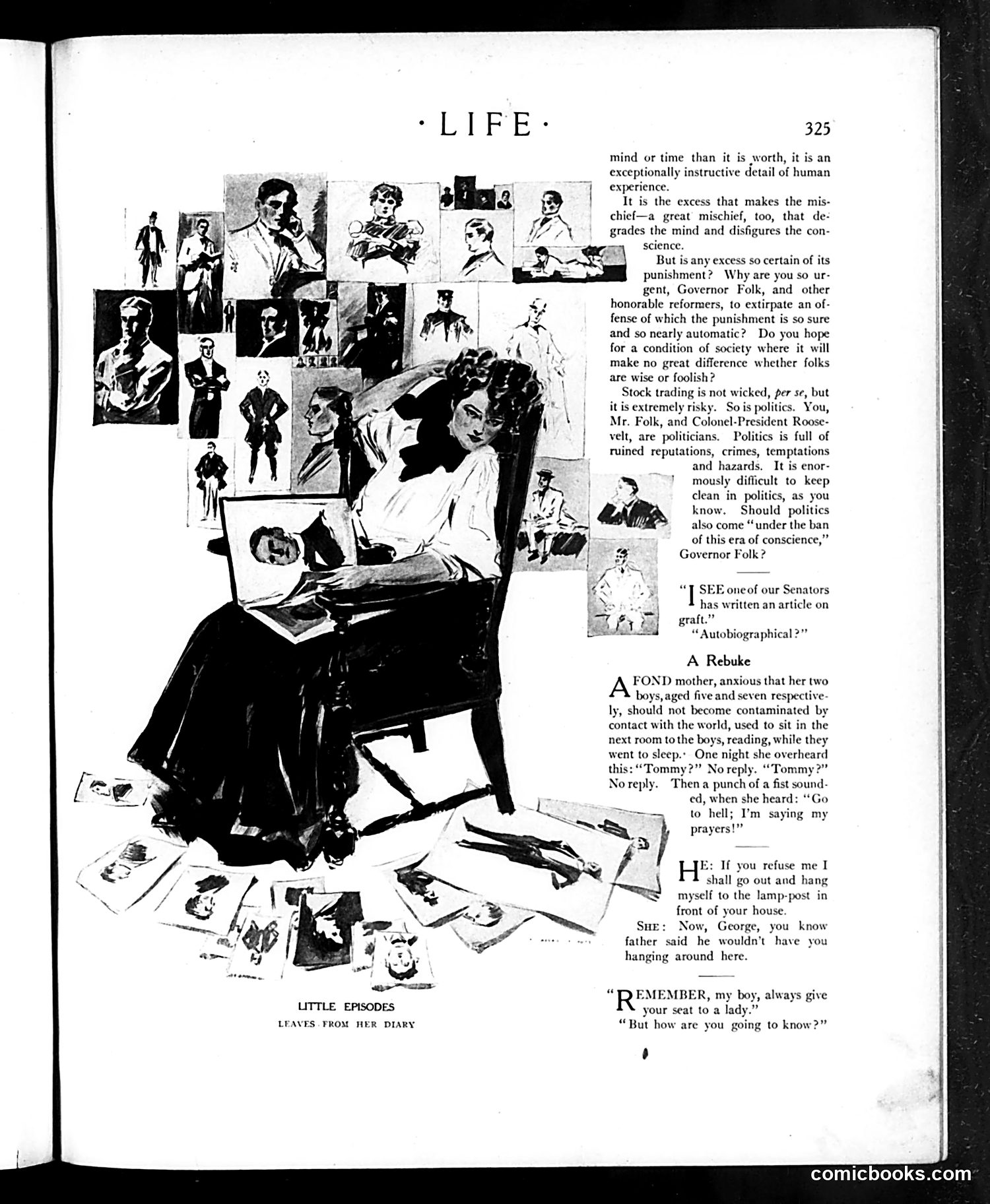
This page contains two distinct pieces. The main illustration, titled "Little Episodes: Leaves from Her Diary," satirizes excessive moral reformism. It depicts a woman surrounded by photographs and documents, apparently cataloging evidence of societal misconduct. The accompanying text directly addresses **Governor Folk** and **Colonel-President Roosevelt**, prominent Progressive Era reformers known for anti-corruption campaigns. The author sarcastically challenges their crusades against stock trading and graft, arguing that if reformers truly believed in eliminating all risky or morally compromising activities, they should also ban politics itself—which is equally "full of ruined reputations, crimes, temptations and hazards." The joke is that the reformers are hypocrites: they condemn certain vices while participating in an equally corrupt system. The diary/photograph motif mocks the obsessive documentation of others' moral failings while ignoring systemic problems in politics itself. The smaller anecdotes below provide humorous counterpoints about moral hypocrisy in everyday life.
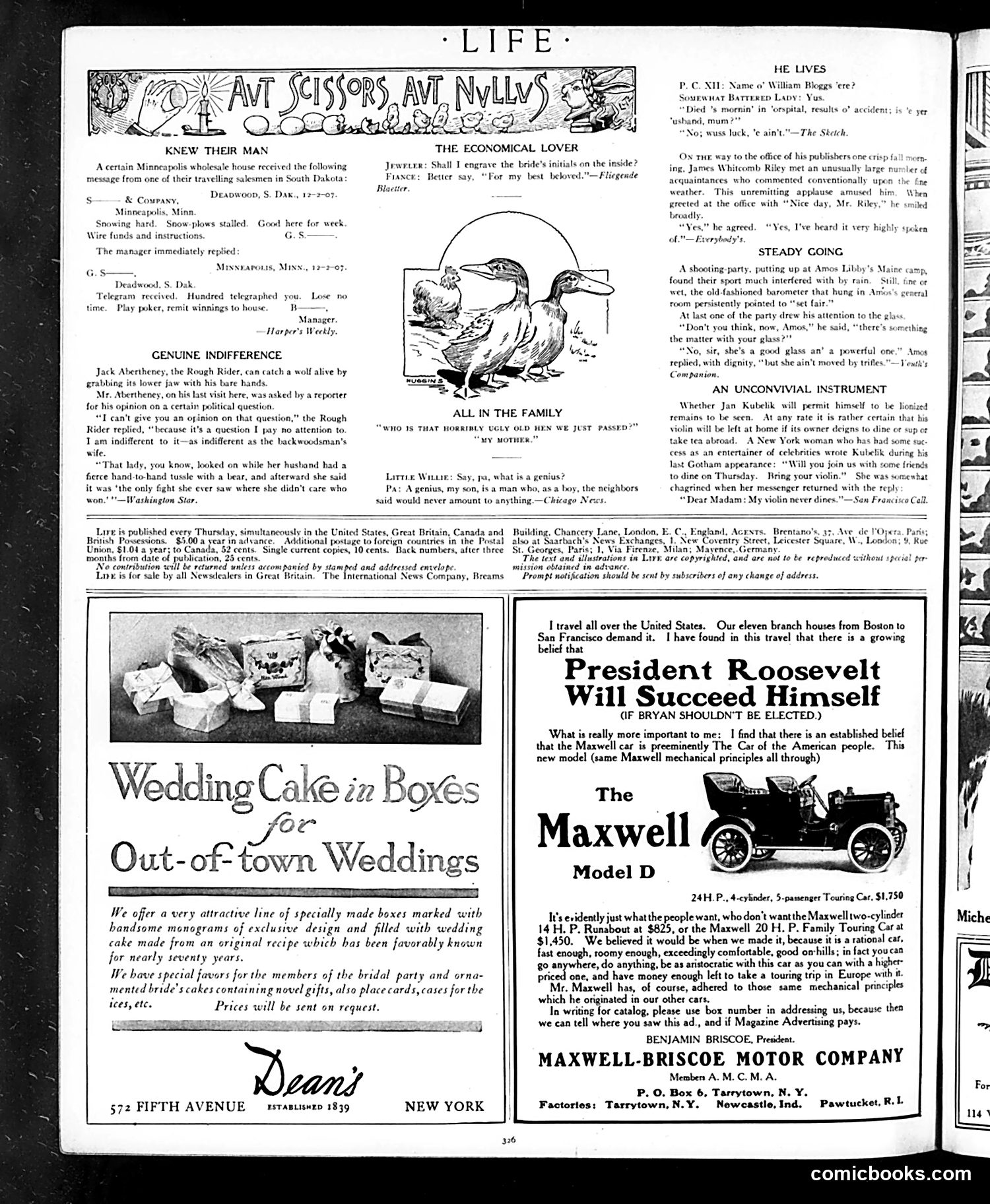
This page contains several short humorous pieces typical of early 20th-century Life magazine: **"Knew Their Man"** satirizes business efficiency through a telegram exchange where a Minneapolis manager demands a traveling salesman stop wasting time and focus on poker winnings. **"The Economical Lover"** jokes about a cheapskate fiancé who won't pay for personalized engraving, suggesting generic text instead. **"Genuine Indifference"** features Jack Abertheney (a teddy Roosevelt-era adventurer known for catching wolves) claiming studied indifference to political questions—mocking politicians who dodge controversial topics. **"All in the Family"** presents domestic humor about an unflattering elderly woman, and a musician (Jan Kubelik, a famous violinist) who refuses dinner invitations because his violin won't dine out. The page also advertises wedding cakes, jewelry, and Maxwell automobiles. The humor reflects turn-of-the-century attitudes: business ruthlessness, gender dynamics, and the pretensions of cultural elites.
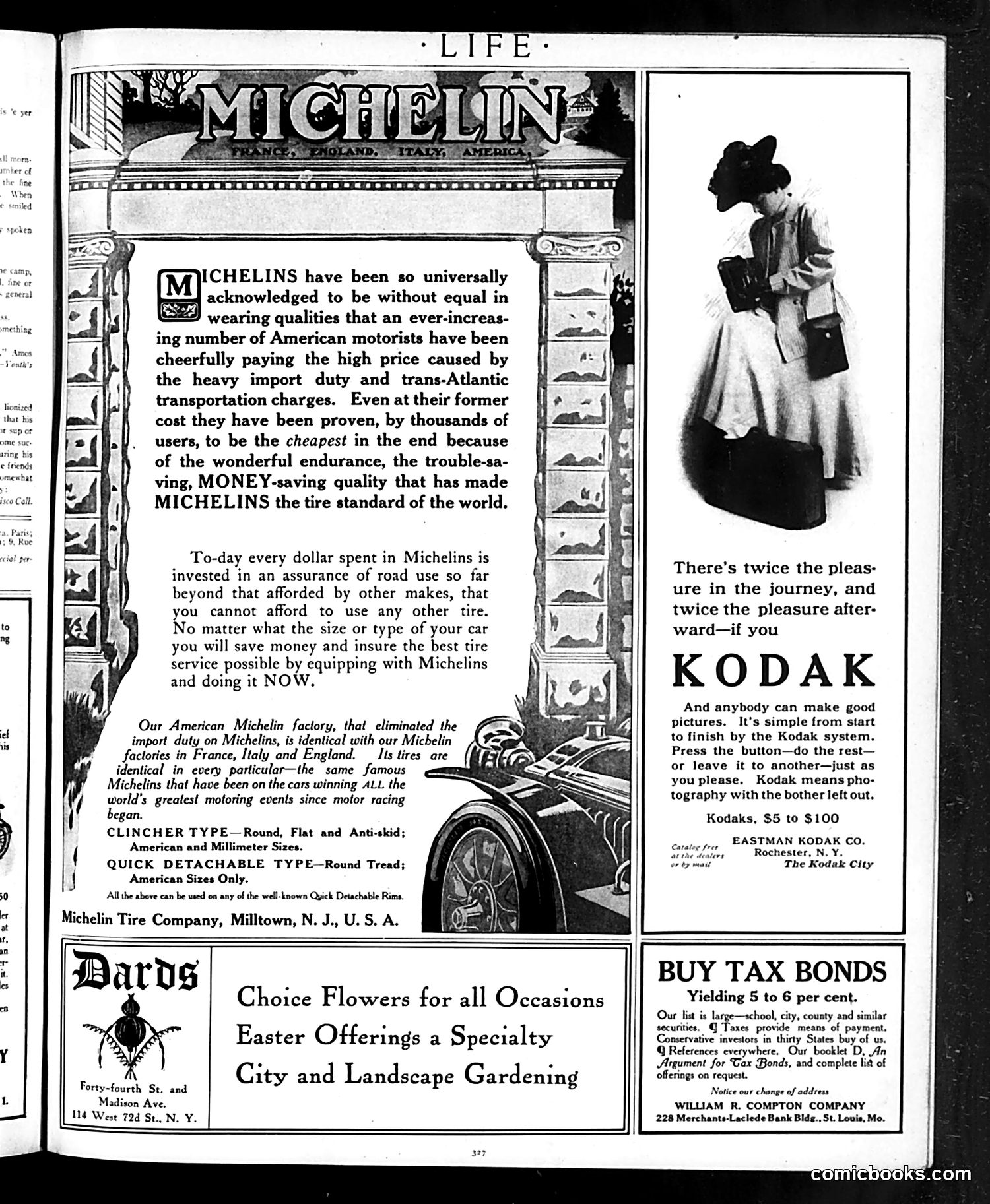
This page is primarily **advertising**, not political satire. It contains four advertisements from the early 20th century: 1. **Michelin Tires**: Emphasizes quality despite high import duties and trans-Atlantic shipping costs. The ad argues the French product's durability makes it cheapest "in the end." This reflects post-WWI American protectionism—Michelin established a U.S. factory to bypass import taxes. 2. **Kodak Cameras**: Promotes consumer photography with the slogan "press the button—do the rest," targeting leisure travelers (the image shows a woman with luggage). 3. **Dard Flowers**: Simple Easter advertisement. 4. **Tax Bonds**: Investment opportunity yielding 5-6%, likely wartime Liberty Bonds or similar government securities. The page reflects 1910s-1920s consumer culture and economic conditions: international trade protectionism, emerging leisure travel, and government financing needs. No political cartoon or satire is present—this is straightforward commercial messaging.
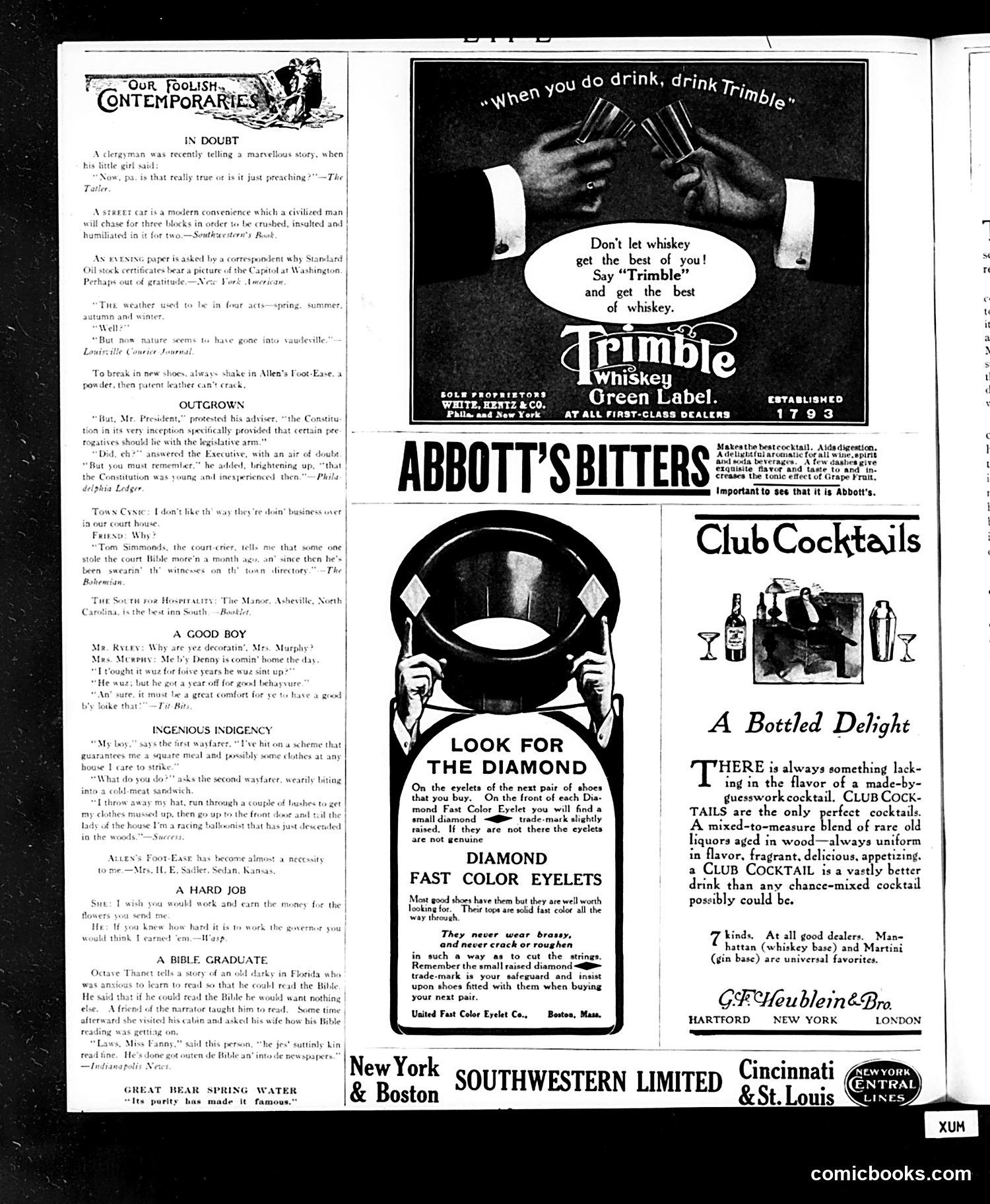
This page is primarily **advertising**, not political satire. It features period advertisements (circa early 1900s based on styling) for consumer goods: **Main content:** - **Trimble Whiskey** ad: A pitch for "Green Label" whiskey with the slogan "when you do drink, drink Trimble"—standard liquor marketing - **Abbott's Bitters** ad: Promotes a medicinal tonic (bitters were marketed as digestive aids) - **Diamond Fast Color Eyelets** ad: Shoe hardware with a quality-assurance diamond trademark - **Club Cocktails** ad: Pre-made bottled cocktails marketed as superior to homemade versions - Various other ads for shoes, transportation lines **Left column:** Contains brief humorous anecdotes/jokes from Life's "Our Foolish Contemporaries" section—not political cartoons. **Context for modern readers:** These ads reflect pre-Prohibition America (alcohol openly advertised) and an era when patent medicines and branded components were heavily marketed with quality-assurance logos. The page shows how advertising dominated magazine revenue.
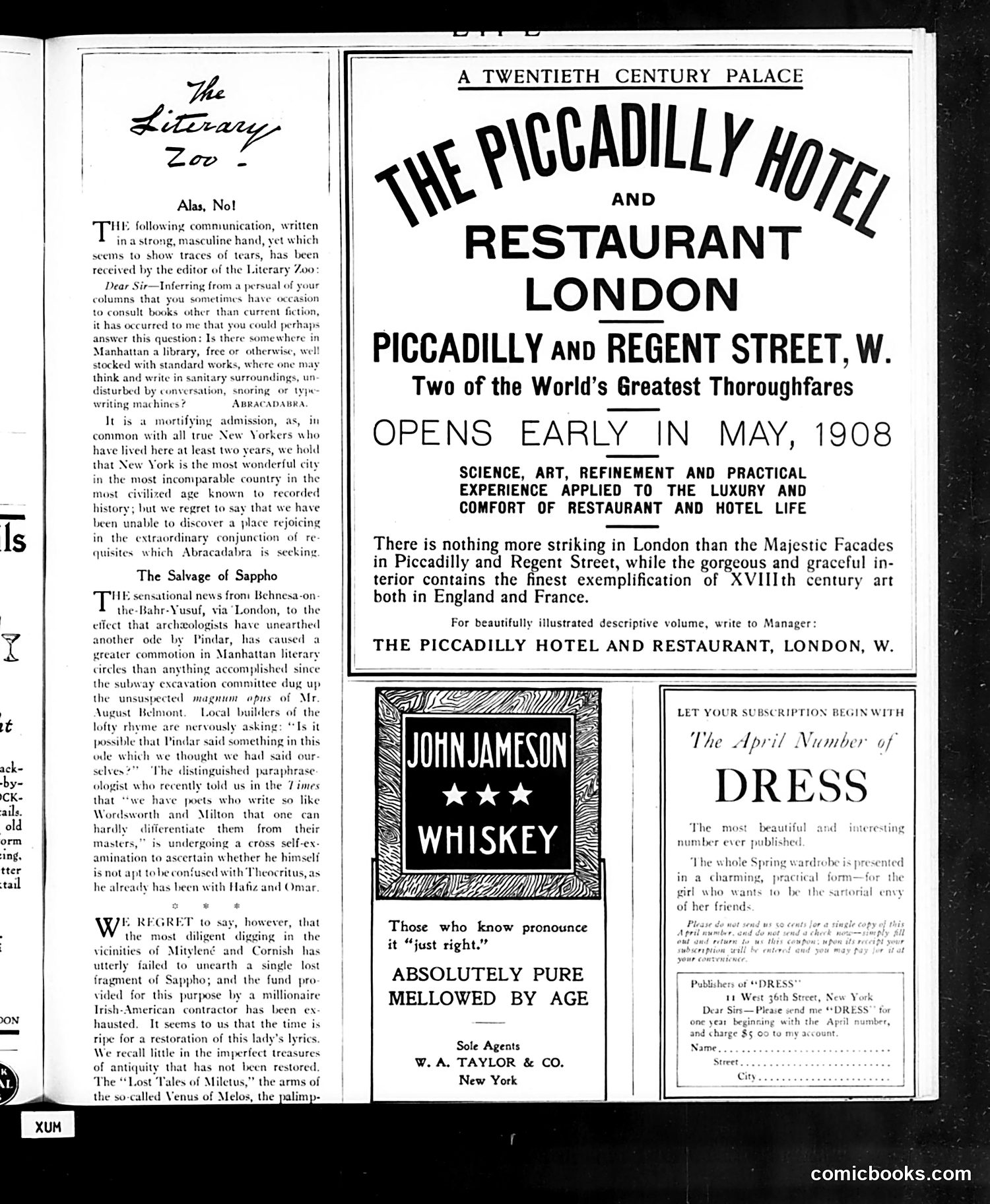
This page is primarily **advertising and editorial content**, not political satire requiring historical context. **Left side** contains two brief satirical pieces: 1. **"The Literary Zoo"** — A humorous letter mocking New York City's self-regard. A reader sarcastically asks where in Manhattan one can find a quiet library to work, noting that New Yorkers boast their city is "the most wonderful" yet lack basic intellectual infrastructure. The satire targets civic pride divorced from reality. 2. **"The Salvage of Sappho"** — A joke about literary pretension. It references recent archaeological discoveries of classical Greek poetry, then mocks Manhattan poets who nervously worry their work might be confused with ancient masters. The satire suggests these contemporary writers are mediocre and paranoid about plagiarism from antiquity. **Right side** is straightforward advertising: The Piccadilly Hotel opening in London (1908), John Jameson whiskey, and *Dress* magazine subscription offers. The humor relies on observational satire about urban life and literary affectation rather than specific historical events or figures.
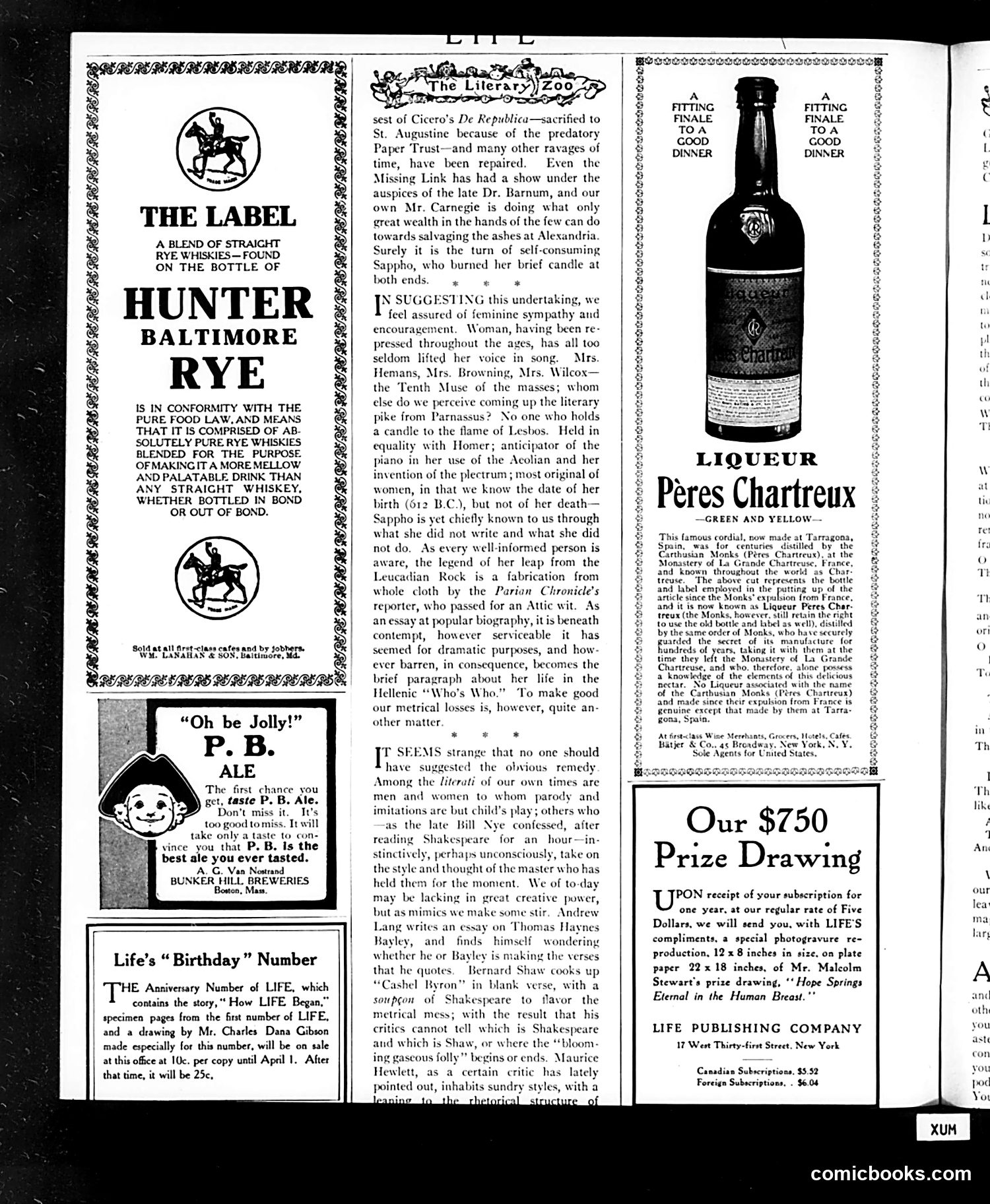
This page mixes advertising with satirical commentary on literary figures. The central text discusses "The Literary Zoo," sarcastically lamenting gaps in female literary history. The author suggests a mock solution: that contemporary writers (Andrew Lang, Bernard Shaw, Maurice Hewlett) should "complete" Sappho's missing works through parody and imitation, since these modern writers are so skilled at mimicking classical styles that readers can't distinguish their pastiches from originals. The satire targets both classical scholarship (dismissing the Leucadian Rock legend as fabrication) and contemporary literary pretension—the joke being that mediocre modern writers think they can convincingly recreate ancient masterworks. The rest is period advertising for whiskey, ale, liqueur, and a Life magazine anniversary issue, typical of early 20th-century magazine content.
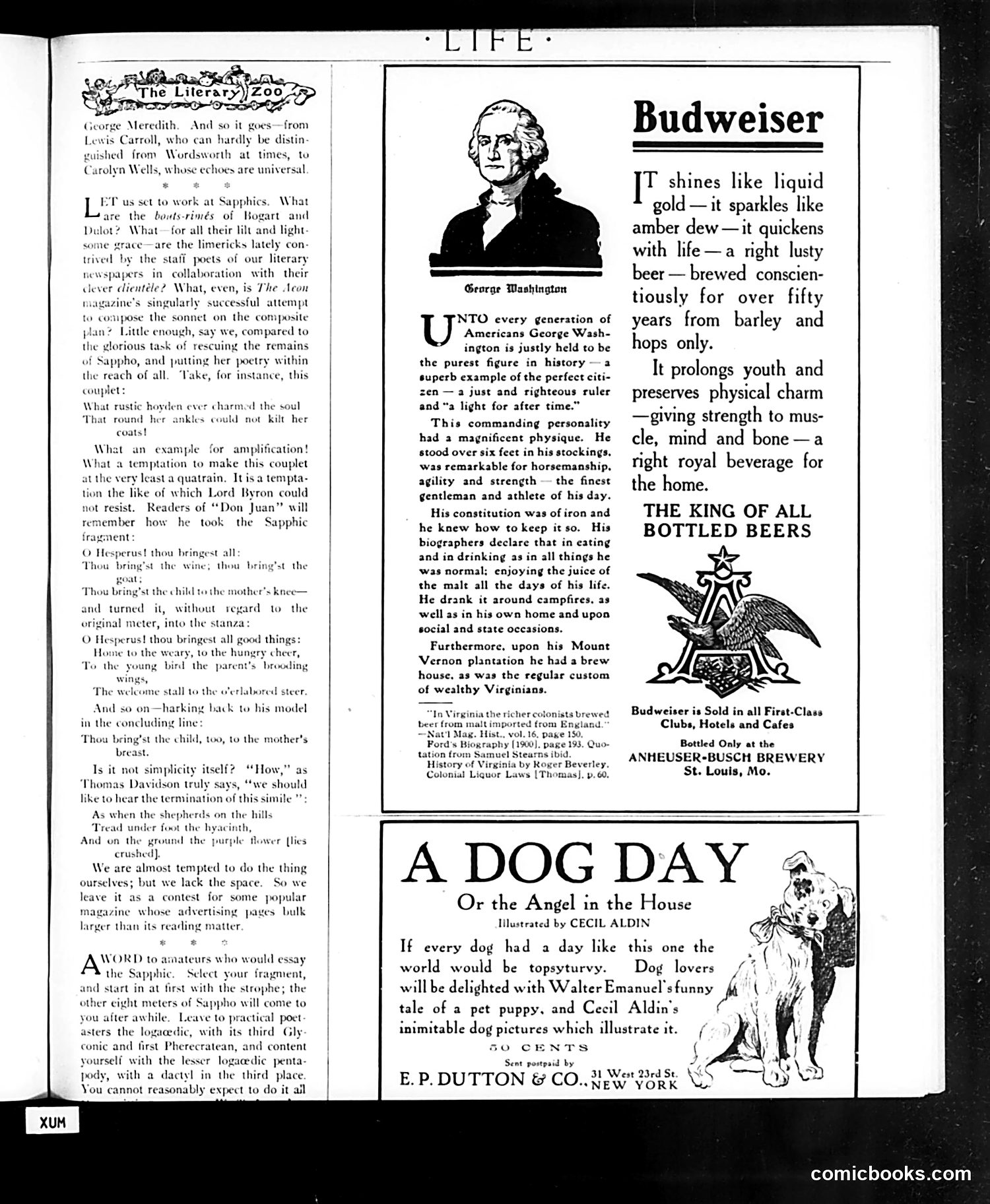
This page contains two distinct elements: a literary essay and advertisements. **The Literary Content ("The Literary Zoo"):** A humorous piece about composing poetry in classical forms, specifically Sapphic verse. The author playfully critiques contemporary poets' attempts at this difficult meter while celebrating Lord Byron's mastery of it. It's literary satire aimed at a educated readership familiar with classical poetry. **The Advertisements:** The Budweiser ad explicitly connects beer consumption to George Washington, claiming the Founding Father drank malt beverages daily and maintained a brewhouse at Mount Vernon. This is patriotic marketing—associating beer with American virtue and the nation's greatest hero. Below is an advertisement for "A Dog Day," a humorous illustrated story by Walter Emanuel and Cecil Aldin. **Context for Modern Readers:** This reflects early 20th-century advertising before regulations restricted health claims. Linking alcohol to physical vigor and moral character was standard practice.
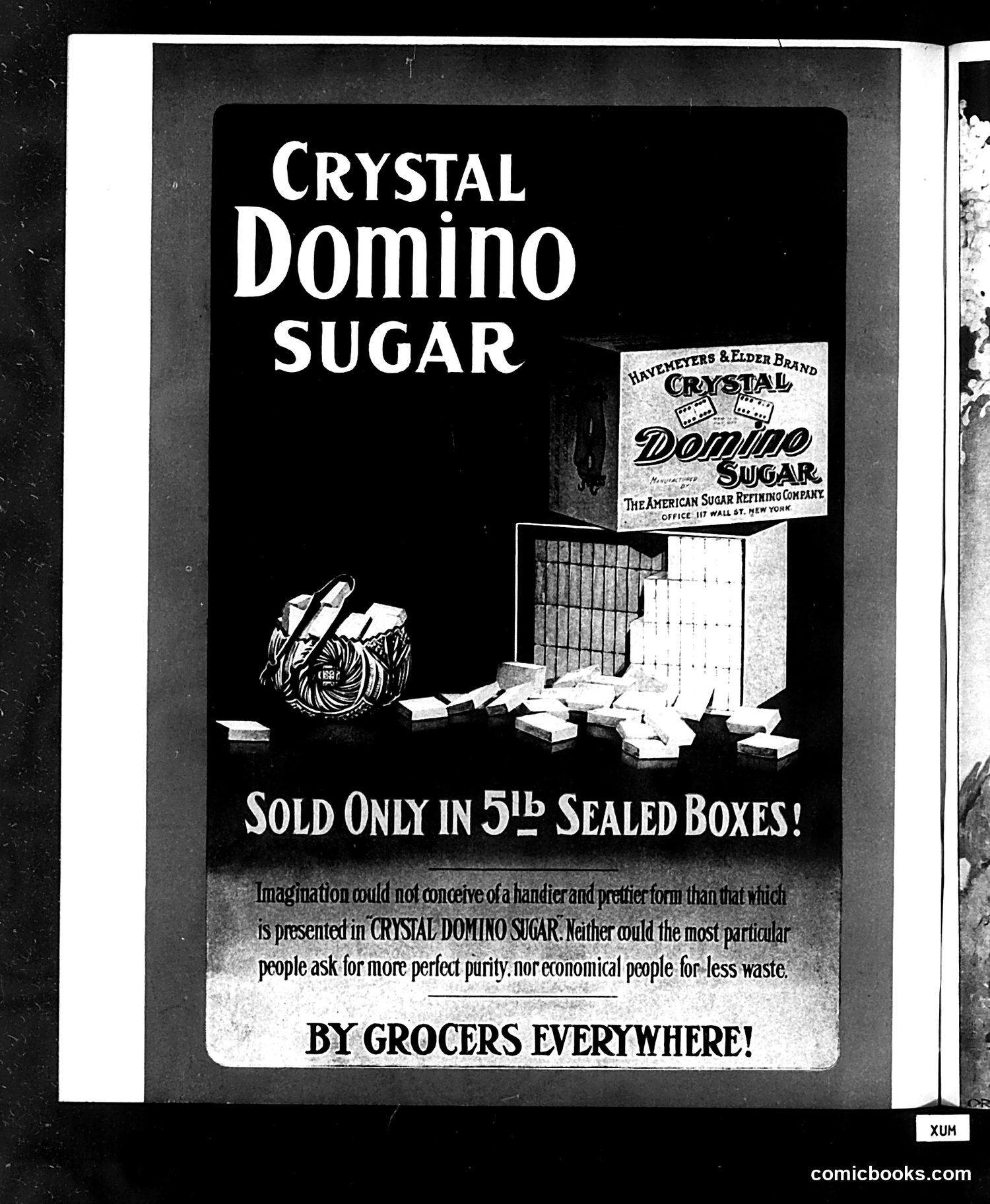
This is a vintage advertisement for Crystal Domino Sugar by the American Sugar Refining Company, not political satire. The ad emphasizes that the product comes "Sold Only in 5lb Sealed Boxes," highlighting packaging as a mark of quality and purity. The accompanying text claims the sugar represents "a handier and prettier form" with superior purity and economy compared to alternatives. The visual shows sugar cubes and packaging alongside the Domino brand logo. This appears designed to appeal to early 20th-century consumers concerned about product authenticity and cleanliness—concerns that would resonate given the era's food safety scandals. The ad's emphasis on sealed boxes suggests competition from bulk or loose sugar products. There is no political commentary visible; this is straightforward commercial advertising.