
Life, 1908-03-26 · page 7 of 22
Life — March 26, 1908 — page 7: what you’re looking at
What you’re looking at
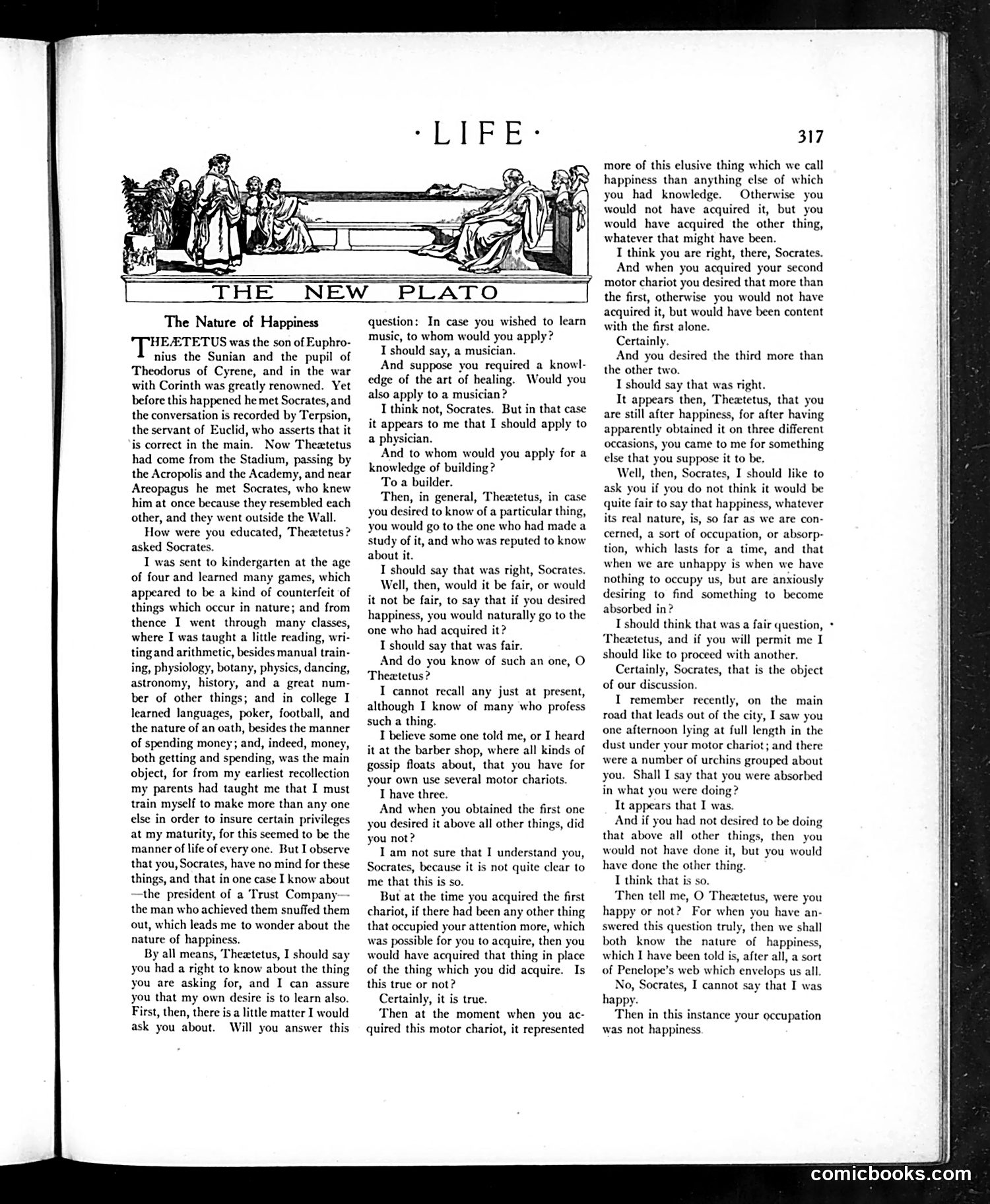
This page presents a philosophical dialogue titled "The Nature of Happiness," structured as a Socratic conversation between Socrates and Thaetetus. The illustration shows classical figures in robes arranged in a formal debate setting. The dialogue explores whether happiness comes from knowledge or desire fulfillment. Socrates argues that true happiness involves occupation and purpose rather than passive contentment. The discussion references acquiring motor chariots (automobiles) as an example of desired possessions. This appears to be satirical commentary on early-20th-century American materialism and the then-novel automobile industry. By framing consumer desire through classical philosophy, Life magazine likely critiques the notion that purchasing modern goods—particularly cars—brings genuine happiness, suggesting instead that meaningful occupation matters more.
📄 Transcribed text from this page (OCR, searchable)
Machine-transcribed from the original scan — historical spelling and the odd misread are preserved.
THE NEW. PLATO The Nature of Happiness "THEE rerys was the son of Euphro- nius the Sunian and the pupil of Theodorus of Cyrene, and in the war with Corinth was greatly renowned. Yet before this happened he met Socrates, and the conversation is recorded by Terpsion, the servant of Euclid, who asserts that it is correct in the main. Now Theetetus had come from the Stadium, passing by the Acropolis and the Academy, and near Areopagus he met Socrates, who knew him at once because they resembled each other, and they went outside the Wall. How were you educated, Theatetus? asked Socrates. I was sent to kindergarten at the age of four and learned many games, which appeared to be a kind of counterfeit of things which occur in nature; and from thence I went through many classes, where I was taught a little reading, wri- ting and arithmetic, besides manual train- ing, physiology, botany, physics, dancing, astronomy, history, and a great num- ber of other things; and in college I learned languages, poker, football, and the nature of an oath, besides the manner of spending money’; and, indeed, money, both getting and spending, was the main object, for from my earliest recollection my parents had taught me that I must train myself to make more than any one else in order to insure certain privileges at my maturity, for this seemed to be the manner of life of every one. But I observe that you, Socrates, have no mind for these things, and that in one case I know about the president of a ‘Trust Company: the man who achieved them snuffed them out, which leads me to wonder about the nature of happiness. By all means, Thezxtetus, I should say you had a right to know about the thing you are asking for, and I can assure you that my own desire is to learn also. First, then, there is a little matter I would ask you about. Will you answer this question: In case you wished to learn music, to whom would you apply? I should say, a musician. And suppose you required a knowl- edge of the art of healing. Would you also apply to a musician? I think not, Socrates. But in that case it appears to me that I should apply to a physician. And to whom would you apply for a knowledge of building? To a builder. Then, in general, Thewtetus, in case you desired to know of a particular thing, you would go to the one who had made a study of it, and who was reputed to know about it. I should say that was right, Socrates. Well, then, would it be fair, or would it not be fair, to say that if you desired happiness, you would naturally go to the one who had acquired it? I should say that was fair. And do you know of such an one, O Theatetus? I cannot recall any just at present, although I know of many who profess such a thing. I believe some one told me, or I heard it at the barber shop, where all kinds of gossip floats about, that you have for your own use several motor chariots. I have three. And when you obtained the first one you desired it above all other things, did you not? I am not sure that I understand you, Socrates, because it is not quite clear to me that this is so. But at the time you acquired the first chariot, if there had been any other thing that occupied your attention more, which was possible for you to acquire, then you would have acquired that thing in place of the thing which you did acquire. Is this true or not? Certainly, it is true. Then at the moment when you ac- quired this motor chariot, it represented 317 more of this elusive thing which we call happiness than anything else of which you had knowledge. Otherwise you would not have acquired it, but you would have acquired the other thing, whatever that might have been. I think you are right, there, Socrates. And when you acquired your second motor chariot you desired that more than the first, otherwise you would not have acquired it, but would have been content with the first alone. Certainly. And you desired the third more than the other two. I should say that was right. It appears then, Thextetus, that you are still after happiness, for after having apparently obtained it on three different occasions, you came to me for something else that you suppose it to be, Well, then, Socrates, I should like to ask you if you do not think it would be quite fair to say that happiness, whatever its real nature, is, so far as we are con- cerned, a sort of occupation, or absorp- tion, which lasts for a time, and that when we are unhappy is when we have nothing to occupy us, but are anxiously desiring to find something to become absorbed in? T should think that was a fair question, Thextetus, and if you will permit me I should like to proceed with another. Certainly, Socrates, that is the object of our discussion. I remember recently, on the main road that leads out of the city, I saw you one afternoon lying at full length in the dust under your motor chariot; and there were a number of urchins grouped about you. Shall I say that you were absorbed in what you were doing? It appears that I was. And if you had not desired to be doing that above all other things, then you would not have done it, but you would have done the other thing. I think that is so. Then tell me, O Theztetus, were you happy or not? For when you have an- swered this question truly, then we shall both know the nature of happiness, which I have been told is, after all, a sort of Penelope’s web which envelops us all. No, Socrates, I cannot say that I was happy. Then in this instance your occupation was not happiness. comicbooks.com