
Life, 1908-03-26 · page 8 of 22
Life — March 26, 1908 — page 8: what you’re looking at
What you’re looking at
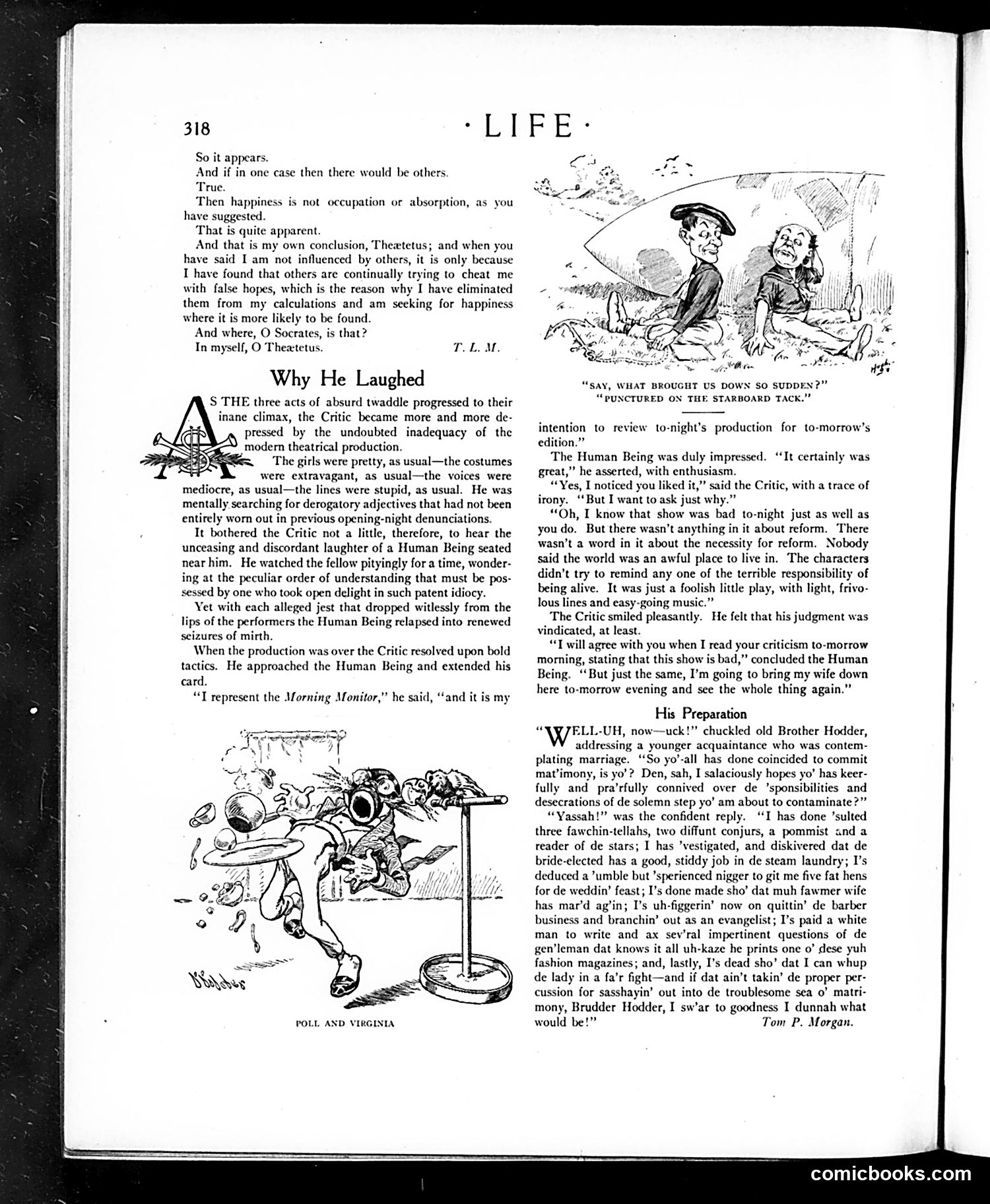
This page contains a satirical theater review titled "Why He Laughed." The critic mocks a contemporary theatrical production called "The Morning Monitor" for its absurd incompetence: poor costumes, mediocre acting, and pretentious dialogue. The accompanying illustrations ridicule the play's ineptitude—one shows performers in exaggerated chaos. The critic finds dark humor in the production's awfulness, suggesting the playwright unintentionally entertains through failure rather than skill. The lower section, "His Preparation," features a humorous monologue (credited to Tom P. Morgan) about arranging a marriage, written in exaggerated dialect. It satirizes overly verbose, self-important speech and pretentious literary affectation. Overall, the page satirizes theatrical mediocrity and pompous writing styles of the era.
📄 Transcribed text from this page (OCR, searchable)
Machine-transcribed from the original scan — historical spelling and the odd misread are preserved.
318 So it appears. And if in one case then there would be others. True. Then happiness is not occupation or absorption, as you have suggested. That is quite apparent. And that is my own conclusion, Theztetus; and when you have said I am not influenced by others, it is only because I have found that others are continually trying to cheat me with false hopes, which is the reason why I have eliminated them from my calculations and am seeking for happiness where it is more likely to be found. And where, O Socrates, is that? In myself, O Thewtetus. T.L. af. Why He Laughed S THE three acts of absurd twaddle progressed to their inane climax, the Critic became more and more de- pressed by the undoubted inadequacy of the _modem theatrical production. The girls were pretty, as usual—the costumes were extravagant, as usual—the voices were mediocre, as usual—the lines were stupid, as usual. He was mentally searching for derogatory adjectives that had not been entirely worn out in previous opening-night denunciations. It bothered the Critic not a little, therefore, to hear the unceasing and discordant laughter of a Human Being seated near him. He watched the fellow pityingly for a time, wonder- ing at the peculiar order of understanding that must be pos- sessed by one who took open delight in such patent idiocy. Yet with each alleged jest that dropped witlessly from the lips of the performers the Human Being relapsed into renewed seizures of mirth. When the production was over the Critic resolved upon bold tactics. He approached the Human Being and extended his card, “J represent the Morning Monitor,” he said, “and it is my POLL AND VIRGINIA “SAY, WHAT BROUGHT US DOWN SO SUDDEN?” “PUNCTURED ON THE STARBOARD TAC! intention to review to-night’s production for to-morrow’s edition.” The Human Being was duly impre: great,” he asserted, with enthusiasm. “Yes, I noticed you liked it,” said the Critic, with a trace of irony. ‘But I want to ask just why.” “Oh, I know that show was bad to-night just as well as you do. But there wasn’t anything in it about reform. ‘There wasn’t a word in it about the necessity for reform. Nobody said the world was an awful place to live in. The characters didn’t try to remind any one of the terrible responsibility of being alive. It was just a foolish litle play, with light, frivo- lous lines and easy-going music.” "The Critic smiled pleasantly. vindicated, at least. “T will agree with you when I read your criticism to-morrow morning, stating that this show is bad,” concluded the Human Being. ‘But just the same, I’m going to bring my wife down here to-morrow evening and see the whole thing again.” . “It certainly was He felt that his judgment was His Preparation LL-UH, now—uck!” chuckled old Brother Hodder, addr ig a younger acquaintance who was contem- plating marriage. “So yo'.all has done coincided to commit mat’imony, is yo’? Den, sah, I salaciously hopes yo’ has keer- fully and ‘pra’rfully connived over de ’sponsibilities and desecrations of de solemn step yo’ am about to contaminate?” “Yassah!” was the confident reply. “I has done ’sulted three fawchin-tellahs, two diffunt conjurs, a pommist and a reader of de stars; I has ’vestigated, and diskivered dat de bride-elected has a good, stiddy job in de steam laundry; I’s deduced a ’umble but ’sperienced nigger to git me five fat hens for de weddin’ feast; I’s done made sho’ dat muh fawmer wife has mar’d ag’in; I’s uh-figgerin’ now on quittin’ de barber business and branchin’ out as an evangelist; I’s paid a white man to write and ax sev’ral impertinent questions of de gen'leman dat knows it all uh-kaze he prints one o dese yuh fashion magazines; and, lastly, I’s dead sho’ dat I can whup de lady in a fa’r fight—and if dat ain’t takin’ de proper per- cussion for sasshayin’ out into de troublesome sea o’ matri mony, Brudder Hodder, I sw’ar to goodness I dunnah what would be!” Tom P. Morgan. comicbooks.com