
Life, 1908-03-26 · page 12 of 22
Life — March 26, 1908 — page 12: what you’re looking at
What you’re looking at
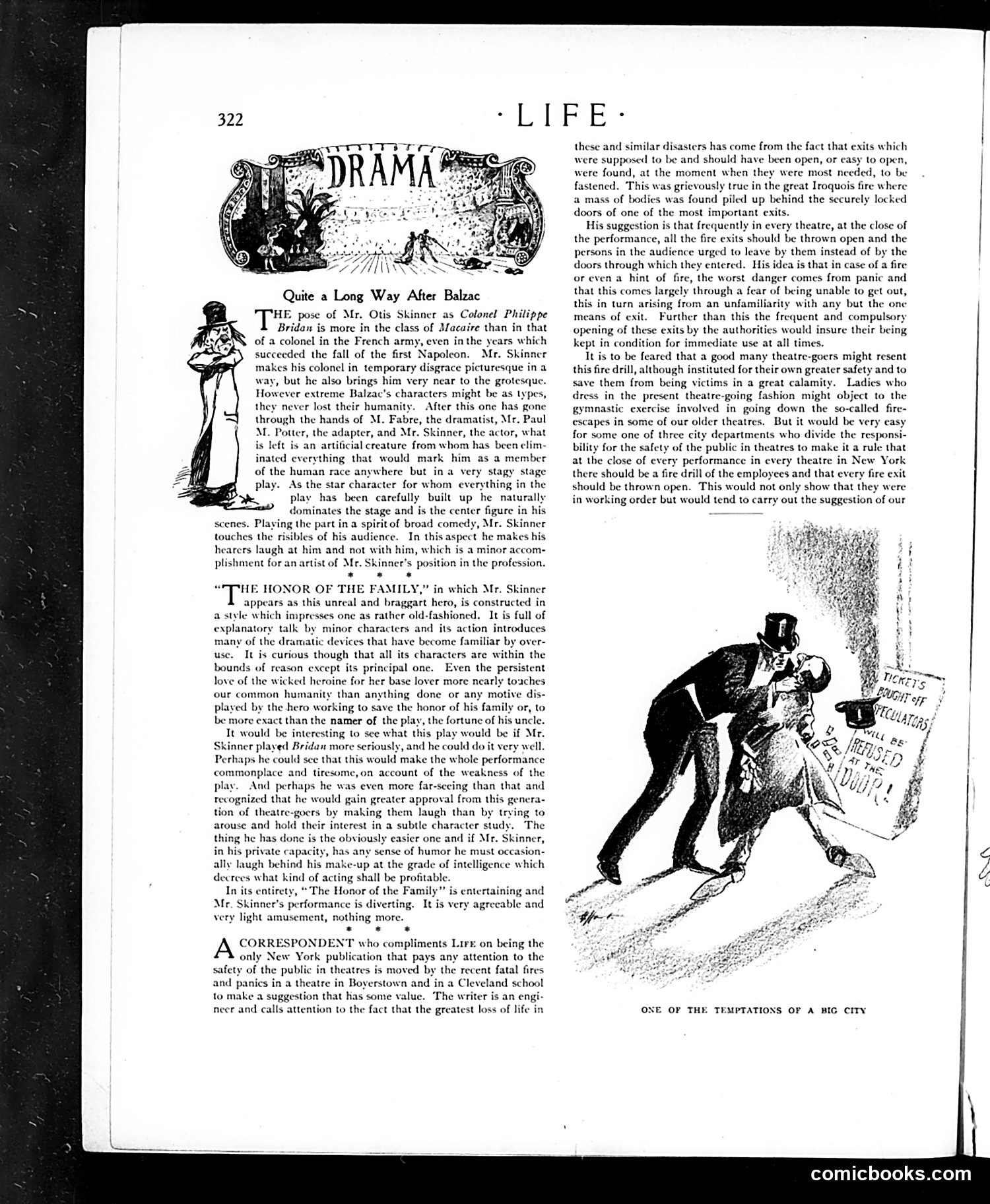
This page discusses theatrical drama reviews, focusing on Mr. Otis Skinner's performances in plays including "Colonel Philippe Bridau" and "The Honor of the Family." The illustration captioned "ONE OF THE TEMPTATIONS OF A BIG CITY" depicts a well-dressed man in a top hat being approached by a woman on a street corner with posted notices. This appears to be social commentary on urban vice and moral temptation—likely referencing solicitation or street-level seduction that was a recognized urban social problem of the era. The text also addresses theater safety concerns, discussing fire exits and audience evacuation procedures following recent deadly theater fires in Boyerstown and Cleveland. The writer advocates for mandatory fire drills in theaters to prevent panic-related fatalities.
📄 Transcribed text from this page (OCR, searchable)
Machine-transcribed from the original scan — historical spelling and the odd misread are preserved.
Quite a Long Way After Balzac HE pose of Mr. Otis Skinner as Colonel Philippe Bridan is more in the class of Macaire than in that of a colonel in the French army, even in the years which succeeded the fall of the first Napoleon. Mr. Skinner makes his colonel in temporary disgrace picturesque in a way, but he also brings him very near to the grotesque. However extreme Balzac’s characters might be as types, they never lost their humanity. After this one has gone through the hands of M. Fabre, the dramatist, Mr. Paul M. Potter, the adapter, and Mr. Skinner, the actor, what is left is an artificial creature from whom has been clim- inated everything that would mark him as a member of the human race anywhere but in a very stagy stage play. As the star character for whom everything in the ye play has been carefully built up he naturally dominates the stage and is the center figure in his scenes. Playing the part in a spiritof broad comedy, Mr. Skinner touches the risibles of his audience. In this aspect he makes his hearers laugh at him and not with him, which is a minor accom- plishment for an artist of Mr. Skinner's position in the profession. +e 8 "Ti HONOR OF THE FAMILY,” in which Mr. Skinner ppears as this unreal and braggart hero, is constructed in a style which impresses one as rather old-fashioned. It is full of explanatory talk by minor characters and its action introduces many of the dramatic devices that have become familiar by over= use. It is curious though that all its characters are within the bounds of reason except its principal one. Even the persistent love of the wicked heroine for her base lover more nearly toaches our common humanity than anything done or any motive dis- played by the hero working to save the honor of his family or, to be more exact than the namer of the play, the fortune of his uncle. It would be interesting to sce what this play would be if Mr. Skinner played Bridax more seriously, and he could do it very well. Perhaps he could sce that this would make the whole performance commonplace and tiresome,on account of the weakness of the play. And perhaps he was even more far-seeing than that and recognized that he would gain greater approval from this gencra- tion of theatre-gocrs by making them laugh than by trying to arouse and hold their interest in a subtle character study. The thing he has done is the obviously easier one and if Mr. Skinner, in his private capacity, has any sense of humor he must occasion- ally laugh behind his make-up at the grade of intelligence which decrees what kind of acting shall be profitable. In its entirety, “The Honor of the Family” is entertaining and Mr. Skinner’s performance is diverting. It is very agrecable and very light amusement, nothing more. ce & CORRESPONDE: ? who compliments Lire on being the only New York publication that pays any attention to the fety of the public in theatres is moved by the recent fatal fires and panics in a theatre in Boyerstown and in a Cleveland school to make a suggestion that has some value. The writer is an en, neer and calls attention to the fact that the greatest loss of life in “LIP E : these and similar disasters has come from the fact that exits which were supposed to be and should have been open, of easy to open, | were found, at the moment when they were most needed, to be | fastened. This was grievously true in the great Iroquois fire where a mass of bodies was found piled up behind the securely locked doors of one of the most important exits. His suggestion is that frequently in every theatre, at the close of the performance, all the fire exits should be thrown open and the persons in the audience urged to leave by them instead of by the doors through which they entered. His idea is that in case of a fire oreven a hint of fire, the worst danger comes from panic and that this comes largely through a fear of being unable to get out, this in turn arising from an unfamiliarity with any but the one means of exit. Further than this the frequent and compulsory opening of these exits by the authorities would insure their being kept in condition for immediate use at all times. It is to be feared that a good many theatre-goers might resent this fire drill, although instituted for their own greater safety and to save them from being victims in a great calamity. Ladics who dress in the present theatre-going fashion might object to the ymnastic exercise involved in going down the so-called fire- escapes in some of our older theatres. But it would be very easy for some one of three city departments who divide the responsi- bility for the safety of the public in theatres to make it a rule that at the close of every performance in every theatre in New York there should be a fire drill of the employees and that every fire exit should be thrown open. This would not only show that they were in working order but would tend to carry out the suggestion of our ONE OF THE TEMPTATIONS OF A BIG CITY comicbooks.com