
Life, 1908-03-26 · page 14 of 22
Life — March 26, 1908 — page 14: what you’re looking at
What you’re looking at
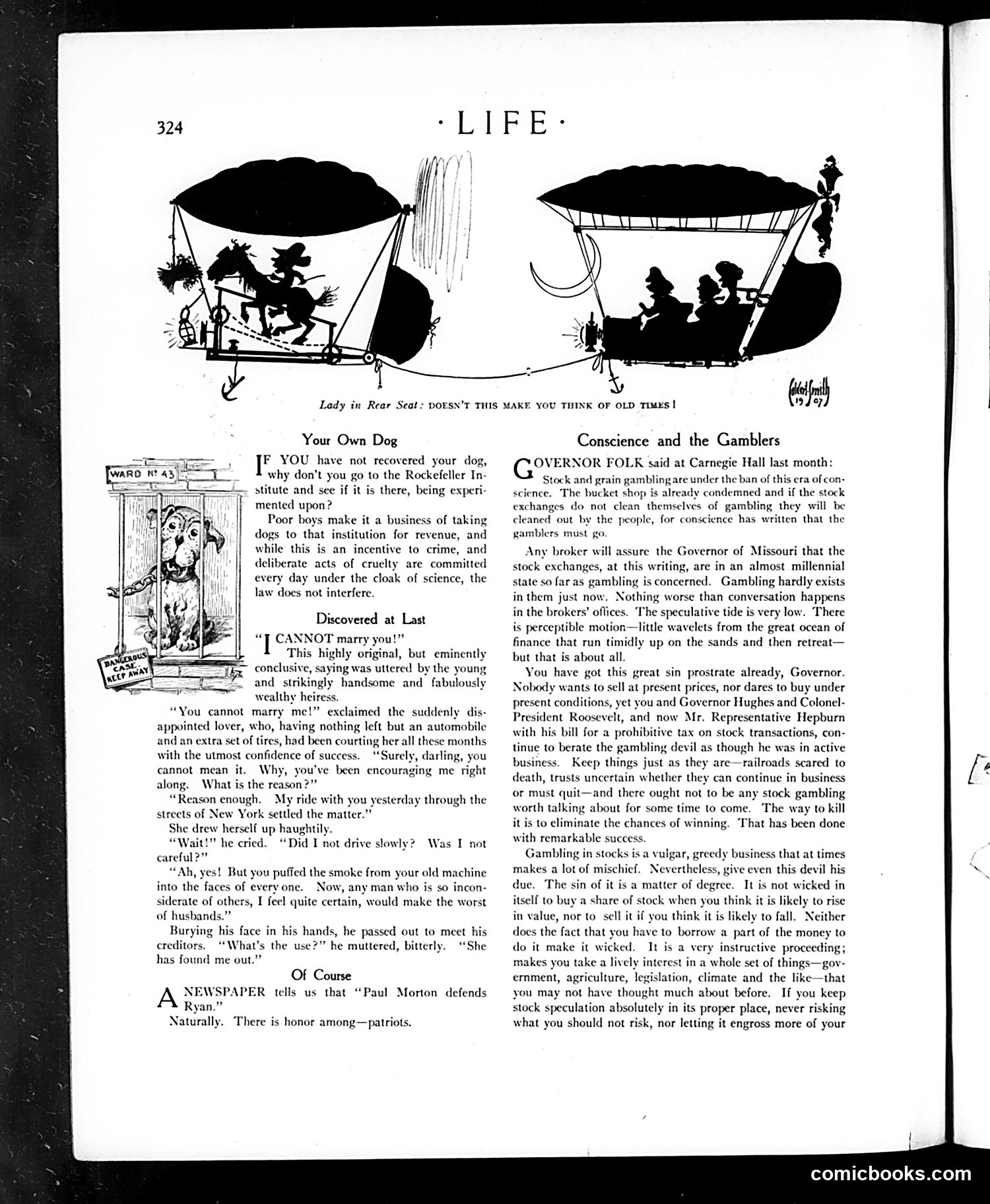
**Top Cartoon**: Two hot-air balloons carrying passengers. Caption suggests nostalgia for "old times"—likely satirizing early automobile culture by contrasting it with older forms of transportation, mocking both progress and those who romanticize the past. **"Your Own Dog"**: Critiques the Rockefeller Institute's animal experimentation. The piece argues that poor boys steal dogs to sell them for research revenue, enabling animal cruelty under the guise of science while law enforcement ignores it—a reform-era complaint about unregulated scientific ethics. **"Discovered at Last"**: A romantic comedy exposing a wealthy heir's character flaw: his inconsiderate behavior (smoking in others' faces while driving) reveals moral unfitness for marriage, despite his wealth and automobile. Social satire on what truly matters in character. **"Conscience and the Gamblers"**: Sarcastically defends stock-market gambling against Governor Folk's moral crusade. The author argues the market is already "dying" due to economic fear, making anti-gambling rhetoric pointless—ironic commentary on politicians taking credit for problems already solved by circumstance rather than reform.
📄 Transcribed text from this page (OCR, searchable)
Machine-transcribed from the original scan — historical spelling and the odd misread are preserved.
Lady in Rear Seat: DOESN'T THIS MAKE YOU THINK OF OLD TIMES! Your Own Dog FF YOU have not recovered your dog, why don’t you go to the Rockefeller In- stitute and see if it is there, being experi- mented upon? Poor boys make it a business of taking dogs to that institution for revenue, and while this is an incentive to crime, and deliberate acts of cruelty are committed every day under the cloak of science, the law does not interfere. Discovered at Last a | CANNOT marry you!” This highly original, but eminently conclusive, saying was uttered by the young and strikingly handsome and. fabulously wealthy heire “You cannot marry me!” exclaimed the suddenly dis- appointed lover, who, having nothing left but an automobile and an extra set of tires, had been courting her all these months. with the utmost confidence of success. ‘‘Surely, darling, you cannot mean it. Why, you've been encouraging me right along. What is the reason?” “Reason enough. My ride with you yesterday through the 's of New York settled the matter.” She drew herself up haughtily. “Wait!” he cried. “Did I not drive slowly? careful?” “Ah, yes! But you puffed the smoke from your old machine into the faces of every one. Now, any man who is so incon- siderate of others, I feel quite certain, would make the worst of husbands.” Burying his face in his hands, he passed out to meet his creditors, ‘What's the use?” he muttered, bitterly. ‘She has found me out.” Was I not Of Course NEWSPAPER tells us that “Paul Morton defends Ryan.” Naturally. There is honor among—patriots. Conscience and the Gamblers OVERNOR FOLK said at Carnegie Hall last month: Stock and grain gambling are under the ban of this era of con- science. The bucket shop is already condemned and if the stock exchanges do not clean themselves of gambling they will be cleaned out by the people, for conscience has written that the gamblers must go. Any broker will assure the Governor of Missouri that the stock exchanges, at this writing, are in an almost millennial state so far as gambling is concerned. Gambling hardly exists in them just now. Nothing worse than conversation happens in the brokers’ oflices. ‘The speculative tide is very low. There is perceptible motion—little wavelets from the great ocean of finance that run timidly up on the sands and then retreat— but that is about all. You have got this great sin prostrate already, Governor. Nobody wants to sell at present prices, nor dares to buy under present conditions, yet you and Governor Hughes and Colonel- President Roosevelt, and now Mr. Representative Hepburn with his bill for a prohibitive tax on stock transactions, con- tinue to berate the gambling devil as though he was in active business. Keep things just as they are—railroads scared to death, trusts uncertain whether they can continue in business or must quit—and there ought not to be any stock gambling worth talking about for some time to come. The way to kill it is to eliminate the chances of winning. That has been done with remarkable success. Gambling in stocks is a vulgar, greedy business that at times makes a lot of mischief. Nevertheless, give even this devil his due. The sin of it is a matter of degree. It is not wicked in itself to buy a share of stock when you think it is likely to rise in value, nor to sell it if you think it is likely to fall. Neither does the fact that you have to borrow a part of the money to do it make it wicked. It is a very instructive proceeding; makes you take a lively interest in a whole set of things—gov- ernment, agriculture, legislation, climate and the like—that you may not have thought much about before. If you keep stock speculation absolutely in its proper place, never risking what you should not risk, nor letting it engross more of your comicbooks.com