
Life, 1908-03-26 · page 4 of 22
Life — March 26, 1908 — page 4: what you’re looking at
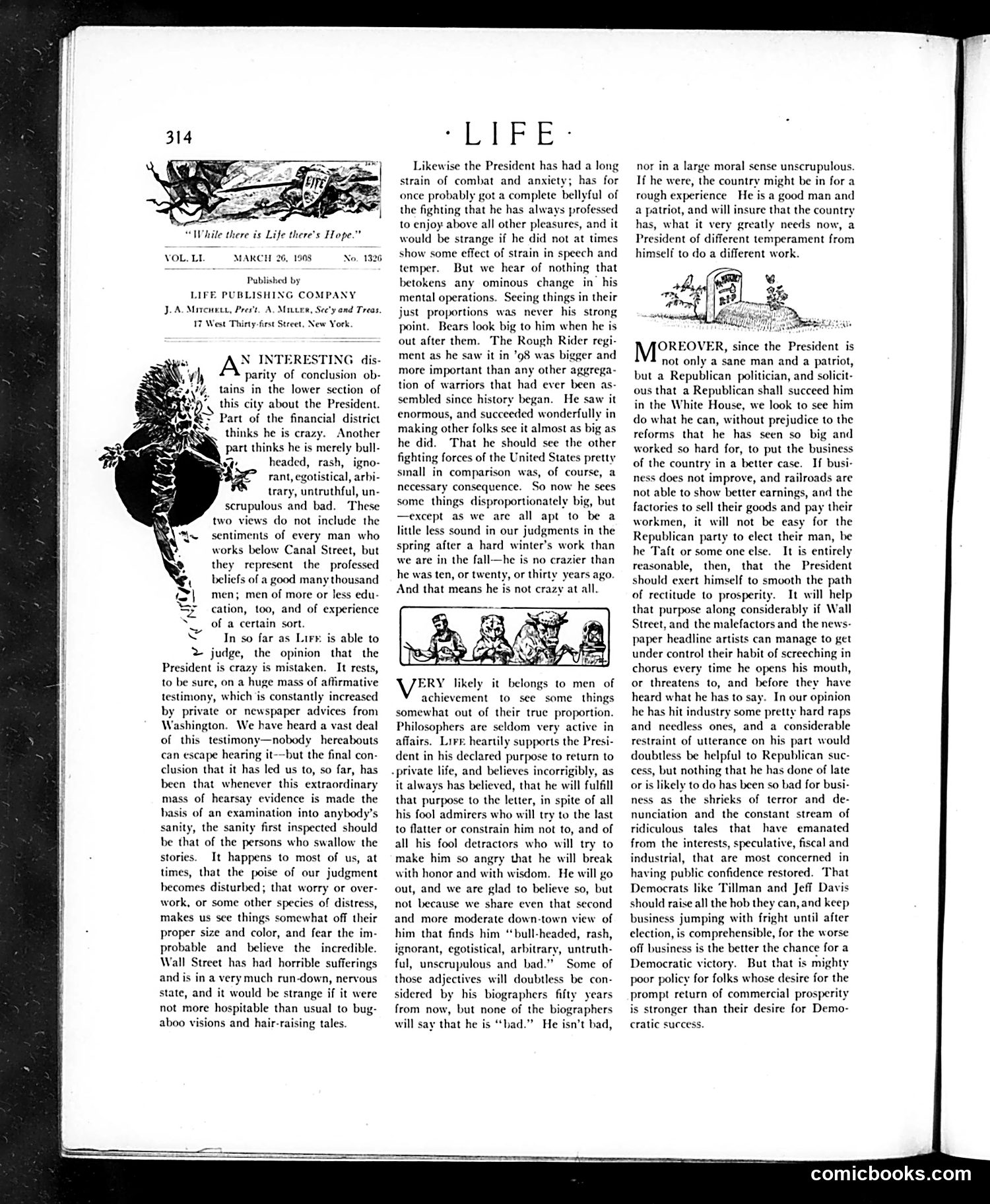
A restored page from Life, 1908-03-26. Page through the whole issue in the reader above.
📄 Transcribed text from this page (OCR, searchable)
Machine-transcribed from the original scan — historical spelling and the odd misread are preserved.
“While there is Life there's Hope.” VOL. LI. MARCH 26, 1908 No. 1326 Published by LIFE PUBLISHING COMPANY J.A. Maven 17 West Thinty-first Street, New York. 1, Pres't, A. Muvure, See'y and Treas ry N INTER. + dis- hy parity of conclusion ob- =a\i7_ tains in the lower section of of). this city about the President. Part of the financial district thinks he is crazy. Another part thinks he is merely bull- headed, rash, igno- rant, egotistical, arbi- trary, untruthful, un- scrupulous and bad. These two views do not include the sentiments of every man who works below Canal Street, but they represent the professed beliefs of a good many thousand men; men of more or less edu- cation, too, and of experience of a certain sort. In so far as Lire: is able to ‘D judge, the opinion that the President is crazy is mistaken. It rests, to be sure, on a huge mass of affirmative testimony, which is constantly increased by private or newspaper advices from Washington. We have heard a vast deal of this testimony—nobody hereabouts can escape hearing it-—but the final con- clusion that it has led us to, so far, has been that whenever this extraordinary mass of hearsay evidence is made the is of an examination into anybody’s , the sanity first inspected should be that of the persons who swallow the i It happens to most of us, at that the poise of our judgment becomes disturbed; that worry or over- work, or some other species of distr makes us see things somewhat off their proper size and color, and fear the im- probable and believe the incredible. Wall Street has had horrible sufferings and is in a very much run-down, nervous state, and it would be strange if it were not more hospitable than usual to bug- aboo visions and hair-raising tales. ‘LIFE * Likewise the President has had a long strain of combat and anxiety; has for once probably got a complete bellyful of the fighting that he has always professed to enjoy above all other pleasures, and it would be strange if he did not at times show some effect of strain in speech and temper. But we hear of nothing that betokens any ominous change in’ his mental operations. Seeing things in their just proportions was never his strong point. Bears look big to him when he is out after them. The Rough Rider regi- ment as he saw it in ’98 was bigger and more important than any other aggrega- tion of warriors that had ever been as- sembled since history began. He saw it enormous, and succeeded wonderfully in making other folks sce it almost as big as he did. That he should see the other fighting forces of the United States pretty small in comparison was, of course, a necessary consequence. So now he sees some things disproportionately big, but except as we are all apt to be a little less sound in our judgments in the spring after a hard winter's work than we are in the fall—he is no crazier than he was ten, or twenty, or thirty years ago. And that means he is not crazy V Y likely it s achievement to sce some things somewhat out of their true proportion. Philosophers are seldom very active in affairs. Lire: heartily supports the Presi- dent in his declared purpose to return to «private life, and believes incorrigibly, as it always has believed, that he will fulfill that purpose to the letter, in spite of all his fool admirers who will try to the last to flatter or constrain him not to, and of all his fool detractors who will try to make him so angry that he will break with honor and with wisdom. He will go out, and we are glad to believe so, but not because we share even that second and more moderate down-town view of him that finds him ‘‘bull-headed, rash, ignorant, egotistical, arbitrary, untruth- ful, unscrupulous and bad.” Some of those adjectives will doubtless be con- sidered by his biographers fifty years from now, but none of the biographers will say that he is “bad.” He isn’t bad, nor in a large moral sense unscrupulous. If he were, the country might be in for a rough experience He is a good man and a patriot, and will insure that the country has, what it very greatly needs now, a President of different temperament from himself to do a different work. _ & — OREOVER, since the President is not only a sane man and a patriot, but a Republican politician, and solicit- ous that a Republican shall succeed him in the White House, we look to see him do what he can, without prejudice to the reforms that he has seen so big and worked so hard for, to put the busine: of the country in a better case. If busi- ness does not improve, and railroads are not able to show better earnings, and the factories to sell their goods and pay their workmen, it will not be easy for the Republican party to elect their man, be he Taft or some one else. It is entirely reasonable, then, that the President should exert himself to smooth the path of rectitude to prosperity. It will help that purpose along considerably if Wall Street, and the malefactors and the new. paper headline artists can manage to get under control their habit of screeching in chorus every time he opens his mouth, or threatens to, and before they have heard what he has to say. In our opinion he has hit industry some pretty hard raps and needless ones, and a considerable restraint of utterance on his part would doubtless be helpful to Republican suc- cess, but nothing that he has done of late or is likely to do has been so bad for busi- ness as the shrieks of terror and de- nunciation and the constant stream of ridiculous tales that have emanated from the interests, speculative, fiscal and industrial, that are most concerned in having public confidence restored. That Democrats like Tillman and Jeff Davis should raise all the hob they can, and keep business jumping with fright until after election, is comprehensible, for the worse off business is the better the chance for a Democratic victory. But that is mighty poor policy for folks whose desire for the prompt return of commercial prosperity is stronger than their desire for Demo- cratic success. comicbooks.com