
Life, 1908-03-26 · page 21 of 22
Life — March 26, 1908 — page 21: what you’re looking at
What you’re looking at
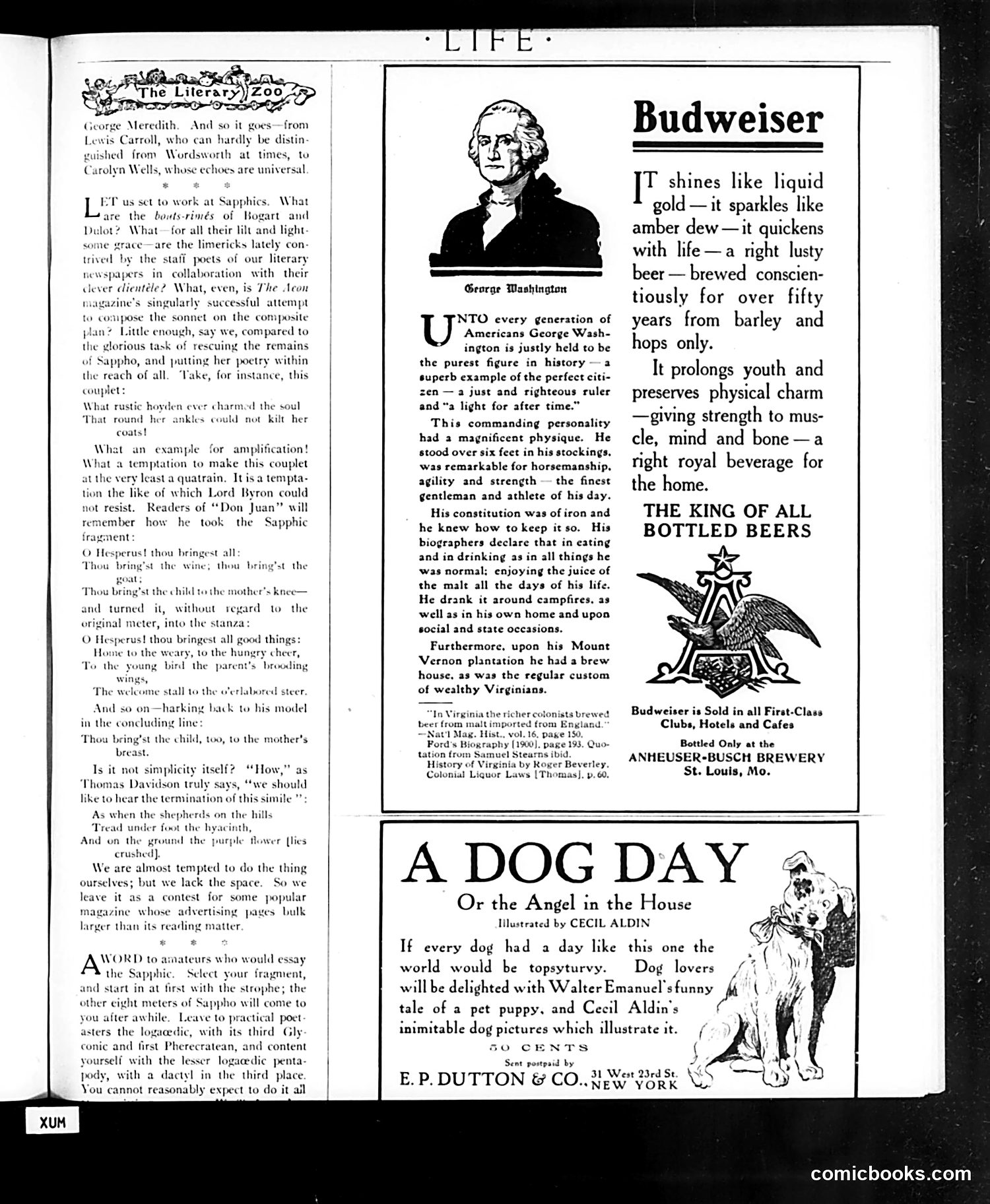
This page contains two distinct elements: a literary essay and advertisements. **The Literary Content ("The Literary Zoo"):** A humorous piece about composing poetry in classical forms, specifically Sapphic verse. The author playfully critiques contemporary poets' attempts at this difficult meter while celebrating Lord Byron's mastery of it. It's literary satire aimed at a educated readership familiar with classical poetry. **The Advertisements:** The Budweiser ad explicitly connects beer consumption to George Washington, claiming the Founding Father drank malt beverages daily and maintained a brewhouse at Mount Vernon. This is patriotic marketing—associating beer with American virtue and the nation's greatest hero. Below is an advertisement for "A Dog Day," a humorous illustrated story by Walter Emanuel and Cecil Aldin. **Context for Modern Readers:** This reflects early 20th-century advertising before regulations restricted health claims. Linking alcohol to physical vigor and moral character was standard practice.
📄 Transcribed text from this page (OCR, searchable)
Machine-transcribed from the original scan — historical spelling and the odd misread are preserved.
ees he riers 'Z00. AP George Meredith, And so it goes—from Lewis Carroll, who can hardly be distin guished from Wordsworth at times, to Carolyn Wells, whose echoes are universal ET us set to work at Sapphics. What e the bowts-rimés of Bogart and Dulot?) What—for all their lilt and light ce are the Limericks lately trived by the staff poets of our literary newspapers in collaboration with their ever dientéle? What, even, is The Acon magazine's singularly successful attempt to compose the sonnet on the composite plan? Little enough, say we, compared to the glorious task of rescuing the remains of Sappho, and putting her poetry within the reach of all. ‘Vake, for instance, this couplet: mod the soul Jd not kilt her What rustic hoy That round her ar coats! What an example for amplification! What a temptation to make this couplet at the very Ieast a quatrain, It isa tempta- tion the like of which Lord Byron could esist. Readers of “Don Juan” will how he took the Sapphic thou bringest all Thou bring’st the wine; thou bring'st- the Thou bring’st the child ta the mother’s knee and turned it, without regard to the original meter, into the stanza: © Hesperus! thou bringest all good things: Home to the weary, to the hungry cheer, To the young bird the parent's brooding he o'erlabored steer. And so on—harking back to his model in the concluding line ‘Thou bring’st the child, too, to the mother’s breast. Is it not simplicity itself? “How,” as ‘Thomas Davidson truly says, “we should like to hear the termination of this simile As when the shepherds on the hills ‘Tread under foot the hyacinth, And on the ground the purple flower [lies crushed]. We are almost tempted to do the thing ourselves; but we lack the space. So we leave it as a contest for some popular magazine whose advertising pages bulk larger than its re ng Matter, WORD to amateurs who would essay the Sapphic. Select your fragment, 1 start in at first with the strophe; the cight meters of Sappho will come to 5 awhile. Leave to practical poet asters the logacedic, with its third Gly conic and first Pherecratean, and content yourself with the lesser logaaedie penta pody, with a dactyl in the third place You cannot reasonably expect to do it ail George Washington NTO every generation of | J Americans George Wash- ington is justly held to be the purest figure in history —a superb example of the perfect citi- zen — a just and righteous ruler and “a light for after time.” This commanding personality had a magnificent physique. He stood over six feet in his stockings, was remarkable for horsemanship, agility and strength — the finest gentleman and athlete of his day. His constitution was of iron and he knew how to keep itso. His biographers declare that in eating and in drinking as in all things he was normal; enjoying the juice of the malt all the days of his life. He drank it around campfires, a3 well as in his own home and upon social and state occasions. Furthermore, upon his Mount Vernon plantation he had a brew house, as was the regular custom of wealthy Virginians. Virginia the richer colonists brewed mported f ngland . Hist., vol. 16, page 150. ‘aphy [1900]. page 193. Quo- tation from Samuel Stearns ibid. by Roger Beverley. Colonial Liquor Laws [Thomas], p. 60. Budweiser T shines like liquid gold — it sparkles like amber dew — it quickens with life—a right lusty beer — brewed conscien- tiously for over fifty years from barley and hops only. It prolongs youth and preserves physical charm —giving strength to mus- cle, mind and bone —a right royal beverage for the home. THE KING OF ALL BOTTLED BEERS Budweiser is Sold in all First-Class Clubs, Hotels and Cafes Bottled Only at the ANHEUSER-BUSCH BREWERY St. Louis, Mo. A DOG DAY @. Or the Angel in the House * Illustrated by CECIL ALDIN If every dog had a day like this one the world would be topsyturvy. Dog lovers will be delighted with Walter Emanuel’s funny tale of a pet puppy, and Cecil Aldin’s inimitable dog pictures which illustrate it. ITs Sent postpaid by E.P. DUTTON & CO.. Wer gist comicbooks.com