
A complete issue · 20 pages · 1908
Life — January 23, 1908
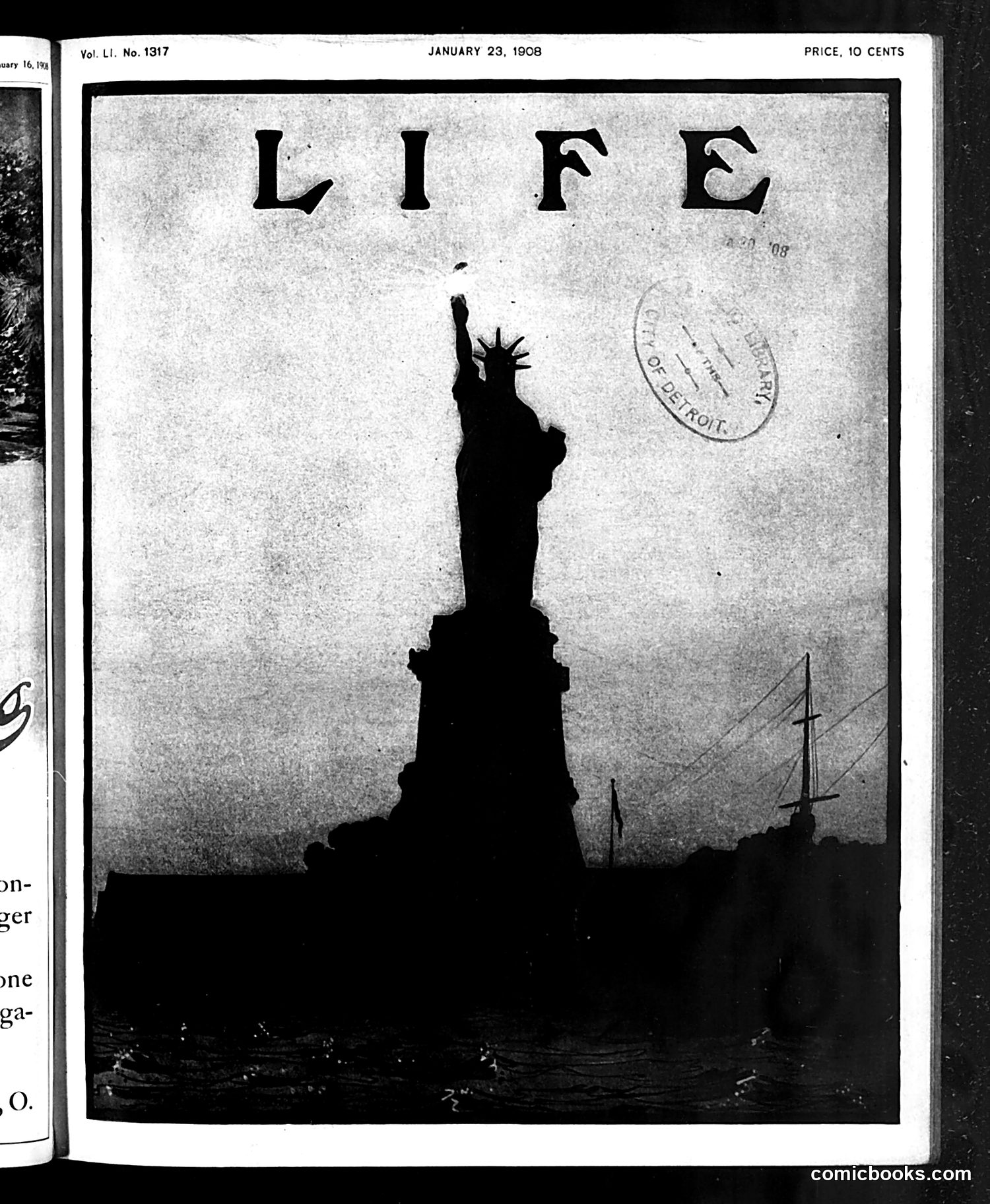
This is the cover of *Life* magazine from January 23, 1908, priced at 10 cents. The image shows the Statue of Liberty in silhouette against a twilight sky, with ships visible on the water below. The cover's meaning is unclear without additional context or accompanying article text. The stark, dramatic silhouetting of the iconic statue could suggest commentary on American identity, immigration policy, or national values—all significant political topics in 1908. The title "LIFE" appears above, but without the interior text visible, the specific satirical message or current event being referenced cannot be definitively determined.
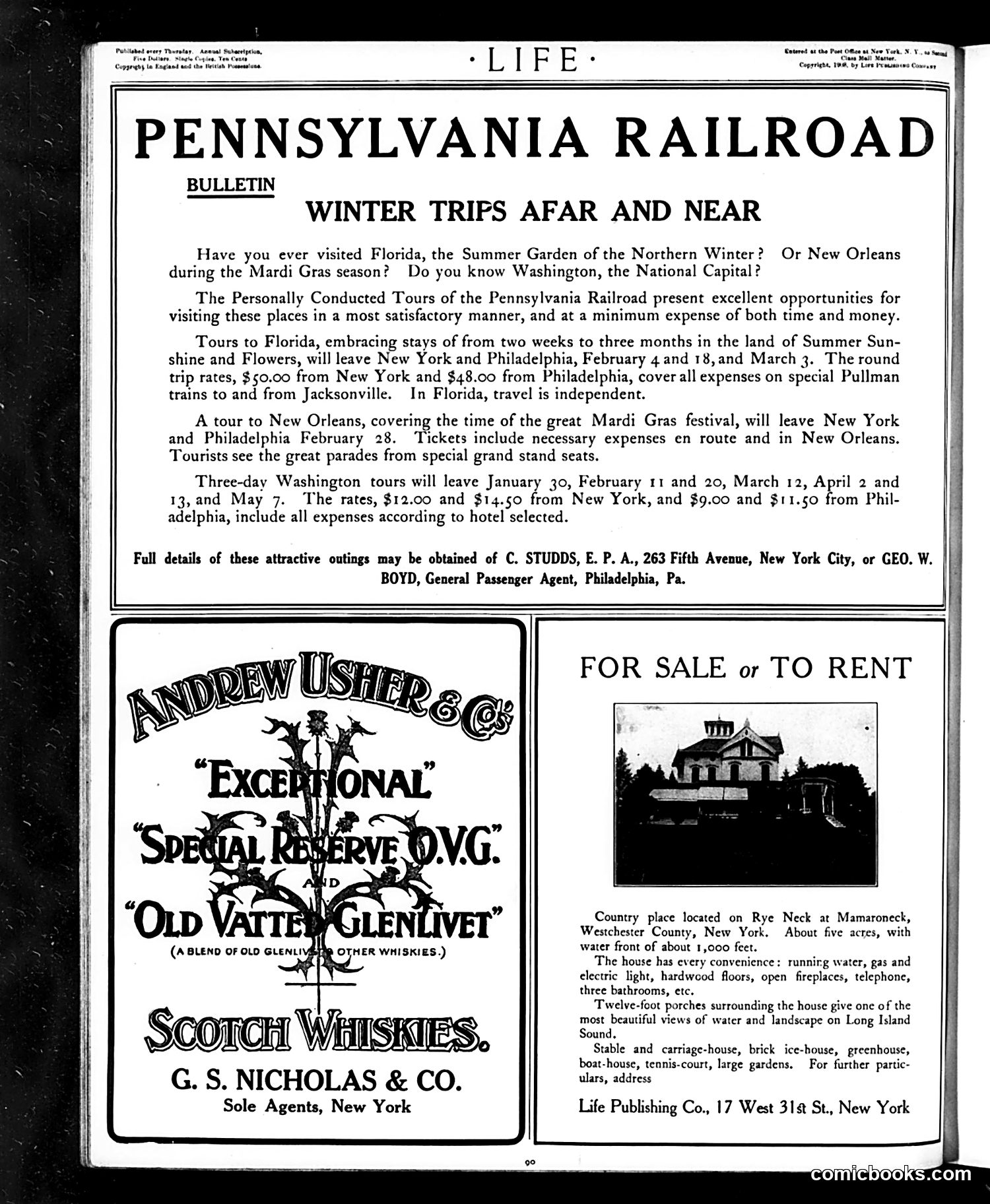
This page contains **no political cartoons or satire**. It consists entirely of advertisements and travel promotions for the Pennsylvania Railroad. The top half advertises winter tours to Florida, New Orleans (for Mardi Gras), and Washington, D.C., marketed as affordable leisure trips for affluent travelers. Below are two commercial advertisements: one for Andrew Usher & Co. Scotch whiskeys (left) and one for a country property for sale or rent in Westchester County, New York (right). The page reflects early 20th-century leisure culture and consumer advertising, not political commentary. There are no caricatures, political figures, or satirical content to analyze.
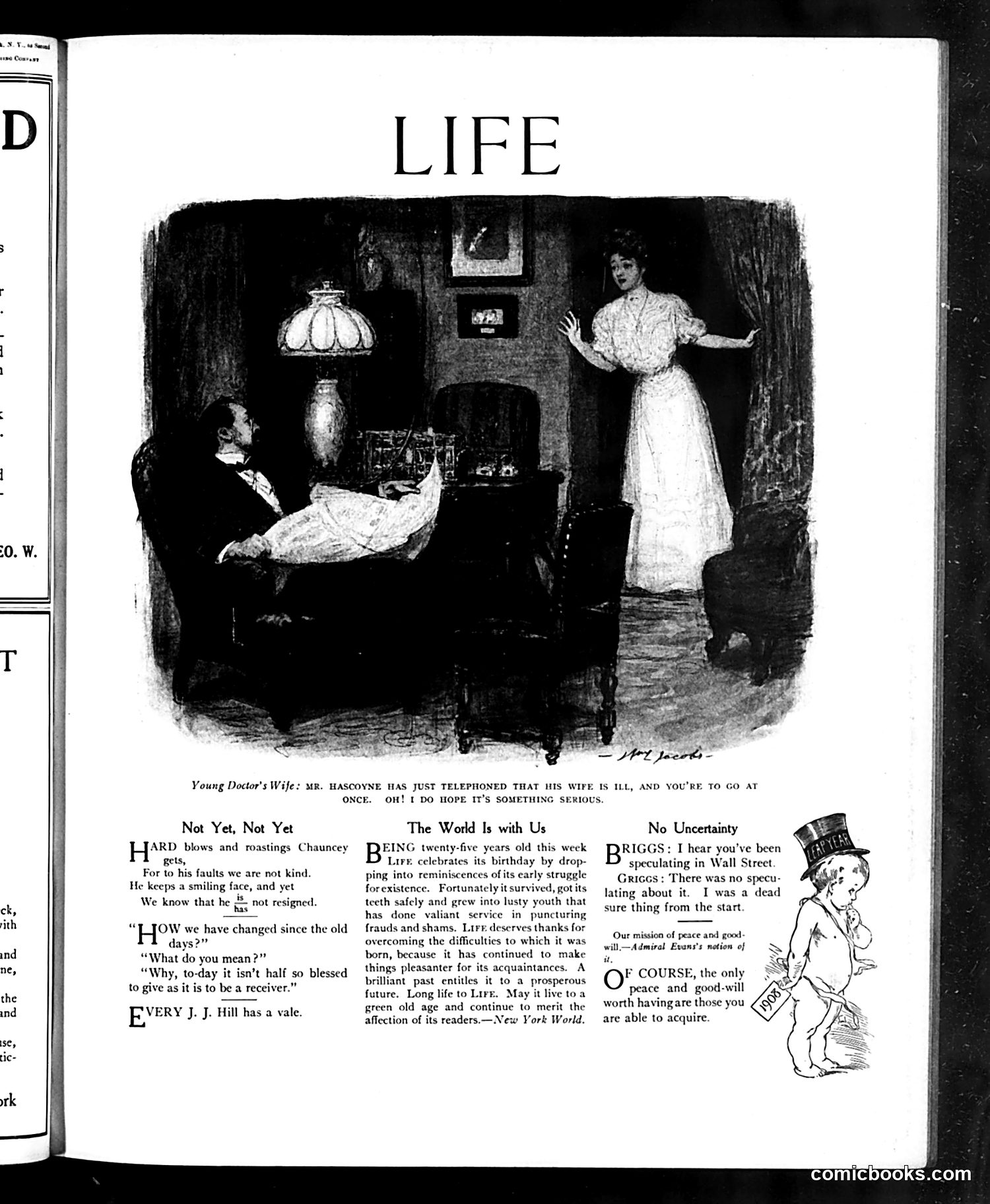
This page satirizes three contemporary social attitudes about aging and success. **"Not Yet, Not Yet"** mocks a man who refuses to acknowledge his failures, clinging to undeserved optimism despite clear evidence he's unsuitable for advancement. **"The World Is with Us"** celebrates a twenty-five-year-old on their birthday, praising Life magazine's optimistic worldview that youth and persistence overcome obstacles. It encourages readers to embrace an ambitious future. **"No Uncertainty"** presents a wealthy man (Briggs) lecturing about peace and goodwill, suggesting that financial success brings confidence and philosophical certainty—satirizing how the rich present themselves as wise authorities on happiness. The cartoon at top shows a young doctor's wife receiving urgent news, illustrating domestic drama typical of the era's magazine humor. Overall, the page contrasts youthful hope with aging denial and wealthy smugness.
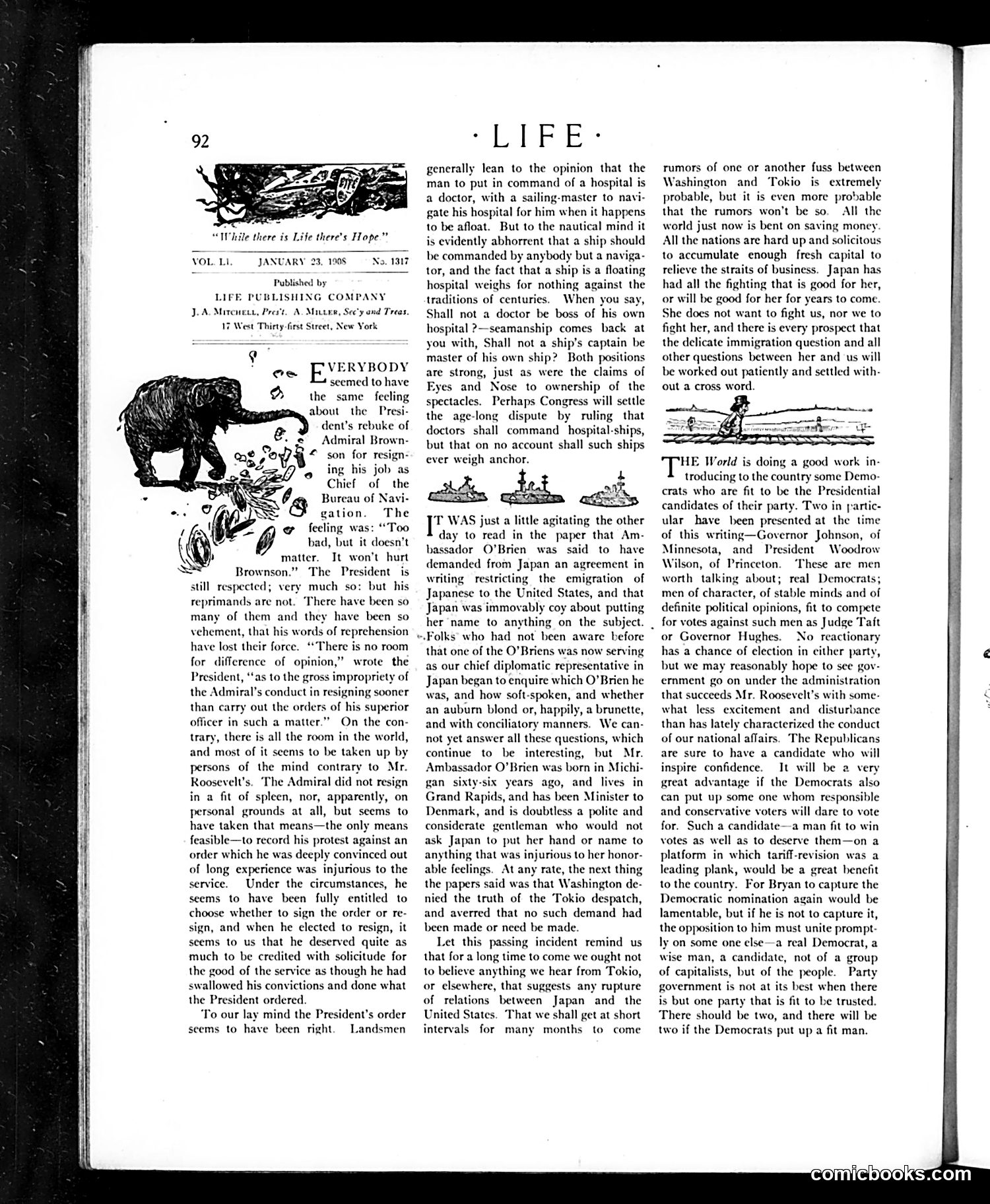
The page contains satirical editorial text addressing naval command disputes and political candidates. The left side features a cartoon of a bear labeled with what appears to be political criticism, though the specific figure is unclear from the image quality. The main text discusses a controversy involving Admiral Brownson and disputes over who should command hospital ships—doctors or naval officers. This reflects early 1900s tensions about military hierarchy and civilian expertise. The article also mentions Ambassador O'Brien's demands regarding Japanese emigration to America, and evaluates potential Democratic presidential candidates including Governor Johnson of Minnesota and Woodrow Wilson of Princeton. The writer argues for selecting strong Democratic leaders to challenge Republican dominance, emphasizing character and political independence over party loyalty.
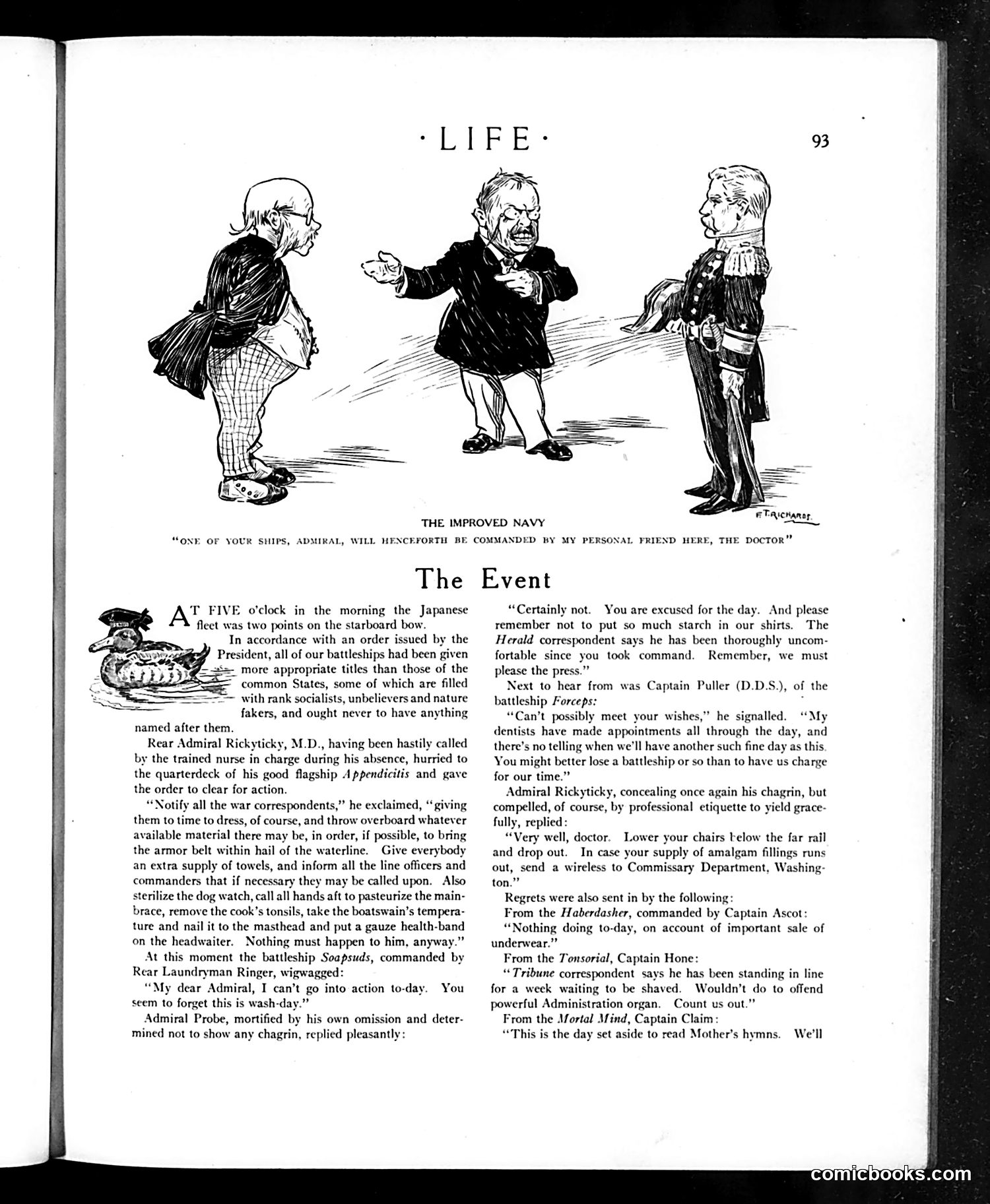
This political cartoon satirizes President Theodore Roosevelt's naval policies and personnel appointments during the early 1900s. The top cartoon shows Roosevelt's friend, a doctor, being appointed to command a naval vessel—a clear jab at nepotism and unqualified appointments in the military hierarchy. The text below documents comedic naval orders and complaints from various ship captains protesting absurd directives and operational disruptions. The satire mocks Roosevelt's intervention in naval affairs, suggesting his appointments and commands were impractical and undermined military professionalism. The title "The Improved Navy" is ironic, implying Roosevelt's reforms actually worsened naval operations through political favoritism rather than merit-based advancement.
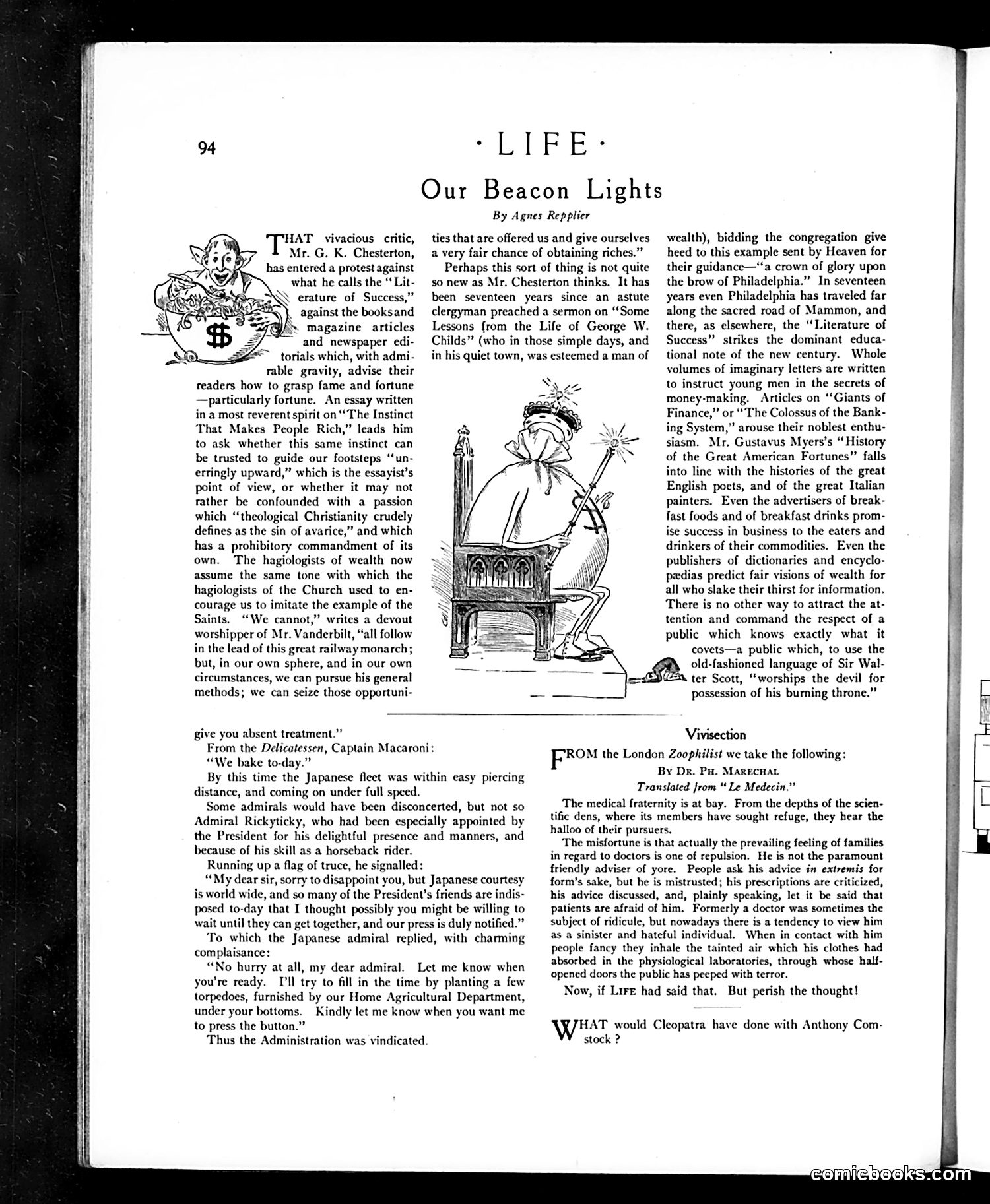
This page contains three distinct pieces: 1. **"Our Beacon Lights" by Agnes Repplier** - A critical essay attacking G.K. Chesterton's "Literature of Success," which Repplier argues encourages wealth-seeking. She criticizes how success literature and business guides have replaced traditional religious and moral instruction. 2. **The left illustration** shows a rotund figure at a desk, apparently representing the type of self-help author Repplier critiques—someone profiting from "how to get rich" advice. 3. **"Vivisection"** - An excerpt from a London medical journal discussing how doctors are often mistrusted by patients who fear them as "hateful individuals." The satire targets both commercial success literature and public distrust of the medical profession during this era.
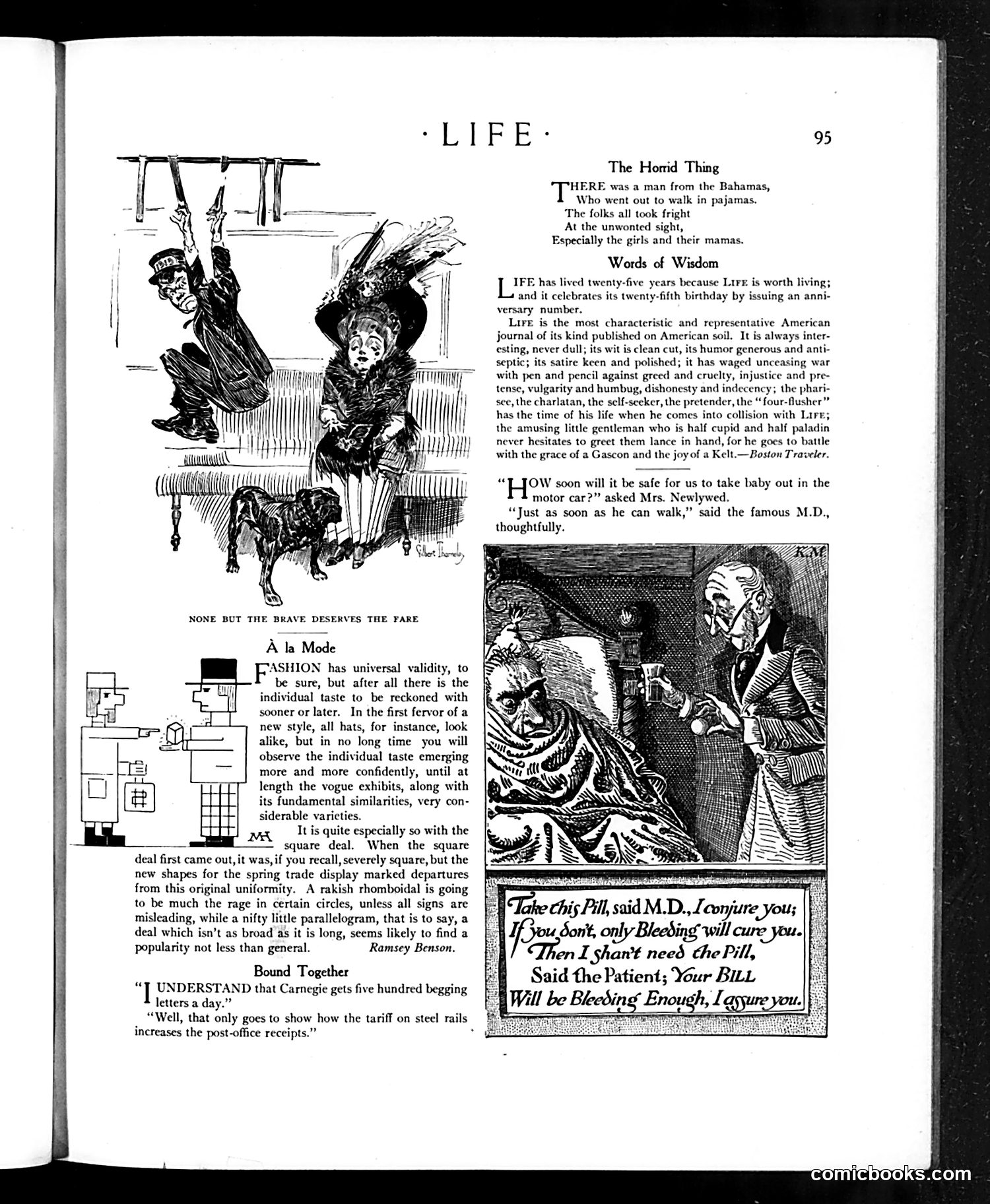
This page contains three separate humorous pieces: **"The Horrid Thing"** is a brief verse about a man from the Bahamas walking in pajamas, causing shock—likely satirizing both casual dress and colonial attitudes about propriety. **"A la Mode"** discusses fashion trends, particularly square hat designs. The text suggests that while universal fashion exists, individual taste emerges over time, and the square shape represents a significant departure from established style conventions. **"Bound Together"** is a brief joke about Andrew Carnegie receiving five hundred begging letters daily, with the punchline that increased tariffs on steel rails are boosting postal receipts—satirizing both Carnegie's wealth and protectionist economic policy. The illustrations are period satirical cartoons using exaggerated caricatures typical of early 20th-century American humor magazines.
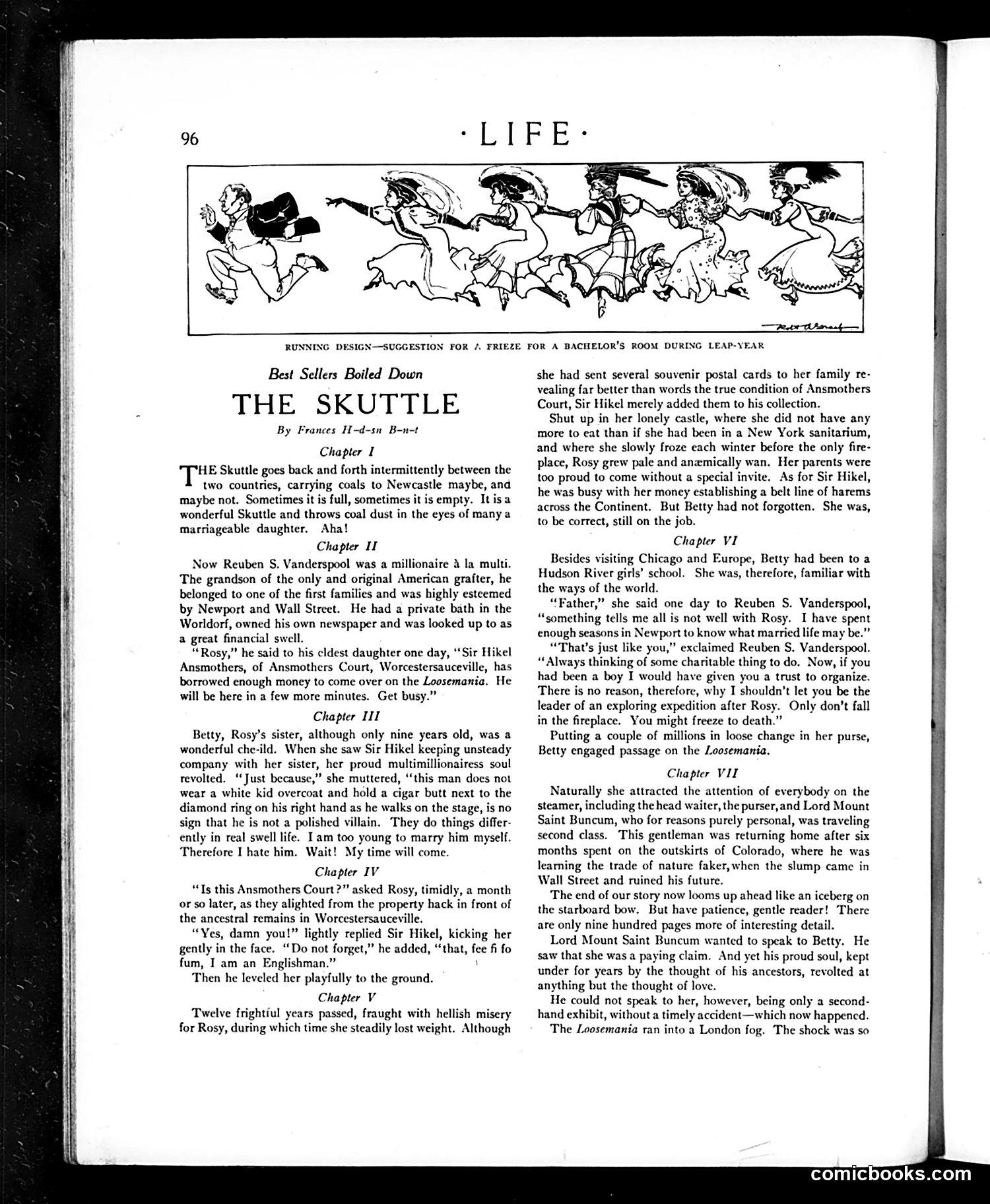
This page presents a serialized story titled "The Skuttle" by Frances H-d-n B-tt, with an illustration at the top showing figures in motion (appearing to be women in period dress running or dancing). The story itself—not a political cartoon—concerns wealthy American characters: Reuben S. Vanderspool (a millionaire), his daughter Rosy, and her sister Betty. The narrative involves romantic complications during a transatlantic voyage on the *Loosemania*, where Betty encounters Lord Mount Saint Buncum. The content satirizes upper-class society: idle wealthy heiresses, international romance seeking, and the leisured pursuits of the ultra-rich. The "Skuttle" (gossip/scandal) format allows the magazine to gently mock aristocratic pretensions and romantic entanglements among the social elite, using humor rather than serious critique.
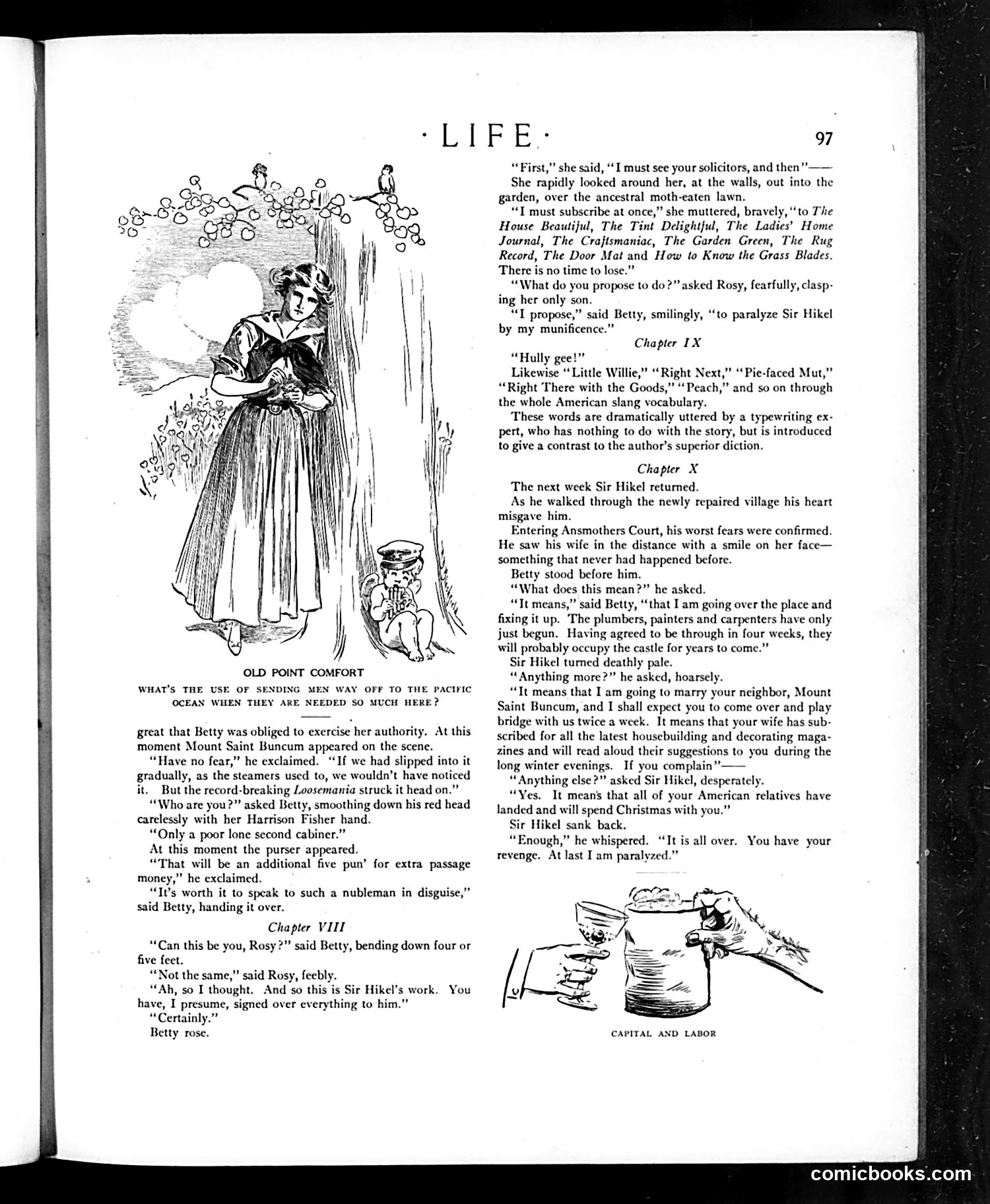
This page contains two illustrated scenes from what appears to be a serialized story rather than political satire. The upper illustration shows a woman in Victorian-era dress reading magazines outdoors. The caption "WHAT'S THE USE OF SENDING SILK OFF TO THE PACIFIC OCEAN WHEN THEY ARE NEEDED SO MUCH HERE?" suggests commentary on resource allocation—likely critiquing the export of American goods (silk) during a period when domestic needs were pressing. The lower illustration labeled "CAPITAL AND LABOR" depicts what appears to be scattered papers or documents, possibly representing workplace conflict or economic disparity between capital owners and workers—a common satirical topic in early 20th-century Life magazine. The surrounding text comprises Chapters VIII-X of a narrative story featuring characters like Betty, Sir Hikel, and Rosy, making this primarily literary content rather than political cartoon commentary.
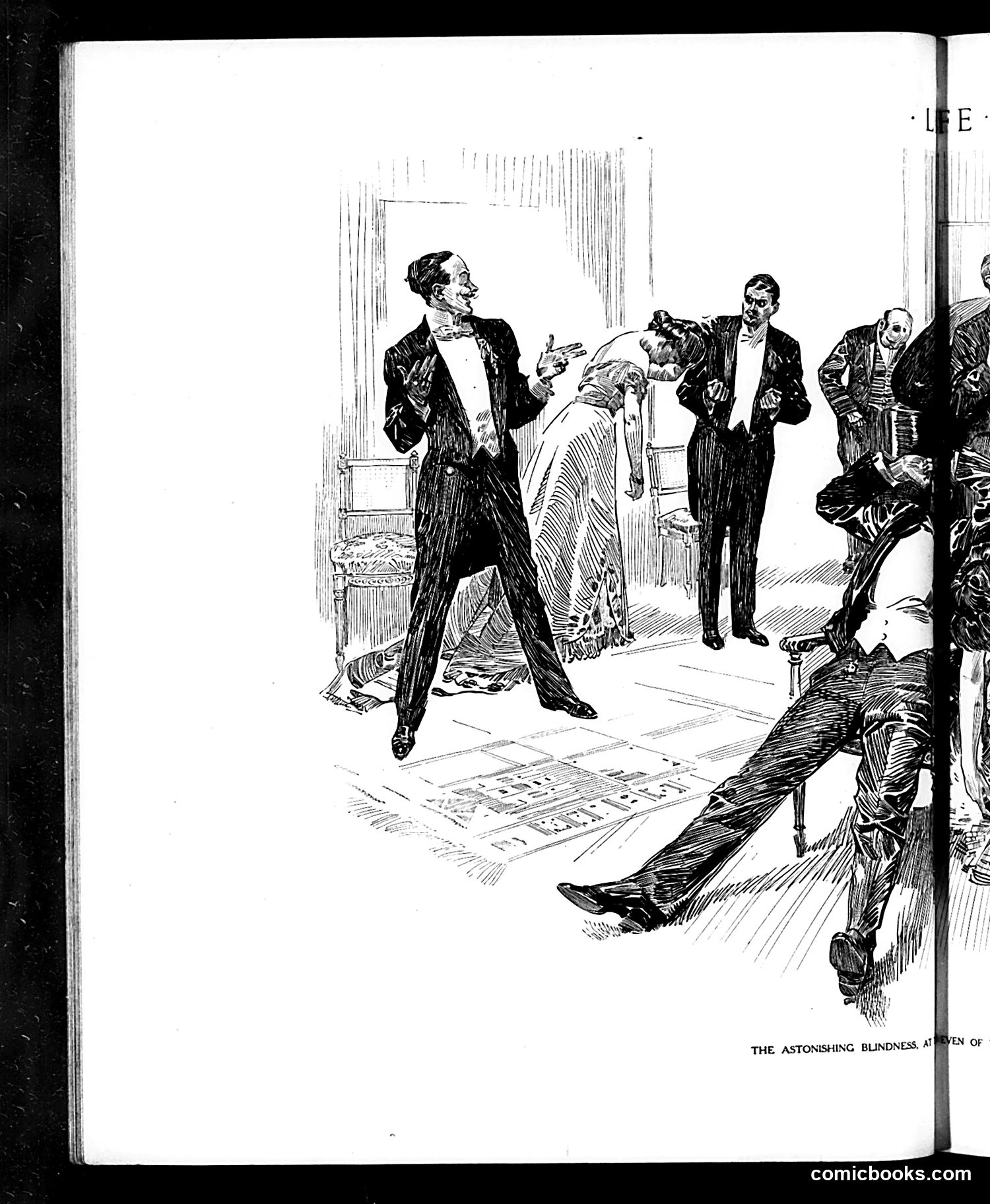
The caption reads "THE ASTONISHING BLINDNESS OF [text cut off]" — the full title is not visible on this page. This appears to be a satirical illustration depicting a formal indoor scene with well-dressed men in suits. One man gestures dramatically while speaking to others who listen or react with apparent indifference or skepticism. There are papers or documents on the floor, suggesting some kind of presentation or argument is underway. Without the complete caption, the specific political or social reference is unclear. However, the composition suggests satire about willful ignorance — the "blindness" of the title likely refers to these men's refusal to see or acknowledge something obvious (perhaps represented by the documents on the floor). The exact historical context and figures cannot be determined from the visible text alone.
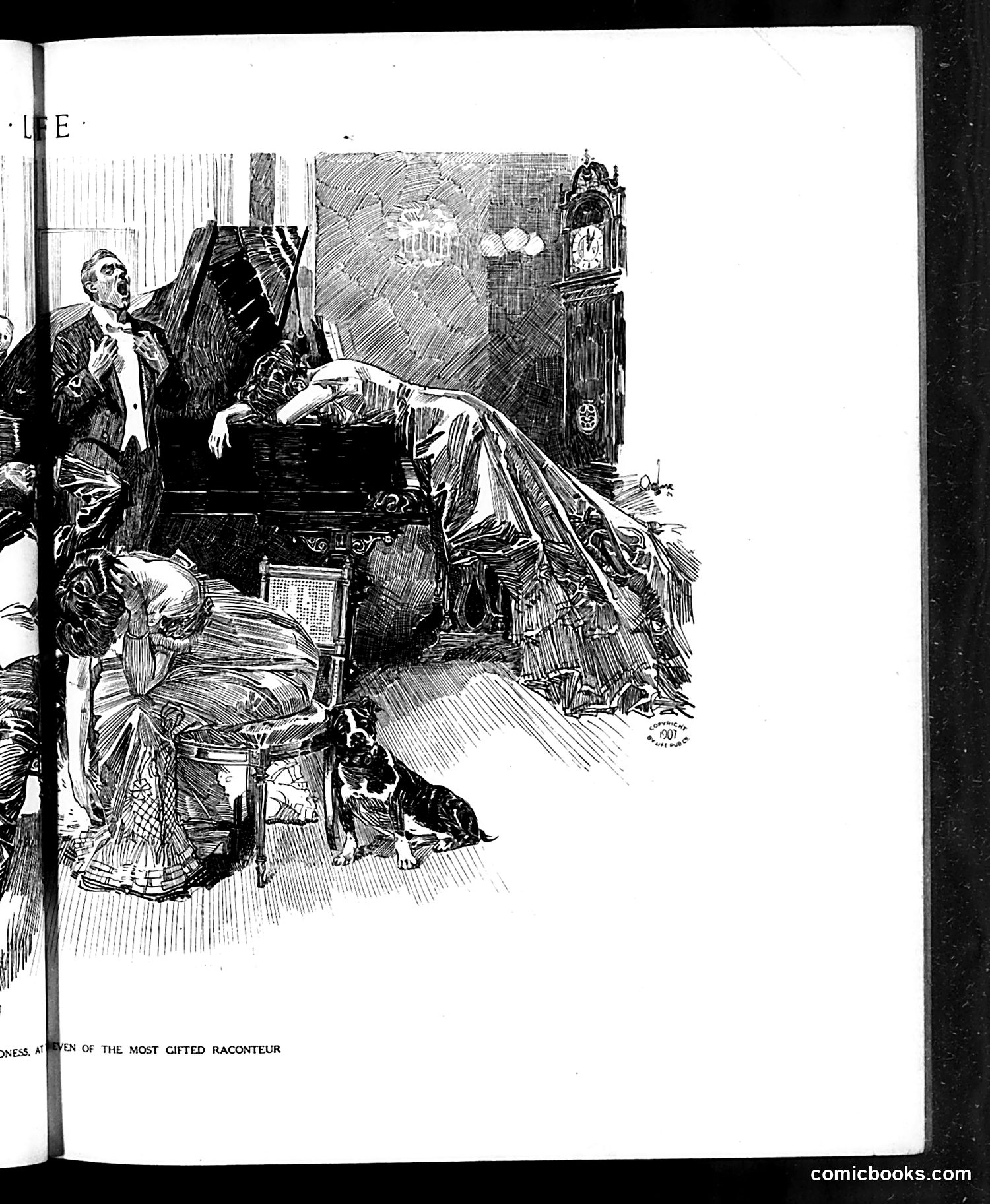
This appears to be an illustration from *Life* magazine accompanying text about "One of the Most Gifted Raconteur" (visible at bottom). The black-and-white sketch depicts an interior scene with several figures: a well-dressed man standing on the left, a woman seated at a piano in the center, and another figure reclining dramatically across the piano. A small dog is visible in the foreground. A grandfather clock and ornate interior details suggest a wealthy household. The scene appears to satirize social pretension and theatrical behavior among the upper classes—the exaggerated pose of the reclining figure and the formal setting suggest mockery of affected mannerisms or affected storytelling ("raconteur"). However, without the complete article text, I cannot identify the specific figures being caricatured or determine the precise historical or social context of the satire.
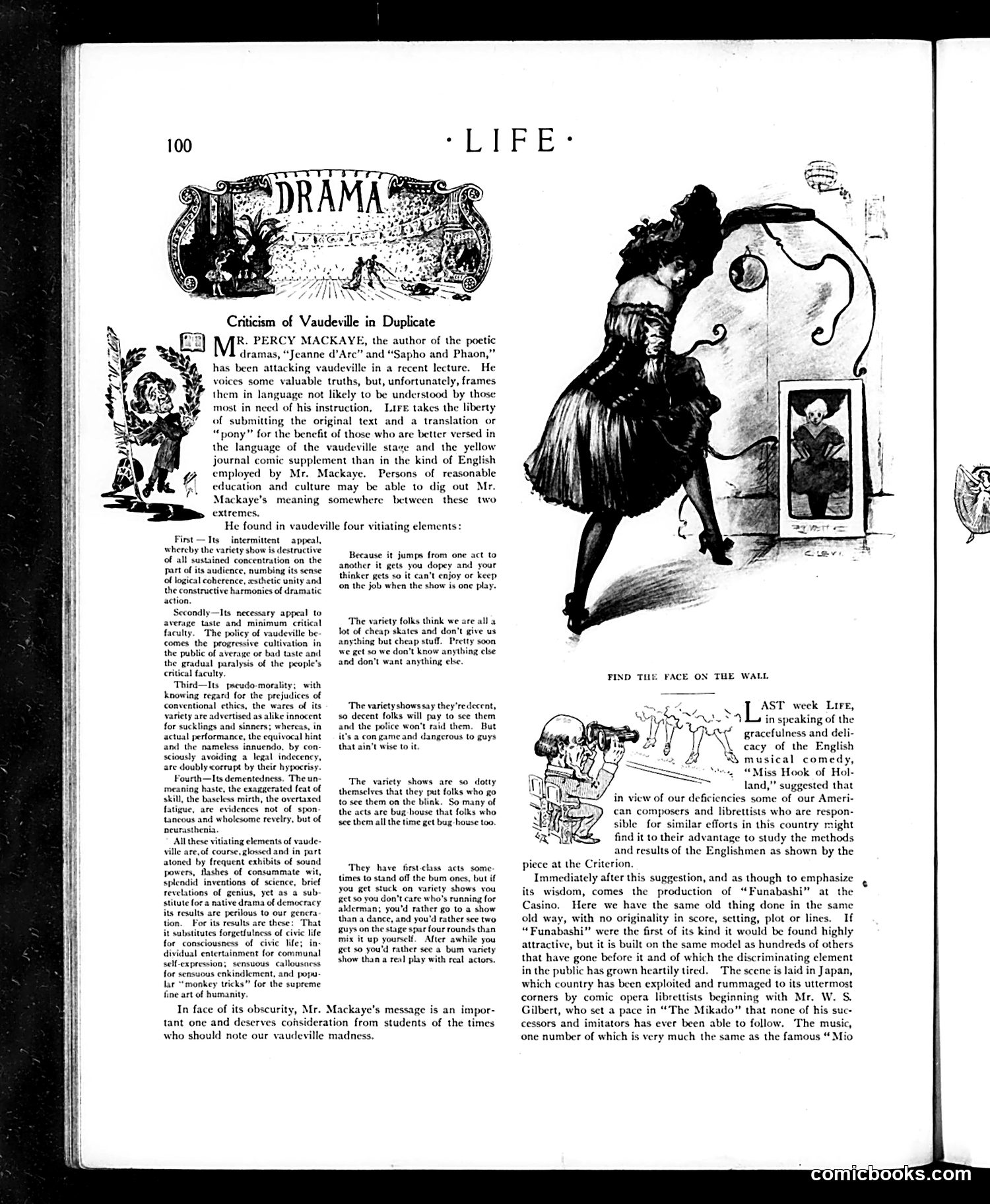
This page critiques vaudeville theater through Mr. Percy MacKaye's recent lecture attacking it. The text lists four "vitalizing elements" of vaudeville that MacKaye apparently finds problematic: its intermittent appeal, its appeal to "average taste," its pseudo-morality, and its variety format. The main illustration titled "FIND THE FACE ON THE WALL" shows a woman looking at a question mark on a wall—likely satirizing vaudeville's lack of substance or coherent meaning. The lower section discusses musical comedy, mentioning "Miss Hook of Holland" and "Funabashi," arguing that English operettas lack originality compared to foreign imports. The satire suggests American entertainment borrows heavily from abroad while critics like MacKaye dismiss native vaudeville as artistically worthless.
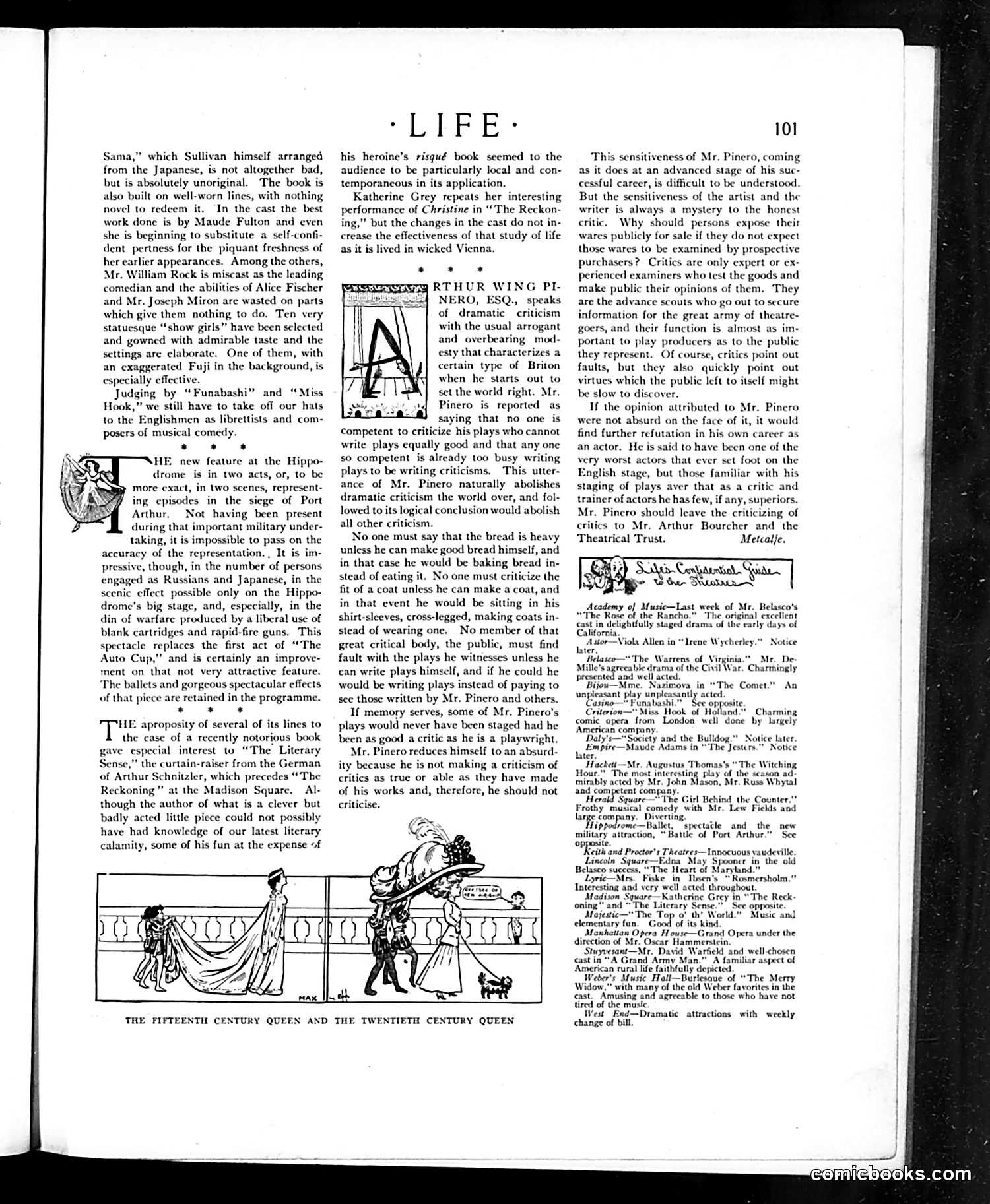
This satirical cartoon contrasts two queens across centuries. The left figure appears to be a 15th-century royal in elaborate period dress with attendants managing her train. The right figure represents a modern (20th-century) queen dressed more simply, walking a small dog. The satire mocks how royal dignity and formality have diminished over time. Where the historical queen required multiple servants just to manage her clothing, the contemporary queen's main concern is her pet. This reflects Life magazine's commentary on how modern royalty—and perhaps modern society generally—has become less ceremonious and more casual, with even the highest-ranking women reduced to domestic pursuits like dog-walking rather than maintaining traditional aristocratic dignity.
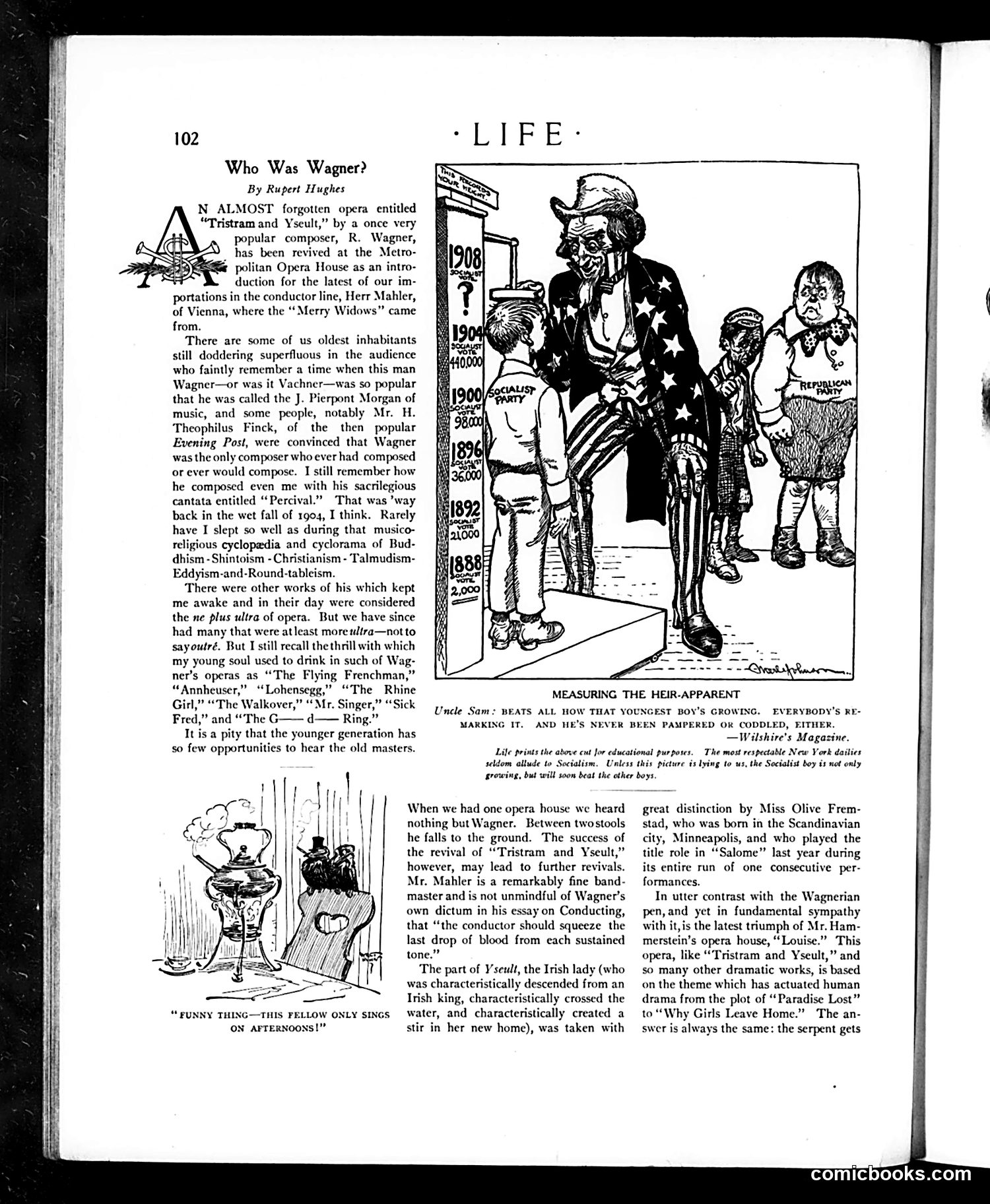
This cartoon satirizes early 20th-century American socialism. It depicts Uncle Sam (identifiable by his starred top hat and patriotic clothing) measuring the height of a young boy labeled "Socialist Party" against a wall marked with growth dates from 1892 to 1908. Other children labeled "Republican" and another party stand nearby, appearing smaller or concerned. The satire's point: Life magazine is ironically commenting on socialism's rapid growth in America. The caption notes that respectable New York newspapers rarely discuss socialism, yet "this picture" (the boy's noticeable growth) proves the movement is expanding—and will "soon beat the other boys." The humor lies in the contradiction: while the mainstream press ignores socialism, it's visibly gaining strength. This reflects genuine early-1900s anxiety about socialist political movements gaining American support.
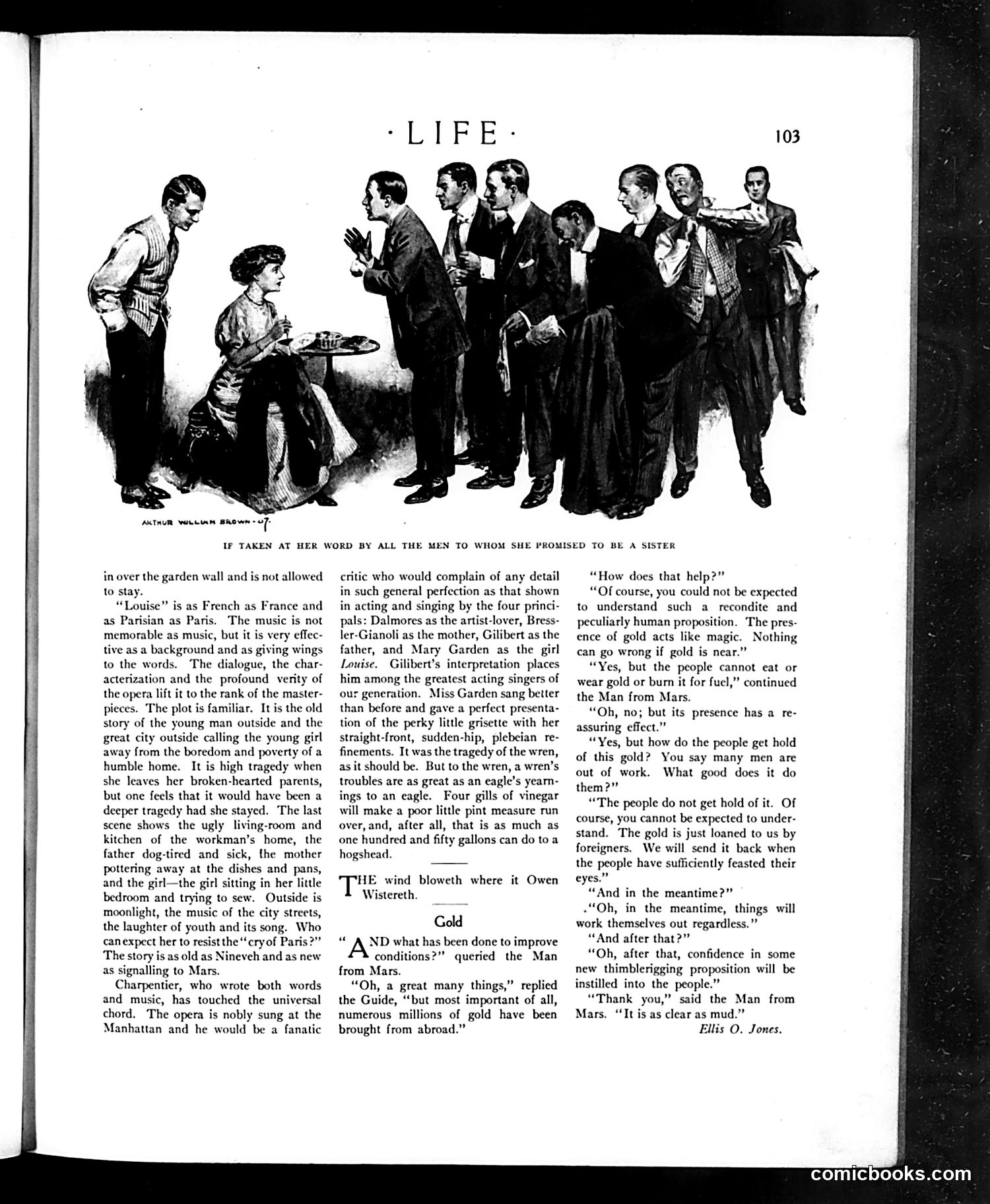
The page contains two distinct satirical pieces: ## Top Cartoon Titled "If Taken at Her Word by All the Men to Whom She Promised to Be a Sister," the illustration depicts a woman surrounded by men eagerly approaching her. The satire mocks the social hypocrisy of the era: men interpret a woman's promise of sisterly friendship as romantic availability, while she intends it literally. It's commentary on gender relations and male presumption. ## Bottom Section: "Gold" Dialogue This is a satirical conversation between an otherworldly "Man from Mars" and an Earth "Guide." It mocks American economic policy and public delusion during what appears to be an economic crisis. The satire exposes that: - Gold imported from abroad provides only psychological reassurance, not actual material benefit - Workers remain unemployed despite gold's presence - The gold isn't even accessible to ordinary people—it's merely loaned back to foreigners - Politicians rely on public confidence tricks rather than solving real problems The Man from Mars represents an outsider's logical perspective, revealing the absurdity of the system to modern readers.
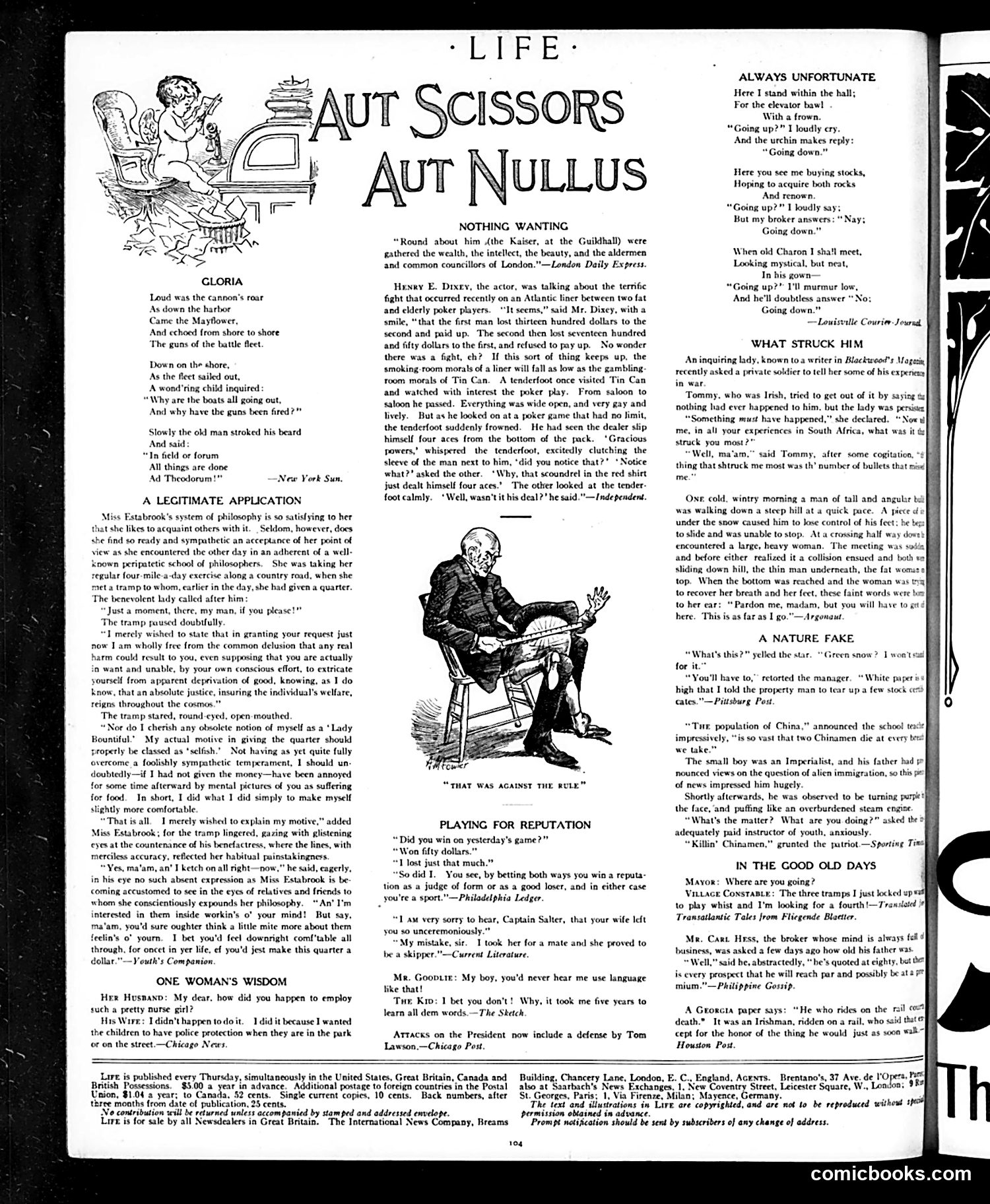
This page from Life magazine (circa early 1900s) contains several satirical pieces mocking pretension and folly: **"Aut Scissors Aut Nullus"** (top): A poem mockingly titled in Latin, likely satirizing grandiose rhetoric about the German Kaiser's visit to London's Guildhall, where he was surrounded by "wealth, intellect, beauty, and aldermen." The satire suggests hollow pomp. **"A Legitimate Application"** (center): A woman expounds pseudo-philosophical justification to a tramp for giving him a quarter, explaining her charity isn't benevolence but selfishness—she needed comfort. The tramp's response is the joke's punch: he suggests she'd feel *better* mentally if she simply called it charity rather than intellectualizing it. This mocks overwrought philosophizing masking simple human acts. **"One Woman's Wisdom"** (bottom): A wife explains hiring a pretty nurse girl isn't vanity but practical—for "police protection" in the park, a wink-and-nudge joke about the girl's appearance providing deterrence. All three pieces satirize self-deception and elaborate excuses for transparent motives.
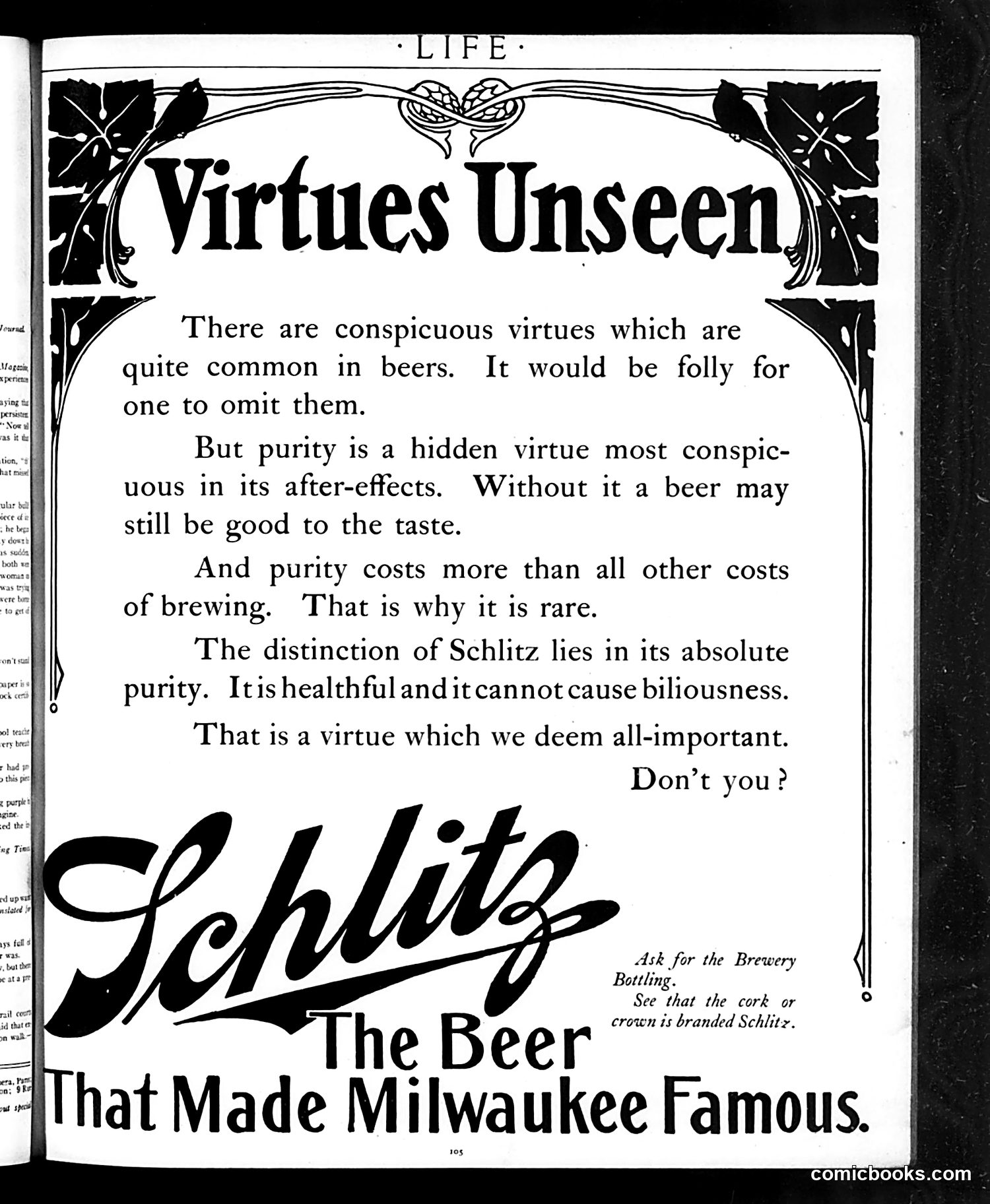
This is a **full-page beer advertisement**, not political satire. The ornamental Art Nouveau border and "Life" magazine masthead frame promotional copy for Schlitz beer. The ad argues that while beers share obvious qualities, **purity is the hidden virtue that matters most**—distinguishing Schlitz from competitors. The text claims purity is expensive, therefore rare, and crucially, that it prevents "biliousness" (digestive upset), positioning the product as healthful. The phrase "The Beer That Made Milwaukee Famous" anchors Schlitz's brand identity. The ad instructs consumers to verify authenticity by checking the bottle's cork or crown for the Schlitz brand mark. This reflects early-20th-century advertising strategy: emphasizing product purity and health benefits to justify premium pricing in a competitive brewing market.
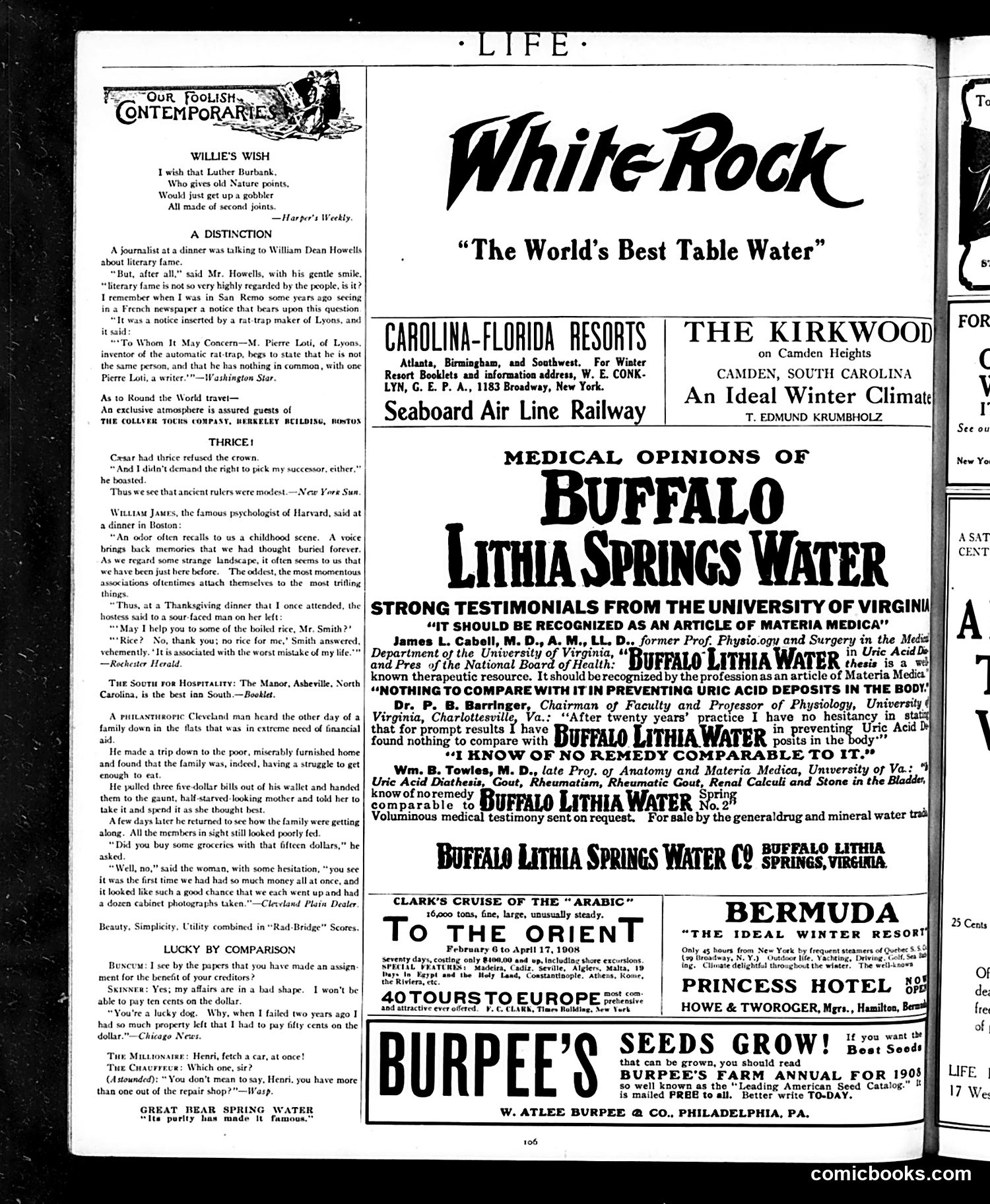
This page from *Life* magazine features a humor section titled "Our Foolish Contemporaries"—a regular satirical column mocking contemporary figures and social absurdities. The jokes target: 1. **Luther Burbank** (botanist/horticulturist): Mocked for his famous plant-breeding work; the joke imagines him creating a turkey made entirely of drumsticks (the "best part"). 2. **William Dean Howells** (prominent American novelist): The anecdote illustrates how literary fame pales compared to practical invention—a French rat-trap maker felt compelled to publicly distance himself from the famous writer Pierre Loti. 3. **Various social pretensions**: Other short pieces satirize human vanity, such as poor families prioritizing photography over groceries, or wealthy people claiming financial misfortune as good luck. The page is primarily **advertising** (White Rock water, resorts, Burpee's seeds), typical of *Life* magazine's mixed format. The humor reflects early-1900s concerns: American individualism, the gap between fame and utility, and middle-class social climbing.
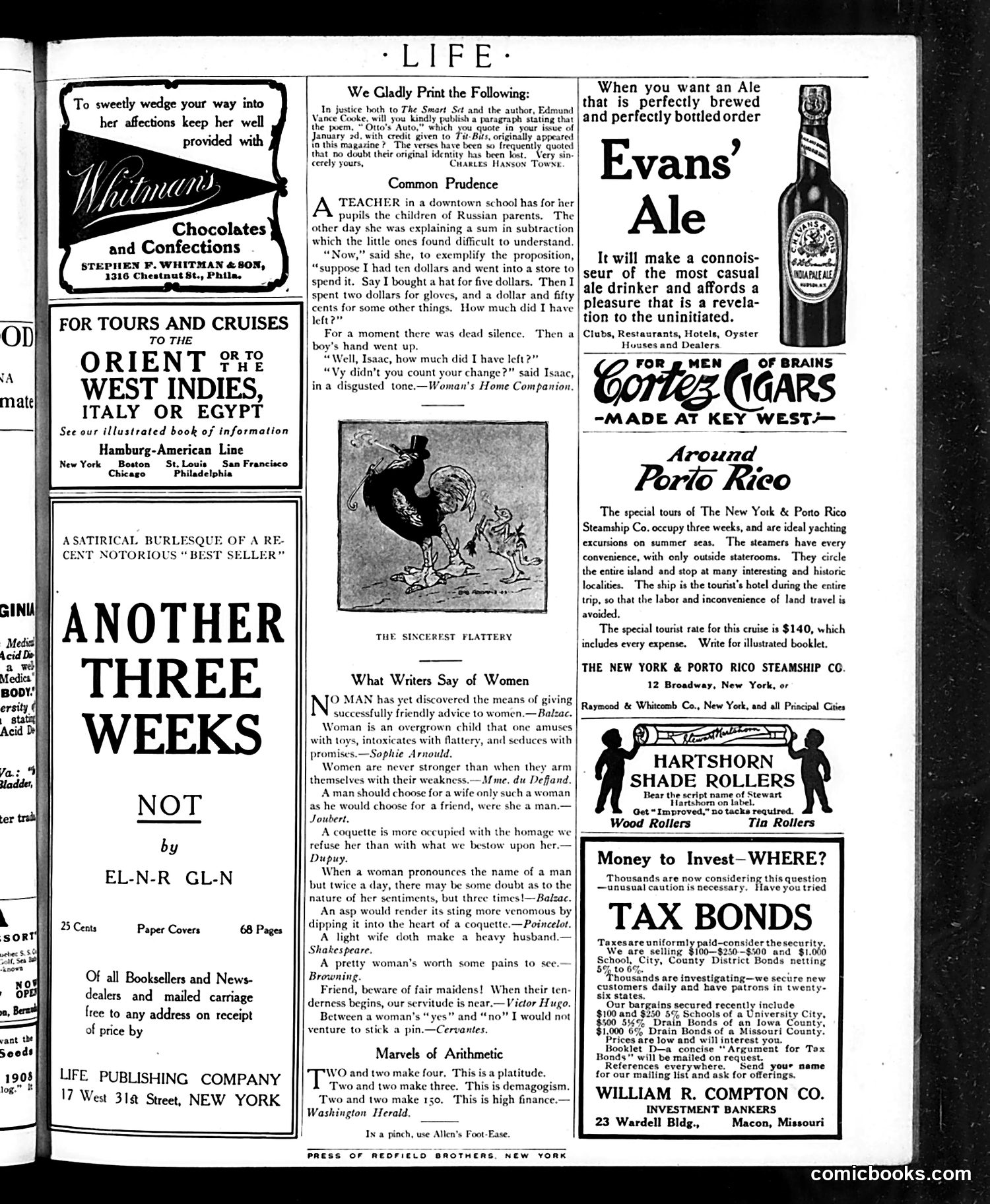
This page is primarily **advertisements and reader letters**, not political satire. The main content includes: **Reader Letters Section**: A letter from Charles Hanson Towne requesting proper credit for a poem "Otto's Auto" published in *The Smart Set* magazine. **"Common Prudence" Anecdote**: A brief humorous story about a schoolteacher explaining subtraction to Russian immigrant children's children using a shopping scenario. A boy's literal answer ("You didn't count your change?") represents the practical, street-smart perspective of working-class immigrant children versus the teacher's abstract mathematical lesson—a gentle commentary on cultural and educational differences. **"What Writers Say of Women" Section**: A collection of cynical, misogynistic quotes from male writers (Balzac, Joubert, etc.) about women's weakness, vanity, and emotional nature—representing period attitudes rather than satire endorsing them. The page is dominated by period advertisements (chocolates, cruises, cigars, shade rollers, tax bonds) typical of early 1900s *Life* magazine layouts.
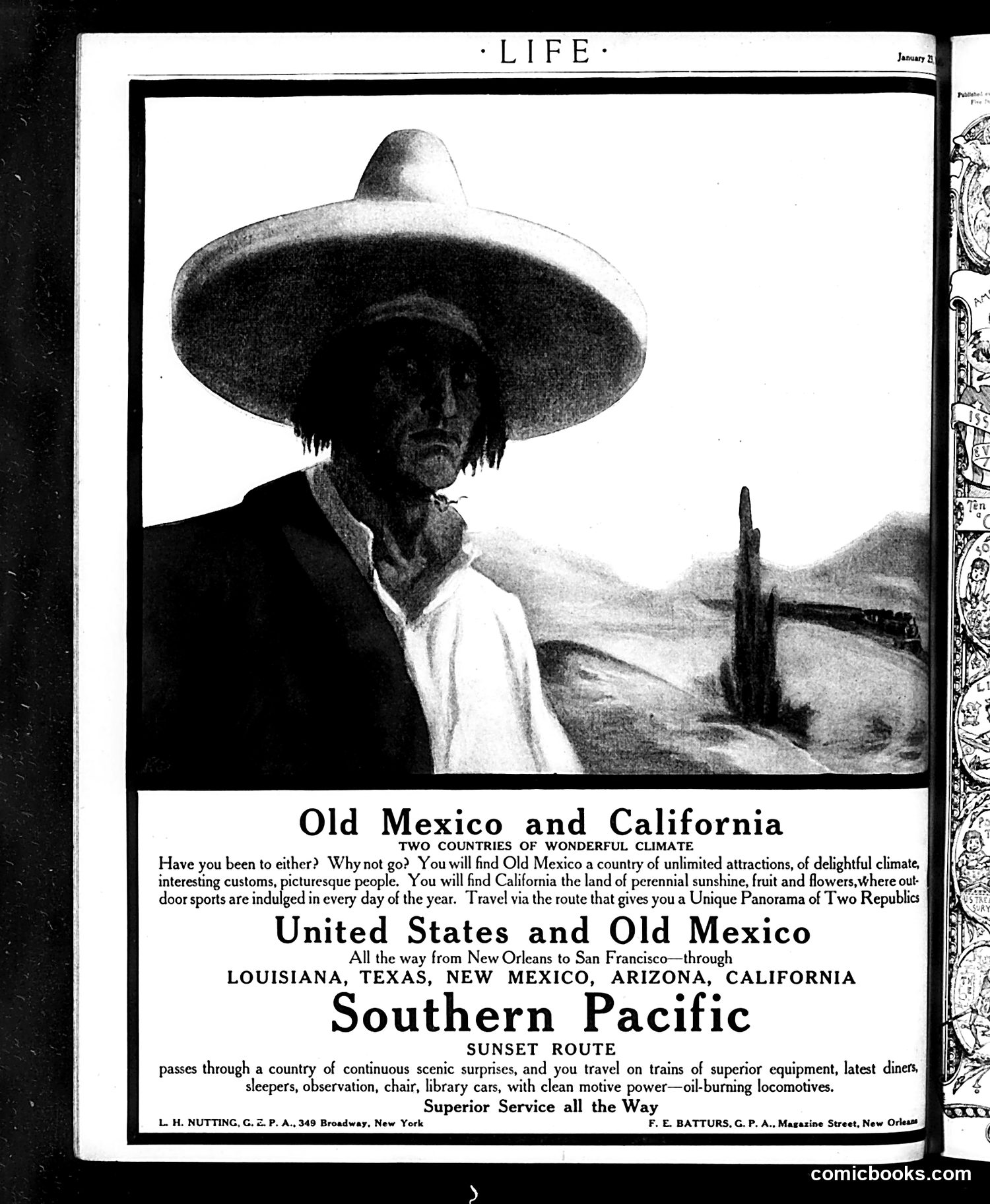
This is a **Southern Pacific Railroad advertisement**, not political satire. The page promotes travel via the "Sunset Route" from New Orleans to San Francisco through the American Southwest and Mexico. The image shows a man wearing a large sombrero in a Mexican landscape with a cactus, embodying the "picturesque" stereotype the ad appeals to. The text emphasizes Mexico as exotic and climatically desirable ("delightful climate," "picturesque people"), while California is positioned as equally appealing ("perennial sunshine, fruit and flowers"). The appeal is to leisure travelers seeking adventure and pleasant weather. The romanticized depiction of Mexico and its people reflects early 20th-century American tourism marketing—exoticizing neighboring territories as vacation destinations while promoting railroad infrastructure and "superior service." This represents commercial advertising rather than editorial cartooning or political commentary.