
Life, 1908-01-23 · page 15 of 20
Life — January 23, 1908 — page 15: what you’re looking at
What you’re looking at
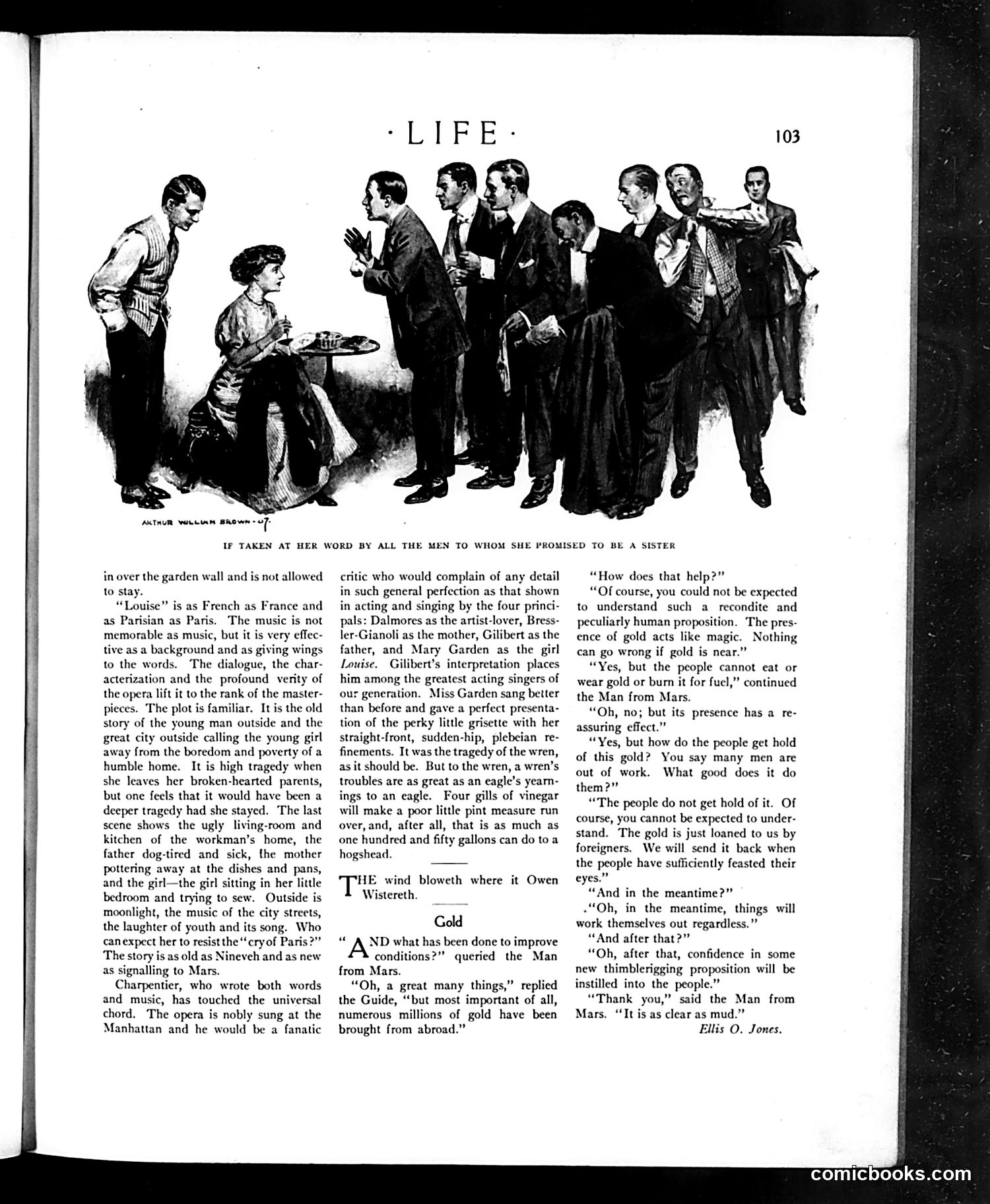
The page contains two distinct satirical pieces: ## Top Cartoon Titled "If Taken at Her Word by All the Men to Whom She Promised to Be a Sister," the illustration depicts a woman surrounded by men eagerly approaching her. The satire mocks the social hypocrisy of the era: men interpret a woman's promise of sisterly friendship as romantic availability, while she intends it literally. It's commentary on gender relations and male presumption. ## Bottom Section: "Gold" Dialogue This is a satirical conversation between an otherworldly "Man from Mars" and an Earth "Guide." It mocks American economic policy and public delusion during what appears to be an economic crisis. The satire exposes that: - Gold imported from abroad provides only psychological reassurance, not actual material benefit - Workers remain unemployed despite gold's presence - The gold isn't even accessible to ordinary people—it's merely loaned back to foreigners - Politicians rely on public confidence tricks rather than solving real problems The Man from Mars represents an outsider's logical perspective, revealing the absurdity of the system to modern readers.
📄 Transcribed text from this page (OCR, searchable)
Machine-transcribed from the original scan — historical spelling and the odd misread are preserved.
ARTAUR WOLLIN BROWN -O7: IP TAKEN AT HER WORD BY ALL THE MEN TO WHOM SHE PROMISED TO BE A SISTER in over the garden wall and is not allowed to stay. “Louise” is as French as France and as Parisian as Paris. The music is not memorable as music, but it is very effec- tive as a background and as giving wings to the words. The dialogue, the char- acterization and the profound verity of the opera lift it to the rank of the master- pieces. The plot is familiar. It is the old story of the young man outside and the great city outside calling the young girl away from the boredom and poverty of a humble home. It is high tragedy when she leaves her broken-hearted parents, but one feels that it would have been a deeper tragedy had she stayed. The last scene shows the ugly living-room and kitchen of the workman’s home, the father dog-tired and sick, the mother pottering away at the dishes and pans, and the girl—the girl sitting in her little bedroom and trying to sew. Outside is moonlight, the music of the city streets, the laughter of youth and its song. Who canexpect her to resist the “cry of Paris?” The story is as old as Nineveh and as new as signalling to Mars. Charpentier, who wrote both words and music, has touched the universal chord. The opera is nobly sung at the Manhattan and he would be a fanatic critic who would complain of any detail in such general perfection as that shown in acting and singing by the four princi- pals: Dalmores as the artist-lover, Bress- ler-Gianoli as the mother, Gilibert as the father, and Mary Garden as the girl Louise. Gilibert’s interpretation places him among the greatest acting singers of our generation. Miss Garden sang better than before and ga’ perfect presenta- tion of the perky little grisette with her straight-front, sudden-hip, plebeian re- finements. It was the tragedy of the wren, as it should be. But to the wren, a wren’s troubles are as great as an eagle’s yearn- ings to an eagle. Four gills of vinegar will make a poor little pint measure run over, and, after all, that is as much as one hundred and fifty gallons can do to a hogshead. HE wind bloweth where it Owen Wistereth. Gold “* AND what has been done to improve conditions?” queried the Man from Mars. “Oh, a great many things,” replied the Guide, “but most important of all, numerous millions of gold have been brought from abroad.” “How does that help?” “Of course, you could not be expected to understand such a recondite and peculiarly human proposition. ‘The pres- ence of gold acts like magic. Nothing can go wrong if gold is near.” “Yes, but the people cannot eat or wear gold or bum it for fuel,” continued the Man from Mars. “Oh, no; but its presence has a re- assuring effect.” “Yes, but how do the people get hold of this gold? You say many men are out of work. What good does it do them?” “The people do not get hold of it. Of course, you cannot be expected to under- stand. The gold is just loaned to us by foreigners. We will send it back when the people have sufficiently feasted their eyes.” “And in the meantime?” -“Oh, in the meantime, things will work themselves out regardless.” “And after that?” “Oh, after that, confidence in some new thimblerigging proposition will be instilled into the people.” “Thank you,” said the Man from Mars. “It is as clear as mud.” Ellis O. Jones. comicbooks.com