
Life, 1908-01-23 · page 4 of 20
Life — January 23, 1908 — page 4: what you’re looking at
What you’re looking at
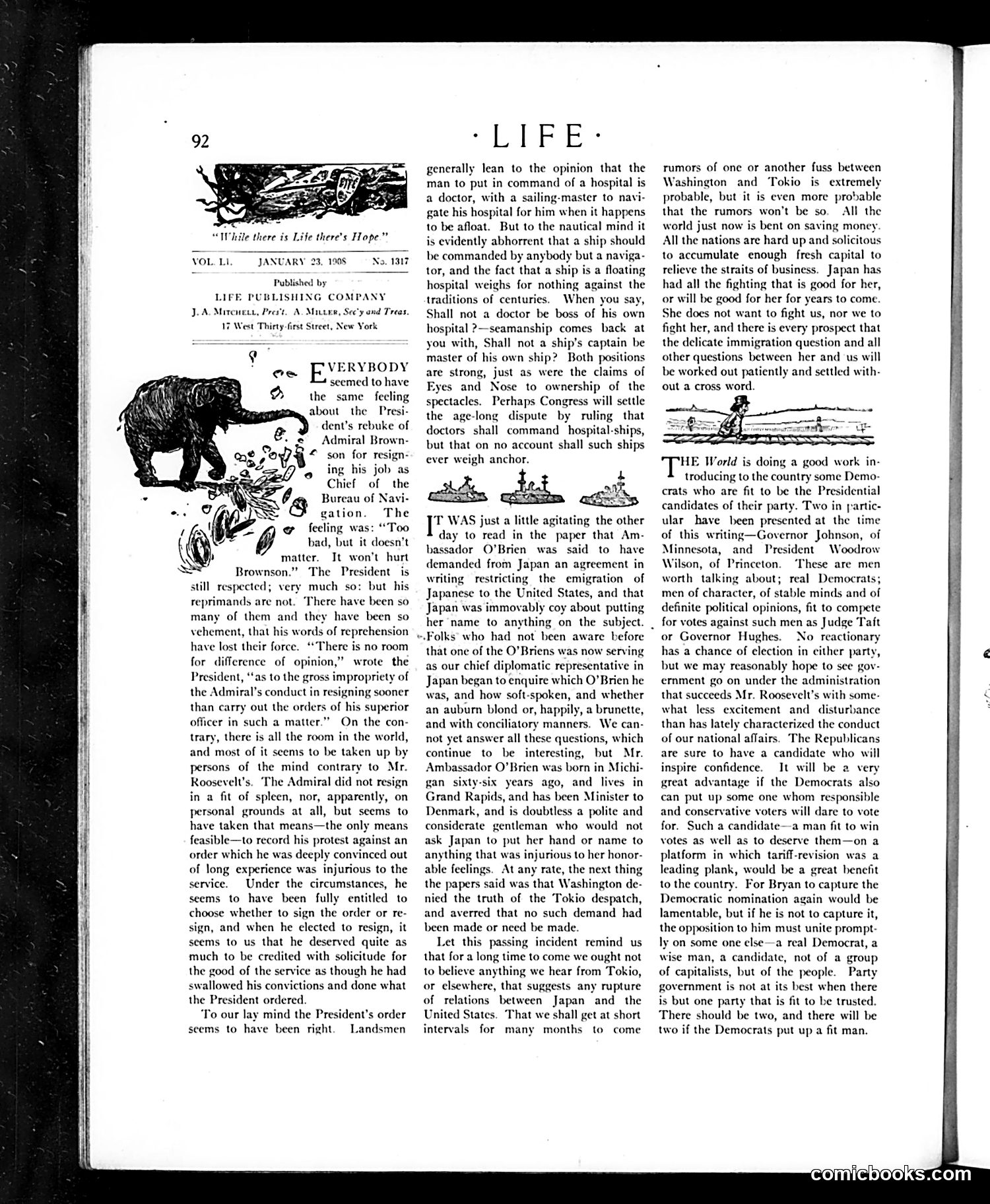
The page contains satirical editorial text addressing naval command disputes and political candidates. The left side features a cartoon of a bear labeled with what appears to be political criticism, though the specific figure is unclear from the image quality. The main text discusses a controversy involving Admiral Brownson and disputes over who should command hospital ships—doctors or naval officers. This reflects early 1900s tensions about military hierarchy and civilian expertise. The article also mentions Ambassador O'Brien's demands regarding Japanese emigration to America, and evaluates potential Democratic presidential candidates including Governor Johnson of Minnesota and Woodrow Wilson of Princeton. The writer argues for selecting strong Democratic leaders to challenge Republican dominance, emphasizing character and political independence over party loyalty.
📄 Transcribed text from this page (OCR, searchable)
Machine-transcribed from the original scan — historical spelling and the odd misread are preserved.
“While there is Life there's Hope” VOL. Li JANUARY 23, 1908 No. 1317 Published by LIFE PUBLISHING COMPANY JA. Mirewene, Prost. A. Miuurr, 17 West Thirty-first Street, New York ey and Treas. VERYBODY seemed to have the same fecling about the Presi- dent’s rebuke of Admiral Brown- £ son for resign- ing his job as Chief of the Bureau of Navi- gation. The feeling was: “Too bad, but it doesn’t matter. It won't hurt Brownson.” The President is ul respected; very much so: but his reprimands are not. There have been so many of them and they have been so vehement, that his words of reprehension have lost their force. “There is no room for difference of opinion,” wrote the President, “‘as to the gross impropriety of the Admiral’s conduct in resigning sooner than carry out the orders of his superior officer in such a matter.” On the con- trary, there is all the room in the world, and most of it seems to be taken up by persons of the mind contrary to Mr. Roosevelt's. The Admiral did not resign in a fit of spleen, nor, apparently, on personal grounds at all, but seems to have taken that means—the only means feasible—to record his protest against an order which he was deeply convinced out of long experience was injurious to the service. Under the circumstances, he seems to have been fully entitled to choose whether to sign the order or re- sign, and when he elected to resign, it scems to us that he deserved quite as much to be credited with solicitude for the good of the service as though he had swallowed his convictions and done what the President ordered. To our lay mind the President's order ms to have been right. Landsmen oe LIP E generally lean to the opinion that the man to put in command of a hospital is a doctor, with a sailing-master to navi- gate his hospital for him when it happens to be afloat. But to the nautical mind it is evidently abhorrent that a ship should be commanded by anybody but a naviga- tor, and the fact that a ship is a floating hospital weighs for nothing against the traditions of centuries. When you say, Shall not a doctor be boss of his own hospital ?—seamanship comes back at you with, Shall not a ship's captain be master of his own ship? Both positions are strong, just as were the claims of Fyes and se to ownership of the spectacles. Perhaps Congress will settle the age-long dispute by ruling that doctors shall command hospital-ships, but that on no account shall such ships ever weigh anchor. abd, edith, catth r WAS just a little agitating the other day to read in the paper that Am- bassador O’Brien was said to have demanded from Japan an agreement in writing restricting the emigration of Japanese to the United States, and that Japan was immovably coy about putting her name to anything on the subject. | ‘olks who had not been aware before that one of the O’Briens was now serving as our chief diplomatic representative in Japan began to enquire which O’Brien he was, and how soft-spoken, and whether an aubum blond or, happily, a brunette, and with conciliatory manners, We can- not yet answer all these questions, which continue to be interesting, but Mr. Ambassador O’Brien was born in Michi- gan sixty-six years ago, and li in Grand Rapids, and has been Minister to Denmark, and is doubtless a polite and considerate gentleman who would not ask Japan to put her hand or name to anything that was injurious to her honor- able feelings. At any rate, the next thing the papers said was that Washington de- nied the truth of the Tokio despatch, and averred that no such demand had been made or need be made. Let this passing incident remind us that for a long time to come we ought not to believe anything we hear from Tokio, or elsewhere, that suggests any rupture of relations between Japan and the United States. That we shall get at short intervals for many months to come rumors of one or another fuss between Washington and Tokio is extremely probable, but it is even more probable that the rumors won't be so. All the world just now is bent on saving money All the nations are hard up and solicitous to accumulate enough fresh capital to relieve the straits of business. Japan has had all the fighting that is good for her, or will be good for her for years to come She does not want to fight us, nor we to fight her, and there is every prospect that the delicate immigration question and all other questions between her and us will be worked out patiently and settled with- out a cross word. 'HE World is doing a good work in- troducing to the country some Demo- crats who are fit to be the Presidential candidates of their party. Two in partic- ular have been presented at the time of this writing—Governor Johnson, of Minnesota, and President Woodrow Wilson, of Princeton. These are men worth talking about; real Democrats; men of character, of stable minds and of definite political opinions, fit to compete for votes against such men as Judge Taft or Governor Hughes. No reactionary has a chance of election in cither party, but we may reasonably hope to see gov- ernment go on under the administration that succeeds Mr. Roosevelt’s with some- what less excitement and disturbance than has lately characterized the conduct of our national affairs. The Republicans are sure to have a candidate who will inspire confidence. It will be a very great advantage if the Democrats also can put up some one whom responsible and conservative voters will dare to vote for. Such a candidate—a man fit to win votes as well as to deserve them—on a platform in which tariff-revision was a leading plank, would be a great benefit to the country. For Bryan to capture the Democratic nomination again would be lamentable, but if he is not to capture it, the opposition to him must unite prompt- ly on some one else—a real Democrat, a wise man, a candidate, not of a group of capitalists, but of the people. Party government is not at its best when there is but one party that is fit to be trusted. There should be two, and there will be two if the Democrats put up a fit man. ‘omicbooks.com