
Life, 1908-01-23 · page 12 of 20
Life — January 23, 1908 — page 12: what you’re looking at
What you’re looking at
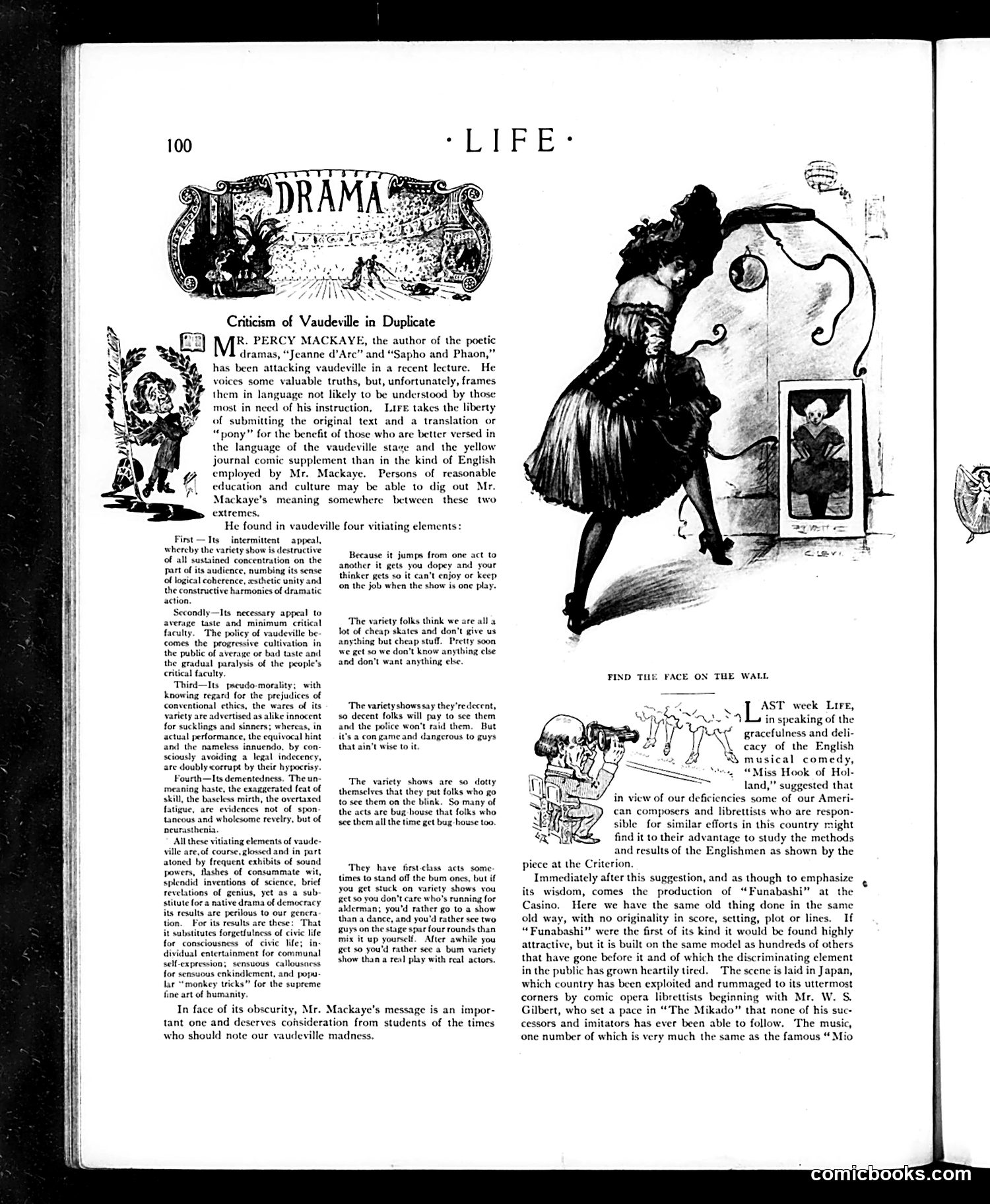
This page critiques vaudeville theater through Mr. Percy MacKaye's recent lecture attacking it. The text lists four "vitalizing elements" of vaudeville that MacKaye apparently finds problematic: its intermittent appeal, its appeal to "average taste," its pseudo-morality, and its variety format. The main illustration titled "FIND THE FACE ON THE WALL" shows a woman looking at a question mark on a wall—likely satirizing vaudeville's lack of substance or coherent meaning. The lower section discusses musical comedy, mentioning "Miss Hook of Holland" and "Funabashi," arguing that English operettas lack originality compared to foreign imports. The satire suggests American entertainment borrows heavily from abroad while critics like MacKaye dismiss native vaudeville as artistically worthless.
📄 Transcribed text from this page (OCR, searchable)
Machine-transcribed from the original scan — historical spelling and the odd misread are preserved.
Criticism of Vaudeville in Duplicate R. PERCY MACKAYE, the author of the poetic dramas, “Jeanne d’Arc” and “Sapho and Phaon,” has been attacking vaudeville in a recent lecture. He voices some valuable truths, but, unfortunately, frames them in language not likely to be understood by those most in need of his instruction, Lire takes the liberty of submitting the original text and a translation or “pony” for the benefit of those who are better versed in the language of the vaudeville stage and the yellow journal comic supplement than in the kind of English employed by Mr. Mackaye. Persons of reasonable education and culture may be able to dig out Mr. Mackaye’s meaning somewhere between these two extremes. He found in vaudeville four vitiating elements: First —Its intermittent appeal, whereby the variety show is destructive of all sustained concentration on the part of its audience, numbing its sense of logical coherence, zesthetic unity and the constructive harmonies of dramatic action. Secondly—Its necessary appeal average taste and minimum critical faculty. The policy of vaudeville be comes the progressive cultivation in the public of average or bad taste and the gradual paralysis of the people's critical faculty. Third—Its _pscudo-morality; with Knowing regard for the prejudices of conventional ethics, the wares of its variety are advertised as alike innocent for sucklings and sinners; whereas, in actual performance, the equivocal hint and the nameless innuendo. by con- sciously avoiding a legal indecency, are doubly corrupt by their hypocrisy. Fourth—Its dementedness. The un- meaning haste, the exaggerated feat of skill, the baseless mirth, the overtaxed fatigue, are evidences not of spon tancous and wholesome revelry, but of acurasthenia. All these vitiating elements of vaude- ville are,of course, glossed and in part atoned by frequent exhibits of sound powers, flashes of consummate wit, splendid inventions of science, brief revelations of genius, yet as a sub: stitute for a native drama of democracy its results are perilous to our genera tion. For its results are these: That it substitutes forgetfulness of civic life for consciousness of civic life; in- dividual entertainment for communal self-expression; sensuous callousness for sensuous enkindlement, and popu- lar “monkey tricks” for the supreme fine art of humanity. Because it jumps from one act to another it gets you dopey and your thinker gets so it can't enjoy or keep fon the fob when the show is one play. ‘The variety folks think we are all a lot of cheap skates and don’t give us anything but cheap stuff. Pretty sooa we get so we don’t know anything else and don’t want anything else. ‘The variety shows say they'redecent, so decent folks will pay to see them and the police won't raid them. But it’s a con gameand dangerous to guys that ain't wise to it The variety shows are so dotty themselves that they put folks who go to see them on the blink, So many of the acts are bug house that folks who m all the time get bug-house too ey have first-class acts some times to stand off the bum ones, but if you get stuck on variety shows vou et so you don't care who's running for alderman; you'd rather go to a show than a dance, and you'd rather see two guys on the stage spar four rounds than mix it up yourself. After awhile you get so you'd rather see a bum variety show than a real play with real actors. In face of its obscurity, Mr. Mackaye’s message is an impor- tant one and deserves cohsideration from students of the times who should note our vaudeville madness. FIND THE FACE ON THE WALL AST week Lire, in speaking of the iN gracefulness and deli- \\ cacy of the English SS musical comedy + “Miss Hook of Hol- land,” suggested that in view of our deficiencies some of our Ameri- can composers and librettists who are respon- sible for similar efforts in this country might find it to their advantage to study the methods and results of the Englishmen as shown by the piece at the Criterion. Immediately after this suggestion, and as though to emphasize its wisdom, comes the production of “Funabashi” at the Casino. Here we have the same old thing done in the same old way, with no originality in score, setting, plot or lines. If “Funabashi” were the first of its kind it would be found highly attractive, but it is built on the same model as hundreds of others that have gone before it and of which the discriminating clement in the public has grown heartily tired. ‘The scene is laid in Japan, which country has been exploited and rummaged to its uttermost corners by comic opera librettists beginning with Mr. W. S Gilbert, who set a pace in “The Mikado” that none of his suc- cessors and imitators has ever been able to follow. The music, one number of which is very much the same as the famous “Mio comicbooks.com