
Life, 1908-01-23 · page 6 of 20
Life — January 23, 1908 — page 6: what you’re looking at
What you’re looking at
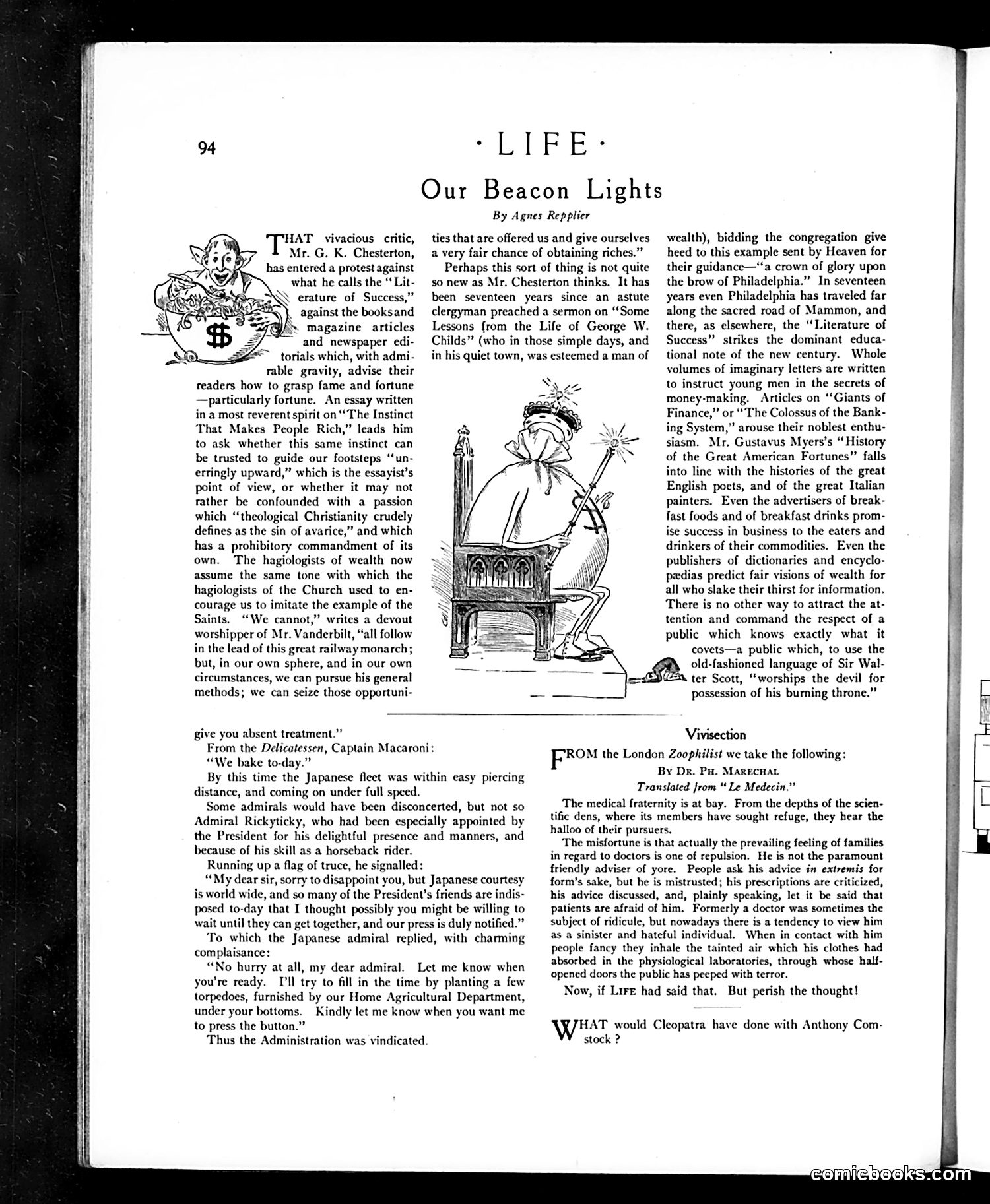
This page contains three distinct pieces: 1. **"Our Beacon Lights" by Agnes Repplier** - A critical essay attacking G.K. Chesterton's "Literature of Success," which Repplier argues encourages wealth-seeking. She criticizes how success literature and business guides have replaced traditional religious and moral instruction. 2. **The left illustration** shows a rotund figure at a desk, apparently representing the type of self-help author Repplier critiques—someone profiting from "how to get rich" advice. 3. **"Vivisection"** - An excerpt from a London medical journal discussing how doctors are often mistrusted by patients who fear them as "hateful individuals." The satire targets both commercial success literature and public distrust of the medical profession during this era.
📄 Transcribed text from this page (OCR, searchable)
Machine-transcribed from the original scan — historical spelling and the odd misread are preserved.
Tit vivacious critic, Mr. G. K. Chesterton, as entered a protest against what he calls the ‘Lit- AS erature of Success,” Q}, against the booksand magazine articles and newspaper edi- torials which, with admi- *LIFE* Our Beacon Lights By Agnes Repplier ties that are offered us and give ourselves a very fair chance of obtaining riches.” Perhaps this sort of thing is not quite so new as Mr. Chesterton thinks. It has been seventeen years since an astute clergyman preached a sermon on “Some Lessons from the Life of George W. Childs” (who in those simple days, and in his quiet town, was esteemed a man of wealth), bidding the congregation give heed to this example sent by Heaven for their guidance—‘‘a crown of glory upon the brow of Philadelphia.” In seventeen years even Philadelphia has traveled far along the sacred road of Mammon, and there, as elsewhere, the “Literature of Success” strikes the dominant educa- tional note of the new century. Whole rable gravity, advise their readers how to grasp fame and fortune —particularly fortune. An essay written in a most reverent spirit on “The Instinct That Makes People Rich,” leads him to ask whether this same instinct can be trusted to guide our footsteps “‘un- erringly upward,” which is the essayist’s point of view, or whether it may not rather be confounded with a passion which ‘theological Christianity crudely defines as the sin of avarice,” and which has a prohibitory commandment of its own. The hagiologists of wealth now assume the same tone with which the hagiologists of the Church used to en- courage us to imitate the example of the Saints. ‘We cannot,” writes a devout worshipper of Mr. Vanderbilt, “all follow in the lead of this great railway monarch; but, in our own sphere, and in our own circumstances, we can pursue his general methods; we can seize those opportuni- volumes of imaginary letters are written to instruct young men in the secrets of money-making. Articles on “Giants of Finance,” or ‘The Colossus of the Bank- ing System,” arouse their noblest enthu- siasm. Mr. Gustavus Myers’s “History of the Great American Fortunes” falls into line with the histories of the great English poets, and of the great Italian painters. Even the advertisers of break- fast foods and of breakfast drinks prom- ise success in business to the eaters and drinkers of their commodities. Even the publishers of dictionaries and encyclo- pedias predict fair visions of wealth for all who slake their thirst for information. There is no other way to attract the at- tention and command the respect of a public which knows exactly what it covets—a public which, to use the can old-fashioned language of Sir Wal- c— ter Scott, “worships the devil for possession of his burning throne.” give you absent treatment.” From the Delicatessen, Captain Macaroni: “We bake to-day.” By this time the Japanese fleet was within easy piercing distance, and coming on under full speed. Some admirals would have been disconcerted, but not so Admiral Rickyticky, who had been especially appointed by the President for his delightful presence and manners, and because of his skill as a horseback rider. Running up a flag of truce, he signalled: “My dear sir, sorry to disappoint you, but Japanese courtesy is world wide, and so many of the President’s friends are indis- posed to-day that I thought possibly you might be willing to wait until they can get together, and our press is duly notified.” ‘To which the Japanese admiral replied, with charming complaisance: “No hurry at all, my dear admiral. Let me know when you're ready. I'll try to fill in the time by planting a few torpedoes, furnished by our Home Agricultural Department, under your bottoms. Kindly let me know when you want me to press the button.” Thus the Administration was vindicated. Vivisection FROM the London Zoophilist we take the following: By Dr. Pu. MaRecHaL Translated from “Le Medecin.”” The medical fraternity is at bay. From the depths of the scien- tific dens, where its members have sought refuge, they hear the halloo of their pursuers. The misfortune is that actually the prevailing feeling of families in regard to doctors is one of repulsion. He is not the paramount friendly adviser of yore. People ask his advice in extremis for form’s sake, but he is mistrusted; his prescriptions are criticized, his advice discussed, and, plainly speaking, let it be said that patients are afraid of him. Formerly a doctor was sometimes the subject of ridicule, but nowadays there is a tendency to view him as a sinister and hateful individual. When in contact with him people fancy they inhale the tainted air which his clothes had absorbed in the physiological laboratories, through whose half- opened doors the public has peeped with terror. Now, if Lire had said that. But perish the thought! HAT would Cleopatra have done with Anthony Com- stock ? comicbooks.com