
Life, 1908-01-23 · page 13 of 20
Life — January 23, 1908 — page 13: what you’re looking at
What you’re looking at
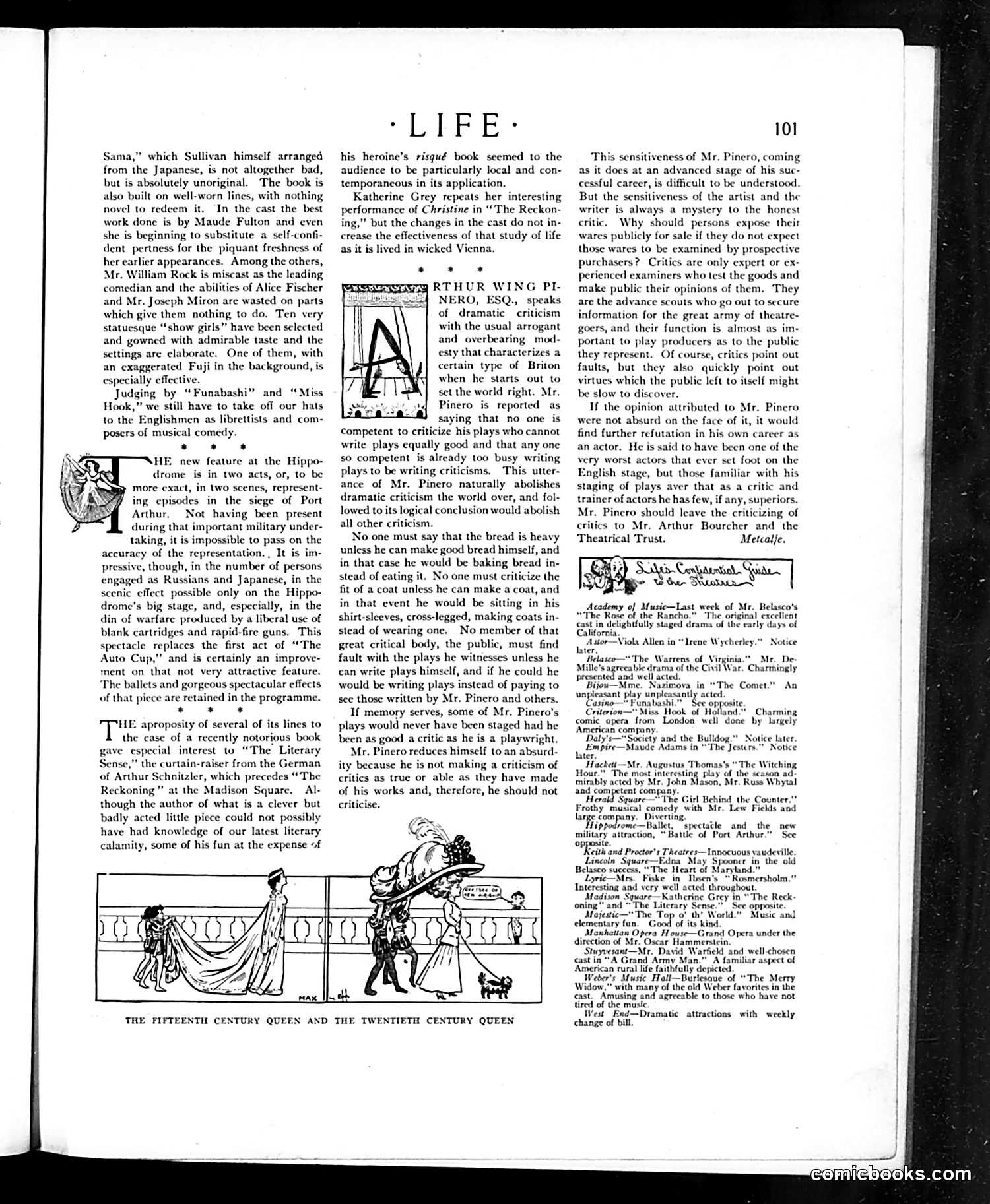
This satirical cartoon contrasts two queens across centuries. The left figure appears to be a 15th-century royal in elaborate period dress with attendants managing her train. The right figure represents a modern (20th-century) queen dressed more simply, walking a small dog. The satire mocks how royal dignity and formality have diminished over time. Where the historical queen required multiple servants just to manage her clothing, the contemporary queen's main concern is her pet. This reflects Life magazine's commentary on how modern royalty—and perhaps modern society generally—has become less ceremonious and more casual, with even the highest-ranking women reduced to domestic pursuits like dog-walking rather than maintaining traditional aristocratic dignity.
📄 Transcribed text from this page (OCR, searchable)
Machine-transcribed from the original scan — historical spelling and the odd misread are preserved.
Sama,” which Sullivan himself arranged from the Japanese, is not altogether bad, but is absolutely unoriginal. The book is also built on well-worn lines, with nothing novel to redcem it. In the cast the best work done is by Maude Fulton and even she is beginning to substitute a self-confi- dent pertness for the piquant freshness of her earlier appearances. Among the others, Mr. William Rock is miscast as the leading comedian and the abilities of Alice Fischer and Mr. Joseph Miron are wasted on parts which give them nothing to do. Ten very statuesque “show girls” have been selected and gowned with admirable taste and the settings are elaborate. One of them, with an exaggerated Fuji in the background, is especially effective. Judging by “Funabashi” and “Miss Hook,” we still have to take off our hats to the Englishmen as librettists and com- posers of musical comedy. s 68 «& HE new feature at the Hippo- drome is in two acts, or, to be more exact, in two scenes, represent- ing episodes in the siege of Port Arthur. Not having been present during that important military under- taking, it is impossible to pass on the accuracy of the representation. , It is im- pressive, though, in the number of persons engaged as Russians and Japanese, in the scenic effect possible only on the Hippo- drome’s big stage, and, especially, in the din of warfare produced by a liberal use of blank cartridges and rapid-fire guns. This. spectacle replaces the first act of “The Auto Cup,” and is certainly an improve- ment on that not very attractive feature. ‘The ballets and gorgeous spectacular effects of that piece are retained in the programme. se & HE aproposity of several of its lines to the case of a recently notorious book gave especial interest to “The Literary Sense,’ the curtain-raiser from the German of Arthur Schnitzler, which precedes “The Reckoning” at the Madison Square. Al- though the author of what is a clever but badly acted little piece could not possibly have had knowledge of our latest literary calamity, some of his fun at the expense of “LIFE: his heroine’s risqué book seemed to the audience to be particularly local and con- temporancous in its application. Katherine Grey repeats her interesting performance of Christine in “The Reckon- ing,” but the changes in the cast do not in- crease the effectiveness of that study of life as it is lived in wicked Vienna. * 8 * 3 RTHUR WING PI- NERO, ESQ., speaks of dramatic criticism with the usual arrogant and overbearing mod- esty that characterizes a certain type of Briton when he starts out to set the world right. Mr. Pinero is reported as saying that no one is competent to criticize his plays who cannot write plays equally good and that any one so competent is already too busy writing plays to be writing criticisms. This utter- ance of Mr. Pinero naturally abolishes dramatic criticism the world over, and fol- lowed to its logical conclusion would abolish all other criticism. No one must say that the bread is heavy unless he can make good bread himself, and in that case he would be baking bread in- stead of eating it. No one must criticize the fit of a coat unless he can make a coat, and in that event he would be sitting in his shirt-sleeves, cross-legged, making coats in- stead of wearing one. No member of that great critical body, the public, must find fault with the plays he witnesses unless he can write plays himself, and if he could he would be writing plays instead of paying to sce those written by Mr. Pinero and others If memory serves, some of Mr. Pinero’s plays would never have been staged had he been as good a critic as he is a playwright, Mr. Pinero reduces himself to an absurd- ity because he is not making a criticism of critics as true or able as they have made of his works and, therefore, he should not criticise. THE FIFTEENTH CENTURY QUE AND THE TWENTIETH CENTURY QUEEN 101 This sensitiveness of Mr. Pinero, coming as it docs at an advanced stage of his suc- cessful career, is difficult to be understood But the sensitiveness of the artist and the writer is always a mystery to the honest critic. Why should persons expose their wares publicly for sale if they do not expect those wares to be examined by prospective purchasers? Critics are only expert or cx- perienced examiners who test the goods and make public their opinions of them. They are the advance scouts who go out to secure information for the great army of theatre- goers, and their function is almost as im- portant to play producers as to the public they represent. Of course, critics point out faults, but they also quickly point out virtues which the public left to itself might be slow to discover. If the opinion attributed to Mr. Pinero were not absurd on the face of it, it would find further refutation in his own career as an actor. He is said to have been one of the very worst actors that ever set foot on the English stage, but those familiar with his staging of play that as a critic and trainer of actors he has few, if any, superiors. Mr. Pinero should leave the criticizing of critics to Mr. Arthur Bourcher and the Theatrical Trust. Metcalfe. Academy of Music—Last week of Mr. Belasco's “The Rose of the Rancho.” ‘The original excellent cast in delightfully staged drama of the early days of California, A stor—Viola Allen in “Irene Wycherley."” Notice later. Belasco—*"The Warrens of Virginia." Mr. De- Mill's agreeable drama ofthe Civil War. Charthingly presented and well acted. Bijou—Mme. Nazimova in “The Comet.” An unpleasant play unplcasantly acted Casino—" Funabashi.” See opposite. Criterion—" Miss Hook of Holland." Charming comic opera from London well done by largely American company Daly's—"Society and the Bulldog.” Notice later Empire—Maude Adams in “The Jesters.” Notice hater. Hackett—Mr. Augustus Thomas's “The Witching Hour.” The most interesting play of the season ad. mirably acted by Mr. John Mason, Mr. Russ Whytal and competent company. Herald Square—"The Girl Beh Frothy musical comedy with Mr large company. Diverting. Hippodrome—Ballet, spectacle and the new military attraction, “Battle of Port Arthur.” See ‘opposite Keith and Proctor's T heatres—Innocuous vaudeville Lincoln Square—Edna May Spooner in the old elasco success, “The Heart of M. Lyric—Mrs. "Fiske in Ibsen's Interesting and very well acted throughout. Madison Square—Katherine Grey in “The Reck The Literary Sense." Mojestic—""The Top o' th’ World elementary fun. Good of its kind Manhattan Opera House—Grand Opera under the direction of Mr. Oscar Hammerstein. ‘Stuyverant—Mr. David Warfield and well-chosen cast in “A Grand Army Man.” A familiar aspect of American rural life faithfully depicted. Weber's Music Hall—Burlesaue of “The Merry Widow.” with many of the old Weber favorites in the cast, Amusing and agreeable to those who have not tired of the music. West End—Dramatic attractions with weekly change of bill. 4 the Counter.” Lew Fiells and Music and