
Life, 1908-01-23 · page 14 of 20
Life — January 23, 1908 — page 14: what you’re looking at
What you’re looking at
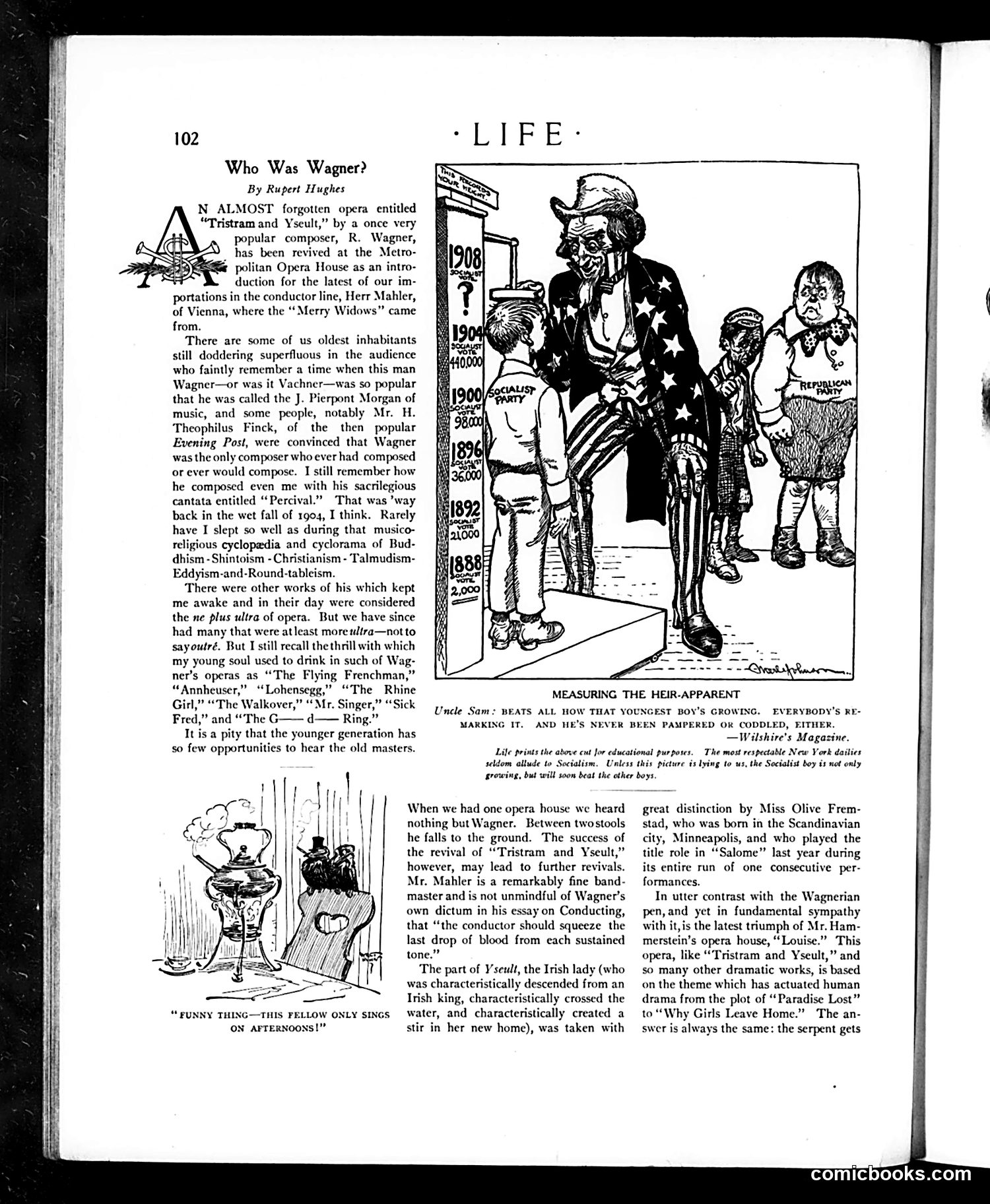
This cartoon satirizes early 20th-century American socialism. It depicts Uncle Sam (identifiable by his starred top hat and patriotic clothing) measuring the height of a young boy labeled "Socialist Party" against a wall marked with growth dates from 1892 to 1908. Other children labeled "Republican" and another party stand nearby, appearing smaller or concerned. The satire's point: Life magazine is ironically commenting on socialism's rapid growth in America. The caption notes that respectable New York newspapers rarely discuss socialism, yet "this picture" (the boy's noticeable growth) proves the movement is expanding—and will "soon beat the other boys." The humor lies in the contradiction: while the mainstream press ignores socialism, it's visibly gaining strength. This reflects genuine early-1900s anxiety about socialist political movements gaining American support.
📄 Transcribed text from this page (OCR, searchable)
Machine-transcribed from the original scan — historical spelling and the odd misread are preserved.
Who Was Wagner? By Rupert Hughes N ALMOST forgotten opera entitled “Tristram and Yseult,” by a once very popular composer, R. Wagner, has been revived at the Metro- ¢ politan Opera House as an intro- duction for the latest of our im- portations in the conductor line, Herr Mahler, of Vienna, where the “Merry Widows” came from. There are some of us oldest inhabitants still doddering superfluous in the audience who faintly remember a time when this man Wagner—or was it Vachner—was so popular that he was called the J. Pierpont Morgan of music, and some people, notably Mr. H. Theophilus Finck, of the then popular Evening Post, were convinced that Wagner was the only composer who ever had composed or ever would compose. I still remember how he composed even me with his sacrilegious cantata entitled “Percival.” That was ’way back in the wet fall of 1904, I think. Rarely have I slept so well as during that musico- religious cyclopedia and cyclorama of Bud- dhism -Shintoism - Christianism - Talmudism- Eddyism-and-Round-tableism. There were other works of his which kept me awake and in their day were considered the ne plus ultra of opera. But we have since had many that were atleast moretltra—notto sayoutré. But I still recall the thrill with which my young soul used to drink in such of Wag- ner’s operas as “The Flying Frenchman,” “Annheuser,” “Lohensegg,” “The Rhine Girl,” “The Walkover,” “Mr. Singer,” “Sick Fred,” and “The G- Ring.” It is a pity that the younger generation has so few opportunities to hear the old masters. ire’s Magazine. Life prints the above cut Jor educational purposes. The most respectable New York dailies seldom allude to Socialism. Unless this picture is lying to us, the Socialist boy is not only growing, but will soon beat the other boys. “FUNNY THING—THIS FELLOW ONLY SINGS ON AFTERNOONS!” When we had one opera house we heard nothing but Wagner. Between twostools he falls to the ground. The success of the revival of “Tristram and Yseult,” however, may lead to further revivals. Mr. Mahler is a remarkably fine band- master and is not unmindful of Wagner’s own dictum in his essay on Conducting, that “the conductor should squeeze the last drop of blood from each sustained tone.” The part of Yseult, the Irish lady (who was characteristically descended from an Irish king, characteristically crossed the water, and characteristically created a stir in her new home), was taken with great distinction by Miss Olive Frem- stad, who was born in the Scandinavian city, Minneapolis, and who played the title role in “Salome” last year during its entire run of one consecutive per- formances. In utter contrast with the Wagnerian pen,and yet in fundamental sympathy with it,is the latest triumph of Mr. Ham- merstein’s opera house, “Louise.” This opera, like “Tristram and Yseult,” and so many other dramatic works, is based on the theme which has actuated human drama from the plot of “Paradise Lost” to “Why Girls Leave Home.” The an- swer is always the same: the serpent gets comicbooks.com