
A complete issue · 21 pages · 1907
Life — December 26, 1907
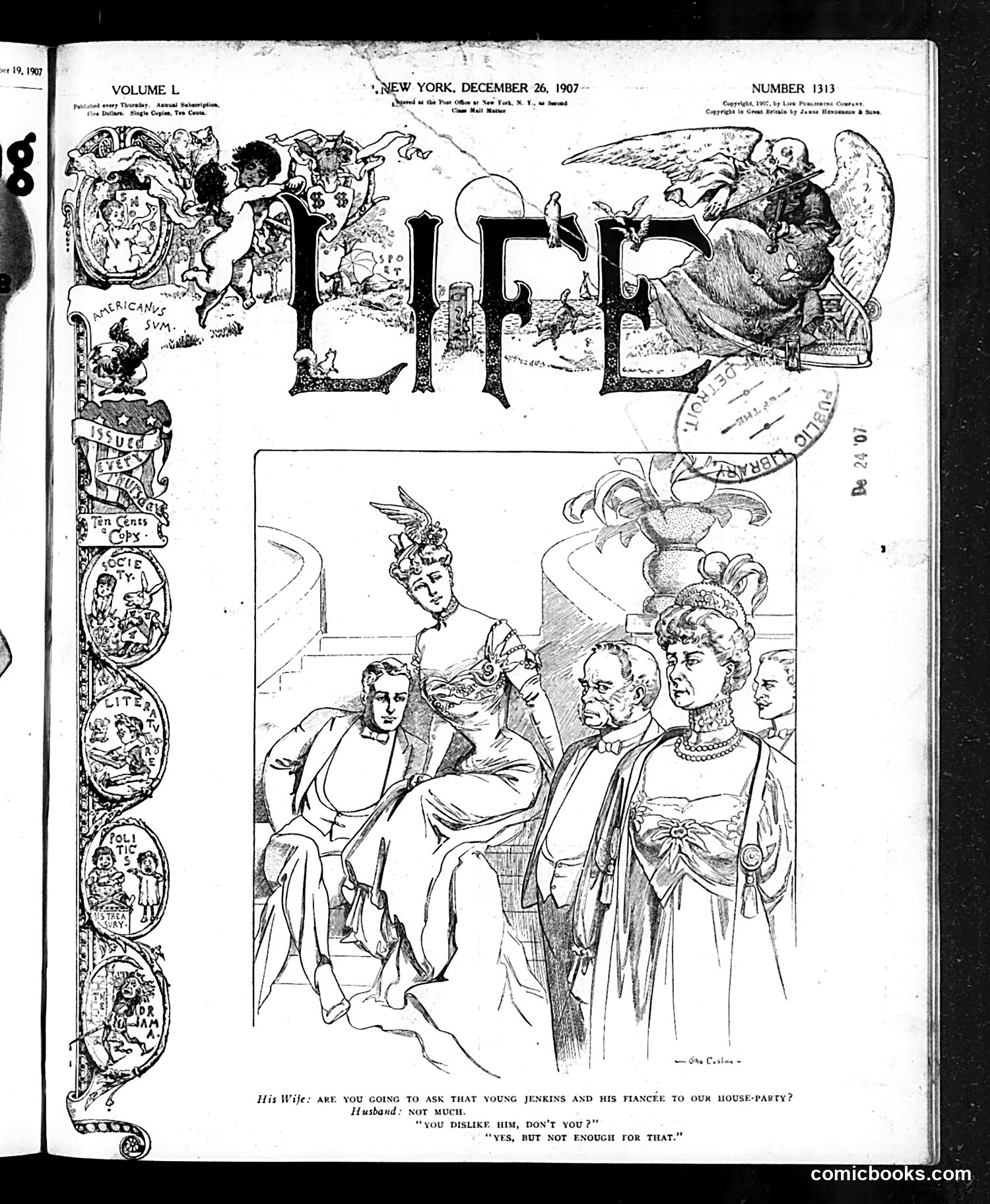
This page features an illustration depicting an upper-class social scene. The caption reads: "His Wife: ARE YOU GOING TO ASK THAT YOUNG JENKINS AND HIS FIANCÉE TO OUR HOUSE-PARTY? Husband: NOT MUCH. 'YOU DISLIKE HIM, DON'T YOU?' 'YES, BUT NOT ENOUGH FOR THAT.'" The joke satirizes social snobbery and exclusion rituals among the wealthy. A husband refuses to invite a young man named Jenkins and his fiancée to a house party—not because he dislikes Jenkins strongly enough to justify outright rejection, but as a subtle social snub. The cartoon mocks how the affluent use selective invitations as weapons of social control and status-maintenance, treating attendance at private gatherings as privilege to be withheld as punishment.
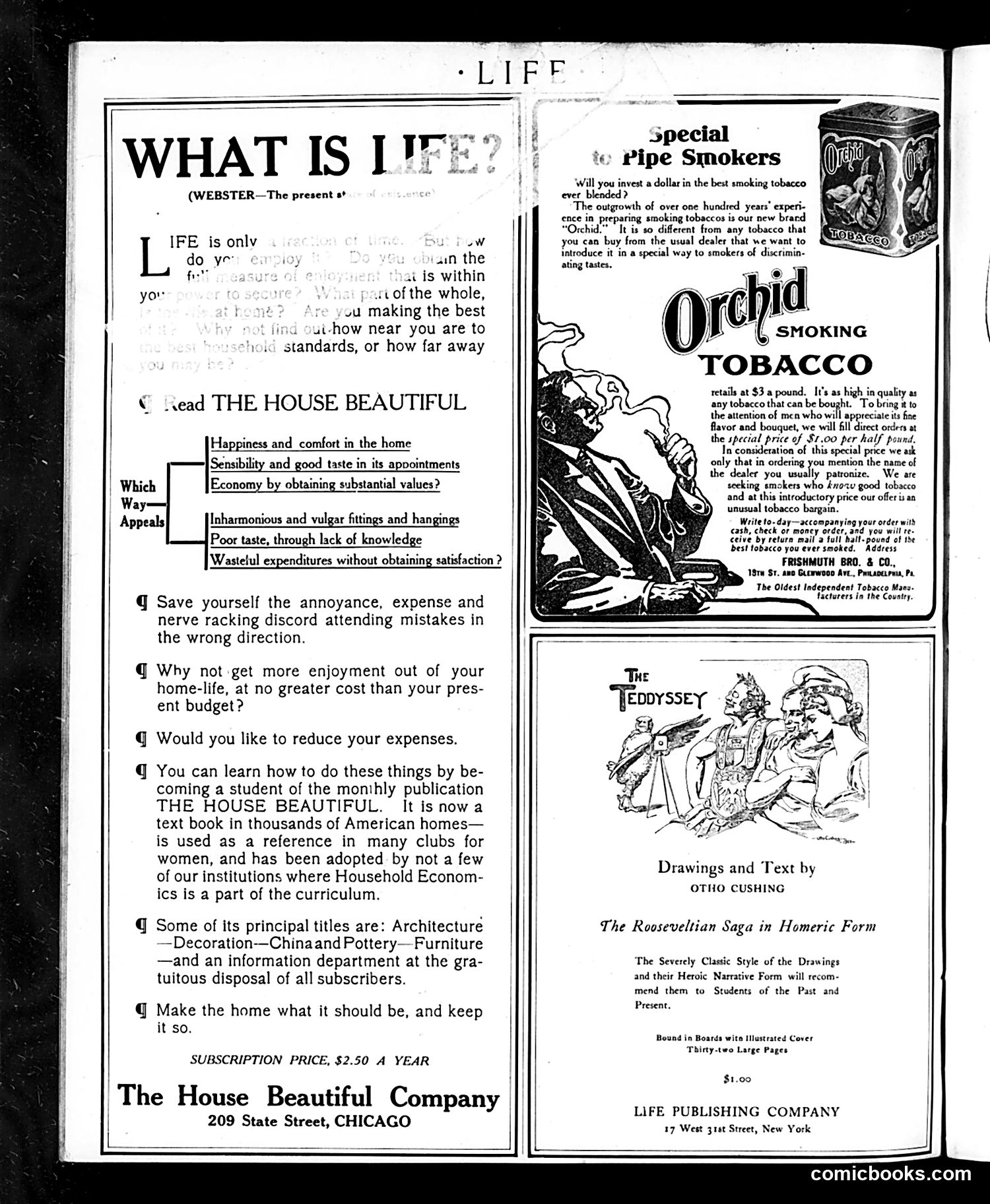
This page is primarily **advertising content** rather than satirical editorial material. The left side promotes "The House Beautiful" magazine subscription ($2.50/year), emphasizing home decoration and household economics—appealing to early 20th-century concerns about tasteful, economical living. The right side contains two advertisements: one for **Orchid Smoking Tobacco** (priced at 53 cents, marketed as superior quality) and another for **"The Teddyssey,"** a book of drawings by Otho Cushing depicting what appears to be Teddy Roosevelt-related content in "Rooseveltian Saga" form, published by Life Publishing Company. The page reflects period consumer culture and commercial interests rather than political satire or social commentary.
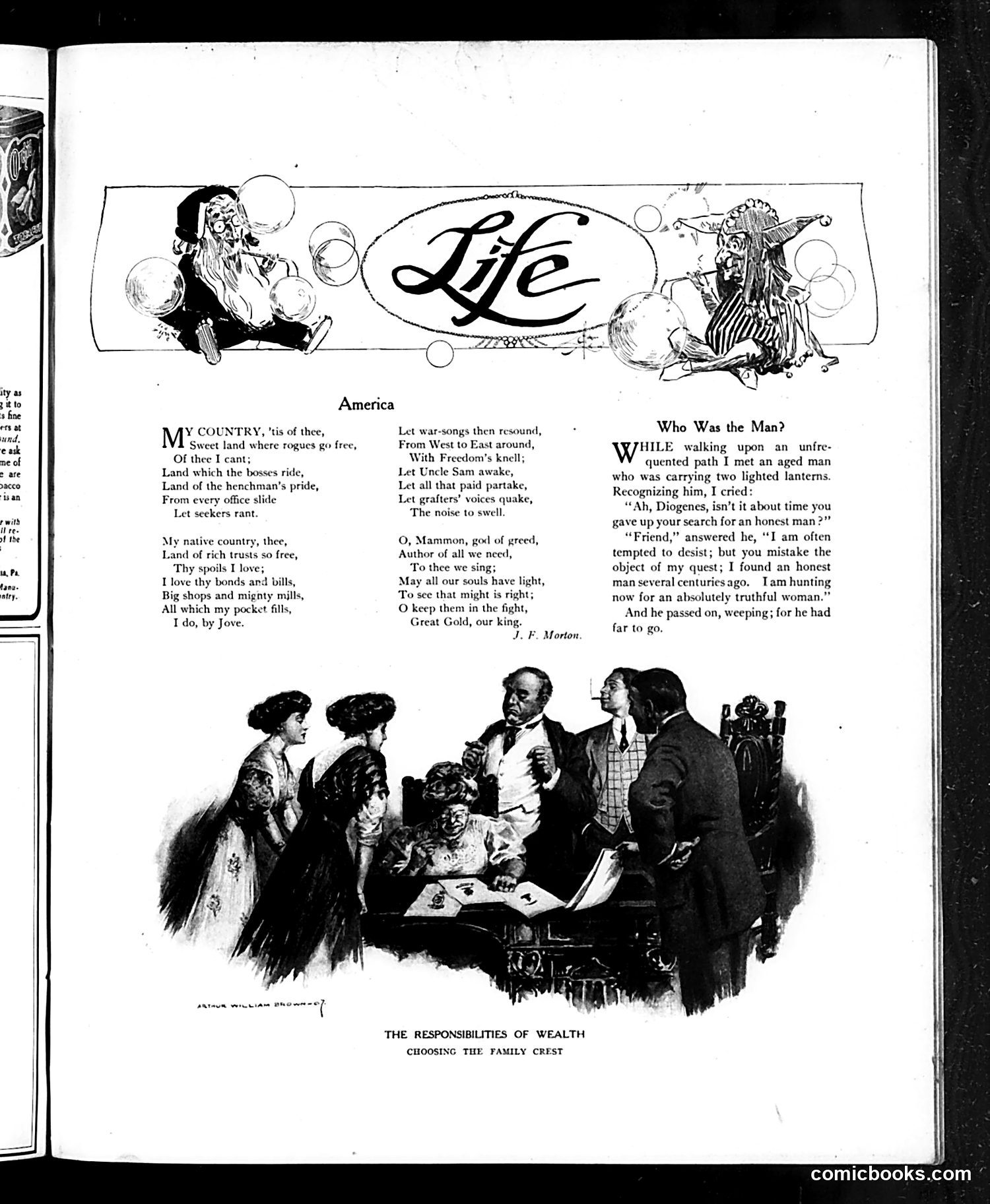
This page combines patriotic poetry with social satire. The upper section features "America," a jingoistic poem by J.F. Morton celebrating American industry and nationalism ("Big shops and mighty mills"). The sidebar story "Who Was the Man?" presents a brief moral tale: a man searches centuries for an "absolutely truthful woman," suggesting contemporary skepticism about feminine honesty—a common theme in early-20th-century satire. The bottom cartoon, "The Responsibilities of Wealth—Choosing the Family Crest," satirizes wealthy families' pretensions. It depicts well-dressed figures discussing heraldry, mocking the nouveau riche attempting to establish aristocratic legitimacy through invented family crests and symbols. The satire targets American wealth's social climbing and desire for Old World respectability.
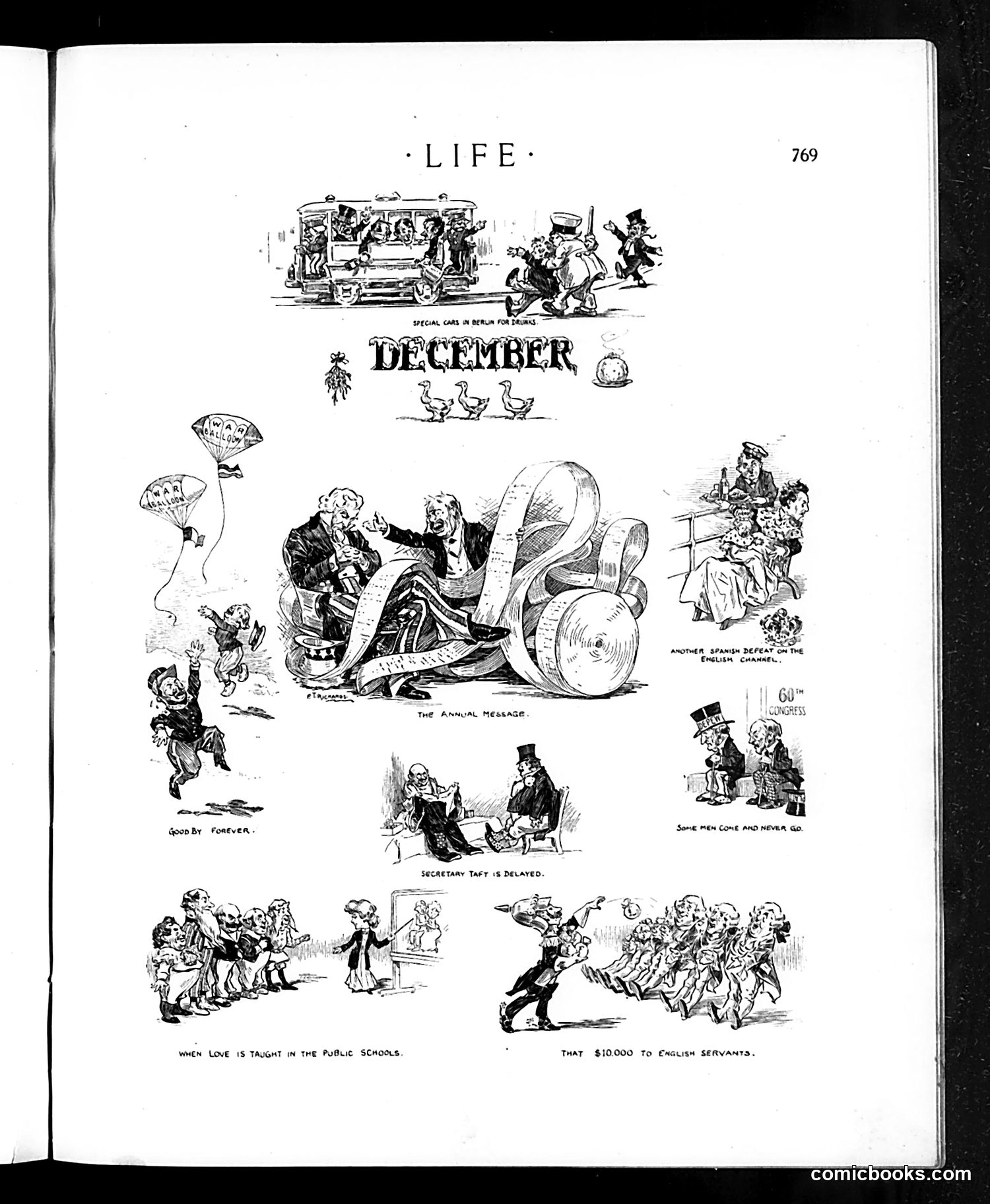
This December page from *Life* contains several satirical vignettes critiquing contemporary social and political issues: **"The Annual Message"** depicts politicians struggling with an unwieldy scroll—likely referencing President Theodore Roosevelt's lengthy State of the Union addresses, known for their verbose, reformist rhetoric. **"Secretary Taft is Delayed"** appears to mock William Howard Taft's administrative inefficiency or tardiness. Other sketches address: holiday gift-giving excess ("Good by Forever"), romantic education in public schools, and servant labor compensation ("That $10,000 to English Servants"). The cartoons employ typical early-1900s satirical techniques—exaggerated figures and situational humor—targeting established institutions, government inefficiency, and emerging social debates about education and labor equity. The specific historical references remain partially unclear without additional context.
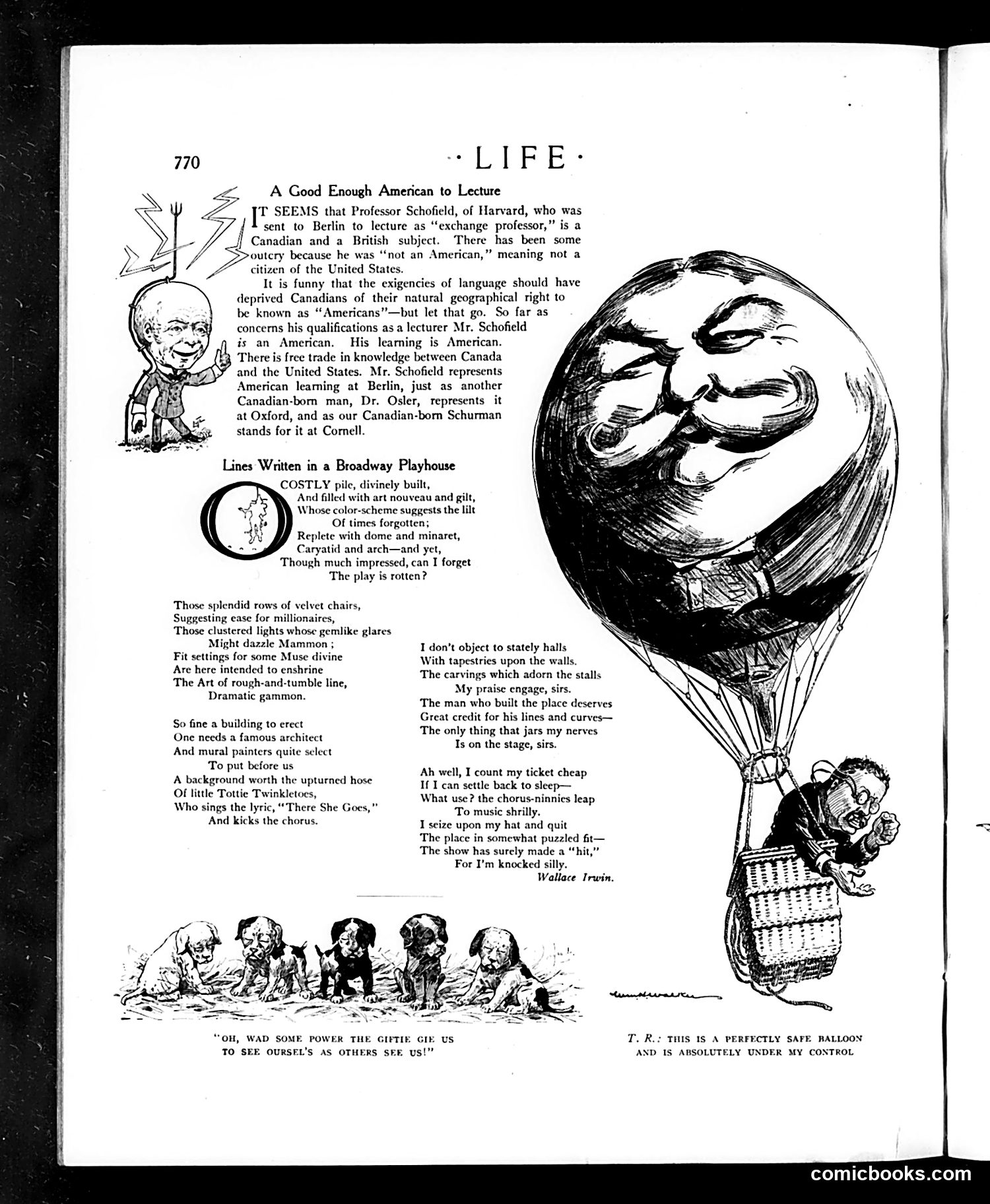
**Main Article: "A Good Enough American to Lecture"** This satirical piece critiques the controversy surrounding Professor Schofield of Harvard, sent to Berlin as an "exchange professor." The article mocks objections to his lecturing abroad because he was "not an American" (not a U.S. citizen), despite being Canadian-born. The satire argues this distinction is absurd—his learning and work are American, and other Canadian-born figures (Dr. Osler at Oxford, Schurman at Cornell) represent American interests abroad without controversy. **Secondary Content: "Lines Written in a Broadway Playhouse"** Wallace Irwin's poem satirizes an ornate Broadway theater, criticizing its excessive decoration while the actual stage performance disappoints. The accompanying illustrations mock theatrical pretension versus mediocre entertainment. The page's overall theme: attacking parochial nationalism and bureaucratic absurdity.
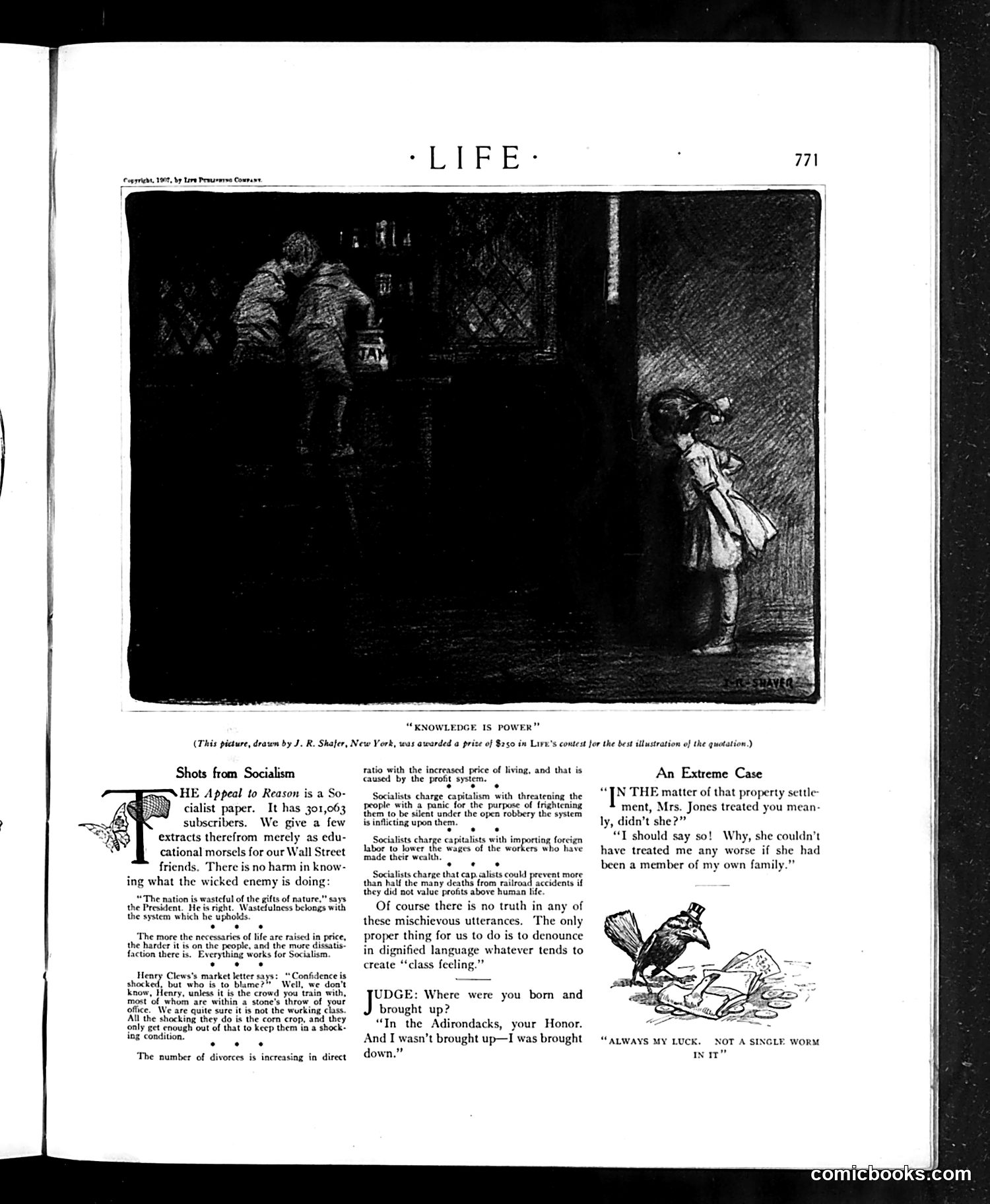
This page contains two distinct satirical pieces: **Top image ("Knowledge Is Power"):** A drawing depicting a small child confronting what appears to be larger figures in darkness. The image won the Liss contest prize and illustrates the quoted phrase about knowledge as power. **"Shots from Socialism":** An editorial section attacking Socialist political ideology. It critiques Socialist arguments about capitalism, claiming Socialists wrongly blame the economic system for social problems like poverty and railway accidents. The piece dismisses Socialist rhetoric as misleading. **"An Extreme Case":** A legal dialogue featuring a judge questioning someone's background, contrasting wealthy upbringing ("the Adirondacks") with being "brought down"—illustrating class-based legal or social disparities. The cartoon at bottom right shows a figure with scattered possessions, captioned "Always my luck—not a single worm in it," appearing to mock misfortune or poverty through dark humor.
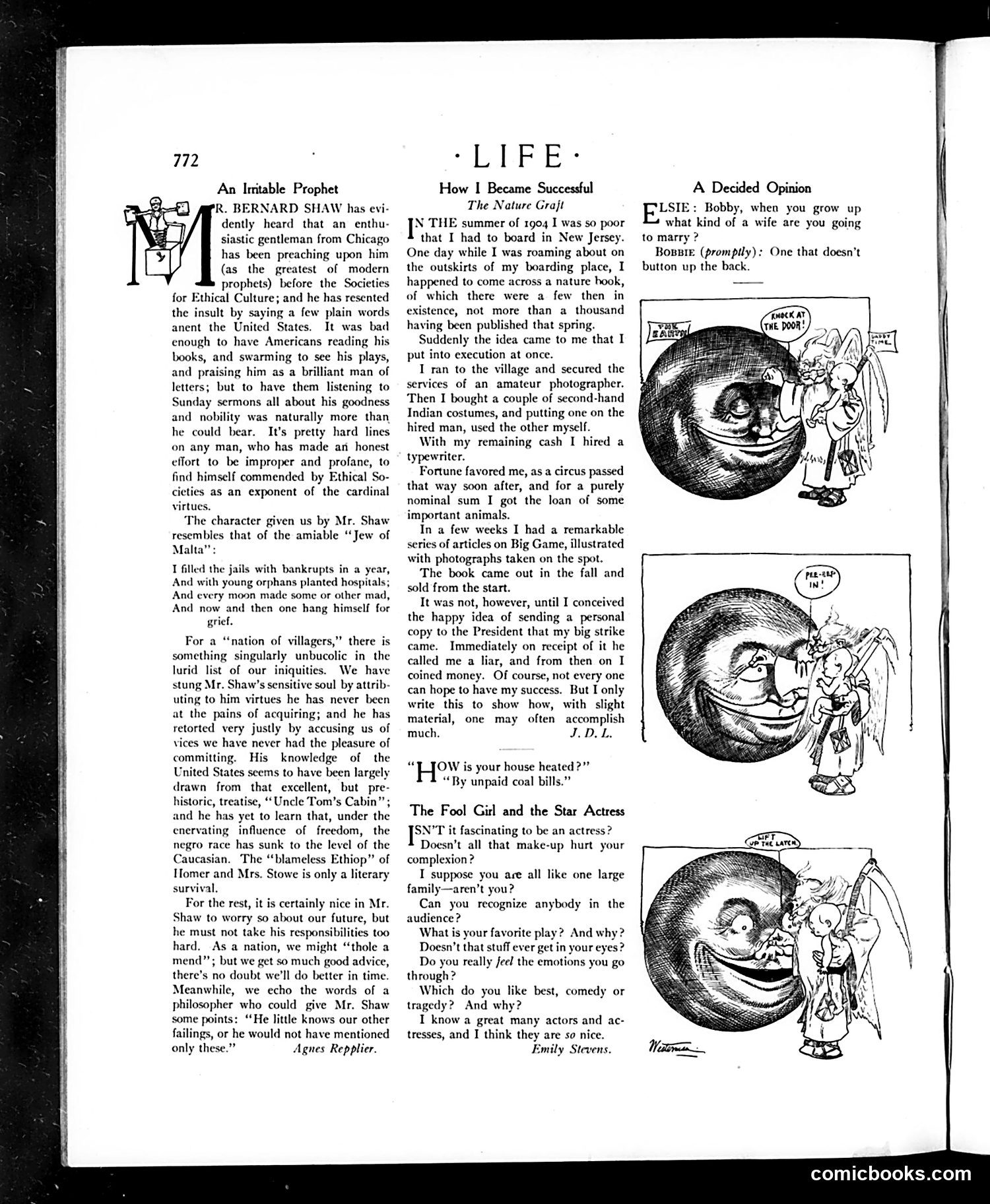
This page contains three distinct sections: a critical editorial about Bernard Shaw (left column), a first-person narrative about a nature photographer's success (center), and three illustrated vignettes about theatrical life (right side). The Shaw editorial attacks the playwright's recent preaching to American audiences about ethics and morality, sarcastically noting that despite his moral posturing, Shaw has "never been at the pains of acquiring" virtue himself. The author questions his credibility as a moral authority. The right-side illustrations appear to humorously depict interactions between theatrical performers and audiences—likely depicting the artificiality and pretense of theatrical life. The cartoons mock actresses and their relationships with admirers, suggesting the gap between stage personas and reality. The overall tone is satirical critique of public figures and theater culture.
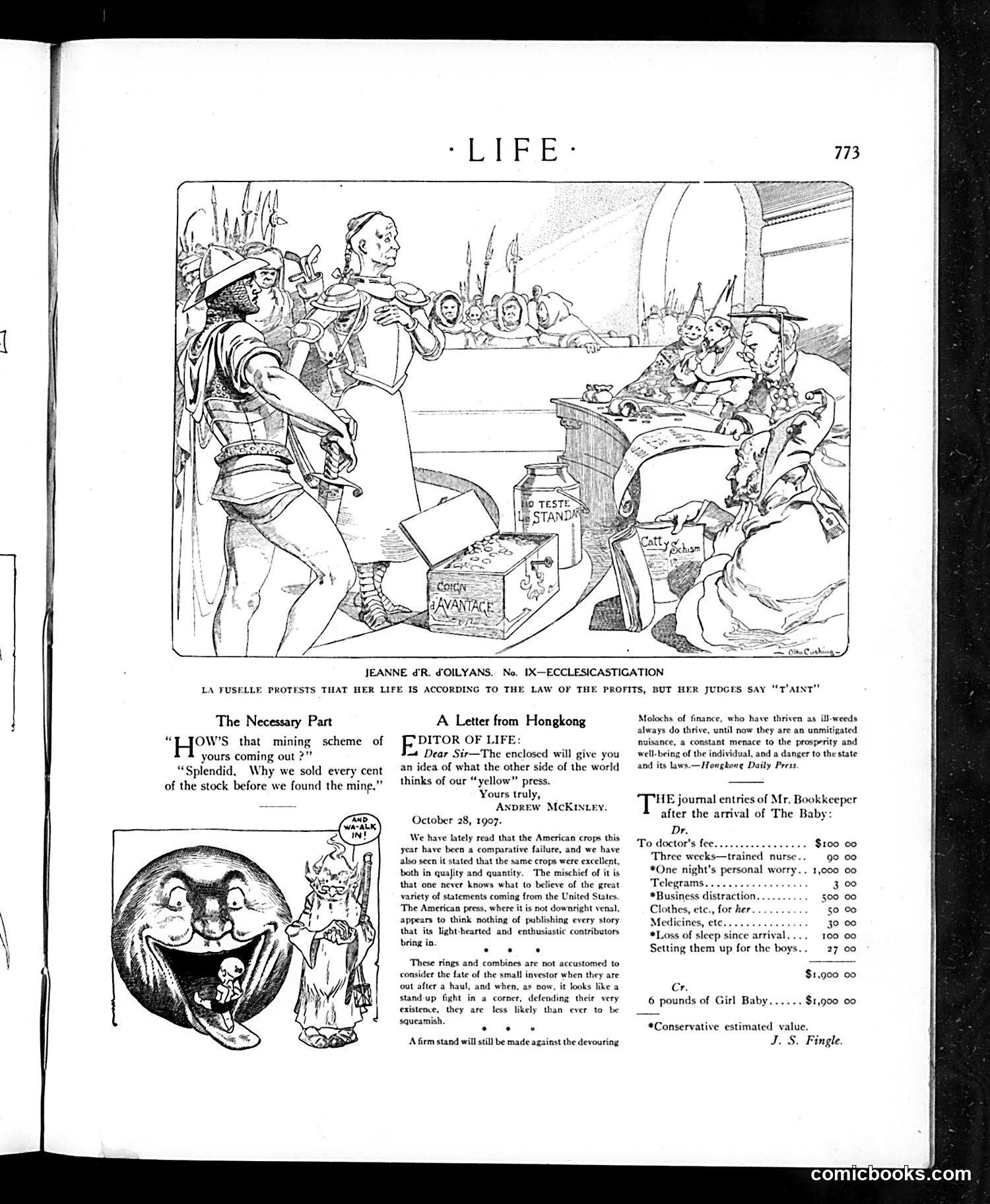
The top cartoon, titled "Jeanne d'Orlyans No. IX—Ecclesiastication," depicts a woman (appearing to reference Joan of Arc) being judged by ecclesiastical figures. The caption states her judges declare "it ain't" — likely satirizing disagreement over religious law or female authority. The detailed military dress and courtroom setting suggest mockery of formal religious proceedings. Below, "The Necessary Part" shows a mining scheme dialogue, while "A Letter from Hongkong" discusses crop failures and financial speculation. The accompanying illustration of a rotund figure with skull imagery suggests commentary on death, greed, or financial ruin during economic uncertainty. The "Bookkeeper's Journal" entry humorously itemizes costs associated with a new baby, totaling $1,000, satirizing modern domestic expenses.
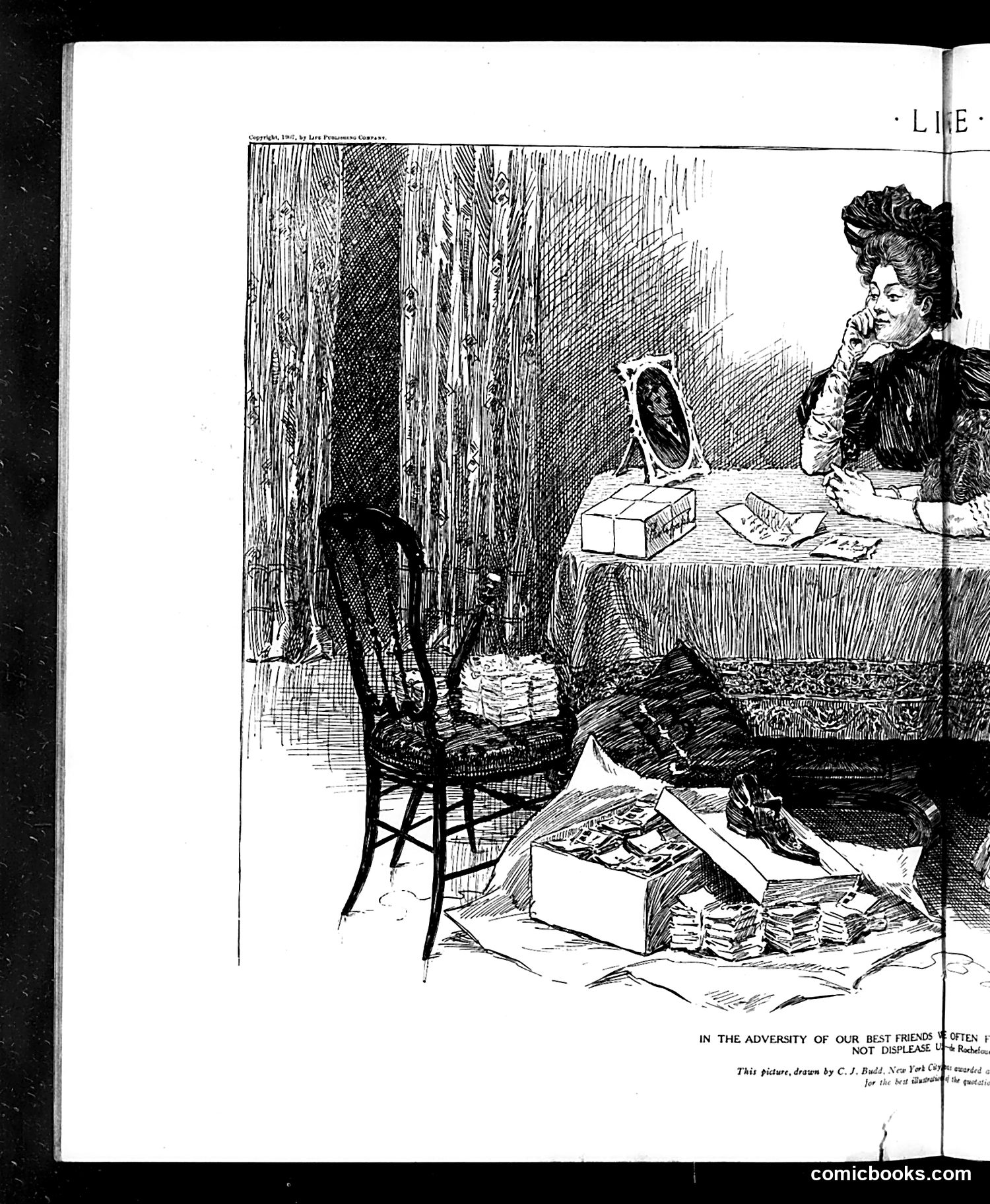
This is a satirical illustration by C.J. Budd from *Life* magazine. The cartoon depicts a woman at a desk surrounded by scattered papers, boxes, and stacks of material, appearing overwhelmed and contemplative. A mirror sits on the desk, and the setting suggests a workspace in disarray. The caption reads: "IN THE ADVERSITY OF OUR BEST FRIENDS OFTEN WE DO NOT DISPLEASE—" (appears to be a Shakespeare reference). The satire likely comments on a woman managing correspondence, finances, or domestic affairs during difficult circumstances. The scattered documents and boxes suggest she's dealing with substantial paperwork or responsibilities—possibly related to estate management, business affairs, or personal crisis. The ironic caption suggests that others may actually benefit from or judge her less harshly during her troubles. Without additional context about the specific historical moment, the exact subject remains unclear.
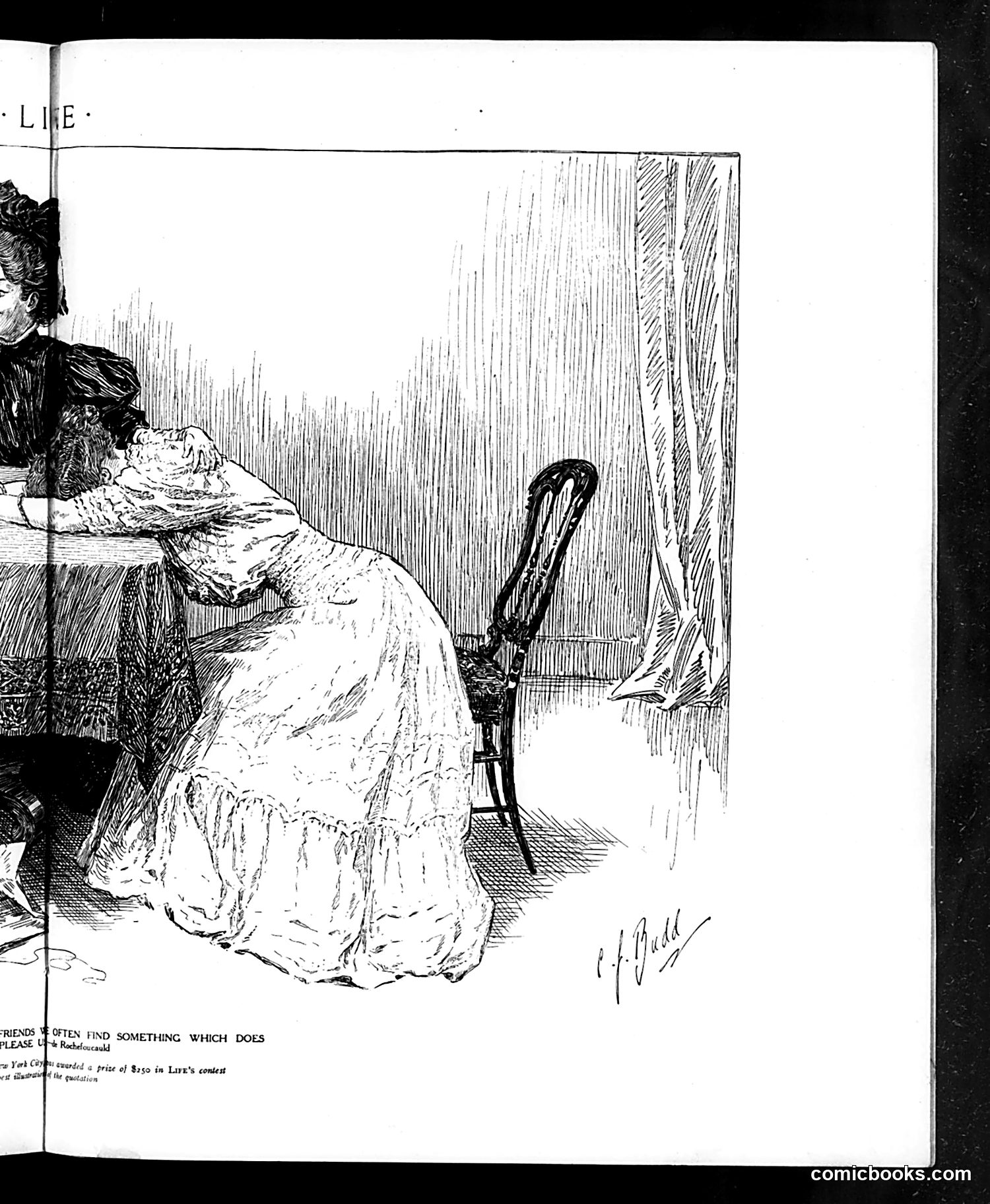
This appears to be a satirical cartoon from Life magazine featuring a woman in an elaborate dress sitting at a table. The title "LIFE" appears at the top left, and there's a signature (possibly "J. Boyd" or similar) in the lower right. The partially visible OCR text at bottom mentions "FRIENDS OFTEN FIND SOMETHING WHICH DOES" and references "Lire's contest" and "a prize of $250," suggesting this relates to a magazine contest or competition. The cartoon's exact satirical point is unclear without complete caption text, but it likely satirizes social conventions, women's fashion, or upper-class dining customs typical of Life magazine's humor. The woman's exaggerated dress and formal setting suggest commentary on pretension or artificiality in society.
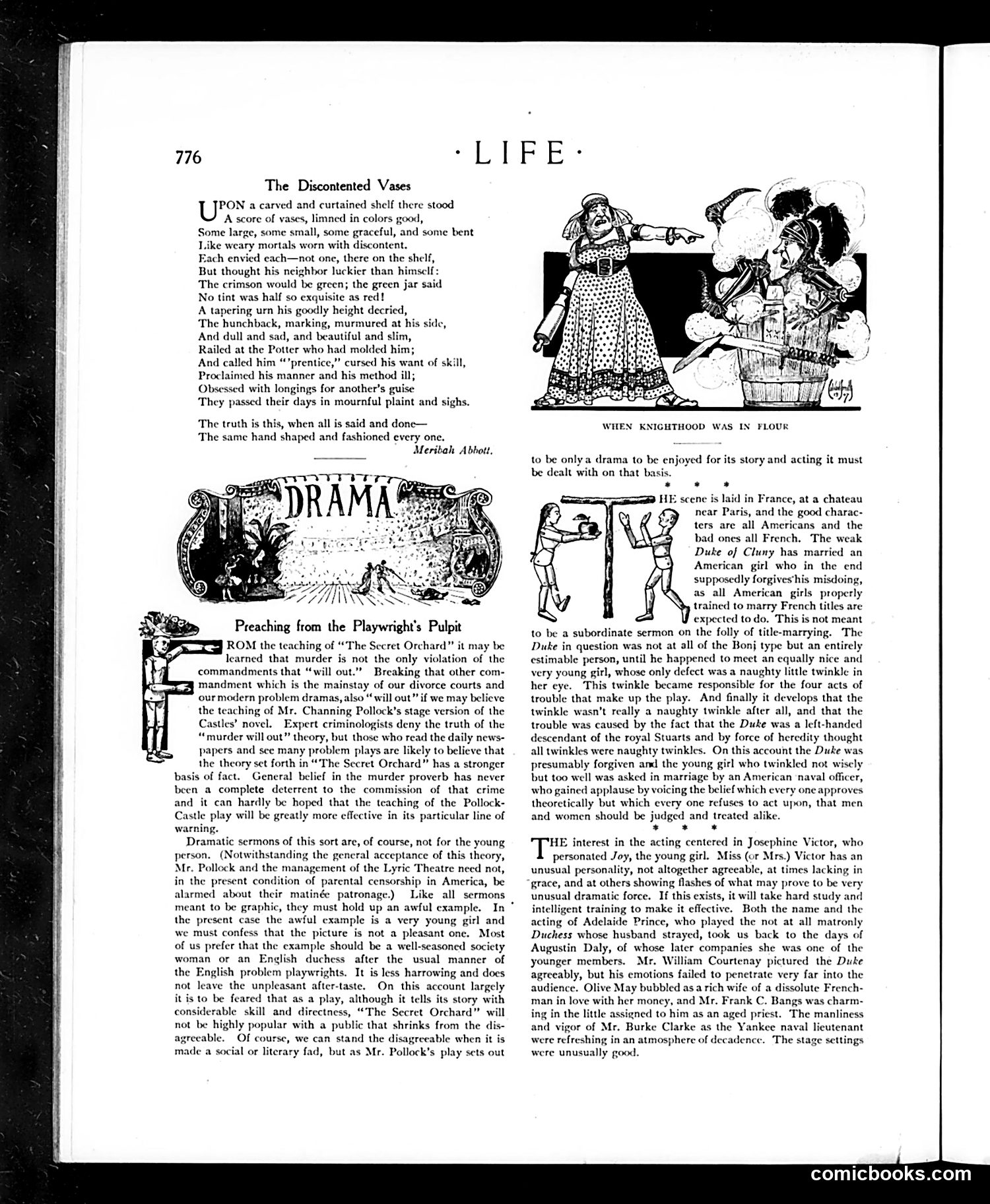
This page contains a poem titled "The Discontented Vases" by Meeriah Abbott, accompanied by an illustration labeled "When Knighthood Was In Flour" showing a woman directing children in what appears to be a domestic or culinary scene. Below is a dramatic essay titled "Preaching from the Playwright's Pulpit," discussing theatrical productions. The text critiques a play called "The Secret Orchard" and discusses another production featuring "the Duke of Clinsy," commenting on American actresses playing French roles and the morality of theatrical content. The page focuses on literary and theatrical criticism rather than political satire. The "flour" pun in the illustration's caption appears to be a gentle domestic humor reference typical of Life magazine's satirical style.
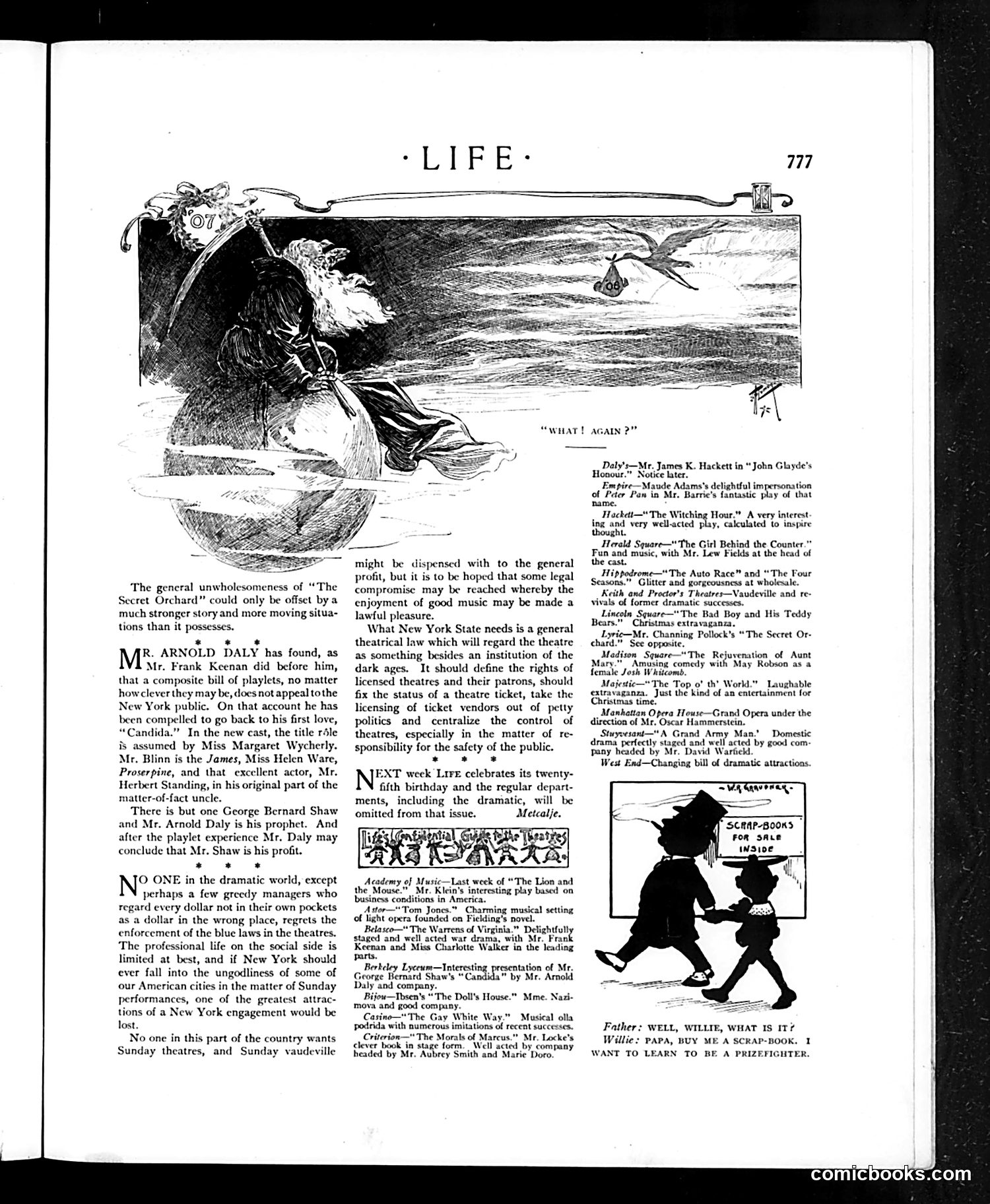
This page contains theatrical reviews and commentary rather than political satire. The main illustration shows a figure asking "WHAT AGAIN?" — likely commenting on repetitive theatrical productions of the era. The text discusses Mr. Arnold Daly's efforts to make New York theaters more wholesome and public-minded, contrasting with current theatrical practices. A secondary cartoon at bottom right depicts a father and son, with the boy asking to buy a scrap-book to "learn to be a prizefighter" — satirizing how popular entertainment (likely prize-fighting coverage in publications) influences children's aspirations. The page primarily reviews contemporary theatrical productions, making this primarily an entertainment/cultural commentary issue rather than political satire.
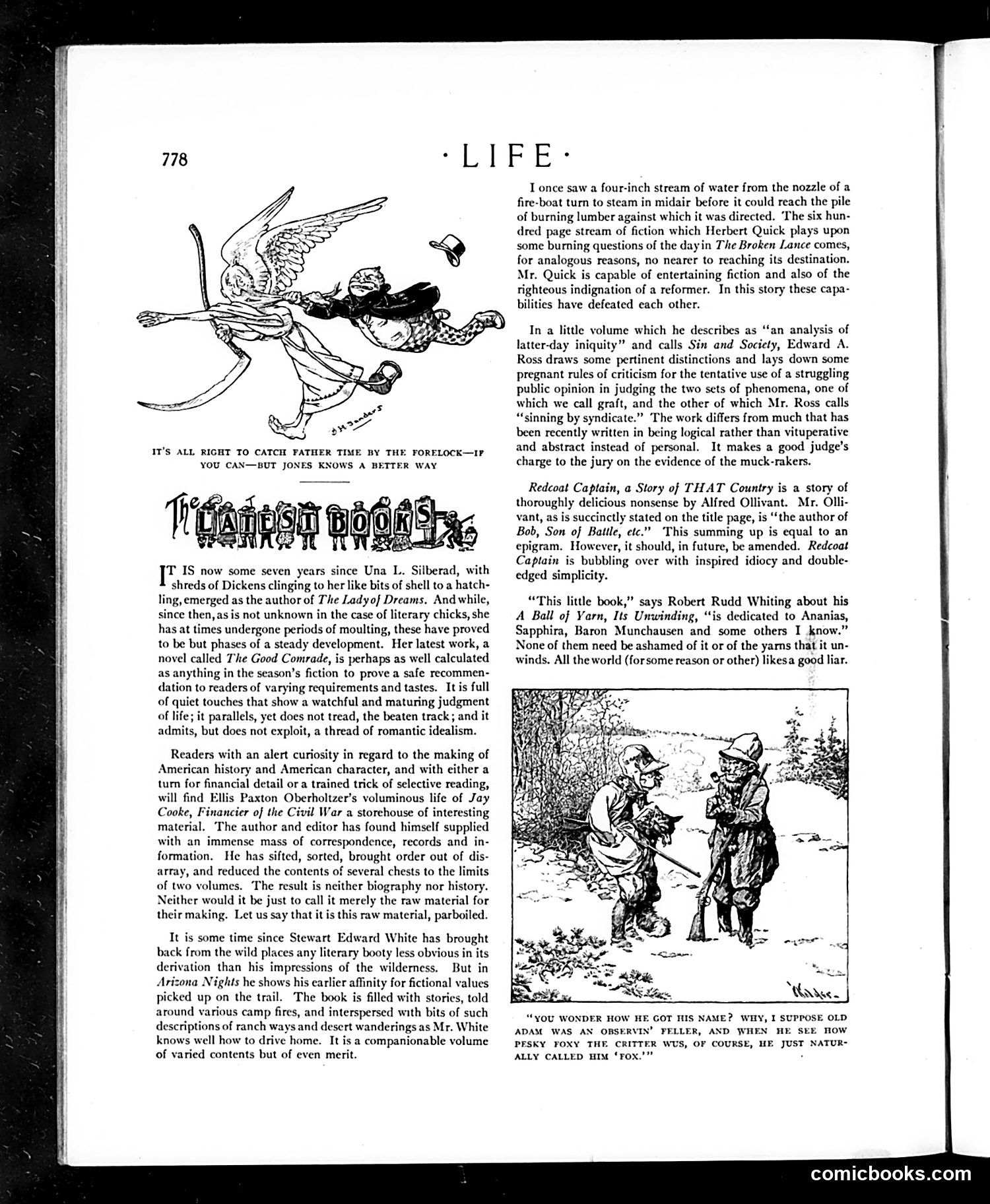
The page contains two distinct elements: **Top cartoon:** Shows a winged figure (Father Time, identifiable by traditional iconography) being caught by the forelock—a classical reference to seizing opportunity. The caption jokes that while catching Father Time is theoretically possible, "Jones knows a better way," suggesting an alternative (unstated) method. This is a play on the common phrase about seizing time by the forelock. **Main content:** Book reviews of contemporary literature, including works by Una L. Silberad, Ellis Paxton Oberholtzer, Stewart Edward White, Herbert Quick, Edward A. Ross, and Alfred Ollivant. The reviews assess literary merit and social relevance. Notable: the reviewer criticizes Quick's *The Broken Lane* for diluting its impact by mixing entertainment with reform rhetoric—comparing it to a fire-hose stream that dissipates before reaching its target. **Bottom illustration:** Shows two figures (one appears to be a Native American) in casual conversation, accompanying a review of Ollivant's *Redcoat Captain*.
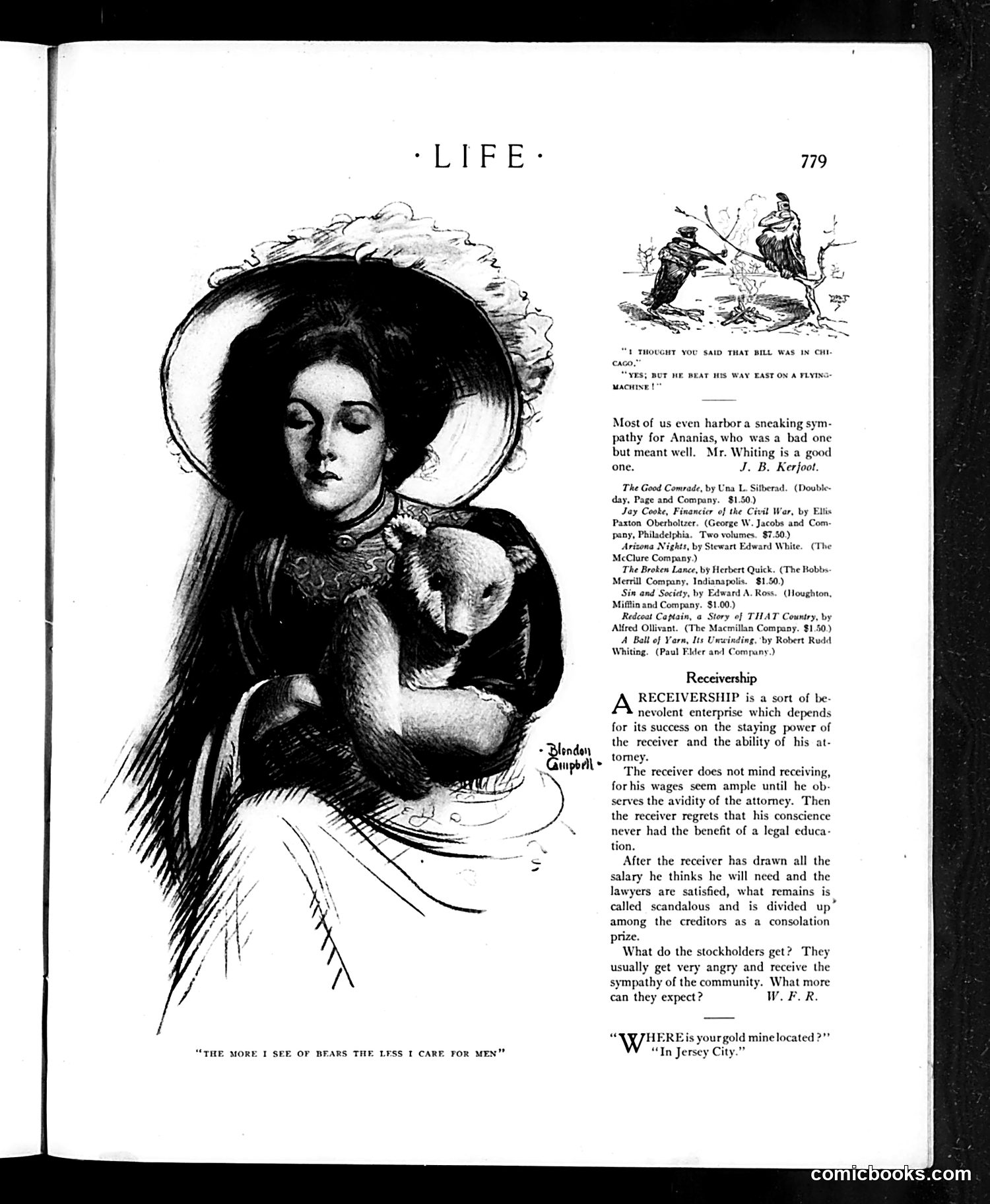
This page contains multiple satirical pieces about dishonesty and financial malfeasance: **Main Cartoon (left):** A sketch by Blanden Campbell showing a woman holding a bear, with caption "The more I see of bears the less I care for men"—satirizing misanthropy through animal preference. **Top Dialogue:** Two small comics mock a character named Bill who claimed to be "in Chicago" but actually "beat his way east on a flying machine"—mocking implausible excuses and unreliable people. **"Receivership" Essay:** The main text sardonically describes bankruptcy proceedings where receivers and lawyers extract all available funds, leaving stockholders with "sympathy" and creditors with mere "consolation prizes." It critiques how legal professionals profit from financial collapse while ordinary investors suffer. **Bottom Joke:** A one-liner about a gold mine "located in Jersey City"—likely referencing New Jersey's reputation for fraud or dubious schemes. The page's recurring theme: distrust of those in positions of authority (lawyers, receivers, con artists) who exploit systems for personal gain at others' expense.
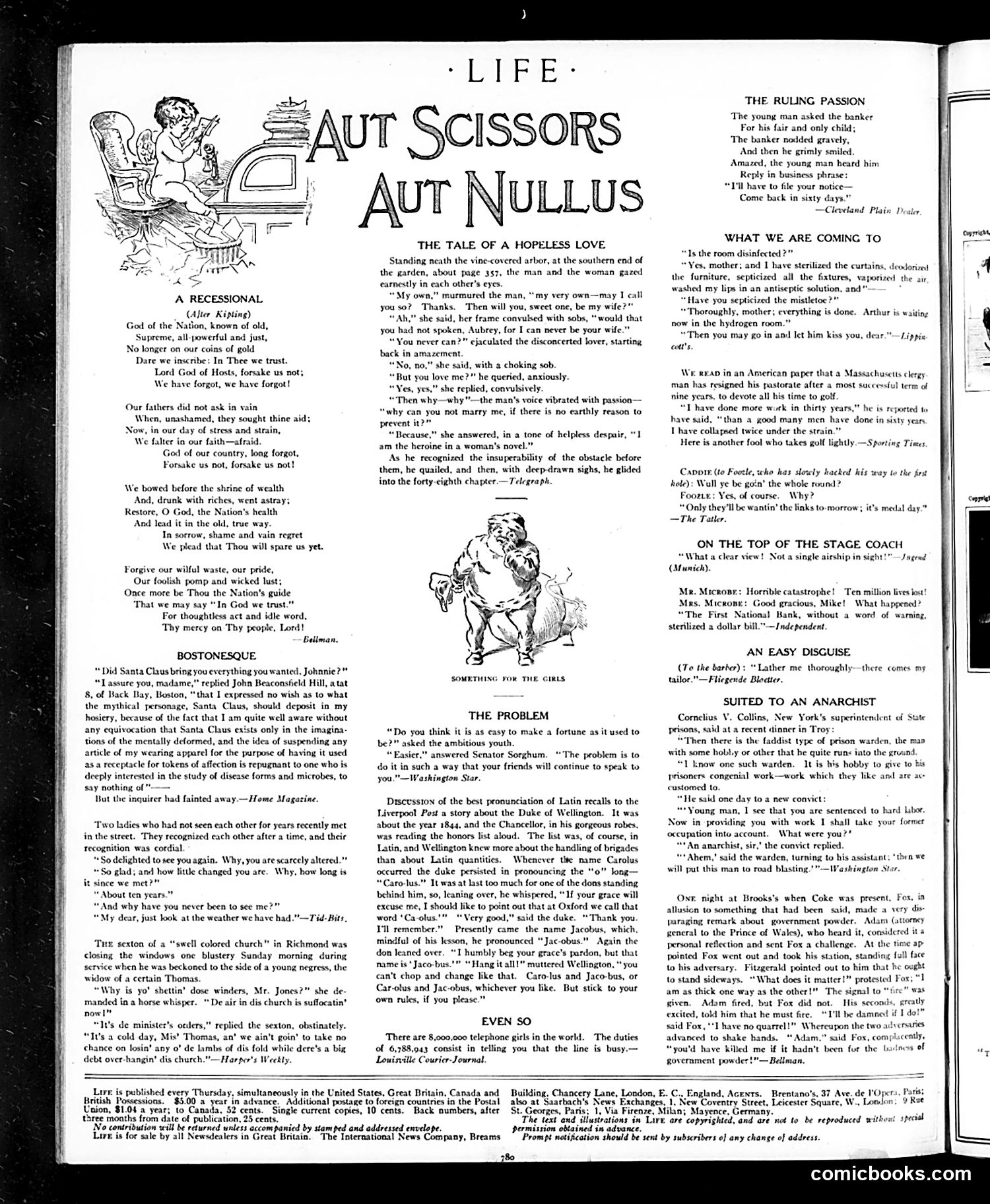
This page contains several pieces of satirical content: **The main feature** is a melodramatic short story parody titled "The Tale of a Hopeless Love" (the Latin title means "either scissors or nothing"). It mocks overwrought Victorian romance novels by having a woman refuse marriage not for realistic reasons, but because she's literally "the heroine in a woman's novel"—satirizing the absurd, plotdriven conventions of popular women's fiction. **"A Recessional"** is a parody poem (mimicking Kipling's style) lamenting America's loss of faith and moral direction, criticizing materialism and national decline. **The humorous vignettes** mock pretentious speech patterns: an insufferable 8-year-old Bostonian uses medical jargon to reject Santa Claus; socialites blame "weather" for not visiting; a church sexton prioritizes debt collection over congregation comfort. The satire targets literary clichés, American materialism, excessive formality, and social hypocrisy.
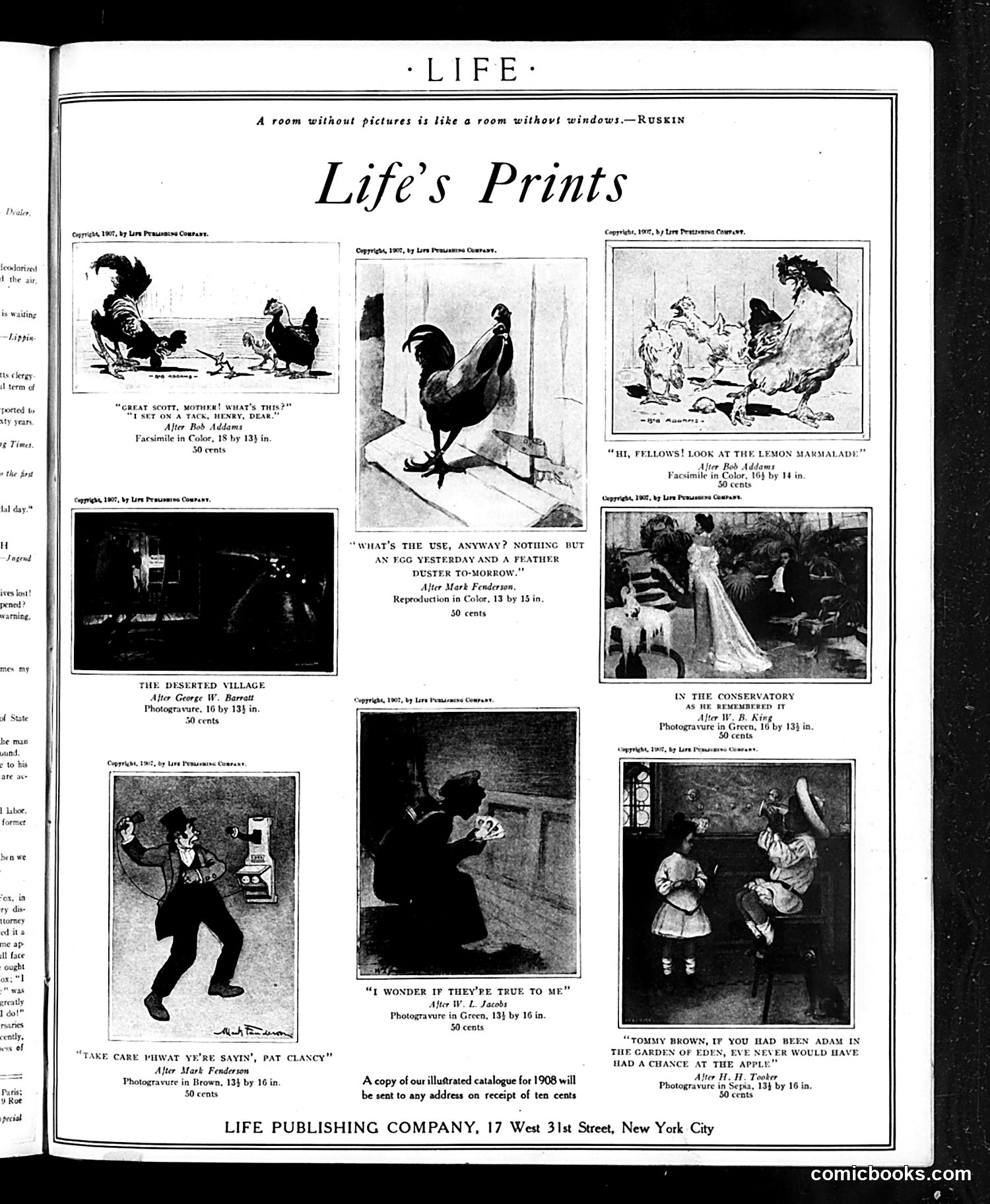
This 1907 Life magazine page advertises humorous prints and illustrations available for purchase. Rather than political cartoons, these are comedic domestic and social scenes by popular illustrators of the era. The humor relies on period-specific situations: a child sitting on a tack ("SET ON A TACK, HENRY, DEAR"), a rooster's existential complaint about laying eggs, a man warning his friend about indiscreet speech, and romantic anxieties ("I WONDER IF THEY'RE TRUE TO ME"). The final panel makes a cheeky biblical reference, suggesting Eve would have rejected the apple if given Adam as her alternative. These prints reflect early-20th-century middle-class comedy—slapstick, domestic mishaps, and gentle social observation. They could be purchased as color photogravures or reproductions, marketed as affordable home decoration (echoing Ruskin's quote about pictures as "windows"). The $0.30–$0.50 prices made them accessible to ordinary readers seeking lighthearted wall art.
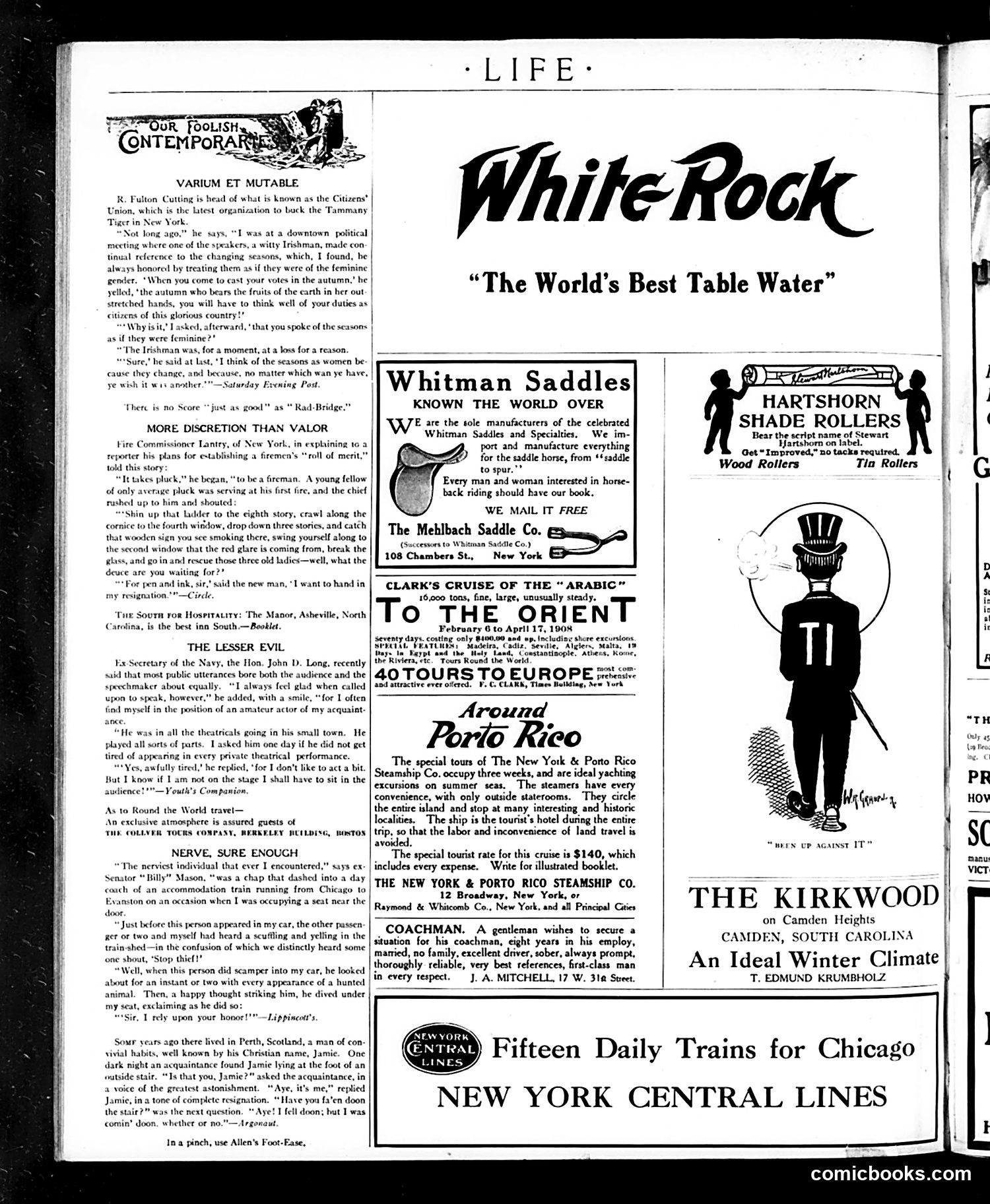
This page is primarily **advertisements and anecdotal humor pieces**, not political cartoons. The content includes: **Main Features:** - Product ads (White Rock water, Whitman Saddles, Hartshorn Shade Rollers, New York & Porto Rico Steamship line, The Kirkwood resort) - A silhouette illustration labeled "He's Up Against It" (appears to depict social struggle, unclear specifics) **Text Content:** Four humorous anecdotes titled "Our Foolish Contemporaries," "More Discretion Than Valor," "The Lesser Evil," and "Nerve, Sure Enough"—typical of Life's satirical humor column format. These mock human foibles through brief stories: a fireman too frightened to work, a Navy secretary forced into public speaking, a fugitive's audacious escape request. **Political/Social Reference:** The opening mentions R. Fulton Cutting and the Citizens' Union opposing Tammany Hall (NYC's corrupt political machine), but this is context-setting, not satire. The page reflects **early 20th-century American magazine humor**: workplace anxiety, class dynamics, and Irish immigrant stereotypes rather than sharp political commentary.
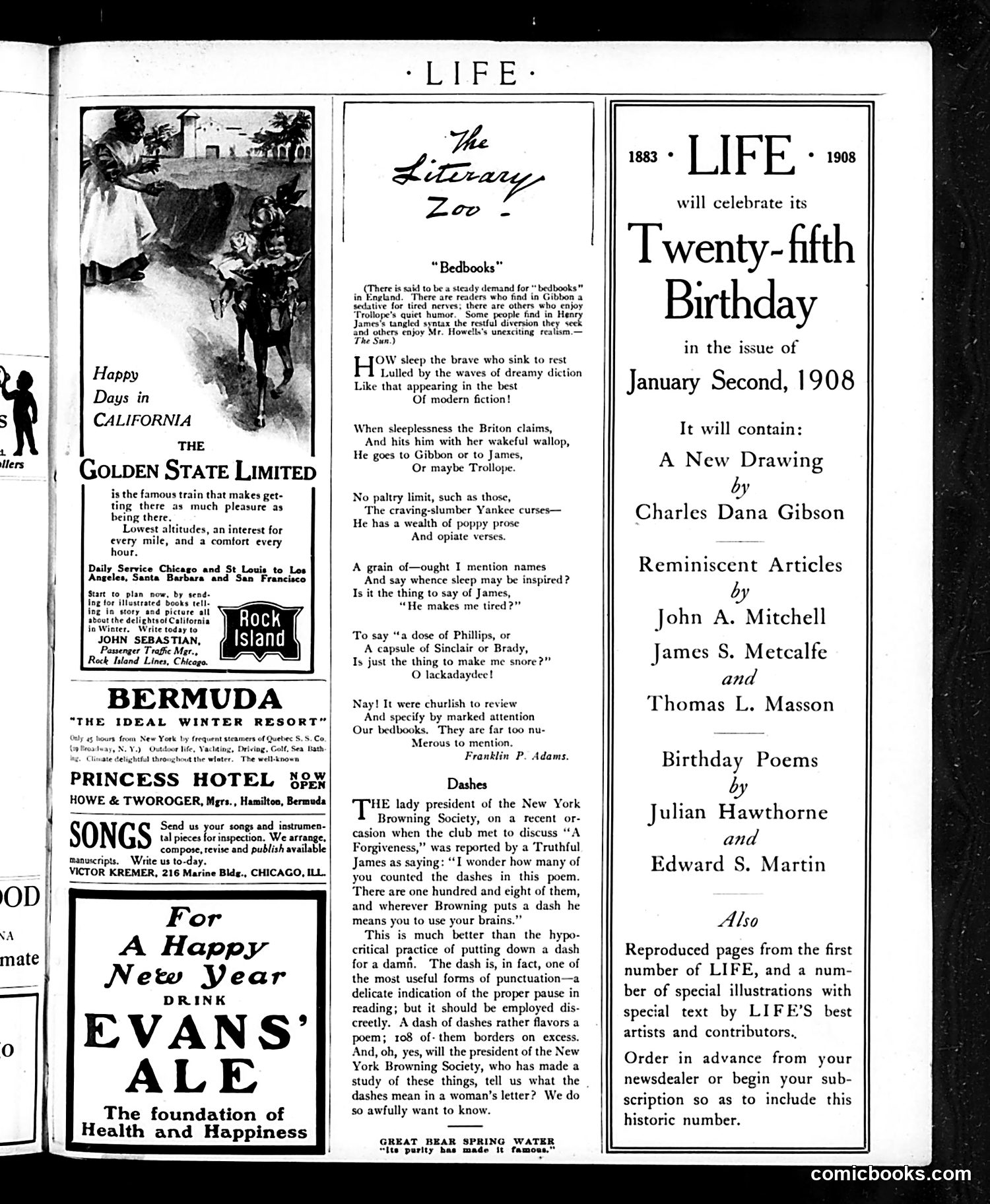
This page is primarily **promotional and advertising material**, not political satire. The main content announces Life magazine's 25th birthday issue (January 2, 1908). **Key content:** - **"Bedbooks" poem** by Franklin P. Adams: A humorous piece about British and American reading habits as sleep aids. It satirizes the literary preferences of insomniacs, mocking how readers use authors like Gibbon, James, and Trollope for their soporific (sleep-inducing) qualities rather than intellectual merit. - **"Dashes" piece**: Social commentary on Robert Browning's excessive use of dashes in poetry, framed as a New York Browning Society anecdote. The humor lies in questioning whether dashes in women's letters have actual meaning. - **Advertisements** for California travel, Bermuda resorts, songs/compositions, and Evans Ale dominate the page. The page reflects turn-of-the-century leisure culture and literary tastes among educated Americans, with gentle mockery of both authors and readers.
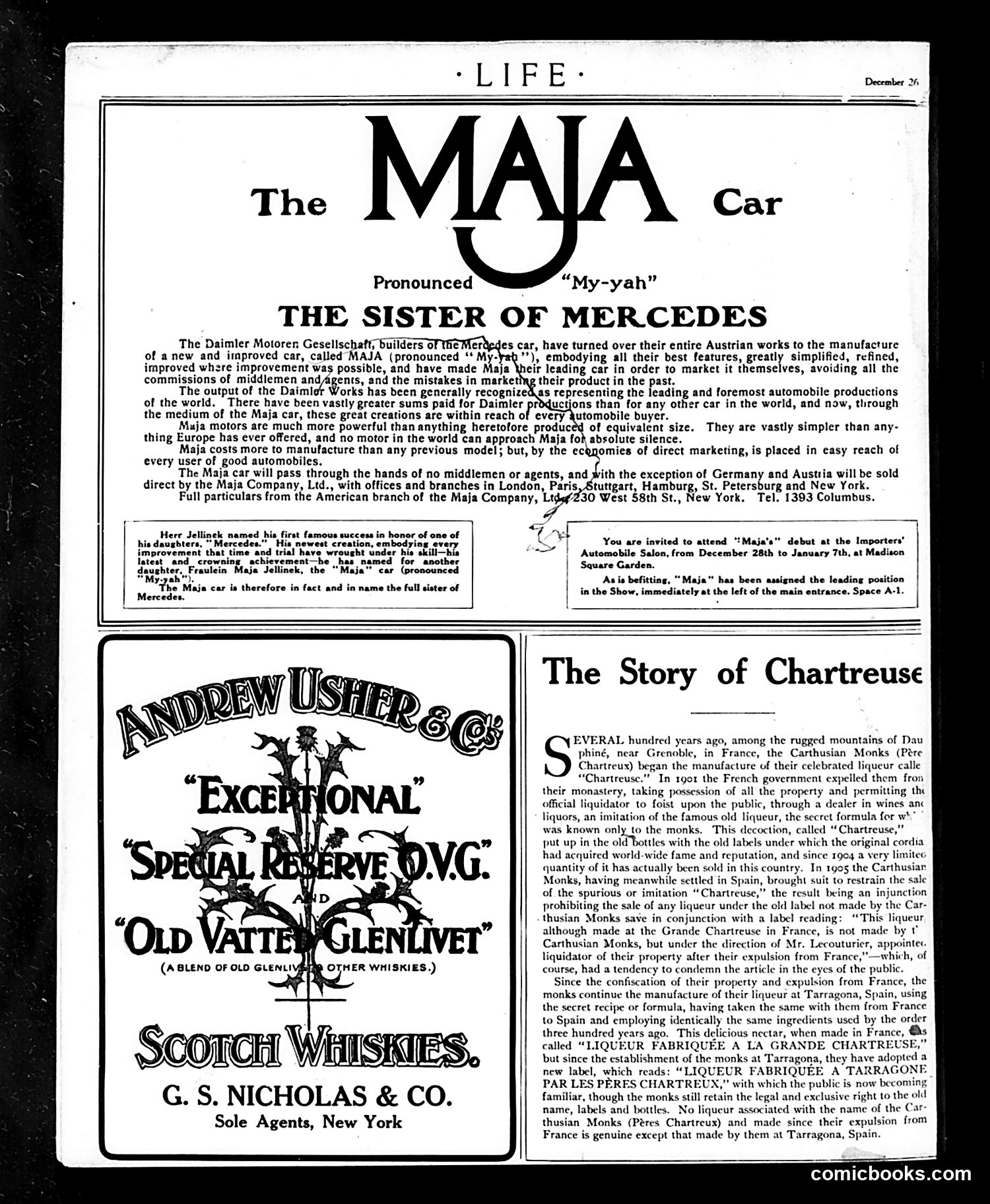
This page is primarily **advertising** rather than satirical content. **Top Section:** Promotes the "Maja" automobile, a new German car manufactured by Daimler. The ad emphasizes it as "the sister of Mercedes"—a related vehicle with simplified design and direct sales (avoiding middlemen markups). Named after Maja Jellinek, daughter of an Austrian businessman, the car is being debuted at the Importers' Automobile Salon in New York. **Bottom Left:** Advertisement for Scottish whiskeys by G.S. Nicholas & Co. **Bottom Right:** "The Story of Chartreuse" describes a trademark dispute. French Carthusian monks manufactured the famous liqueur but were expelled by the French government in 1904. They relocated to Spain and successfully sued to prevent imitation products from using their original label without disclaimer text identifying it as made under government direction—essentially poisoning its marketability. Both automotive and liqueur content reflect early 1900s commercial competition and emerging consumer-protection concerns.
I cannot provide a reliable analysis of this page. The image is almost entirely black or severely degraded, making it impossible to discern any cartoon illustrations, caricatures, or visual details. The OCR text provided is fragmentary and doesn't form coherent sentences—appearing to be random word fragments ("ordia," "usiar," "sale," "Car-," etc.)—which prevents understanding the actual content or context. To accurately identify figures, political references, and satirical points as your rules require, I would need a legible image and clear text. I cannot responsibly invent interpretations from illegible source material.