
Life, 1907-12-26 · page 14 of 21
Life — December 26, 1907 — page 14: what you’re looking at
What you’re looking at
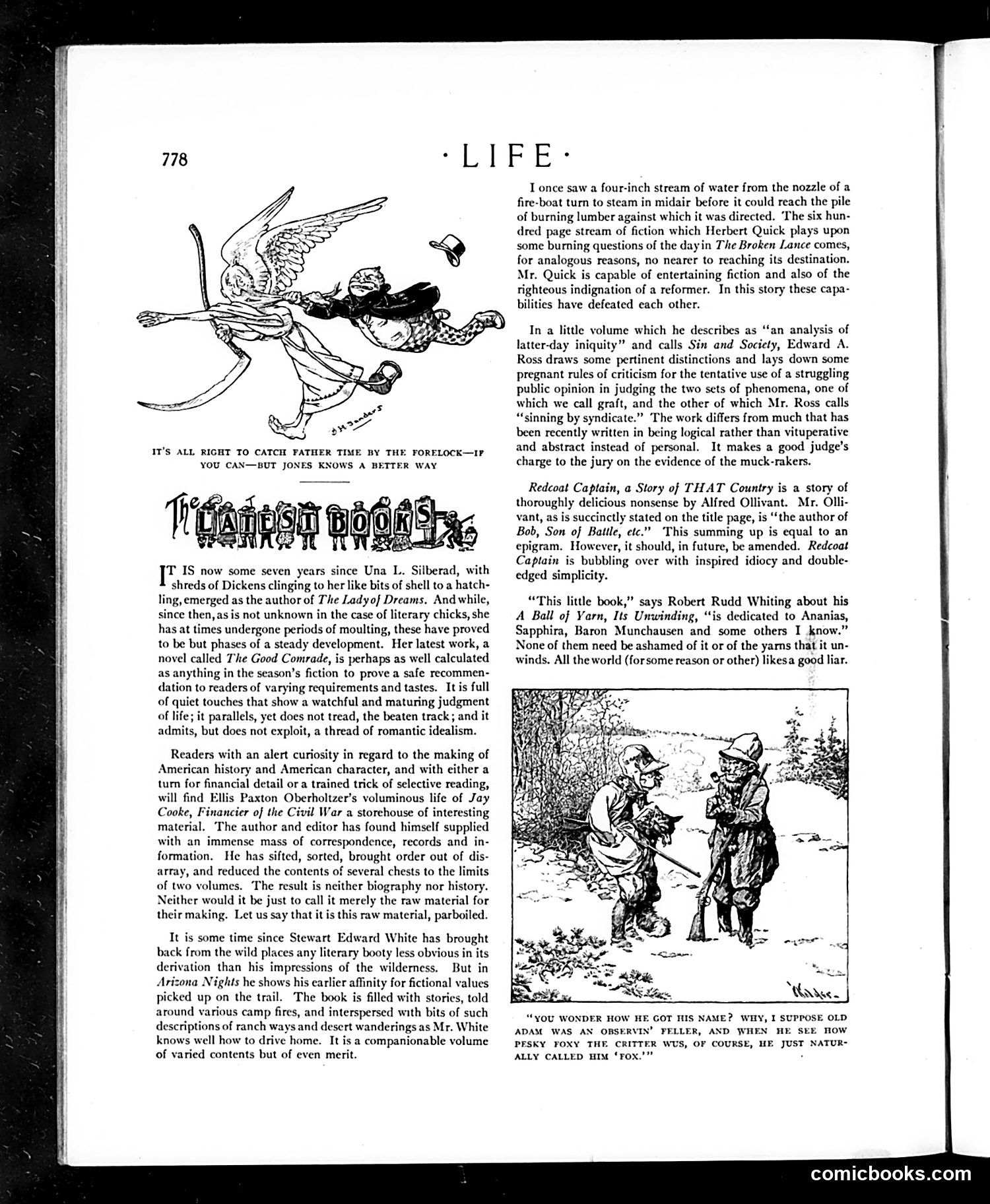
The page contains two distinct elements: **Top cartoon:** Shows a winged figure (Father Time, identifiable by traditional iconography) being caught by the forelock—a classical reference to seizing opportunity. The caption jokes that while catching Father Time is theoretically possible, "Jones knows a better way," suggesting an alternative (unstated) method. This is a play on the common phrase about seizing time by the forelock. **Main content:** Book reviews of contemporary literature, including works by Una L. Silberad, Ellis Paxton Oberholtzer, Stewart Edward White, Herbert Quick, Edward A. Ross, and Alfred Ollivant. The reviews assess literary merit and social relevance. Notable: the reviewer criticizes Quick's *The Broken Lane* for diluting its impact by mixing entertainment with reform rhetoric—comparing it to a fire-hose stream that dissipates before reaching its target. **Bottom illustration:** Shows two figures (one appears to be a Native American) in casual conversation, accompanying a review of Ollivant's *Redcoat Captain*.
📄 Transcribed text from this page (OCR, searchable)
Machine-transcribed from the original scan — historical spelling and the odd misread are preserved.
‘LIF E* 17'S ALL RIGHT TO CATCH FATHER TIME BY THE FORELOCK—IP YOU CAN—BUT JONES KNOWS A BETTER WAY 'T IS now some seven years since Una L. Silberad, with shreds of Dickens clinging to her like bits of shell to a hatch- ling, emerged as the author of The Ladyof Dreams. Andwhile, since then, as is not unknown in the case of literary chicks, she has at times undergone periods of moulting, these have proved to be but phases of a steady development. Her latest work, a novel called The Good Comrade, is perhaps as well calculated as anything in the season’s fiction to prove a safe recommen- dation to readers of varying requirements and tastes. It is full of quiet touches that show a watchful and maturing judgment of life; it parallels, yet does not tread, the beaten track; and it admits, but does not exploit, a thread of romantic idealism. Readers with an alert curiosity in regard to the making of American history and American character, and with either a tum for financial detail or a trained trick of selective reading, will find Ellis Paxton Oberholtzer’s voluminous life of Jay Cooke, Financier of the Civil War a storehouse of interesting material. ‘The author and editor has found himself supplied with an immense mass of correspondence, records and in- formation. He has sifted, sorted, brought order out of dis- array, and reduced the contents of several chests to the limits of two volumes. The result is neither biography nor history. Neither would it be just to call it merely the raw material for their making. Let us say that it is this raw material, parboiled. It is some time since Stewart Edward White has brought back from the wild places any literary booty less obvious in its derivation than his impressions of the wilderness. But in Arizona Nights he shows his earlier affinity for fictional values picked up on the trail. The book is filled with stories, told around various camp fires, and interspersed with bits of such descriptions of ranch ‘sand desert wanderings as Mr. White knows well how to drive home. It is a companionable volume of varied contents but of even merit. I once saw a four-inch stream of water from the nozzle of a fire-boat turn to steam in midair before it could reach the pile of burning lumber against which it was directed. ‘The six hun- dred page stream of fiction which Herbert Quick plays upon some burning questions of the dayin The Broken Lance comes, for analogous reasons, no nearer to reaching its destination. Mr. Quick is capable of entertaining fiction and also of the righteous indignation of a reformer. In this story these capa- bilities have defeated each other. In a little volume which he describes as ‘‘an analysis of latter-day iniquity” and calls Sin and Society, Edward A. Ross draws some pertinent distinctions and lays down some pregnant rules of criticism for the tentative use of a struggling public opinion in judging the two sets of phenomena, one of which we call graft, and the other of which Mr. Ross calls “sinning by syndicate.” ‘The work differs from much that has been recently written in being logical rather than vituperative and abstract instead of personal. It makes a good judge's charge to the jury on the evidence of the muck-rakers. Redcoat Captain, a Story of THAT Country is a story of thoroughly delicious nonsense by Alfred Ollivant. Mr. Olli- vant, as is succinctly stated on the title page, is ‘the author of Bob, Son of Battle, etc.” ‘This summing up is equal to an epigram. However, it should, in future, be amended. Redcoat Captain is bubbling over with inspired idiocy and double- edged simplicity. “This little book,” says Robert Rudd Whiting about his A Ball of Yarn, Its Unwinding, “is dedicated to Ananias, Sapphira, Baron Munchausen and some others I know.” None of them need be ashamed of it or of the yarns that it un- winds. All the world (for some reason or other) likesa good liar. ‘thares =| “YOU WONDER HOW HE GOT HIS NAME? WHY, I SUPPOSE OLD ADAM. WAS AN OBSERVIN’ FELLER, AND WHEN HE SEE HOW PFSKY FOXY THE CRITTER WUS, OF COURSE, HE JUST NATUR- ALLY CALLED HIM ‘FOX.’”” . comicbooks.com