
Life, 1907-12-26 · page 12 of 21
Life — December 26, 1907 — page 12: what you’re looking at
What you’re looking at
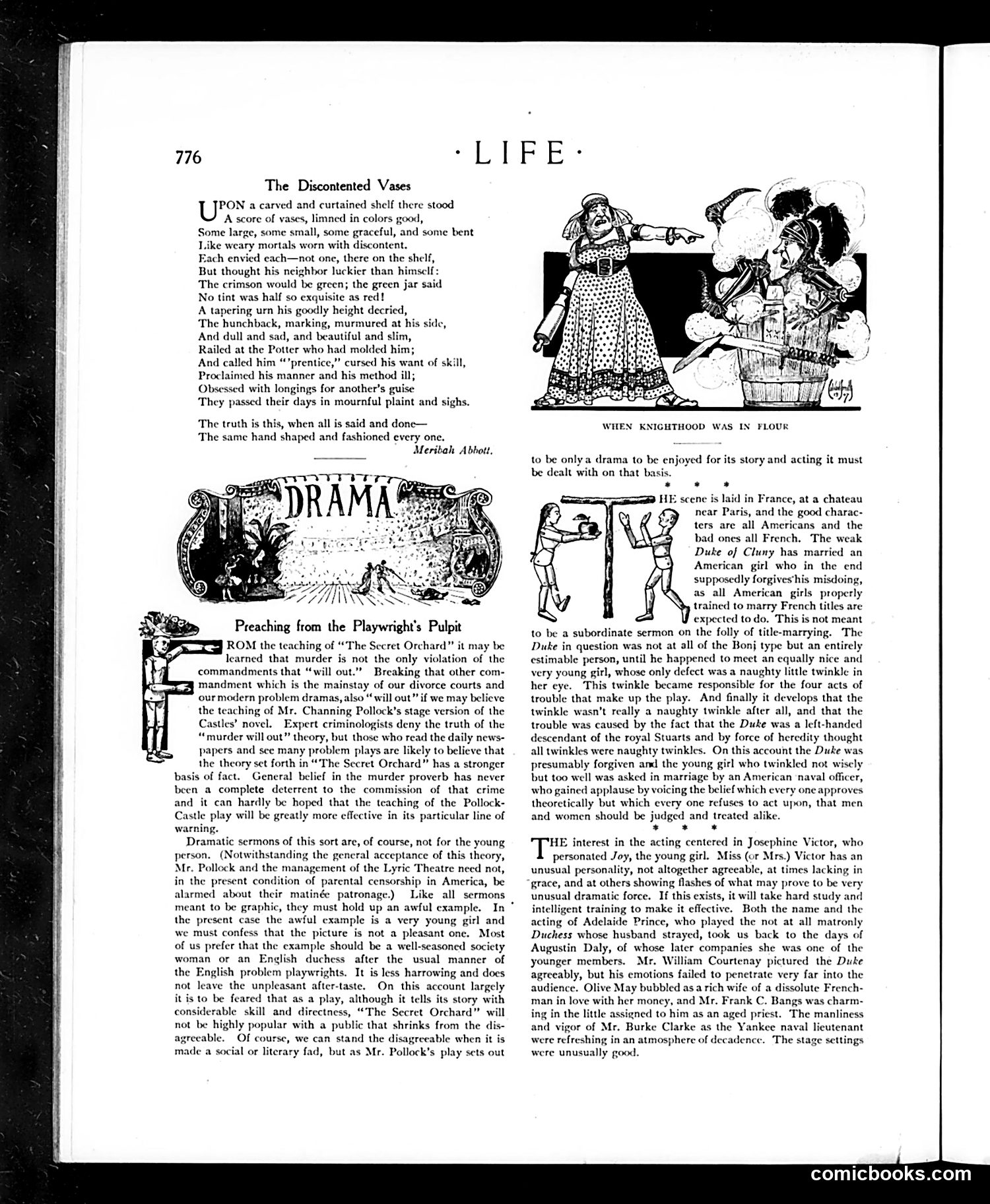
This page contains a poem titled "The Discontented Vases" by Meeriah Abbott, accompanied by an illustration labeled "When Knighthood Was In Flour" showing a woman directing children in what appears to be a domestic or culinary scene. Below is a dramatic essay titled "Preaching from the Playwright's Pulpit," discussing theatrical productions. The text critiques a play called "The Secret Orchard" and discusses another production featuring "the Duke of Clinsy," commenting on American actresses playing French roles and the morality of theatrical content. The page focuses on literary and theatrical criticism rather than political satire. The "flour" pun in the illustration's caption appears to be a gentle domestic humor reference typical of Life magazine's satirical style.
📄 Transcribed text from this page (OCR, searchable)
Machine-transcribed from the original scan — historical spelling and the odd misread are preserved.
The Discontented Vases PON a carved and curtained shelf there stood A score of vases, limned in colors good, Some large, some small, some graceful, and some bent Like weary mortals worn with discontent. Fach envied each—not one, there on the shelf, But thought his neighbor luckier than himself: The crimson would be n; the green jar said No tint was half so exquisite as red! A tapering urn his goodly height decried, The hunchback, marking, murmured at his side, And dull and sad, and beautiful and slim, Railed at the Potter who had molded him; And called him “’prentice,” cursed his want of skill, Proclaimed his manner and his method il Obsessed with longings for another's guise ‘They passed their days in mournful plaint and sighs. The truth is this, when all is said and dono— The same hand shaped and fashioned every one. Meribah Abbott. learned that murder is not the ‘only violation of the commandments that “will out.” Breaking that other com- mandment which is the mainstay of our divorce courts and our modern problem dramas, also will out” if we may believe the teaching of Mr. Channing Pollock's stage version of the tIcs’ novel. Expert criminologists deny the truth of the “murder will out” theory, but those who read the daily news- papers and sce many problem plays are likely to believe that the theory set forth in “The Secret Orchard” has a stronger basis of fact. General belief in the murder proverb has never been a complete deterrent to the commission of that crime and it can hardly be hoped that the teaching of the Pollock- Castle play will be greatly more effective in its particular line of warning. Dramatic sermons of this sort are, of course, not for the young person. (Notwithstanding the general acceptance of this theory, Mr. Pollock and the management of the Lyric Theatre need not, in the present condition of parental censorship in America, be alarmed about their matinée patronage.) Like all sermons meant to be graphic, they must hold up an awful example. In * the present case the awful example is a very young girl and we must confess that the picture is not a pleasant one. Most of us prefer that the example should be a well-seasoned society woman or an English duchess after the usual manner of the English problem playwrights. It is less harrowing and docs not leave the unpleasant after-taste. On this account largely it is to be feared that as a play, although it tells its story with considerable skill and directness, “The Secret Orchard” will not be highly popular with a public that shrinks from the di agreeabl Of course, we can stand the disagreeable when it is made a social or literary fad, but as Mr. Pollock's play sets out WHEN KNIGHTHOOD WAS IN FLOUR to be onlya drama to be enjoyed for its story and acting it must be dealt with on that basis. * 8 8 HE scene is laid in France, at a chateau near Paris, and the good charac- ters are all Americans and the bad ones all French, The weak Duke of Cluny has married an American girl who in the end supposedly forgiveshis misdoing, as all American girls properly trained to marry French titles are expected to do. This is not meant to be a subordinate sermon on the folly of title-marrying. ‘The Duke in question was not at all of the Bonj type but an entirely estimable person, until he happened to meet an equally nice and very young girl, whose only defect was a naughty little twinkle in her eye. This twinkle became responsible for the four acts of trouble that make up the play. And finally it develops that the twinkle wasn’t really a naughty twinkle after all, and that the trouble was caused by the fact that the Duke was a left-handed descendant of the roya ts and by force of heredity thought all twinkles were enchany twinkles. On this account the Duke was presumably forgiven and the young girl who twinkled not wisely but too well was asked in marriage by an American naval offic who gained applause by voicing the belief which every one approv theoretically but which every one refuses to act upon, that men and women should be judged and treated alike. + + & HE interest in the acting centered in Josephine Victor, who personated Joy, the young girl. Miss (or Mrs.) Victor has an unusual personality, not altogether agreeable, at times lacking in grace, and at others showing flashes of what may prove to be very unusual dramatic force. If this exists, it will take hard study and intelligent training to make it effective. Both the name and the acting of Adelaide Prince, who played the not at all matronly Duchess whose husband strayed, took us back to the days of Augustin Daly, of whose later companies she was one of the younger members. Mr. William Courtenay pictured the Duke agreeably, but his emotions failed to penetrate very far into the audience. Olive May bubbled as a rich wife of a dissolute French- man in love with her moncy, and Mr. Frank C. Bangs was charm- ing in the little assigned to him as an aged priest. The manliness and vigor of Mr, Burke Clarke as the Yankee naval lieutenant were refreshing in an atmosphere of decadence. The stage settings were unusually good. comicbooks.com