
Life, 1907-12-26 · page 4 of 21
Life — December 26, 1907 — page 4: what you’re looking at
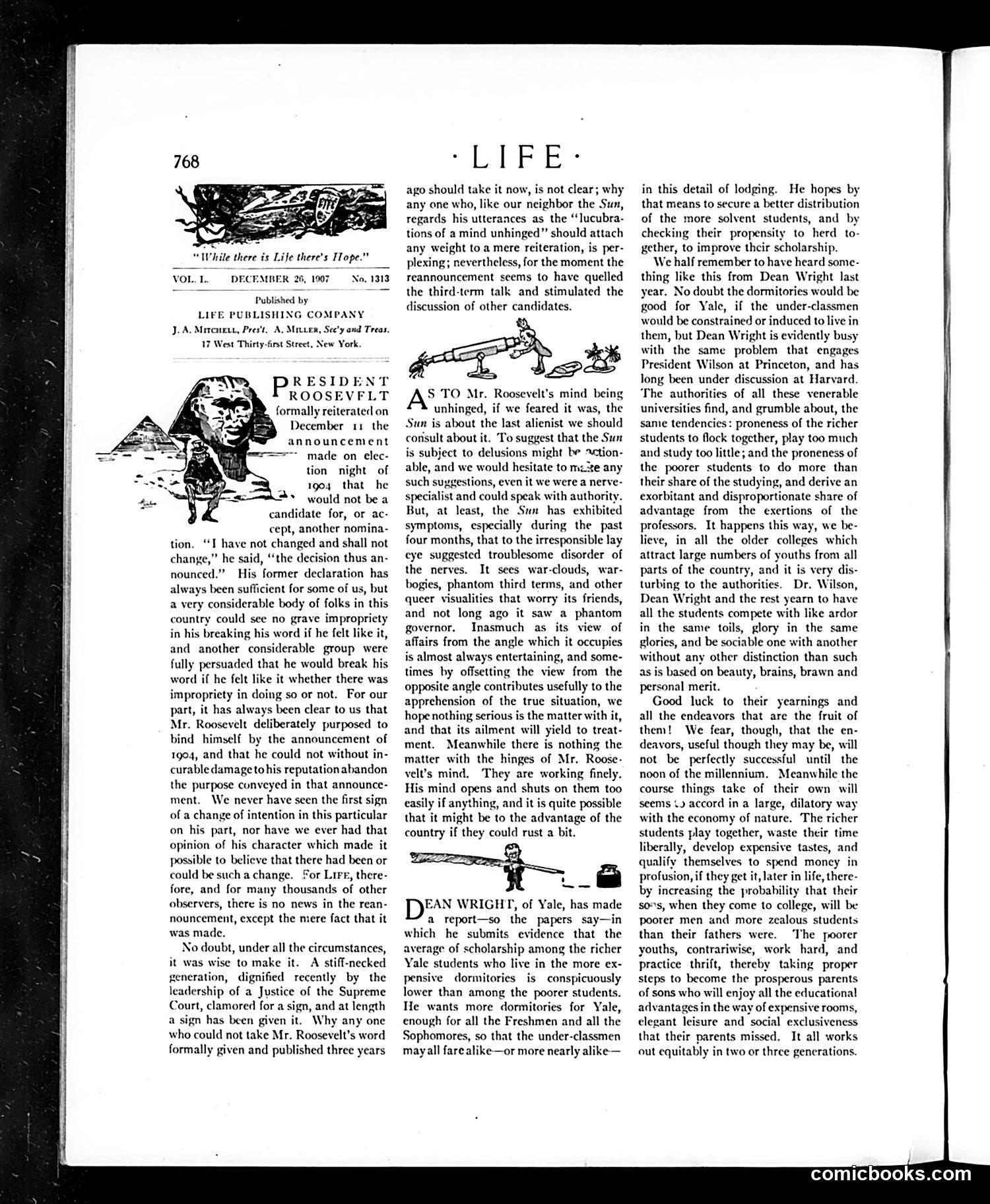
A restored page from Life, 1907-12-26. Page through the whole issue in the reader above.
📄 Transcribed text from this page (OCR, searchable)
Machine-transcribed from the original scan — historical spelling and the odd misread are preserved.
“While there is Life there's Tope.” VOL. 1 DECEMBER 26, 1907 No, 1313 Published by LIFE PUBLISHING COMPANY J.A. Mircuent, Pres, A, Mrtuen, Sec'y and Treas, 17 West Thirty-first Street, New York. RESIDENT ROOSEVFLT ) formally reiterated on December 11 the announcement “made on celec- tion night of 1904 that he would not be a candidate for, or ac- cept, another nomina- tion. ‘I have not changed and shall not change,” he said, “the decision thus an- nounced.” His former declaration has always been sufficient for some of us, but a very considerable body of folks in this country could see no grave impropricty in his breaking his word if he felt like it, and another considerable group were fully persuaded that he would break his word if he felt like it whether there was impropriety in doing so or not. For our part, it has always been clear to us that Mr. Roosevelt deliberately purposed to bind himself by the announcement of 1904, and that he could not without in- curable damage to his reputation abandon the purpose conveyed in that announce- ment. We never have seen the first sign of a change of intention in this particular on his part, nor have we ever had that opinion of his character which made it possible to believe that there had been or could be such a change. For Lire, there- fore, and for many thousands of other observers, there is no news in the rean- nouncement, except the mere fact that it was made, No doubt, under all the circumstances, it was wise to make it. A stiff-necked gencration, dignified recently by the leadership of a Justice of the Supreme Court, clamored for a sign, and at length a sign has been given it. Why any one who could not take Mr. Roosevelt’s word formally given and published three years LIPse ago should take it now, is not clear; why any one who, like our neighbor the Sun, regards his utterances as the “lucubra- tions of a mind unhinged” should attach any weight to a mere reiteration, is per- plexing; nevertheless, for the moment the reannouncement seems to have quelled the third-term talk and stimulated the discussion of other candidates. oP iat TO Mr. Roosevelt's mind being AY vnnged we feared it was, the Sun is about the last alienist we should consult about it. To suggest that the Sun is subject to delusions might be ction- able, and we would hesitate to mz%e any such suggestions, even it we were a nerve- specialist and could speak with authori But, at least, the Sun has exhibited symptoms, especially during the past four months, that to the irresponsible lay eye suggested troublesome disorder of the nerves. It sees war-clouds, war- bogies, phantom third terms, and other queer visualities that worry its friends, and not long ago it saw a phantom governor. Inasmuch as its view of affairs from the angle which it occupies is almost always entertaining, and some- times by offsetting the view from the opposite angle contributes usefully to the apprehension of the true situation, we hope nothing serious is the matter with it, and that its ailment will yield to treat- ment. Meanwhile there is nothing the matter with the hinges of Mr. Roose- velt’s mind. They are working finely. His mind opens and shuts on them too easily if anything, and it is quite possible that it might be to the advantage of the country if they could rust a bit. EAN WRIGHT, of Yale, has made a report—so the papers say—in which he submits evidence that the average of scholarship among the richer Yale students who live in the more ex- pensive dormitories is conspicuously lower than among the poorer students. He wants more dormitories for Yale, enough for all the Freshmen and all the Sophomores, so that the under-classmen mayall farcalike—or more nearly alike— in this detail of lodging. He hopes by that means to secure a better distribution of the more solvent students, and by checking their propensity to herd to- gether, to improve thcir scholarship. We half remember to have heard some- thing like this from Dean Wright last year. No doubt the dormitories would be good for Yale, if the under-classmen would be constrained or induced to live in them, but Dean Wright is evidently busy with the same problem that engages President Wilson at Princeton, and has long been under discussion at Harvard. The authorities of all these venerable universities find, and grumble about, the same tendencies: proneness of the richer students to flock together, play too much and study too little; and the proneness of the poorer students to do more than their share of the studying, and derive an exorbitant and disproportionate share of advantage from the exertions of the professors. It happens this way, we be- lieve, in all the older colleges which attract large numbers of youths from all parts of the country, and it is very dis- turbing to the authorities. Dr. Wilson, Dean Wright and the rest yearn to have all the students compete with like ardor in the same toils, glory in the same glories, and be sociable one with another without any other distinction than such as is based on beauty, brains, brawn and personal merit. Good luck to their yearnings and all the endeavors that are the fruit of them! We fear, though, that the en- deavors, useful though they may be, will not be perfectly successful until the noon of the millennium. Meanwhile the course things take of their own will seems 4» accord in a large, dilatory way with the economy of nature. The richer students play together, waste their time liberally, develop expensive tastes, and qualify themselves to spend money in profusion, if they get it, later in life, there- by increasing the probability that their sos, when they come to college, will be poorer men and more zealous students than their fathers were. ‘The poorer youths, contrariwise, work hard, and practice thrift, thereby taking proper steps to become the prosperous parents of sons who will enjoy all the educational advantages in the way of expensive rooms, elegant leisure and social exclusiveness that their parents missed. It all works out equitably in two or three generations. comicbooks.com