
Life, 1907-12-26 · page 15 of 21
Life — December 26, 1907 — page 15: what you’re looking at
What you’re looking at
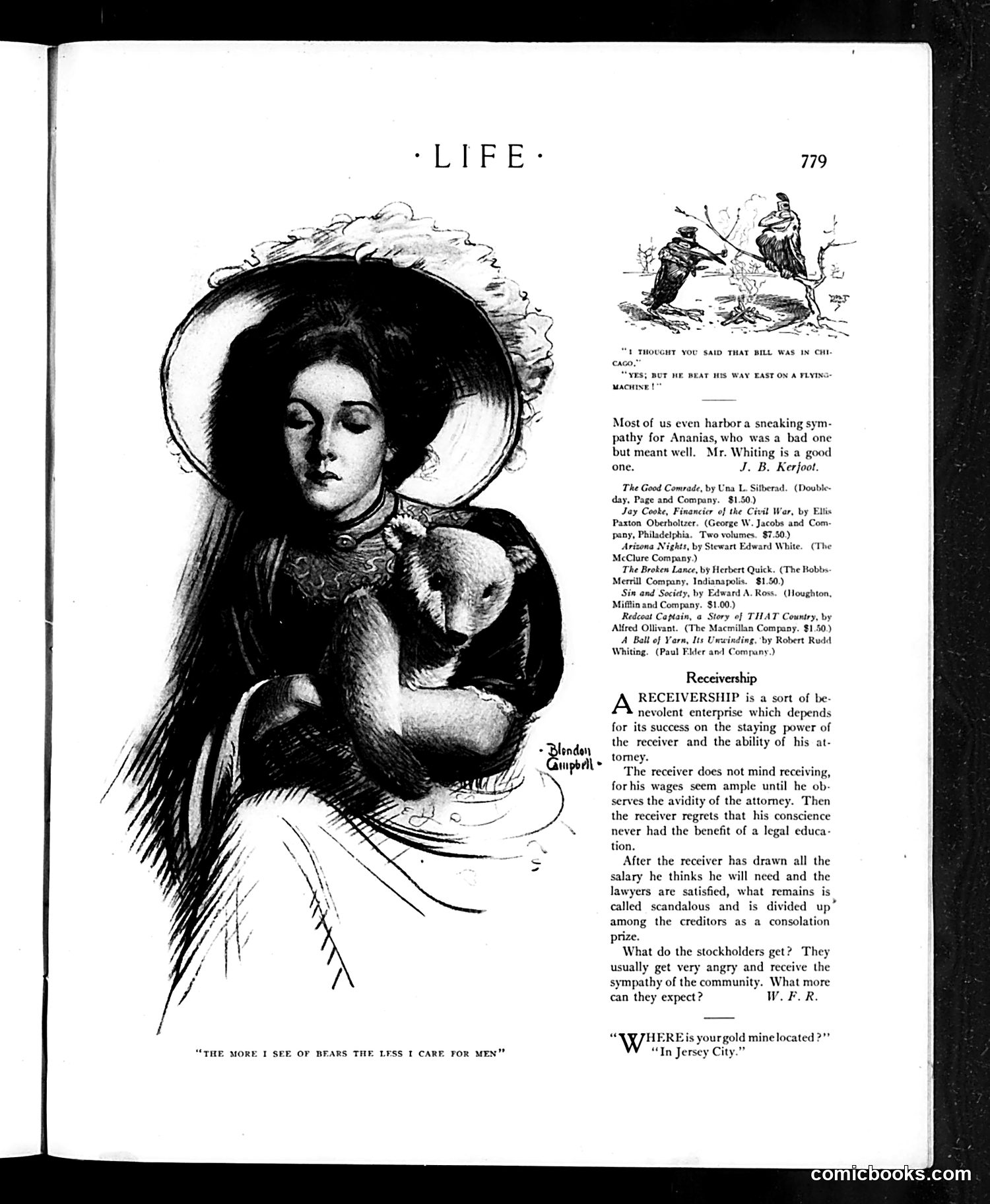
This page contains multiple satirical pieces about dishonesty and financial malfeasance: **Main Cartoon (left):** A sketch by Blanden Campbell showing a woman holding a bear, with caption "The more I see of bears the less I care for men"—satirizing misanthropy through animal preference. **Top Dialogue:** Two small comics mock a character named Bill who claimed to be "in Chicago" but actually "beat his way east on a flying machine"—mocking implausible excuses and unreliable people. **"Receivership" Essay:** The main text sardonically describes bankruptcy proceedings where receivers and lawyers extract all available funds, leaving stockholders with "sympathy" and creditors with mere "consolation prizes." It critiques how legal professionals profit from financial collapse while ordinary investors suffer. **Bottom Joke:** A one-liner about a gold mine "located in Jersey City"—likely referencing New Jersey's reputation for fraud or dubious schemes. The page's recurring theme: distrust of those in positions of authority (lawyers, receivers, con artists) who exploit systems for personal gain at others' expense.
📄 Transcribed text from this page (OCR, searchable)
Machine-transcribed from the original scan — historical spelling and the odd misread are preserved.
“THE MORE I SEE OP BEARS THE LESS T CARE FOR MEN’? “1 THOUGHT YOU SAID THAT BILL WAS IN CH cco.” “YES; BUT HE BEAT If1S WAY EAST ON A FLYING: macuiye t”* Most of us even harbor a sneaking sy pathy for Ananias, who was a bad one but meant well. Mr. Whiting is a good one. J. B. Kerjoot. The Good Comrade, by Una L. Silberad. (Double- day, Page and Company. $1.50.) Jay Cooke, Financier of the Civit War, by Ellis Paxton Oberholtzer. (George W. Jacobs and Com- pany, Philadelphia. Two volumes. $7.50.) Arizona Nights, by Stewart Edward White. (The McClure Company.) The Broken Lance, by Herbert Quick. (The Bobbs: Merrill Company, Indianapolis. $1.50.) Sin and Socidy, by Edward A. Ross. (Houghton, Mifflin and Company. $1.00.) Redcoat Captain, a Story of THAT Country, by Alfred Ollivant. (The Macmillan Company. $1.50.) A Balt of Yarn, Its Unwinding, ‘by Robert Rudd Whiting. (Paul Elder and Company.) Receivership RECEIVERSHIP is a sort of be- nevolent enterprise which depends for its success on the staying power of the receiver and the ability of his at- torney. The receiver does not mind receiving, forhis wages seem ample until he ob- serves the avidity of the attorney. Then the receiver regrets that his conscience never had the benefit of a legal educa- tion. After the receiver has drawn all the salary he thinks he will need and the lawyers are satisfied, what remains is called scandalous and is divided up” among the creditors as a consolation prize. What do the stockholders get? They usually get very angry and receive the sympathy of the community. What more can they expect? WER. “NYJHEREis yourgold mine located ?”” “In Jersey City.”