
Life, 1907-12-26 · page 13 of 21
Life — December 26, 1907 — page 13: what you’re looking at
What you’re looking at
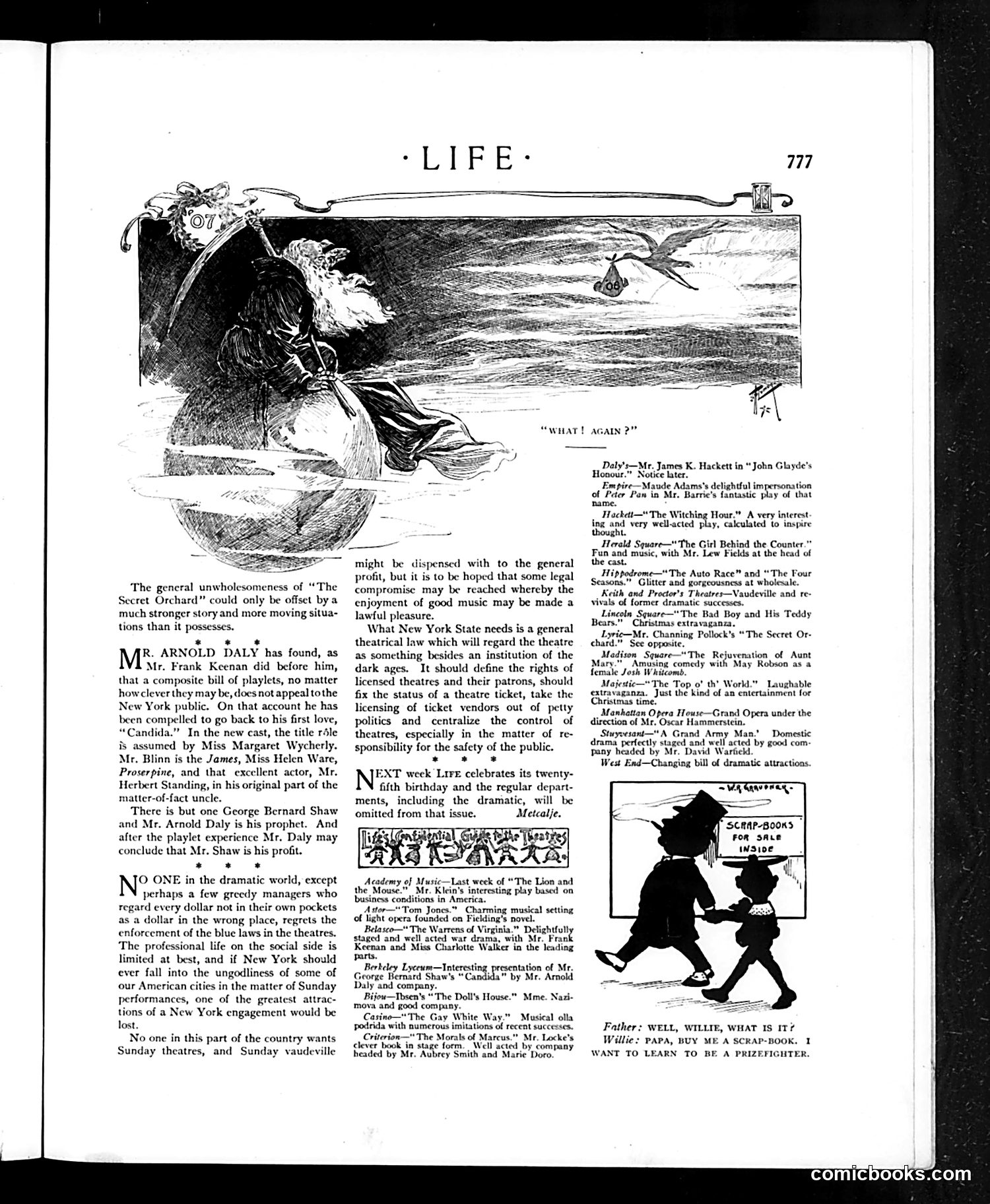
This page contains theatrical reviews and commentary rather than political satire. The main illustration shows a figure asking "WHAT AGAIN?" — likely commenting on repetitive theatrical productions of the era. The text discusses Mr. Arnold Daly's efforts to make New York theaters more wholesome and public-minded, contrasting with current theatrical practices. A secondary cartoon at bottom right depicts a father and son, with the boy asking to buy a scrap-book to "learn to be a prizefighter" — satirizing how popular entertainment (likely prize-fighting coverage in publications) influences children's aspirations. The page primarily reviews contemporary theatrical productions, making this primarily an entertainment/cultural commentary issue rather than political satire.
📄 Transcribed text from this page (OCR, searchable)
Machine-transcribed from the original scan — historical spelling and the odd misread are preserved.
‘The general unwholesomeness of “The Secret Orchard” could only be offset by a much stronger story and more moving situa- tions than it possesses. * * «& R. ARNOLD DALY has found, as Mr. Frank Keenan did before him, that a composite bill of playlets, no matter howclever they may be, does not appeal tothe New York public. On that account he has been compelled to go back to his first love, ‘andida.” In the new cast, the title rile is assumed by Miss Margaret Wycherly. Mr. Blinn is the James, Miss Helen Ware, Proserpine, and that excellent actor, Mr. Herbert Standing, in his original part of the matter-of-fact uncle. There is but one George Bernard Shaw and Mr. Arnold Daly is his prophet. And after the playlet experience Mr. Daly may conclude that Mr. Shaw is his profit. s 8 O ONE in the dramatic world, except perhaps a few greedy managers who regard every dollar not in their own pockets as a dollar in the wrong place, regrets the enforcement of the bluc laws in the theatres. The professional life on the social side is limited at best, and if New York should ever fall into the ungodliness of some of our American cities in the matter of Sunday performances, one of the greatest attrac- tions of a New York engagement would be lost. No one in this part of the country wants Sunday theatres, and Sunday vaudeville “WHAT! AGAIN?” might be dispensed with to the general profit, but it is to be hoped that some legal compromise may be reached whereby the enjoyment of good music may be made a lawful pleasure. What New York State needs is a general theatrical law which will regard the theatre as something besides an institution of the dark ages. It should define the rights of licensed theatres and their patrons, should fix the status of a theatre ticket, take the licensing of ticket vendors out of petty politics and centralize the control of theatres, especially in the matter of re- sponsibility for the safety of the public. + 8 8 EXT week Lire celebrates its twenty- fifth birthday and the regular depart- ments, including the dramatic, will be omitted from that issue. Metcalje. Academy of Music—Last week of “The Lion and the Mouse.” Mr. Klein's interesting play based on business conditions in America. Astor—"Tom Jones.” Charming musical setting of light opera founded on Fielding’s novel. Belaxco—"The Warrens of Virginia." Delightfully staged and well acted war drama, with Mr. Fran Keenan and Miss Charlotte Walker in the leading parts. Berkeley Lyceum—Interesting. presentation of Mr. George Bernard Shaw's “Candida” by Mr. Arnold Daly and company. Bijow—Tbsen's “The Doll's House." Mme. Nazi- mova and ood company. Casino—"The Gay White Way.” Musical olla podrida with numerous imitations of recent successes. Criterion—"The Morals of Marcus." Mr. Locke's clever book in stage form. Well acted by company headed by Mr. Aubrey Smith and Marie Doro. Daly's—Mr. James K. Hackett in “ John Glayde’s ” Notice later. Empire—Maude Adams's delightful impersonation of Peter Pan in Mr. Barrie's fantastic play of that * A very interest ing and very well-acted play, caiculated to inspire thought. Herald Square—" The Girl Behind the Counter.” Fun and music, with Mr. Lew Fields at the head of the cast. Hippodrome—"The Auto Race” and “The Four Seasons." Glitter and gorgeousness at wholesale. Keith and Proctor’s Theatres—Vaudeville and re- vivals of former dramatic successes. Lincoln Square—"The Bad Boy and His Teddy Bears.” Christmas extravaganza. Lyric—Mr. Channing Pollock's “The Secret Or- chard.” See opposite, Madison Square—"The Rejuvenation of Aunt Mary.” “Amusing comedy with May Robson as a female Josh Whitcomb. Majeic—"'The Top o' th' World." Laughable extravaganza. Just the kind of an entertainment for Christmas time, Manhattan Opera House—Grand Opera under the direction of Mr. Oscar Hammerstein. Stuyvesant—""A Grand Army Man.’ Domestic drama perfectly staged and well acted by good com- pany headed by Mr. David Warfield West End—Changing bill of dramatic attractions. SCRAP-BOOKS | FoR save INSi0e Father: WELL, WILLIE, WHAT IS IT? Willie: PAPA, BUY ME A SCRAP-BOOK. WANT TO LEARN TO BE A PRIZEFIGHTER. comicbooks.com