
Life, 1907-12-26 · page 8 of 21
Life — December 26, 1907 — page 8: what you’re looking at
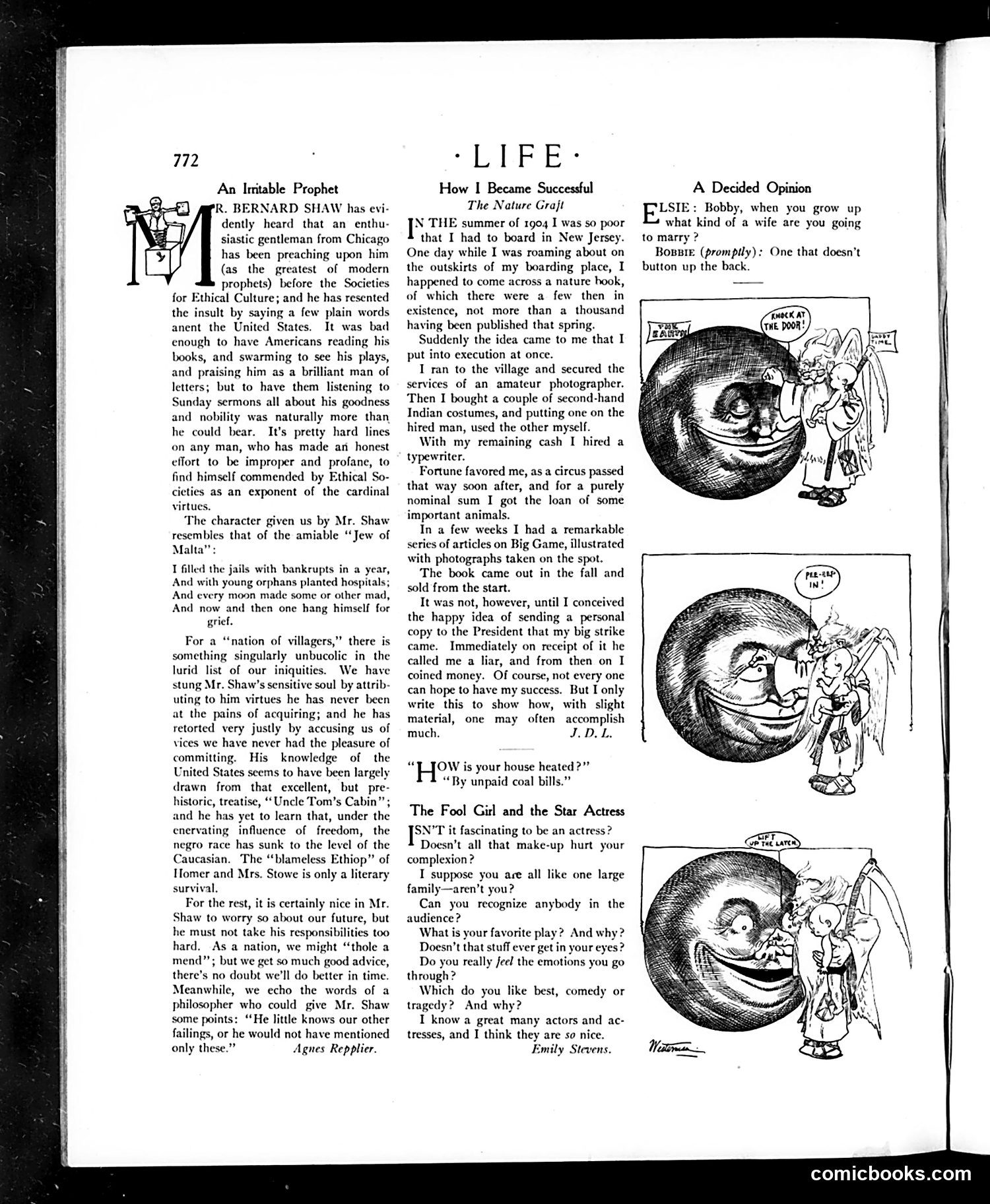
What you’re looking at
This page contains three distinct sections: a critical editorial about Bernard Shaw (left column), a first-person narrative about a nature photographer's success (center), and three illustrated vignettes about theatrical life (right side). The Shaw editorial attacks the playwright's recent preaching to American audiences about ethics and morality, sarcastically noting that despite his moral posturing, Shaw has "never been at the pains of acquiring" virtue himself. The author questions his credibility as a moral authority. The right-side illustrations appear to humorously depict interactions between theatrical performers and audiences—likely depicting the artificiality and pretense of theatrical life. The cartoons mock actresses and their relationships with admirers, suggesting the gap between stage personas and reality. The overall tone is satirical critique of public figures and theater culture.
📄 Transcribed text from this page (OCR, searchable)
Machine-transcribed from the original scan — historical spelling and the odd misread are preserved.
An Irritable Prophet R. BERNARD SHAW has evi- dently heard that an enthu- siastic gentleman from Chicago has been preaching upon him (as the greatest of modern prophets) before the Societies for Ethical Culture; and he has resented the insult by saying a few plain words anent the United States. It was bad enough to have Americans reading his books, and swarming to see his plays, and praising him as a brilliant man of letters; but to have them listening to Sunday sermons all about his goodness and nobility was naturally more than he could bear. It’s pretty hard lines on any man, who has made an honest effort to be improper and profane, to find himself commended by Ethical So- ci as an exponent of the cardinal virtues. The character given us by Mr. Shaw resembles that of the amiable “Jew of Malta”: T filled the jails with bankrupts in a year, And with young orphans planted hospitals; And every moon made some or other mad, And now and then one hang himself for grief. For a ‘‘nation of villagers,” there is something singularly unbucolic in the lurid list of our iniquities. We have stung Mr. Shaw’s sensitive soul by attrib- uting to him virtues he has never been at the pains of acquiring; and he has retorted very justly by accusing us of vices we have never had the pleasure of committing. His knowledge of the United States seems to have been largely drawn from that excellent, but pre- historic, treatise, “Uncle Tom’s Cabin” ; and he has yet to learn that, under the enervating influence of freedom, the negro race has sunk to the level of the Caucasian. The “blameless Ethiop” of Homer and Mrs. Stowe is only a literary survival, For the rest, it is certainly nice in Mr. Shaw to worry so about our future, but he must not take his responsibilities too hard. As a nation, we might “thole a mend”; but we get so much good advice, there’s no doubt we'll do better in time. Meanwhile, we echo the words of a philosopher who could give Mr. Shaw some points: “He little knows our other failings, or he would not have mentioned only these.” Agnes Repplier. *LIFE- How | Became Successful The Nature Grajt I \ THE summer of 1904 I was so poor that I had to board in New Jersey. One day while I was roaming about on the outskirts of my boarding place, I happened to come across a nature book, of which there were a few then in existence, not more than a thousand having been published that spring. Suddenly the idea came to me that I put into execution at once. I ran to the village and secured the services of an amateur photographer. Then I bought a couple of second-hand Indian costumes, and putting one on the hired man, used the other myself. With my remaining cash I hired a typewriter. Fortune favored me, as a circus passed that way soon after, and for a purely nominal sum I got the loan of some important animals. In a few weeks I had a remarkable series of articles on Big Game, illustrated with photographs taken on the spot. The book came out in the fall and sold from the start. It was not, however, until I conceived the happy idea of sending a personal copy to the President that my big strike came. Immediately on receipt of it he called me a liar, and from then on I coined money. Of course, not every one can hope to have my success. But I only write this to show how, with slight material, one may often accomplish much. IDOL. ““FHOW is your house heated ?” “By unpaid coal bills.” The Fool Girl and the Star Actress SN’T it fascinating to be an actress? Doesn’t all that make-up hurt your complexion ? T suppose you ace all like one large family—aren’t you? Can you recognize anybody in the audience ? What is your favorite play? And why? Doesn’t that stuff ever get in your eyes ? Do you really Jeel the emotions you go through? Which do you like best, comedy or tragedy? And why? I know a great many actors and ac- tresses, and I think they are so nice. Emily Stevens. A Decided Opinion LSIE: Bobby, when you grow up what kind of a wife are you going to marry ? Bosie (promptly): One that doesn’t button up the back. comicbooks.com