
A complete issue · 20 pages · 1907
Life — November 28, 1907
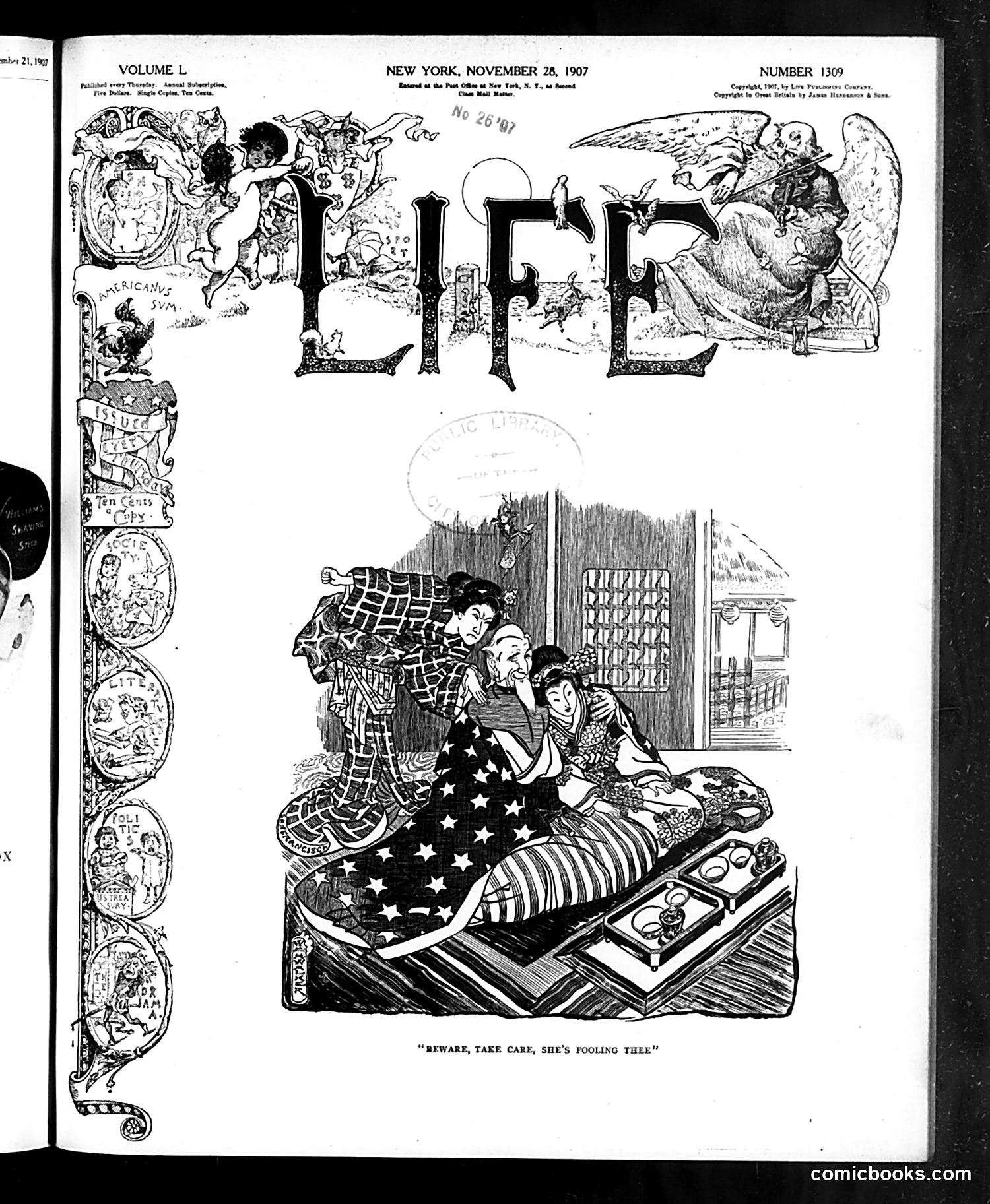
**Main Cartoon Caption:** "Beware, take care, she's fooling thee" The cartoon depicts three men in bed with an American flag blanket, appearing to be tricked or deceived. The setting is a bedroom with a window and bookshelf visible. The satire likely concerns American foreign policy or political deception during the Roosevelt era. The "she" in the caption appears to refer to a female figure (possibly personifying a nation or political entity), warning the men—perhaps representing American interests or politicians—that they are being deceived. Without additional context about specific 1907 events, the precise political reference remains unclear, though it suggests skepticism about American diplomatic dealings or international relations of that period. The American flag imagery indicates patriotic or nationalist themes.
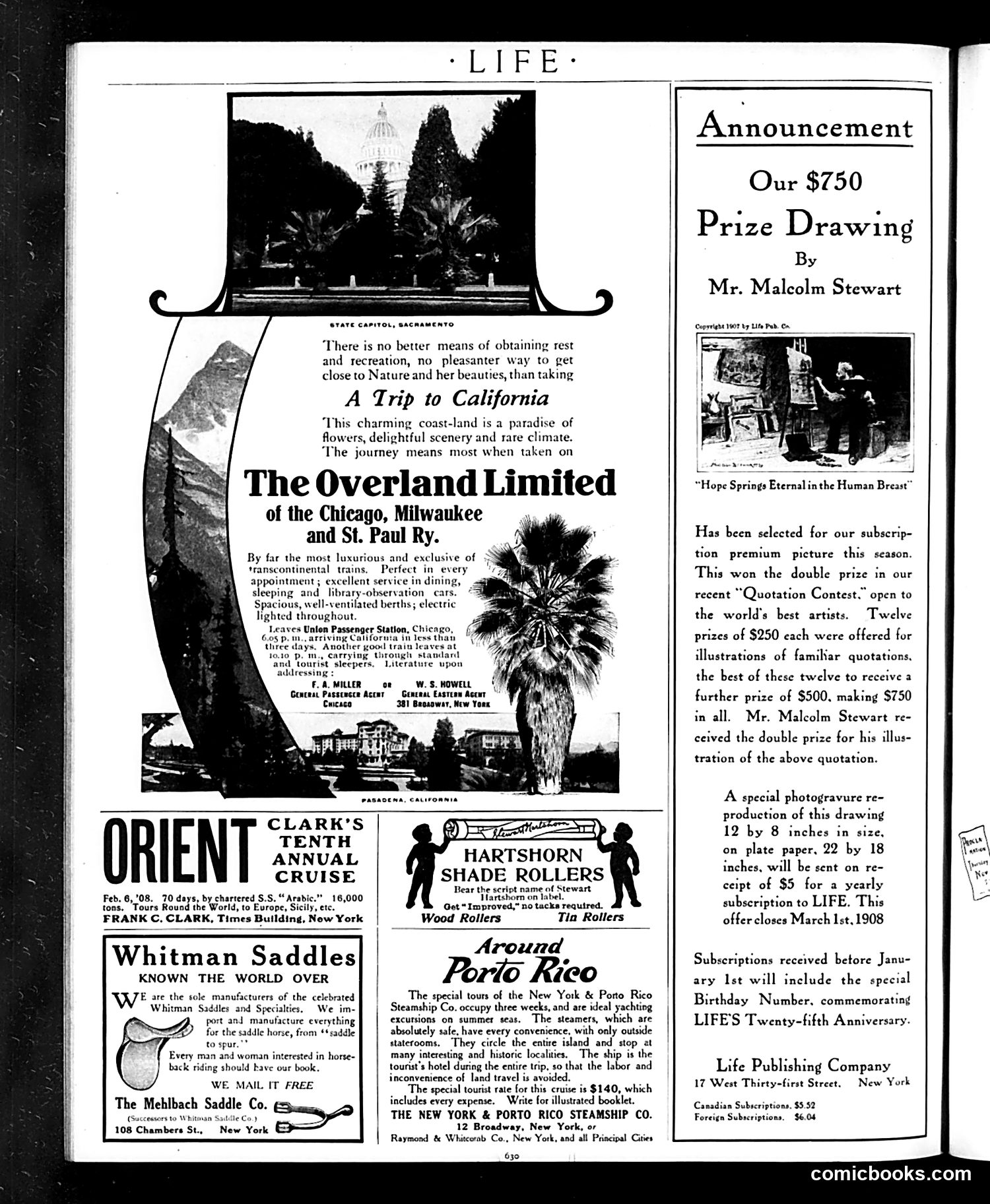
This page is primarily **advertising and announcements**, not political satire. The content includes: **Main advertisements:** - The Overland Limited train service to California - Orient cruise line - Whitman Saddles - Hartshorn Shade Rollers - Porto Rico steamship excursions **Editorial content:** An announcement of Life magazine's "$750 Prize Drawing," featuring Mr. Malcolm Stewart's winning illustration titled "Hope Springs Eternal in the Human Breast." The artwork won a "$250 Quotation Contest" where artists illustrated familiar quotations; Stewart received an additional $500 bonus, totaling $750. The page reflects early 20th-century commercial culture: luxury travel promotions, consumer goods, and the magazine's subscription incentives. There is **no political cartoon or satire present**.
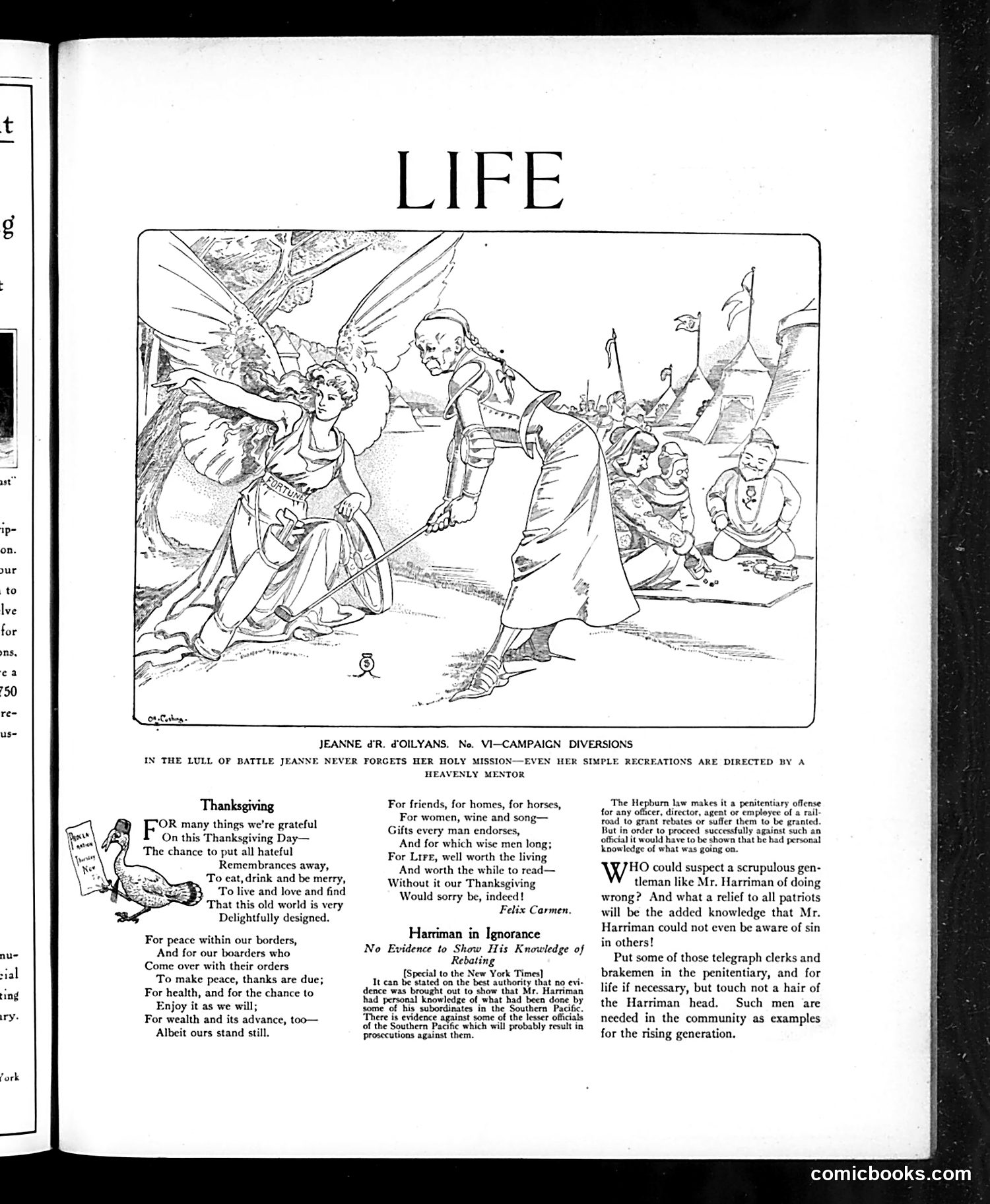
This page features a satirical illustration titled "Jeanne d'Orléans: No. VI—Campaign Diversions," depicting Joan of Arc attempting to maintain her religious mission despite distractions from soldiers and camp followers. The caption notes she "never forgets her holy mission—even her simple recreations are directed by a heavenly mentor." The accompanying articles criticize WWI-era figures: a Thanksgiving piece advocates gratitude for peace and health, while "Harriman in Ignorance" attacks a government official (likely Averell Harriman or similar) for lacking knowledge about telegraph operators and brakemen. The satire suggests these officials are unaware of or indifferent to working-class suffering and should serve as moral examples for society.
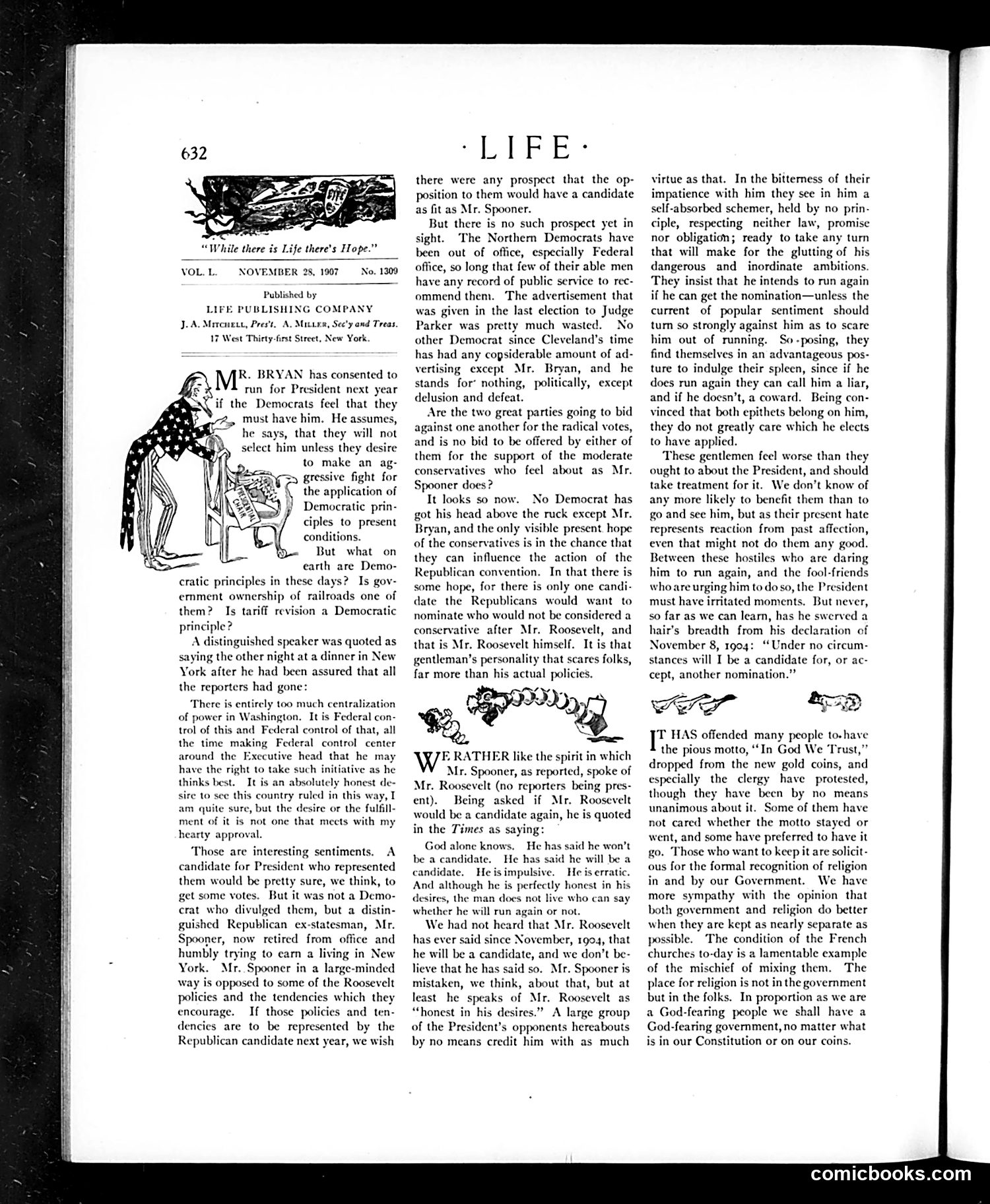
The page features political commentary about the 1908 presidential election. The main cartoon depicts **Uncle Sam as a weighing scale**, presumably balancing competing candidates or party interests—a standard metaphor for electoral choice. The article discusses **William Jennings Bryan's** potential candidacy for the Democrats and criticizes **President Theodore Roosevelt**. The text suggests conservative Republicans fear Roosevelt's radical tendencies and question whether Democrats will nominate someone who can actually win against Republican candidates. The satire targets **factional disputes within both parties**: Democrats struggling to unite around a viable candidate, and Republicans anxious about Roosevelt's influence on their convention. The piece mocks politicians' self-interested calculations about electability versus principle.
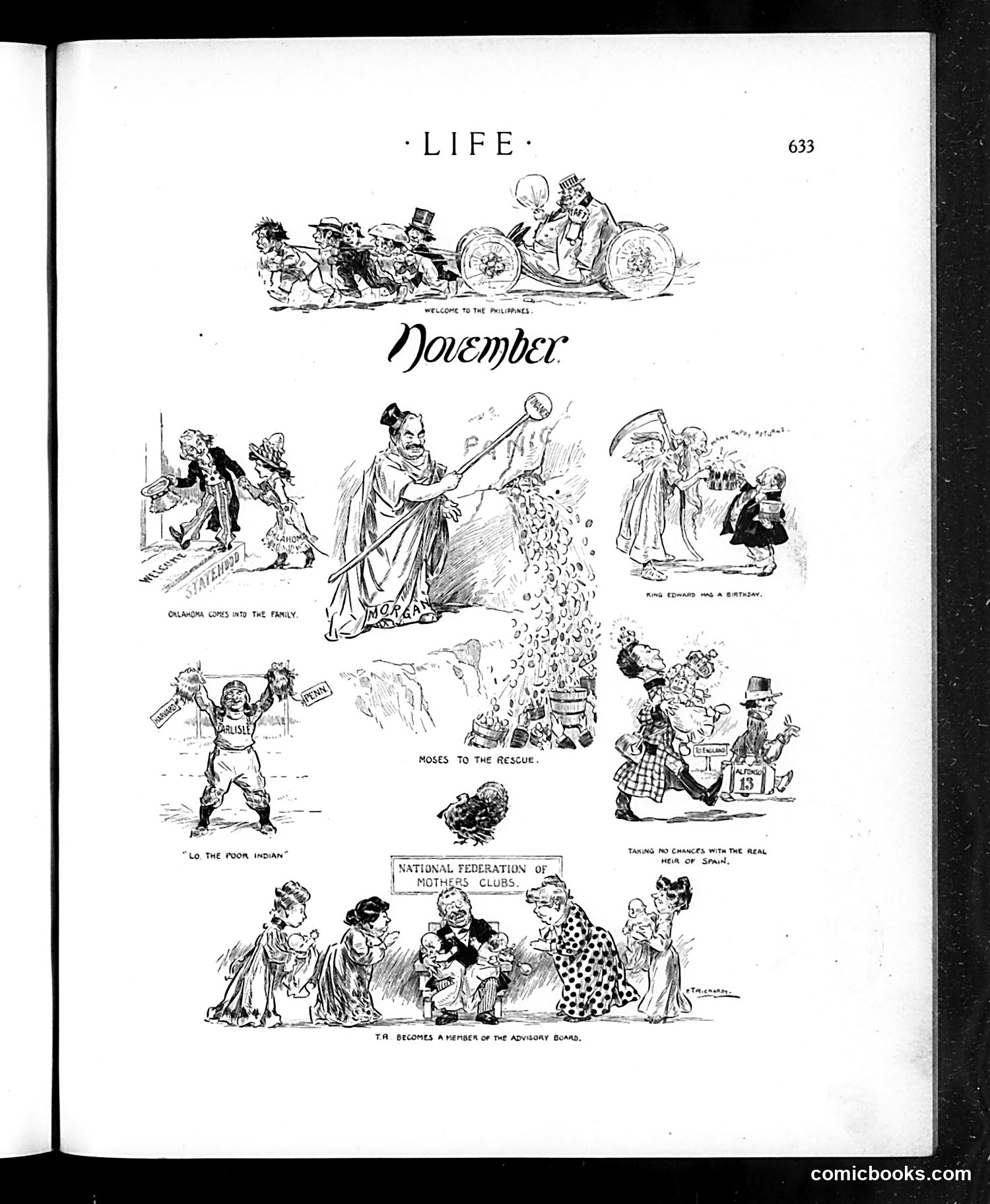
This page collects November satirical cartoons commenting on contemporary events. Key visible references include: - **"Welcome to the Philippines"** (top): References U.S. colonial involvement in the Philippines, likely post-1898 Spanish-American War period - **"Oklahoma Comes into the Family"**: Appears to reference Oklahoma's admission to the Union (1907) - **"Lo the Poor Indian"**: Traditional satirical phrase mocking American treatment of Native Americans - **"Moses to the Rescue"**: Unclear specific reference without clearer caption visibility - **"National Federation of Mothers' Clubs"**: Commentary on women's organizational activism - **"Taking No Chances with the Real Heir of Spain"**: Likely political commentary on Spanish succession The cartoons employ caricature and anthropomorphization typical of early 20th-century American political satire, targeting expansionism, labor issues, women's movements, and international relations.
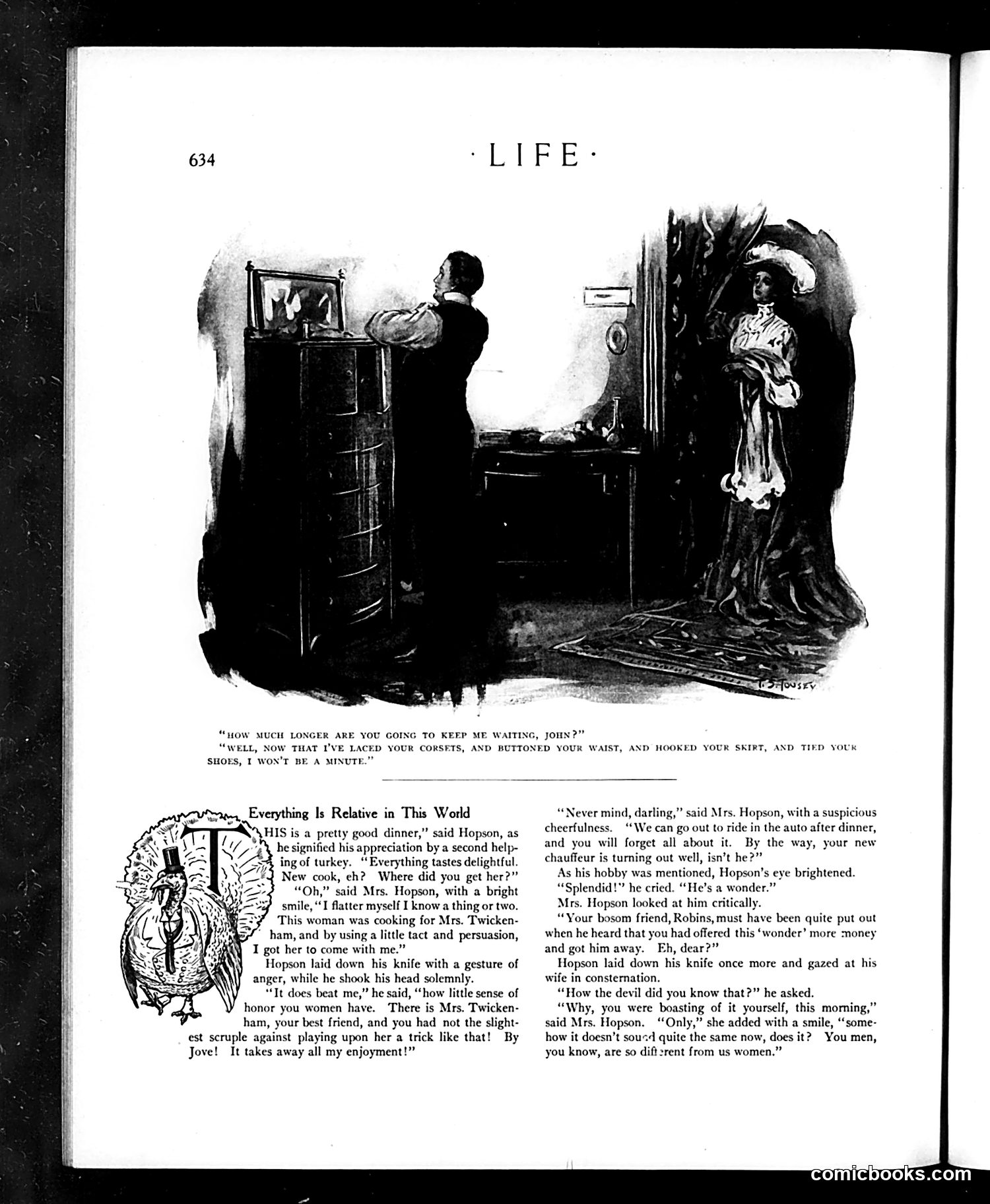
This page contains a domestic humor cartoon and story about a married couple, the Hopsons. The cartoon depicts a woman (Mrs. Hopson) confronting a man (presumably Mr. Hopson) about how long he'll keep her waiting, while he's occupied with what appears to be a new appliance or gadget. The accompanying story satirizes how Mr. Hopson has become obsessed with a new cook he hired, neglecting his wife. Mrs. Hopson sarcastically notes that men are "so different from women"—implying they're distracted by novelty and easily manipulated. The humor targets early 20th-century gender dynamics, particularly men's superficiality and wives' strategic use of domestic management to maintain household control.
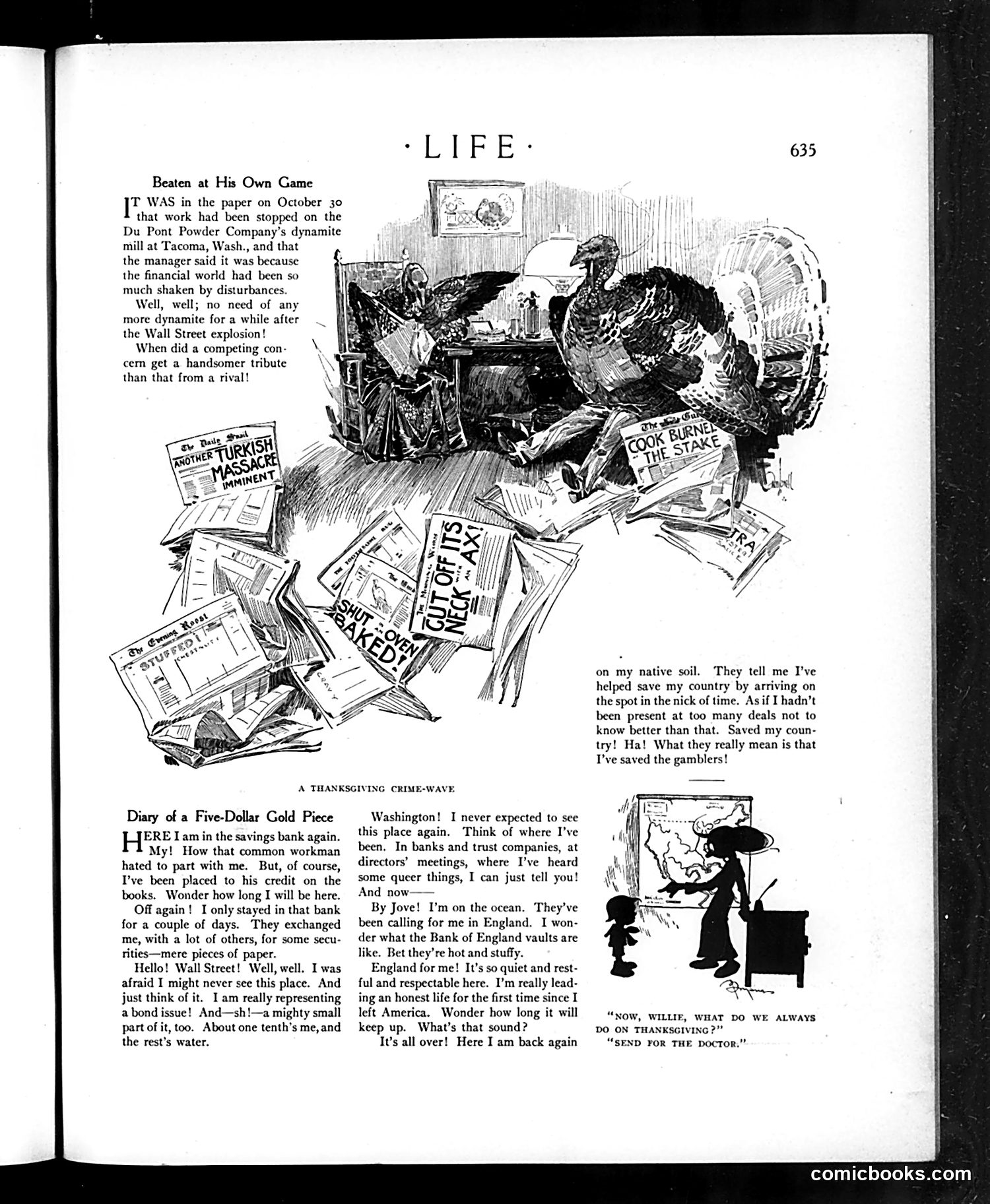
**Top Cartoon: "Beaten at His Own Game"** This satirizes a business executive (likely a Du Pont Powder Company manager) who claimed the October 30 Wall Street explosion damaged the financial world. The cartoon shows him literally beaten down by newspapers with headlines like "COOK BURNED THE STAKE" and "ANOTHER TURKISH ATROCITY IMMINENT." The joke: he complains about dynamite disrupting markets, but competing newspapers generate worse headlines through sensationalism. He's "beaten at his own game"—experiencing the chaos he causes in business. **Bottom: "Diary of a Five-Dollar Gold Piece"** A personified gold coin narrates traveling through banks, trust companies, and financial institutions before ending up in a working person's hands, then being exchanged away. The satirical point critiques wealth circulation and the coin's brief respite from the financial establishment. **Small cartoon**: A domestic joke about Thanksgiving dinner.
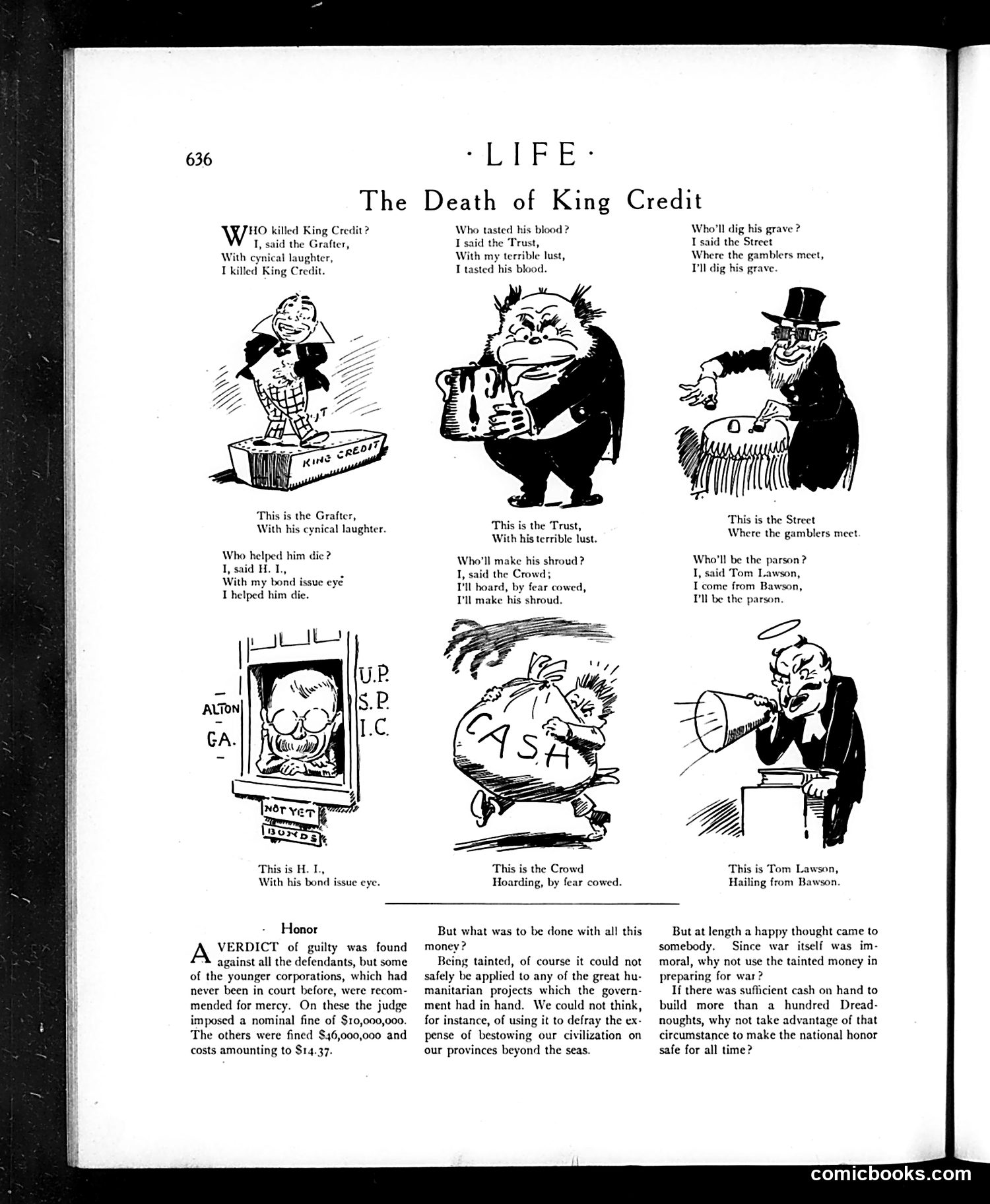
This satirical poem and accompanying illustrations critique financial corruption during what appears to be the early 20th century. The verse uses a nursery-rhyme format to identify six figures blamed for killing "King Credit": 1. **The Grafter** - represents corrupt officials 2. **The Trust** - personifies monopolistic corporations 3. **The Street** - refers to financial district speculators/gamblers 4. **H.I.** - appears to be a specific political figure (possibly with "bond issue eye") 5. **The Crowd** - the fearful public 6. **Tom Lawson** - identified as "Hailing from Bawson" [Boston], likely a real contemporary financier or reformer The accompanying prose section discusses a verdict against "all the defendants" involving fines, suggesting this responds to actual financial scandal litigation. The satire blames various economic actors—politicians, corporations, speculators, and mob mentality—for destroying financial confidence.
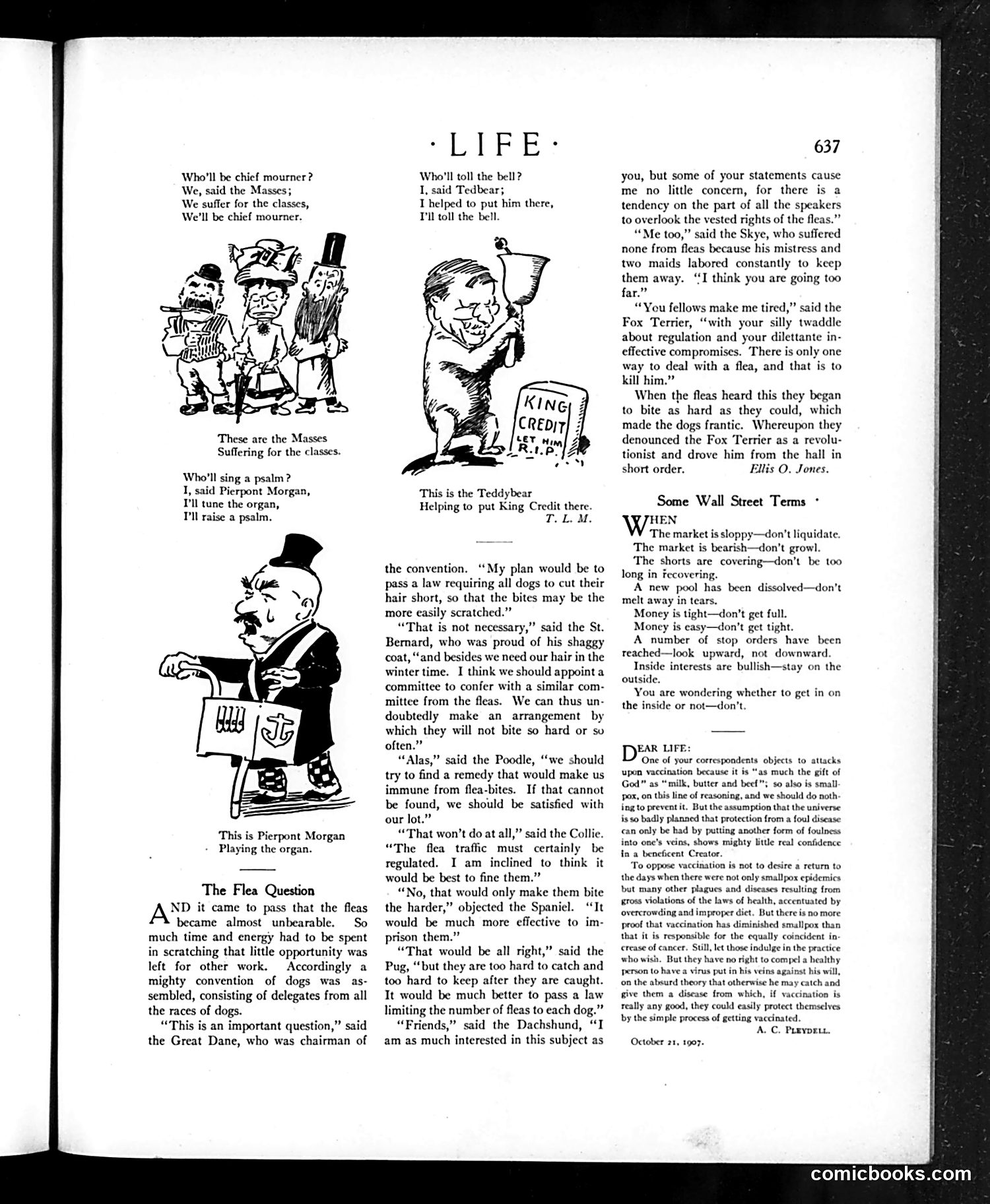
This page satirizes a dogs' convention debating how to control fleas. The cartoon figures represent different dog breeds (St. Bernard, Poodle, Collie, Spaniel, Dachshund) proposing absurd solutions: cutting dogs' hair short, making dogs immune, fining fleas, or imprisoning them. The satire appears to mock political debates of the era—likely early 20th century—where officials proposed ineffectual or ridiculous regulatory solutions to real problems. By having dogs seriously debate "flea traffic" regulations and fines, the cartoonist mocks political rhetoric that sounds authoritative but lacks practical sense. The accompanying "Wall Street Terms" section and "Dear Life" letter on vaccination suggest broader commentary on institutional incompetence during this period.
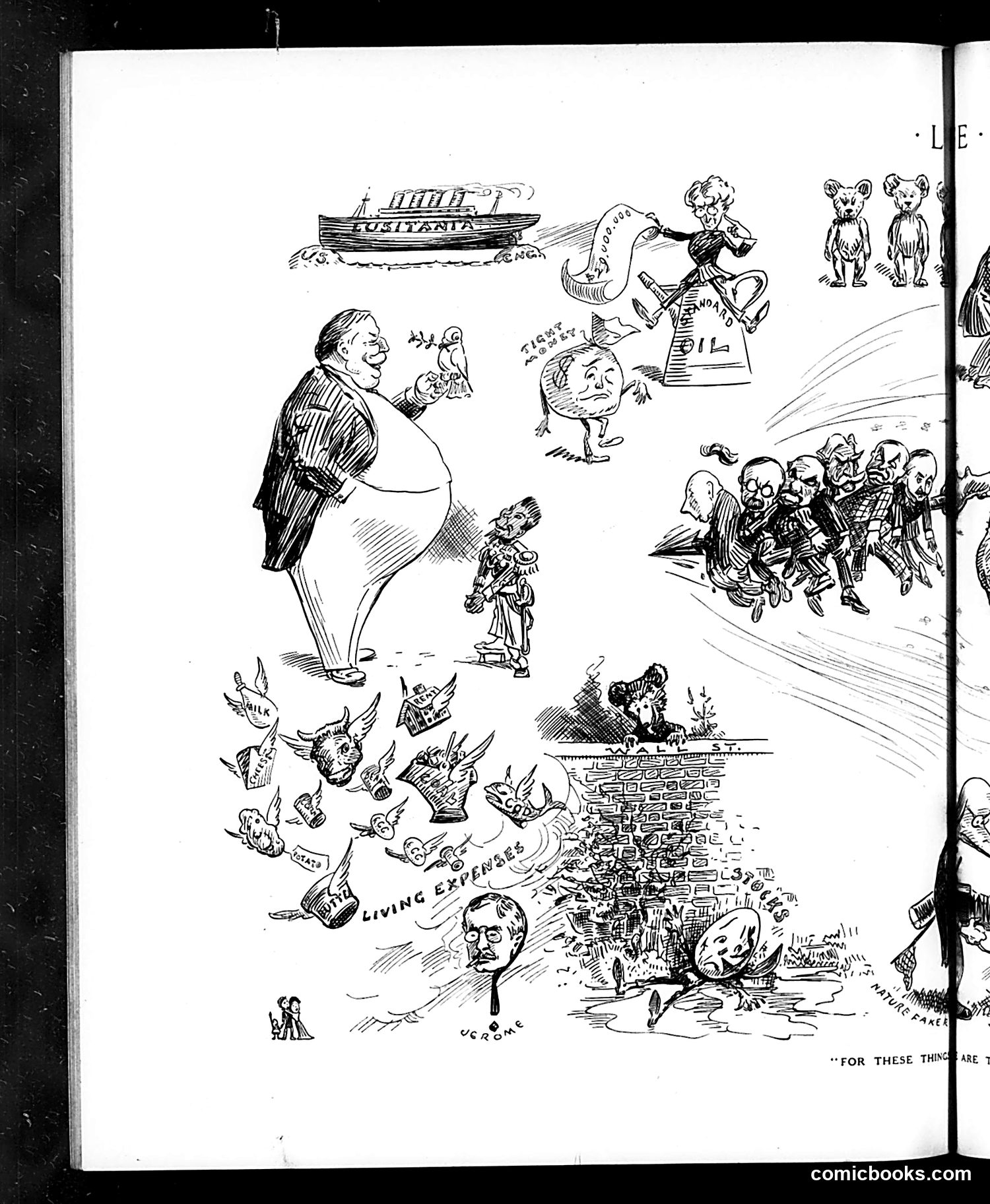
This appears to be a satirical cartoon from Life magazine depicting a portly, well-dressed man juggling various problematic elements: a ship (labeled "Lusitania"), military figures, small animals, and what appears to represent "living expenses." Below him are burning buildings and distressed figures labeled "Europe" and "Ukraine." The cartoon likely critiques someone in power—possibly a political or business leader—for mismanaging or profiting from serious crises: the Lusitania (a ship sunk in WWI), wartime conditions, inflation ("living expenses"), and European suffering. The juggling metaphor suggests reckless or cynical handling of genuine human suffering for personal gain. Without visible attribution or date, I cannot identify the specific figure or exact historical moment with certainty, but the imagery suggests WWI-era American political commentary.
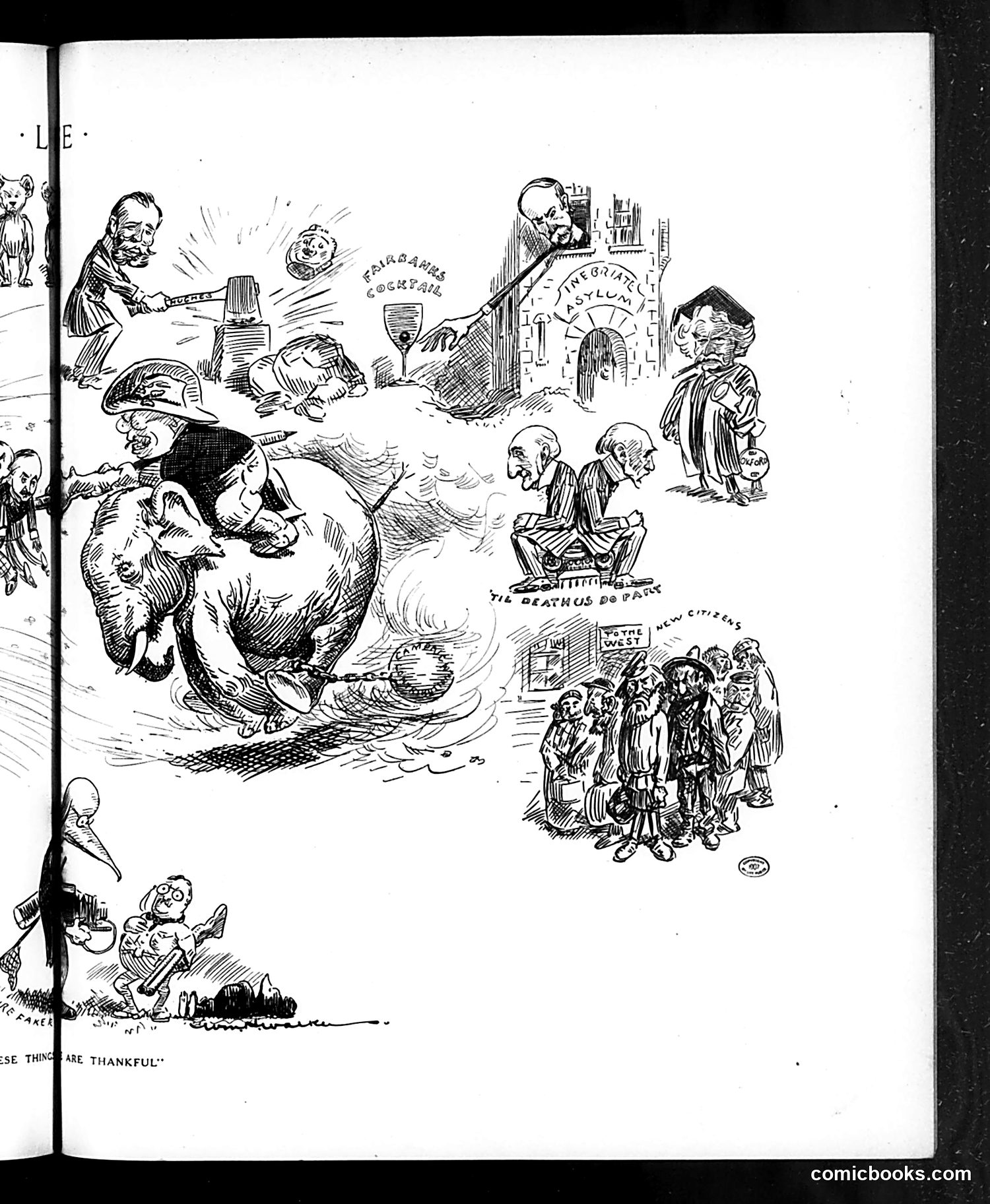
This is a satirical cartoon from *Life* magazine depicting what appears to be urban poverty and social inequality. The central figure is a large, rotund man (likely representing wealth or a wealthy businessman) being served food and drink by attendants, while below him are crowds of thin, poor people labeled "NEW CITIES" and other destitute figures. The caption reads "THESE THINGS ARE THANKFUL." The satire contrasts extreme wealth and indulgence with mass poverty and deprivation. The grotesque caricature of the wealthy man gorging himself while others starve represents critiques of economic inequality—a common *Life* magazine theme during periods of social upheaval, possibly the Gilded Age or early 20th century. The ironic caption suggests the wealthy should be "thankful," mocking their obliviousness to surrounding suffering.
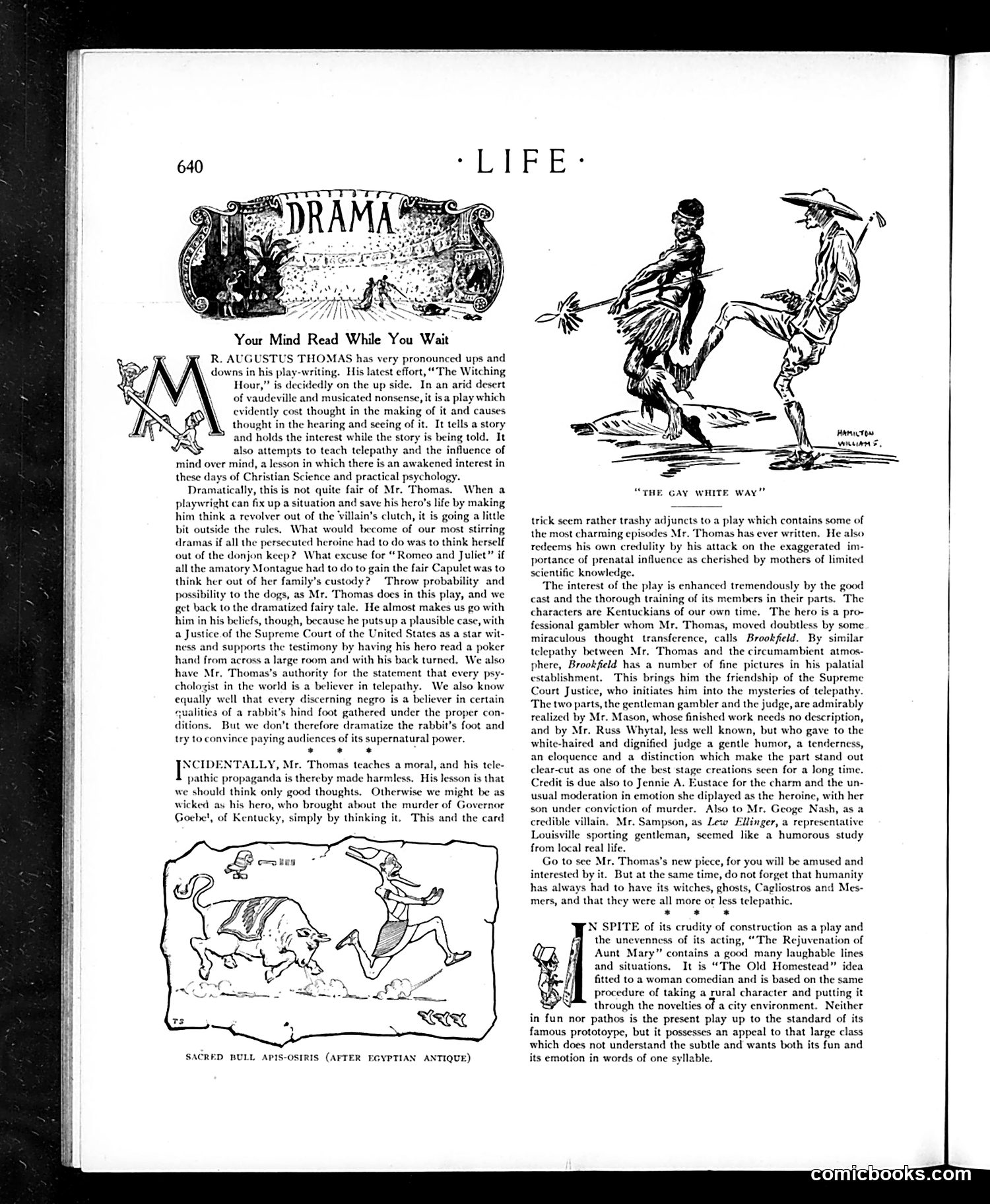
This page reviews Augustus Thomas's play "The Witching Hour." The text critiques the work as "trashy" yet containing "charming episodes," praising Thomas's skill at constructing plausible dramatic situations and his exploration of telepathy and Christian Science themes. The two illustrations are theatrical sketches: "The Gay White Way" shows characters in a comedic scene, while "Sacred Bull Apis-Osiris (After Egyptian Antique)" depicts a humorous figure-drawing exercise, likely a visual joke unrelated to the main review. The overall tone is mixed—acknowledging Thomas's theatrical competence while questioning the play's intellectual substance and its reliance on sensationalism rather than genuine dramatic merit.
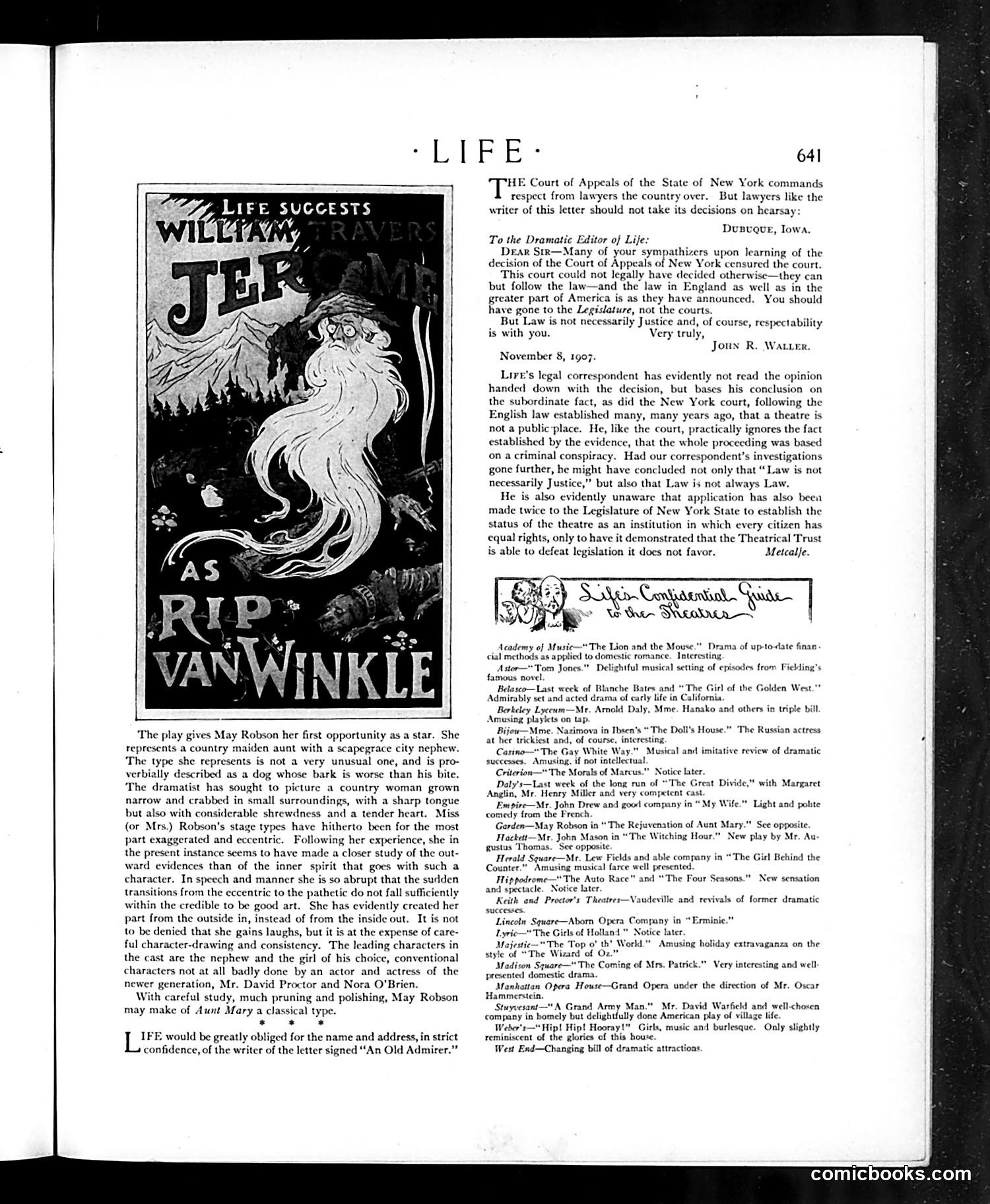
The page features a theatrical advertisement for "Rip Van Winkle," showing an illustration of the famous character with his long beard. The accompanying text discusses May Robson's performance in the play, marking her debut as a star. The bulk of the page consists of letters to the editor debating a New York Court of Appeals decision about theater law. One correspondent argues the court overstepped its authority; another defends the court's legal reasoning. A handwritten note references "Semi-Confidential Guide to the Theatre." Below are theater reviews covering various productions and performers of the era. The content reflects early 20th-century theatrical criticism and legal debates about institutional authority—not primarily political satire. The "Rip Van Winkle" reference trades on the famous Washington Irving story's cultural recognition.
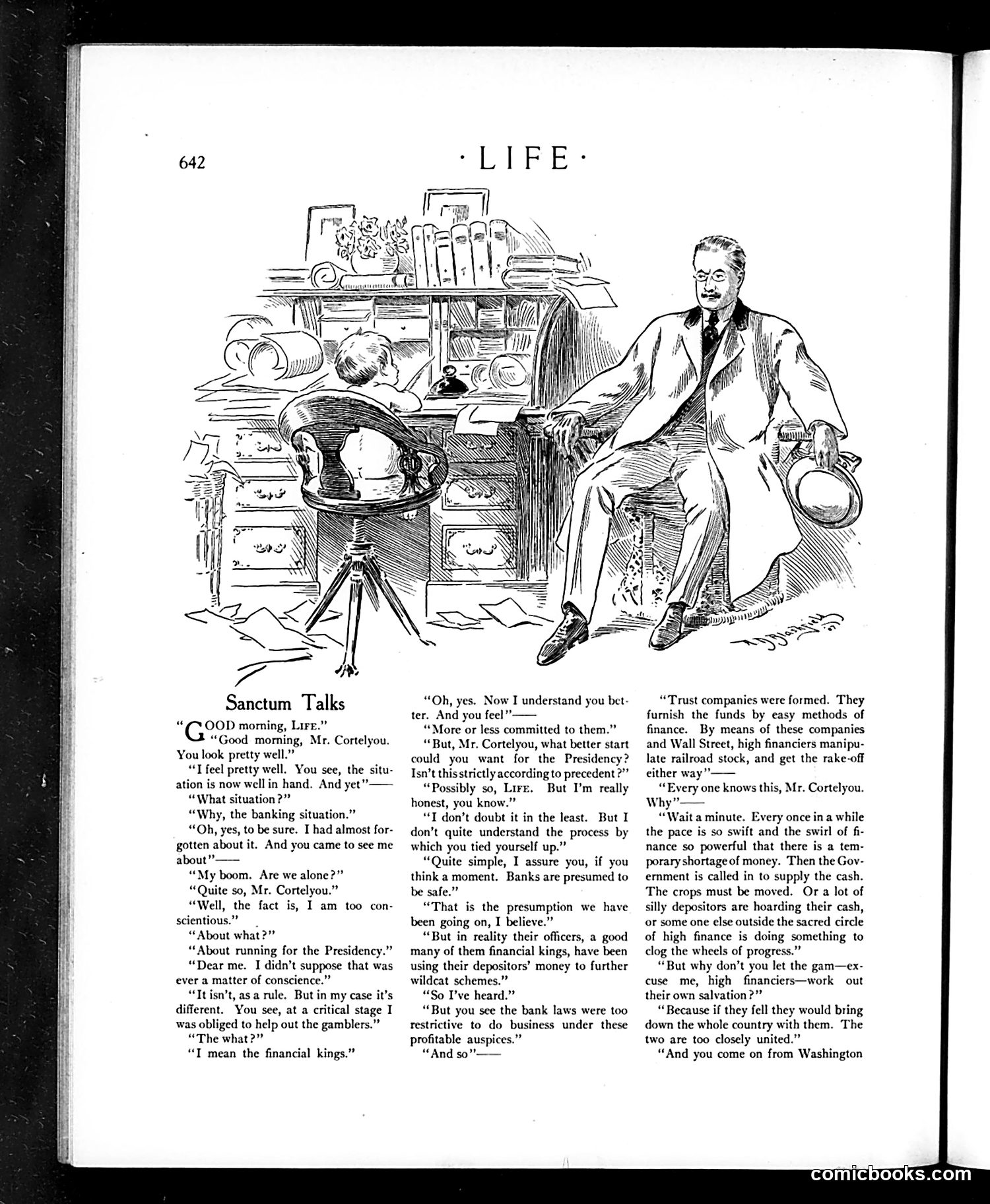
This is a satirical dialogue between "Life" magazine and **George B. Cortelyou**, Treasury Secretary under Theodore Roosevelt. The cartoon mocks Cortelyou's claimed moral scruples about running for President while having aided Wall Street financiers during banking crises. The satire targets the interconnection between government and high finance: Cortelyou admits he helped "financial kings" manipulate railroad stocks and use depositor money for risky schemes. When banking panics occur, the government must bail them out—creating dependency and moral compromise. The joke's bitter irony: Cortelyou claims conscientiousness while describing how he's already compromised himself by rescuing the very speculators and "gamblers" he pretends to oppose. The cartoonist suggests that helping Wall Street during crises is standard political precedent, making his moral hesitation about the Presidency hypocritical. This reflects Progressive-era criticism of financial manipulation and government-business collusion.
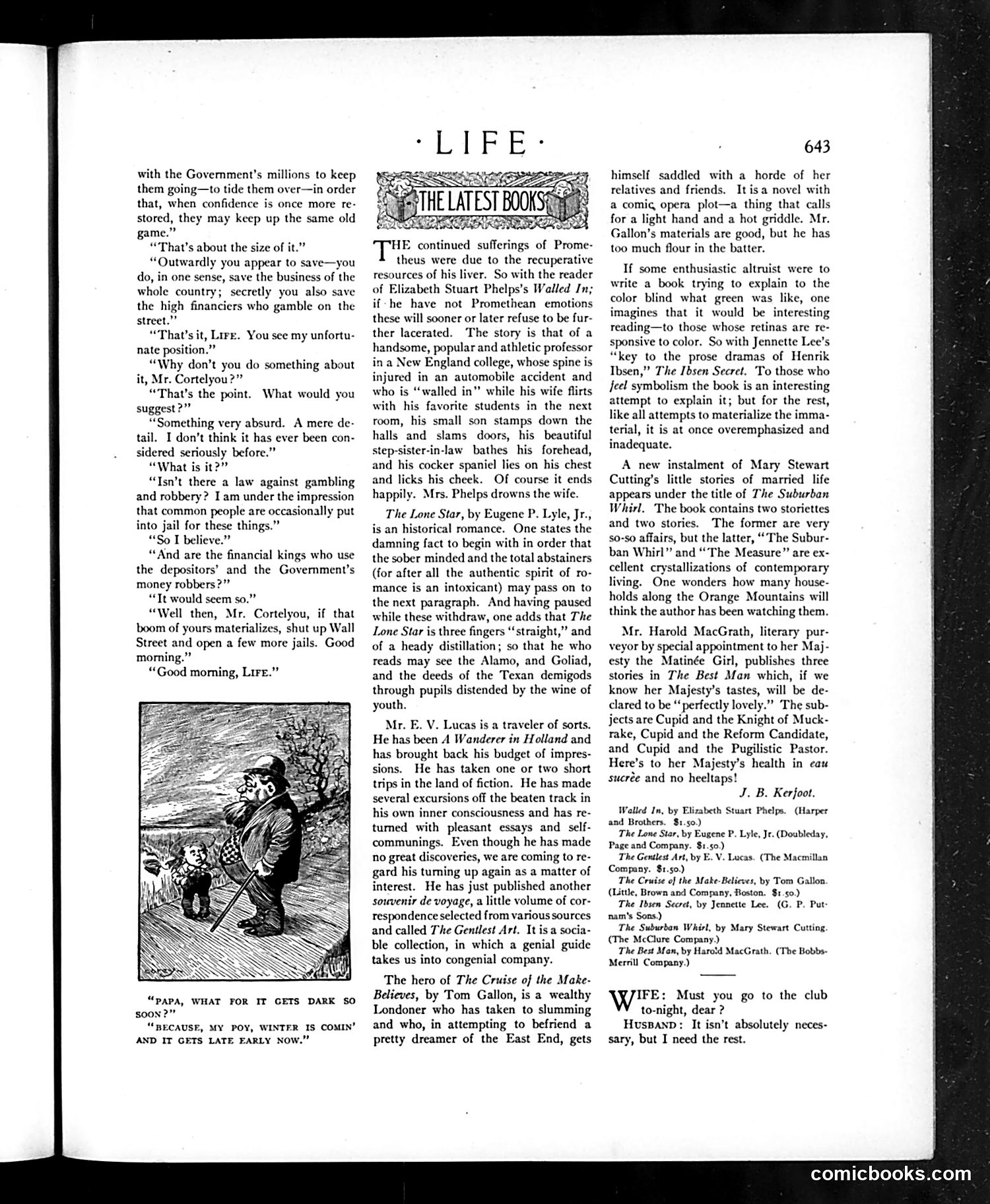
This dialogue-based cartoon satirizes the Government's financial response to the 1907 banking panic. "Mr. Cortelyou" refers to Secretary of the Treasury George B. Cortelyou, who used government funds to stabilize Wall Street during the crisis. The satire's point: While ostensibly "saving" the economy, Cortelyou actually rescued wealthy financiers and speculators—the very "gamblers" and "robbers" causing the collapse. The cartoon's absurdist suggestion is biting: if we jail ordinary people for theft and gambling, shouldn't we jail the financial elite doing the same thing with depositors' money? The inserted Yiddish dialect joke about winter darkness provides comic relief but is thematically unrelated. This reflects Progressive-era outrage at government bailouts protecting the rich while ordinary citizens faced poverty and legal consequences for similar crimes.
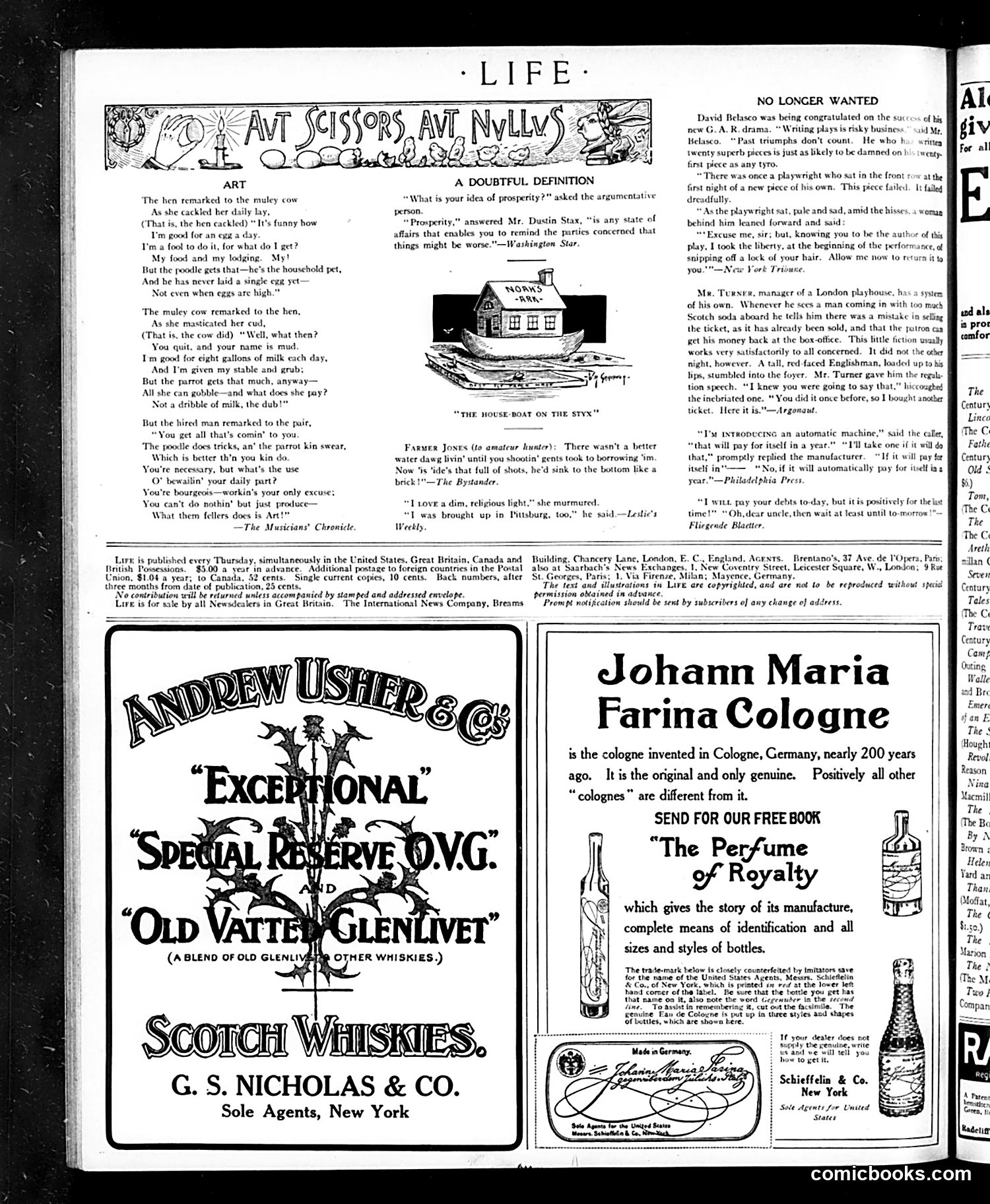
This page from *Life* magazine contains several satirical pieces lampooning social hierarchies and artistic pretension circa early 1900s. **"Art" (main poem):** A farmyard debate where a hen and cow complain about earning their keep through labor while household pets (poodle, parrot) receive the same benefits without "producing." A hired man dismisses their grievances: the pets' value lies in "Art"—their tricks and performance—whereas the animals are merely "bourgeois" workers. The satire mocks both working-class resentment of leisure and society's elevation of entertainment over utility. **"No Longer Wanted":** Anecdotes about theater life, including playwright David Belasco's sardonic observation that past successes guarantee nothing, and a theater manager's trick of claiming tickets are sold-out to remove drunk patrons. The advertisements for whisky and cologne occupy the lower half, standard for the era. The overall tone is cynical about social mobility, artistic value, and consumer culture typical of *Life*'s satirical approach.
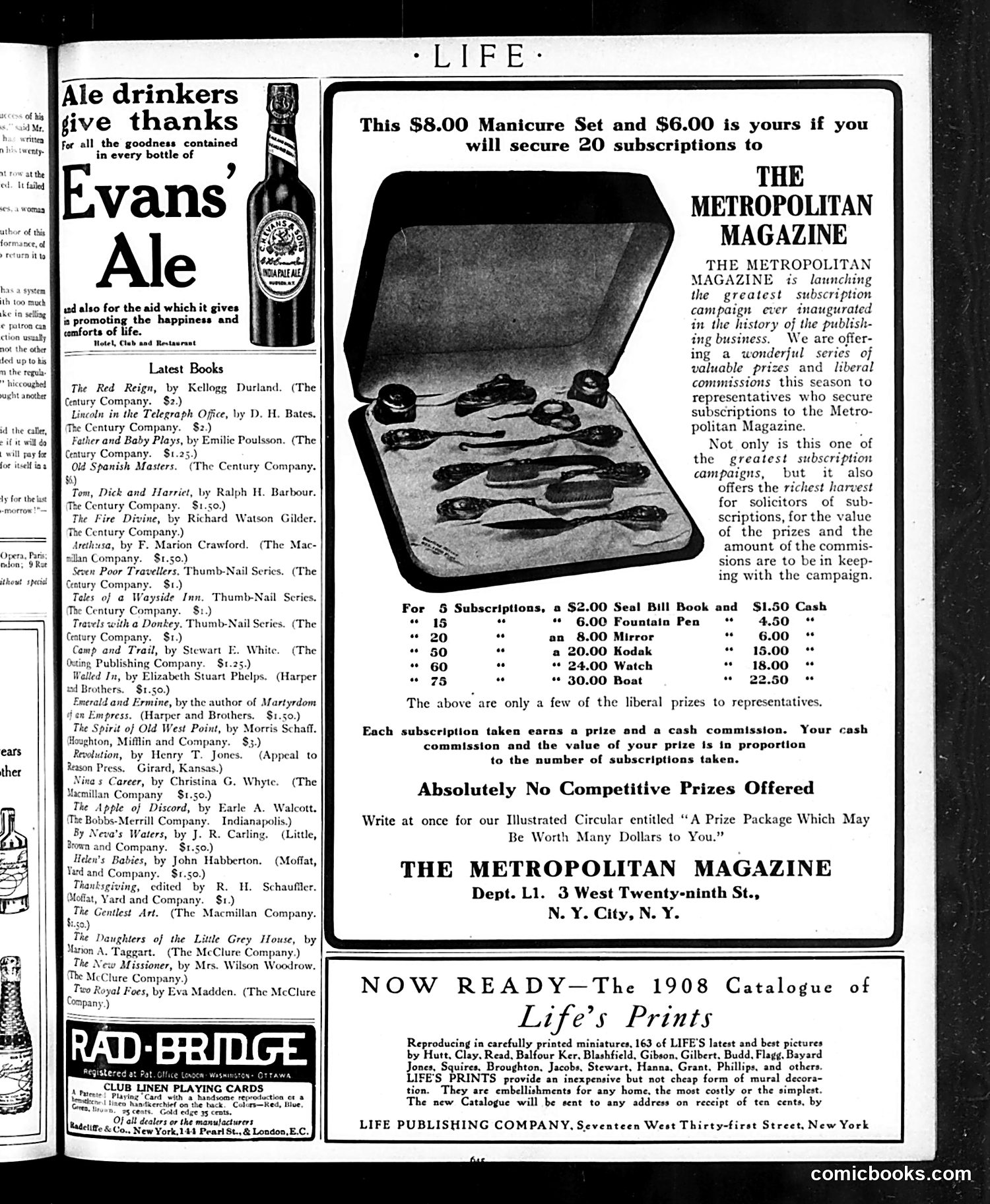
This page is primarily **advertising and book listings**, not political satire. The top left contains a straightforward **beer advertisement** for Evans Ale, using the common early-1900s pitch that ale drinkers should appreciate its quality. The dominant content is a **subscription promotion** for *The Metropolitan Magazine*, offering manicure sets, fountain pens, Kodak cameras, and boats as incentives to solicit 20+ subscriptions. This reflects the era's aggressive magazine circulation wars, where publishers competed aggressively by offering elaborate premiums to subscription salespeople. The page also lists new book releases from major publishers (Century Company, Harper Brothers, McClure Company), and promotes *Life's* own 1908 print catalog at bottom. **For modern readers:** This reveals how magazines sustained themselves pre-radio/television through direct subscription sales networks incentivized by valuable prizes—a now-obsolete business model.
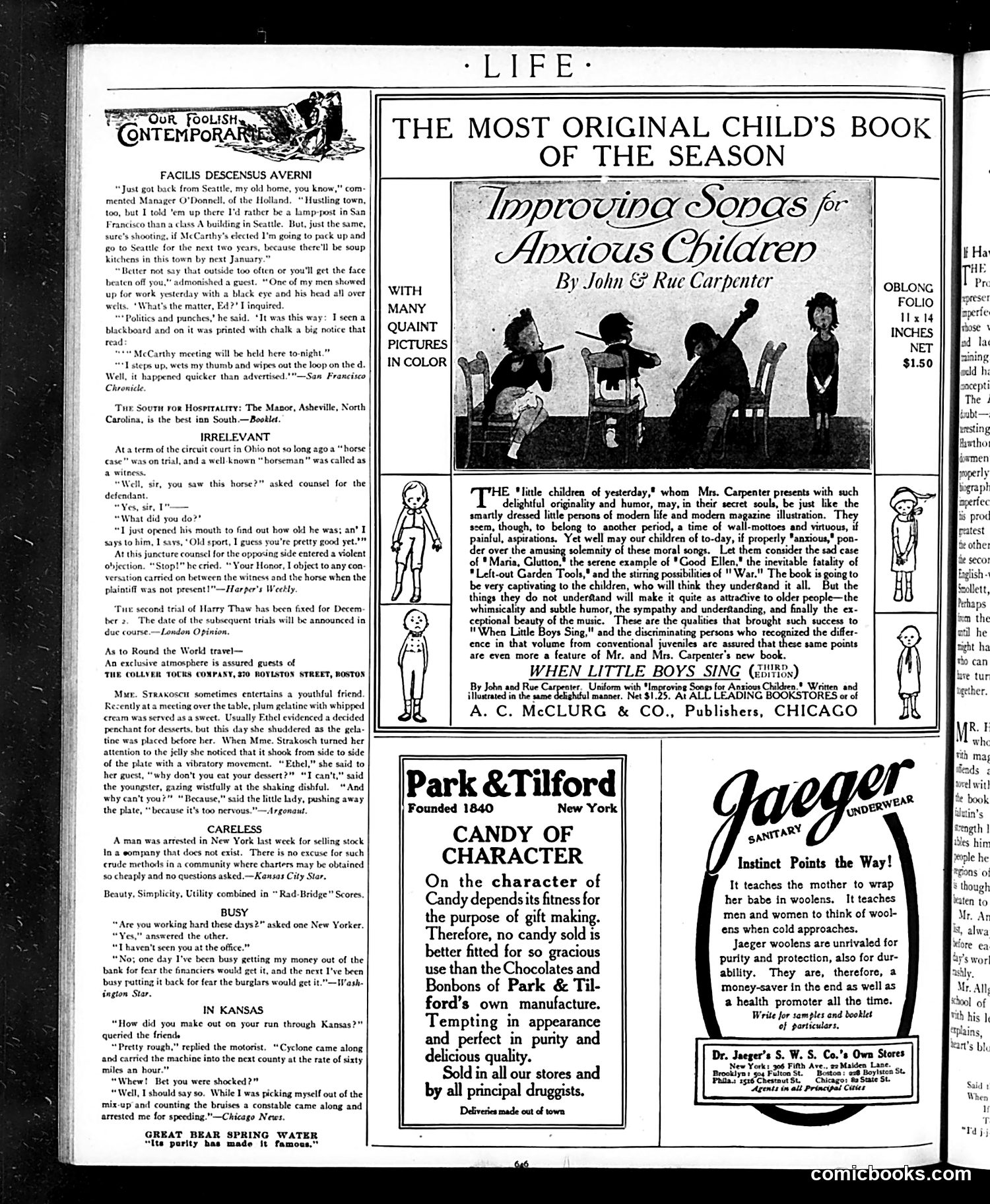
This page is primarily **advertising and book promotion**, not political satire. The dominant content advertises *"Improving Songs for Anxious Children"* by John and Rue Carpenter—a children's book featuring illustrated songs about virtue and proper behavior ("Maria, Glutton," "Good Ellen," etc.). The text praises its originality and appeal to both children and adults through "whimticality and subtle humor." Secondary advertisements promote *"When Little Boys Sing"* (same authors), *Park & Tilford candy*, and *Jaeger underwear*. The left column contains humorous anecdotes (labeled "Our Foolish Contemporary"): a manager's story about Seattle, a courtroom exchange about a horse's age, and a dinner party incident with wobbling gelatin. These are light social humor rather than political commentary—typical of Life's satirical approach to everyday American life and social pretensions. **No political figures or cartoons appear.** This is essentially a product-focused magazine page.
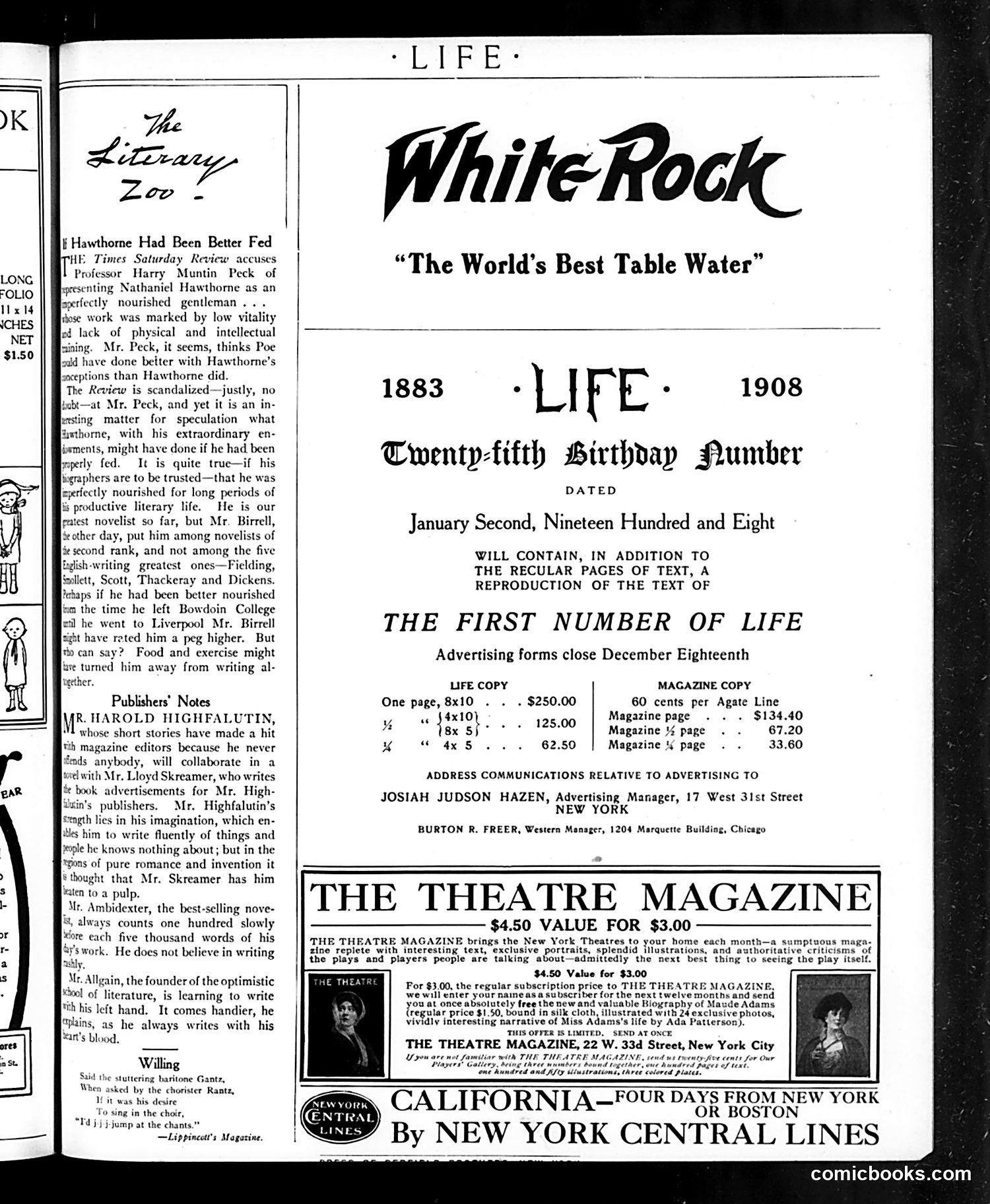
This page is primarily a **title page and advertising section** for Life's 25th anniversary issue (January 2, 1908), not a satirical cartoon page. The left column contains brief **literary gossip** under "Publishers' Notes"—humorous anecdotes about fictitious or minor authors, including jokes about writers' quirks (one counts to 100 between every 5,000 words; another writes with his left hand). These are lighthearted editorial commentary, not political satire. The dominant content is **commercial advertising**: White Rock mineral water promotes itself as "The World's Best Table Water," and The Theatre Magazine offers a subscription deal. The page announces advertising rates for Life's anniversary edition and contact information for ad managers. No identifiable political figures or events appear. The humor is primarily about literary pretension and authorial eccentricity—typical of Life magazine's satirical tone—rather than commentary on contemporary politics or society.
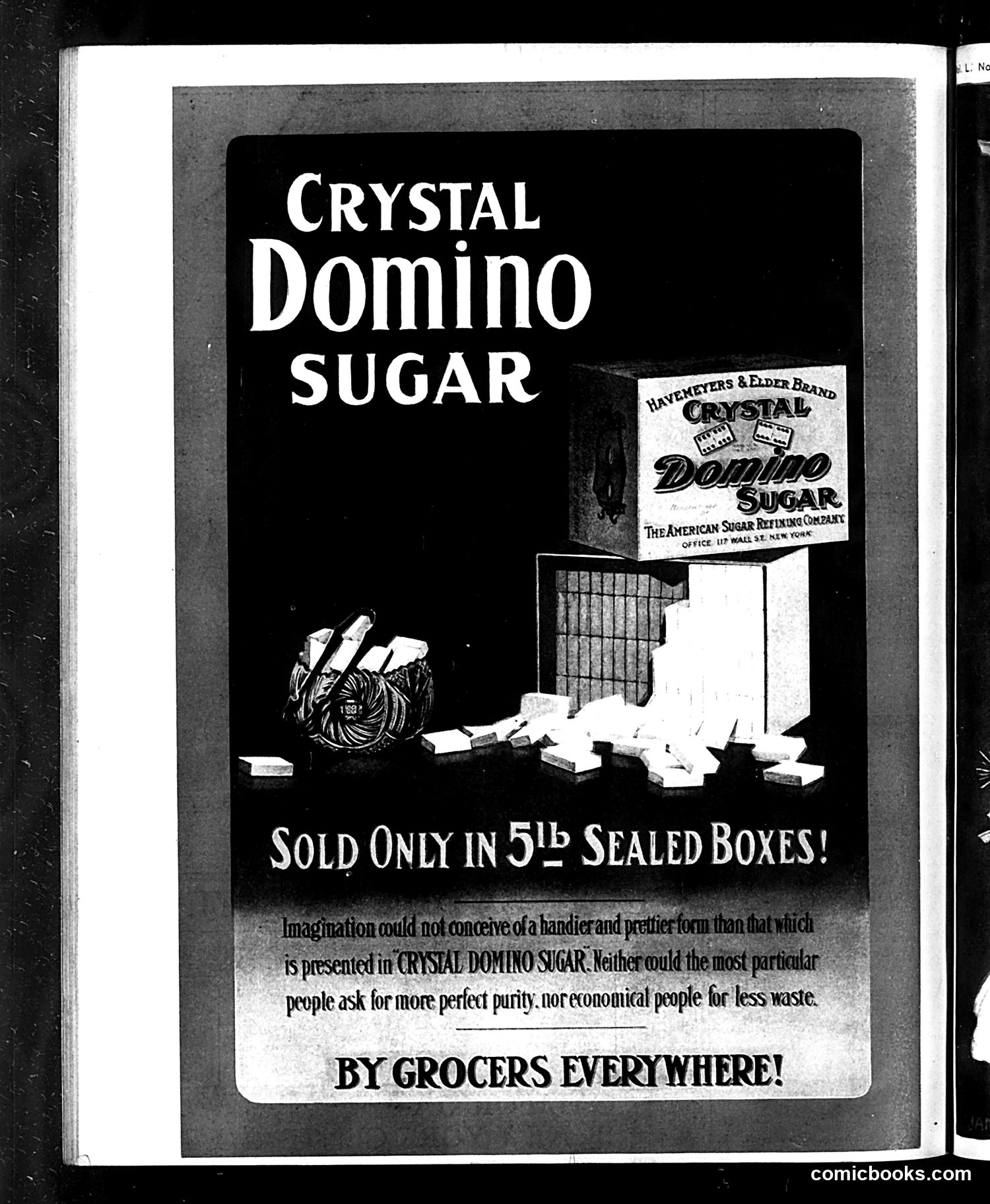
This is a vintage advertisement, not political satire. It promotes Crystal Domino Sugar, manufactured by The American Sugar Refining Company (New York office). The ad emphasizes the product's purity and convenience by highlighting its sale "only in 5lb sealed boxes." The marketing appeal targets both quality-conscious and economy-minded consumers, claiming the sealed packaging prevents waste and ensures cleanliness. The visual shows sugar cubes spilling from a large box with the Domino brand label prominently displayed. This represents early 20th-century advertising strategy: packaging innovations were marketed as guarantees of product integrity and household efficiency. The phrase "by grocers everywhere" emphasizes widespread availability—a selling point in that era.