
Life, 1907-11-28 · page 8 of 20
Life — November 28, 1907 — page 8: what you’re looking at
What you’re looking at
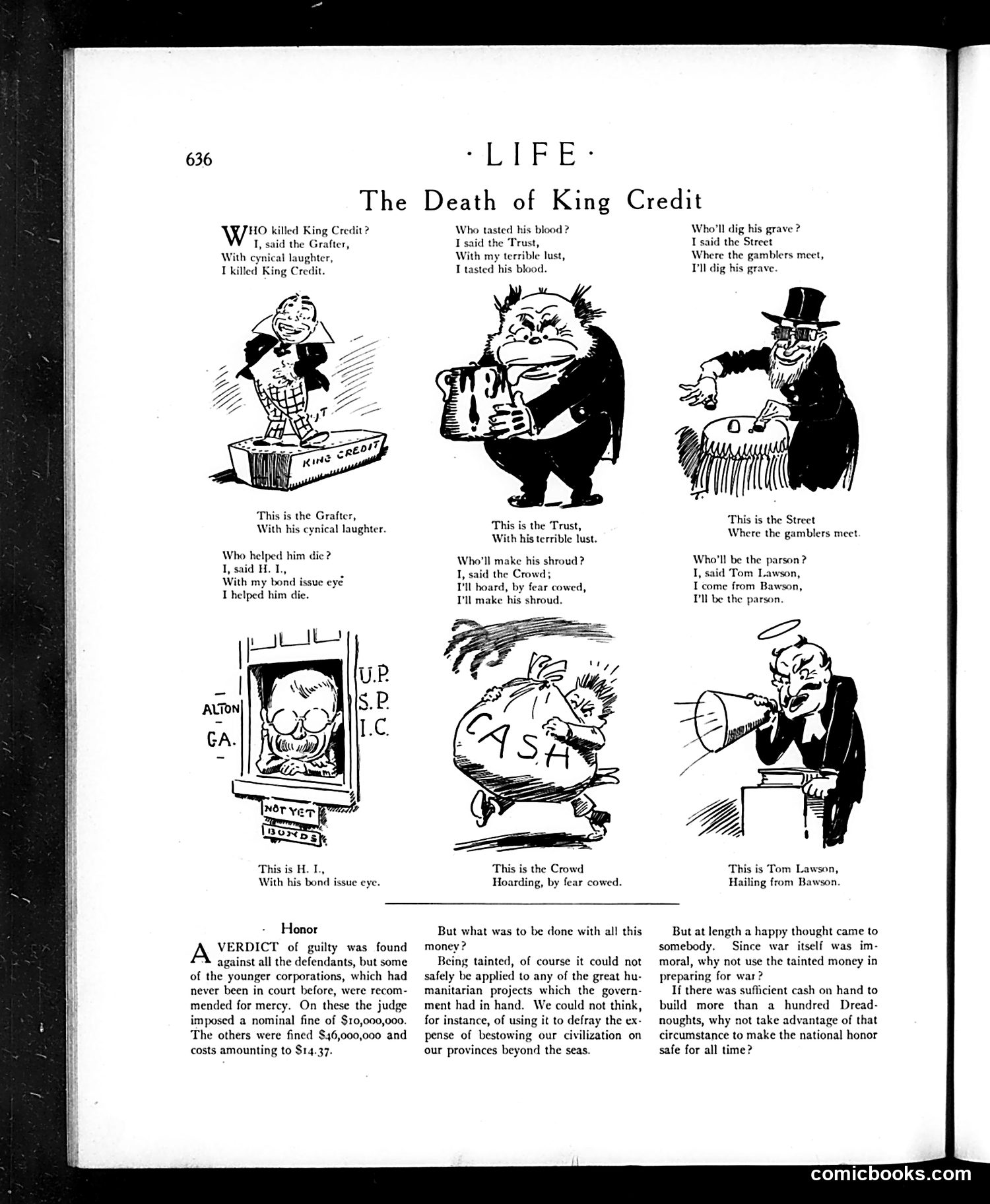
This satirical poem and accompanying illustrations critique financial corruption during what appears to be the early 20th century. The verse uses a nursery-rhyme format to identify six figures blamed for killing "King Credit": 1. **The Grafter** - represents corrupt officials 2. **The Trust** - personifies monopolistic corporations 3. **The Street** - refers to financial district speculators/gamblers 4. **H.I.** - appears to be a specific political figure (possibly with "bond issue eye") 5. **The Crowd** - the fearful public 6. **Tom Lawson** - identified as "Hailing from Bawson" [Boston], likely a real contemporary financier or reformer The accompanying prose section discusses a verdict against "all the defendants" involving fines, suggesting this responds to actual financial scandal litigation. The satire blames various economic actors—politicians, corporations, speculators, and mob mentality—for destroying financial confidence.
📄 Transcribed text from this page (OCR, searchable)
Machine-transcribed from the original scan — historical spelling and the odd misread are preserved.
The HO killed King Credit? id the Grafter, laughter, This is the Grafter, With his cynical laughter. Who helped him dic? 1, said H. 1, With my bond issue T helped him die. BONDS This is H. I., With his bond issue eye. *LIPE® Death of King Credit Who tasted his blood ? I said the Trust, With my terrible lust, T tasted his blood. This is the Trust, With his terrible lust. Who'll make his shroud ? I, said the Crowd; I'll hoard, by fear cowed, T'll make his shroud. This is the Crowd Hoarding, by fear cowed. Who'll dig his grave ? I said the Street Where the gamblers meet, I'll dig his grave. This is the Street Where the gamblers meet Who'll be the parson ? I, said Tom Lawson, T come from Bawson, I'll be the parson. This is Tom Lawson, Hailing from Bawson. Honor A VERDICT of guilty was found against all the defendants, but some of the younger corporations, which had never been in court before, were recom- mended for mercy. On these the judge imposed a nominal fine of $10,000,000. The others were fined $46,000,000 and costs amounting to $14.37. But what was to be done with all this money? Being tainted, of course it could not safely be applied to any of the great hu- manitarian projects which the govern- ment had in hand. We could not think, for instance, of using it to defray the ex- pense of bestowing our civilization on our provinces beyond the seas. But at length a happy thought came to somebody, Since war itself was im- moral, why not use the tainted money in preparing for war? If there was sufficient cash on hand to build more than a hundred Dread- noughts, why not take advantage of that circumstance to make the national honor safe for all time? comicbooks.com