
Life, 1907-11-28 · page 12 of 20
Life — November 28, 1907 — page 12: what you’re looking at
What you’re looking at
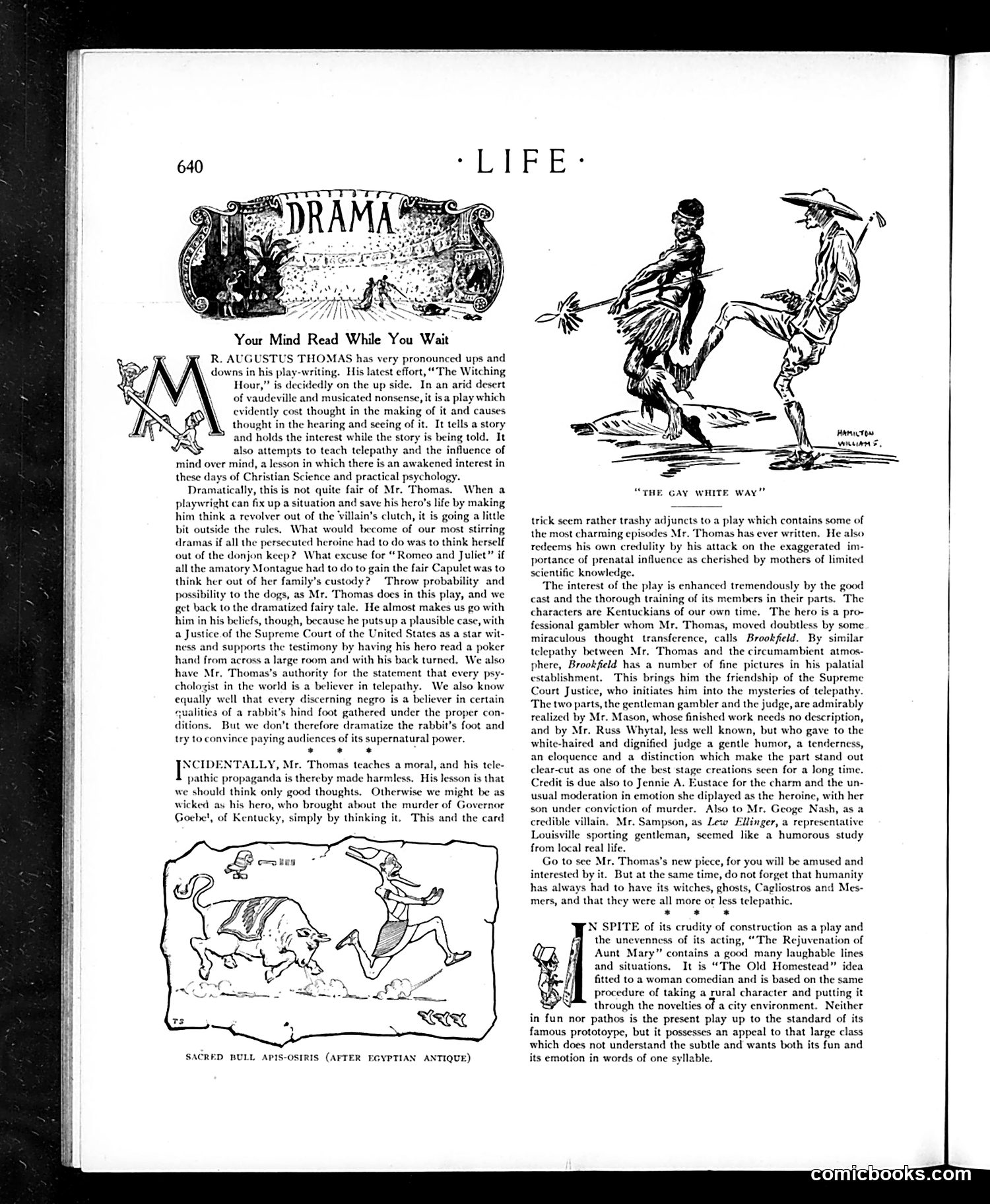
This page reviews Augustus Thomas's play "The Witching Hour." The text critiques the work as "trashy" yet containing "charming episodes," praising Thomas's skill at constructing plausible dramatic situations and his exploration of telepathy and Christian Science themes. The two illustrations are theatrical sketches: "The Gay White Way" shows characters in a comedic scene, while "Sacred Bull Apis-Osiris (After Egyptian Antique)" depicts a humorous figure-drawing exercise, likely a visual joke unrelated to the main review. The overall tone is mixed—acknowledging Thomas's theatrical competence while questioning the play's intellectual substance and its reliance on sensationalism rather than genuine dramatic merit.
📄 Transcribed text from this page (OCR, searchable)
Machine-transcribed from the original scan — historical spelling and the odd misread are preserved.
Your Mind Read While You Wait R. AUGUSTUS THOMAS has very pronounced ups and \ downs in his play-writing. His latest effort, “The Witching Hour,” is decidedly on the up side. In an arid desert of vaudeville and musicated nonsense, it isa play which evidently cost thought in the making of it and causes thought in the hearing and seeing of it. It tells a story and holds the interest while the story is being told. It also attempts to teach telepathy and the influence of ened interest in these days of Christian Science and practical psychology. Dramatically, this is not quite fair of Mr. Thomas. When a playwright can fix up a situation and save his hero's life by making him think a revolver out of the Villain’s clutch, it is going a little bit outside the rules, What would become of our most stirring dramas if all the persecuted heroine had to do was to think herself out of the donjon keep? What excuse for “Romeo and Juliet” if all the amatory Montague had to do to gain the fair Capulet was to think her out of her family’s custody? Throw probability and possibility to the dogs, as Mr. Thomas docs in this play, and we get back to the dramatized fairy tale. He almost makes us go with him in his beliefs, though, because he puts up a plausible case, with a Justice of the Supreme Court of the United States as a star wit- ness and supports the testimony by having his hero read a pol hand from across a large room and with his back turned. We have Mr, Thomas's authority for the statement that every cholozist in the world is a believer in telepathy. We also know ly well that every discerning negro is a believer in certain qualities it’s hind foot gathered under the proper con- ditions. don’t therefore dramatize the rabbit’s foot and ying audiences of its supernatural power. * 8 # CIDENTALLY, Mr. Thomas teaches a moral, and his tele- pathic propaganda is thereby made harmless. His lesson is that we should think only good thoughts. Otherwise we might be as wicked as his hero, who brought about the murder of Governor Goebe!, of Kentucky, simply by thinking it, This and the card mind over mind, a lesson in which there is an awa psy- try to convince py SACRED BULL APIS-OSIRIS (AFTER EGYPTIAN ANTIQUE) “THE GAY WHITE way” trick seem rather trashy adjuncts to a play which contains some of the most charming episodes Mr. ‘Thomas has ever written, He also redeems his own credulity by his attack on the exaggerated im- portance of prenatal influence as cherished by mothers of limited scientific knowledge. ‘The interest of the play is enhanced tremendously by the good cast and the thorough training of its members in their parts. The characters are Kentuckians of our own time. The hero is a pro- fessional gambler whom Mr. Thomas, moved doubtless by some miraculous thought transference, calls Brookfield. By similar telepathy between Mr. ‘Thomas and the circumambient atmos- phere, Brookfeld has a number of fine pictures in his palatial establishment. ‘This brings him the friendship of the Supreme Court Justice, who initiates him into the mysteries of telepathy. ‘The two parts, the gentleman gambler and the judge, are admirably realized by Mr. Mason, whose finished work needs no description, and by Mr. Russ Whytal, less well known, but who gave to the white-haired and dignified judge a gentle humor, a tenderness, an eloquence and a distinction which make the part stand out clear-cut as one of the best stage creations seen for a Jong time. Credit is due also to Jennie A. Eustace for the charm and the un- usual moderation in emotion she diplayed as the heroine, with her son under conviction of murder. Also to Mr. Geoge Nash, as a credible villain. Mr. Sampson, as Lew Ellinger, a representative Louisville sporting gentleman, seemed like a humorous study from local real life. Go to sce Mr. Thomas's new piece, for you will be amused and interested by it. But at the same time, do not forget that humanity has always had to have its witches, ghosts, Cagliostros and Mes- mers, and that they were all more or less telepathic. * * * N SPITE of its crudity of construction as a play and the unevenness of its acting, “The Rejuvenation of Aunt Mary” contains a good many laughable lines and situations, It is “The Old Homestead” idea fitted to a woman comedian and is based on the same procedure of taking a rural character and putting it through the novelties of a city environment. Neither in fun nor pathos is the present play up to the standard of its famous prototoype, but it possesses an appeal to that large class which does not understand the subtle and wants both its fun and its emotion in words of one syllable.