
Life, 1907-11-28 · page 4 of 20
Life — November 28, 1907 — page 4: what you’re looking at
What you’re looking at
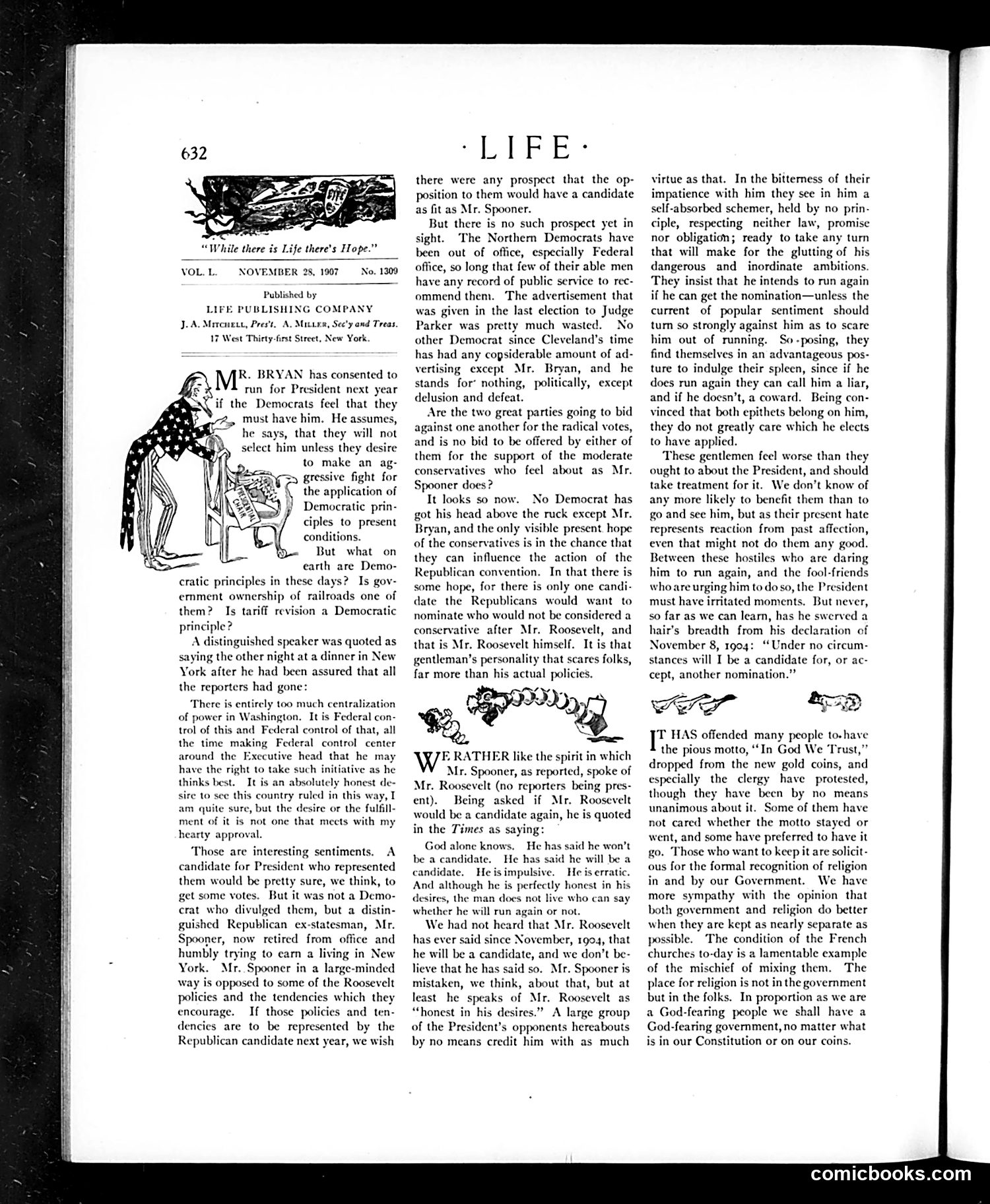
The page features political commentary about the 1908 presidential election. The main cartoon depicts **Uncle Sam as a weighing scale**, presumably balancing competing candidates or party interests—a standard metaphor for electoral choice. The article discusses **William Jennings Bryan's** potential candidacy for the Democrats and criticizes **President Theodore Roosevelt**. The text suggests conservative Republicans fear Roosevelt's radical tendencies and question whether Democrats will nominate someone who can actually win against Republican candidates. The satire targets **factional disputes within both parties**: Democrats struggling to unite around a viable candidate, and Republicans anxious about Roosevelt's influence on their convention. The piece mocks politicians' self-interested calculations about electability versus principle.
📄 Transcribed text from this page (OCR, searchable)
Machine-transcribed from the original scan — historical spelling and the odd misread are preserved.
“While there is Life there's Hope.” VOL. L. NOVEMBER 28, 1907 No. 1309 Published by LIFE PUBLISHING COMPANY J. A. Mrrcuent, Pret, A.M 17 West Thirty-first Stree Sec'y and Treas. ‘ew York. R. BRYAN has consented to run for President next year if the Democrats feel that they must have him. He assumes, he says, that they will not select him unless they desire to make an ag- Sy gressive fight for the application of Democratic prin- ciples to present conditions. But what on earth are Demo- cratic principles in these days? Is gov- emment ownership of railroads one of them? Is tariff revision a Democratic principle? A distinguished speaker was quoted as saying the other night at a dinner in New York after he had been assured that all the reporters had gone: ‘There is entirely too much centralization of power in Washington, It is Federal con- trol of this and Federal control of that, all the time making Federal control center around the Executive head that he may have the right to take such initiative as he thinks best. It is an absolutely honest de- sire to see this country ruled in this way, I am quite sure, but the desire or the fulfill- ment of it is not one that mects with my hearty approval. ‘Those are interesting sentiments. A candidate for President who represented them would be pretty sure, we think, to get some votes. But it was not a Demo- crat who divulged them, but a distin- guished Republican ex-statesman, Mr. Spooner, now retired from office and humbly trying to carn a living in New York. Mr. Spooner in a large-minded way is opposed to some of the Roosevelt policies and the tendencies which they encoura If those policies and ten- dencies are to be represented by the Republican candidate next year, we wish = LIP E+ there were any prospect that the op- position to them would have a candidate as fit as Mr. Spooner. But there is no such prospect yet in sight. The Northern Democrats have been out of office, especially Federal office, so long that few of their able men have any record of public service to ree- ommend them. The advertisement that was given in the last election to Judge Parker was pretty much wasted. No other Democrat since Cleveland's time has had any copsiderable amount of ad- vertising except Mr. Bryan, and he stands for’ nothing, politically, except delusion and defeat. Are the two great parties going to bid against one another for the radical votes, and is no bid to be offered by either of them for the support of the moderate conservatives who feel about as Mr. Spooner doe It looks so now. No Democrat has got his head above the ruck except Mr. Bryan, and the only visible present. hope of the conservatives is in the chance that they can influence the action of the Republican convention. In that there is some hope, for there is only one candi- date the Republicans would want to nominate who would not be considered a conservative after Mr, Roosevelt, and that is Mr. Roosevelt himself. It is that gentleman’s personality that scares folks, far more than his actual polic W RATHER like the spirit in which Mr. Spooner, as reported, spoke of Mr. Roosevelt (no reporters being pres- ent). Being asked if Mr. Roosevelt would be a candidate again, he is quoted in the Times as saying: God alone knows. He has said he won't be a candidate. He has said he will be candidate. He is impulsive. He is erratic. And although he is perfectly honest in his desires, the man does not live who can say whether he will run again or not. We had not heard that Mr. Roosevelt has ever said since November, 1904, that he will be a candidate, and we don’t be- lieve that he has said so. Mr. Spooner is mistaken, we think, about that, but at least he speaks of Mr. Roosevelt as “honest in his desires.” A large group of the President’s opponents hereabouts by no means credit him with as much virtue as that. In the bitterness of their impatience with him they see in him a self-absorbed schemer, held by no prin- ciple, respecting neither law, promise nor obligation; ready to take any turn that will make for the glutting of his dangerous and inordinate ambitions They insist that he intends to run again if he can get the nomination—unless the current of popular sentiment should tum so strongly against him as to scare him out of running. So -posing, they find themselves in an advantageous pos- ture to indulge their spleen, since if he does run again they can call him a liar, and if he doesn’t, a coward. Being con- vinced that both epithets belong on him, they do not greatly care which he elects to have applied. These gentlemen feel worse than the ought to about the President, and should take treatment for it. We don’t know of any more likely to benefit them than to go and see him, but as their present hate represents reaction from past affection, even that might not do them any good. Between these hostiles who are daring him to run again, and the fool-friends who are urging him todo so, the President must have irritated moments. But never, so far as we can learn, has he swerved a hair’s breadth from his declaration of November 8, 1904: “Under no circum- stances will I be a candidate for, or ac- cept, another nomination.” Pp T HAS offended many people to-have the pious motto, “In God We Trust,” dropped from the new gold coins, and especially the clergy have protested, though they have been by no means unanimous about it. Some of them have not cared whether the motto stayed or went, and some have preferred to have it go. Those who want to keep it are solicit- ous for the formal recognition of religion in and by our Government. We have more sympathy with the opinion that both government and religion do better when they are kept as nearly separate as possible. The condition of the French churches to-day is a lamentable example of the mischief of mixing them. The place for religion is not inthe government but in the folks. In proportion as we are a God-fearing people we shall have a God-fearing government, no matter what is in our Constitution or on our coins. comicbooks.com