
Life, 1907-11-28 · page 15 of 20
Life — November 28, 1907 — page 15: what you’re looking at
What you’re looking at
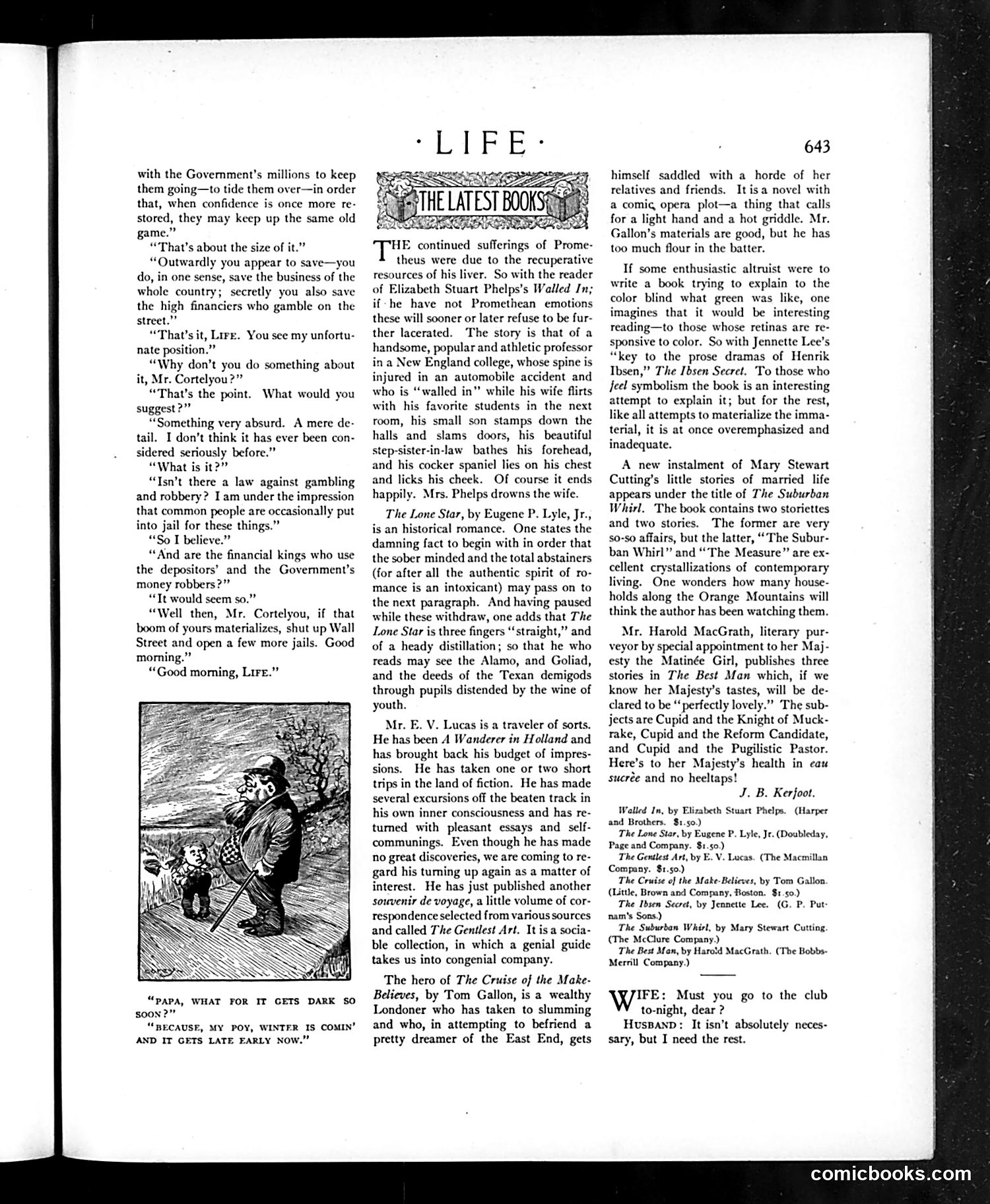
This dialogue-based cartoon satirizes the Government's financial response to the 1907 banking panic. "Mr. Cortelyou" refers to Secretary of the Treasury George B. Cortelyou, who used government funds to stabilize Wall Street during the crisis. The satire's point: While ostensibly "saving" the economy, Cortelyou actually rescued wealthy financiers and speculators—the very "gamblers" and "robbers" causing the collapse. The cartoon's absurdist suggestion is biting: if we jail ordinary people for theft and gambling, shouldn't we jail the financial elite doing the same thing with depositors' money? The inserted Yiddish dialect joke about winter darkness provides comic relief but is thematically unrelated. This reflects Progressive-era outrage at government bailouts protecting the rich while ordinary citizens faced poverty and legal consequences for similar crimes.
📄 Transcribed text from this page (OCR, searchable)
Machine-transcribed from the original scan — historical spelling and the odd misread are preserved.
with the Government’s millions to keep them going—to tide them over—in order that, when confidence is once more re- stored, they may keep up the same old game.” “That's about the size of it.” “Outwardly you appear to save—you do, in one sense, save the business of the whole country; secretly you also save the high financiers who gamble on the street.”’ “That’s it, Lire. You see my unfortu- nate position.” “Why don’t you do something about it, Mr. Cortelyou?” “That's the point. suggest ?”” “Something very absurd. A mere de- tail. I don’t think it has ever been con- sidered seriously before.” “What is it?” “Isn’t there a law against gambling and robbery? Iam under the impression that common people are occasionally put into jail for these things.” “So I believe.” “And are the financial kings who use the depositors’ and the Government’s money robbers?” “Tt would seem so.” “Well then, Mr. Cortelyou, if that boom of yours materializes, shut up Wall Street and open a few more jails. Good morning.” “Good moming, Lire.” What would you “PAPA, WHAT FOR IT GETS DARK SO soon?” CAUSE, MY POY, WINTER IS COMIN’ AND IT GETS LATE EARLY NOW.” el E TAO | AIRY HE, continued inane of Prome- theus were due to the recuperative resources of his liver. So with the reader of Elizabeth Stuart Phelps’s Walled In; if-he have not Promethean emotions these will sooner or later refuse to be fur- ther lacerated. The story is that of a handsome, popular and athletic professor in a New England college, whose spine is injured in an automobile accident and who is “walled in” while his wife flirts with his favorite students in the next room, his small son stamps down the halls and slams doors, his beautiful step-sister-in-law bathes his forehead, and his cocker spaniel lies on his chest and licks his cheek. Of course it ends happily. Mrs. Phelps drowns the wife. The Lone Star, by Eugene P. Lyle, Jr., is an historical romance. One states the damning fact to begin with in order that the sober minded and the total abstainers (for after all the authentic spirit of ro- mance is an intoxicant) may pass on to the next paragraph. And having paused while these withdraw, one adds that The Lone Star is three fingers “straight,” and of a heady distillation; so that he who reads may see the Alamo, and Goliad, and the deeds of the Texan demigods through pupils distended by the wine of youth. Mr. E. V. Lucas is a traveler of sorts. He has been A Wanderer in Holland and has brought back his budget of impres- sions. He has taken one or two short trips in the land of fiction. He has made several excursions off the beaten track in his own inner consciousness and has re- tumed with pleasant essays and self- communings. Even though he has made no great discoveries, we are coming to re- gard his turning up again as a matter of interest. He has just published another souvenir de voyage, a little volume of cor- respondence selected from various sources and called The Gentlest Art. It is a socia- ble collection, in which a genial guide takes us into congenial company. The hero of The Cruise of the Make- Believes, by Tom Gallon, is a wealthy Londoner who has taken to slumming and who, in attempting to befriend a pretty dreamer of the East End, gets 643 himself saddled with a horde of her relatives and friends. It isa novel with a comic, opera plot—a thing that calls for a light hand and a hot griddle. Mr. Gallon’s materials are good, but he has too much flour in the batter. If some enthusiastic altruist were to write a book trying to explain to the color blind what green was like, one imagines that it would be interesting reading—to those whose retinas are re- sponsive to color. So with Jennette Lee’: “key to the prose dramas of Henrik Ibsen,” The Ibsen Secret. To those who jeel symbolism the book is an interesting attempt to explain it; but for the rest, like all attempts to materialize the imma- terial, it is at once overemphasized and inadequate. A new instalment of Mary Stewart Cutting’s little stories of married life appears under the title of The Suburban Whirl. The book contains two storiettes and two stories. The former are very so-so affairs, but the latter, “The Subur- ban Whirl” and “The Measure” are ex- cellent crystallizations of contemporary living. One wonders how many house- holds along the Orange Mountains will think the author has been watching them. Mr. Harold MacGrath, literary pur- r by special appointment to her Maj- esty the Matinée Girl, publishes three stories in The Best Man which, if we know her Majesty’s tastes, will be de- clared to be “‘perfectly lovely.” The sub- jects are Cupid and the Knight of Muck- rake, Cupid and the Reform Candidate, and Cupid and the Pugilistic Pastor. Here's to her Majesty’s health in eau sucrée and no heeltaps! J. B. Kerjoot. Welled In, by Elizabeth Stuart Phelps. (Harper and Brothers. $1.50.) The Lone Star, by Eugene P. Lyle, Jr. (Doubleday, Page and Company. $1.50.) The Gentlest Art, by E. V. Lucas. (The Macmillan Company. $1.50.) The Cruise of the Mate-Believes, by Tom Gallon. (Lite, Brown and Company, Boston. $1.50.) The Ibsen Secret, by Jennette Lee. (G. P. Put nam's Sons.) The Suburban Whirl, by Mary Stewart Cutting. (The McClure Company.) The Best Man, by Harold MacGrath. (The Bobbs- Merrill Company.) Ww Must you go to the club HusBanD: It isn’t absolutely neces- sary, but I need the rest. comicbooks.com