
Life, 1907-11-28 · page 14 of 20
Life — November 28, 1907 — page 14: what you’re looking at
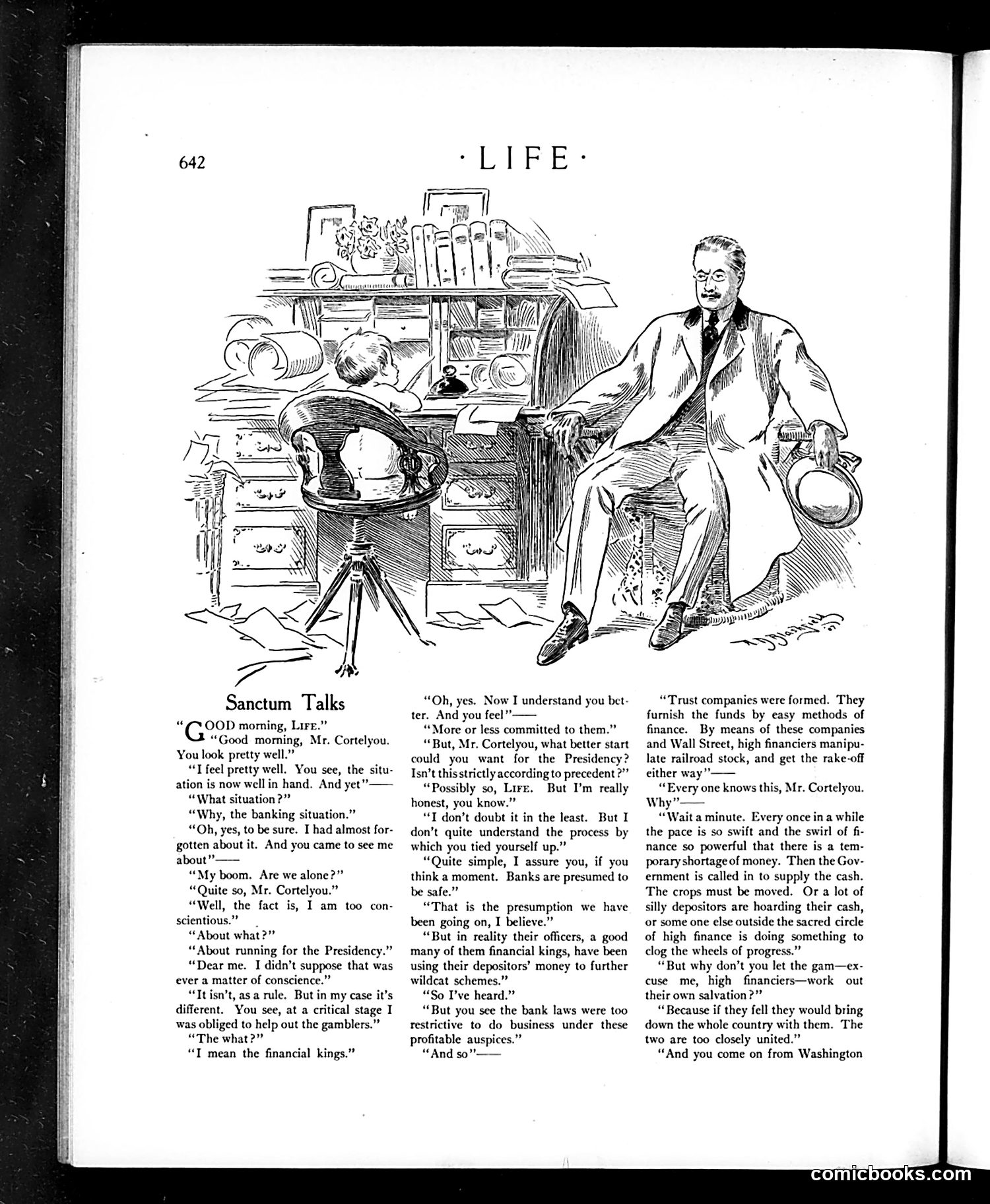
What you’re looking at
This is a satirical dialogue between "Life" magazine and **George B. Cortelyou**, Treasury Secretary under Theodore Roosevelt. The cartoon mocks Cortelyou's claimed moral scruples about running for President while having aided Wall Street financiers during banking crises. The satire targets the interconnection between government and high finance: Cortelyou admits he helped "financial kings" manipulate railroad stocks and use depositor money for risky schemes. When banking panics occur, the government must bail them out—creating dependency and moral compromise. The joke's bitter irony: Cortelyou claims conscientiousness while describing how he's already compromised himself by rescuing the very speculators and "gamblers" he pretends to oppose. The cartoonist suggests that helping Wall Street during crises is standard political precedent, making his moral hesitation about the Presidency hypocritical. This reflects Progressive-era criticism of financial manipulation and government-business collusion.
📄 Transcribed text from this page (OCR, searchable)
Machine-transcribed from the original scan — historical spelling and the odd misread are preserved.
Sanctum Talks “(OOD morming, Lire.” “Good moming, Mr. Cortelyou. You look pretty well.” “T feel pretty well. You see, the situ- ation is now well in hand. And yet” —— “What situation ?” “Why, the banking situation.” “Oh, yes, to be sure. I had almost for- it. And you came to see me “My boom. Are we alone?” “Quite so, Mr. Cortelyou.” “Well, the fact is, I am too con- scientious.” “About what?” “About running for the Presidency.” “Dear me. I didn’t suppose that was ever a matter of conscience.” “Tt isn’t, as a rule. But in my case it’s different. You see, at a critical stage I was obliged to help out the gamblers.” “The what?” “T mean the financial kings.” “Oh, yes. Now I understand you bet ter. And you feel” — “More or less committed to them.” “But, Mr. Cortelyou, what better start could you want for the Presidency? Isn’t this strictly according to precedent ?” “Possibly so, Lire. But I’m really honest, you know.” “TI don’t doubt it in the least. But I don’t quite understand the process by which you tied yourself up.” “Quite simple, I assure you, if you think a moment. Banks are presumed to be safe.” “That is the presumption we have been going on, I believe.” “But in reality their officers, a good many of them financial kings, have been using their depositors’ money to further wildcat schemes.” “So I’ve heard.” “But you see the bank laws were too restrictive to do business under these profitable auspices.” “And so”—— “Trust companies were formed. They furnish the funds by easy methods of finance. By means of these companies and Wall Street, high financiers manipu- late railroad stock, and get the rake-off either way” — “Every one knows this, Mr. Cortelyou. Why” — “Wait a minute. Every once in a while the pace is so swift and the swirl of fi- nance so powerful that there is a tem- porary shortage of money. Then the Gov- ernment is called in to supply the cash. The crops must be moved. Or a lot of silly depositors are hoarding their cash, or some one else outside the sacred circle of high finance is doing something to clog the wheels of progress.” “But why don’t you let the gam—ex- cuse me, high financiers—work out their own salvation?” “Because if they fell they would bring down the whole country with them. The two are too closely united.” “And you come on from Washington