
Life, 1907-11-28 · page 13 of 20
Life — November 28, 1907 — page 13: what you’re looking at
What you’re looking at
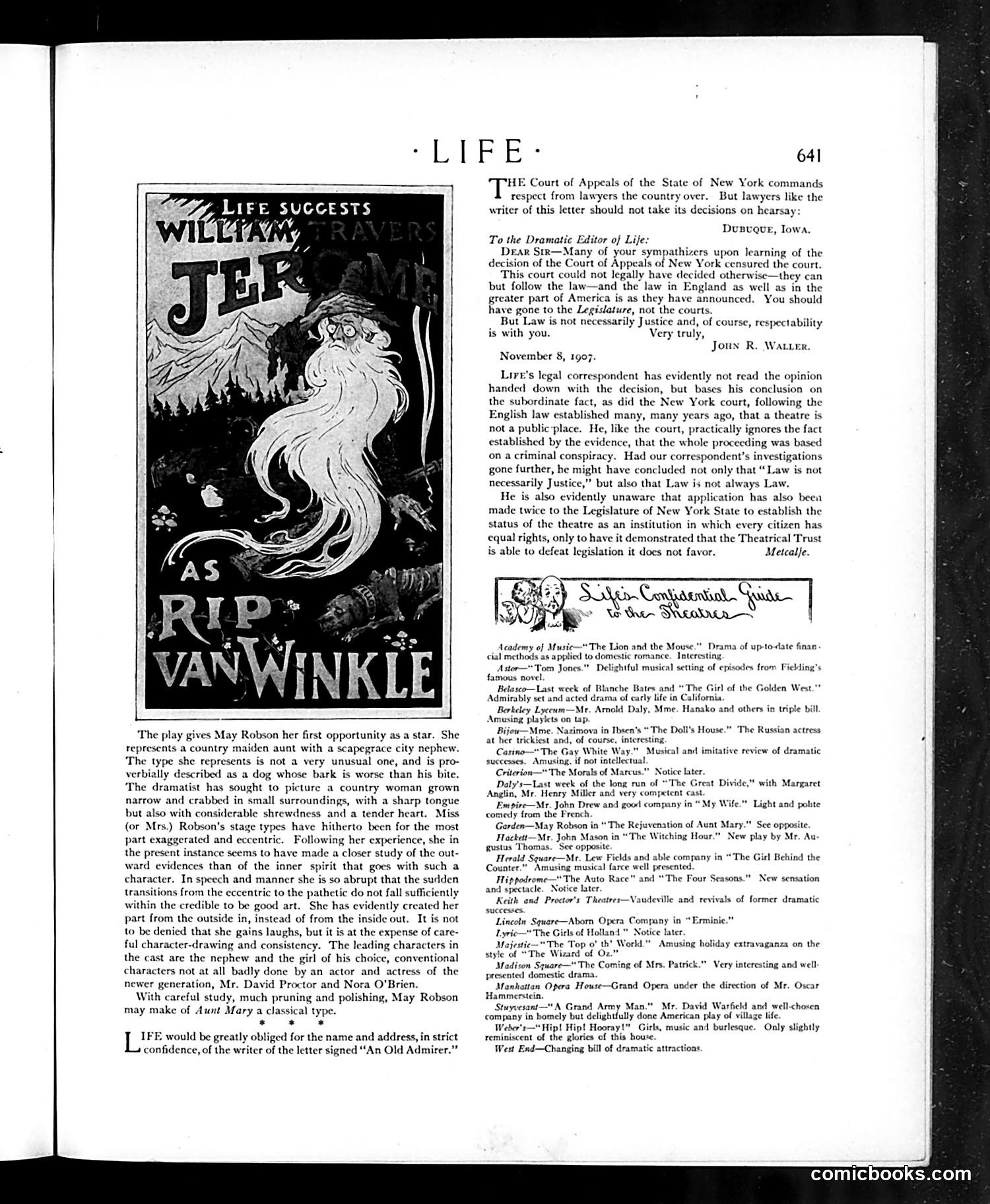
The page features a theatrical advertisement for "Rip Van Winkle," showing an illustration of the famous character with his long beard. The accompanying text discusses May Robson's performance in the play, marking her debut as a star. The bulk of the page consists of letters to the editor debating a New York Court of Appeals decision about theater law. One correspondent argues the court overstepped its authority; another defends the court's legal reasoning. A handwritten note references "Semi-Confidential Guide to the Theatre." Below are theater reviews covering various productions and performers of the era. The content reflects early 20th-century theatrical criticism and legal debates about institutional authority—not primarily political satire. The "Rip Van Winkle" reference trades on the famous Washington Irving story's cultural recognition.
📄 Transcribed text from this page (OCR, searchable)
Machine-transcribed from the original scan — historical spelling and the odd misread are preserved.
LIFE SUCCESTS ueestG nit ‘The play gives May Robson her first opportunity as a star. She represents a country maiden aunt with a scapegrace city nephew. The type she represents is not a very unusual one, and is pro- verbially described as a dog whose bark is worse than his bite. The dramatist has sought to picture a country woman grown narrow and crabbed in small surroundings, with a sharp tongue but also with considerable shrewdness and a tender heart. Miss (or Mrs.) Robson’s stage types have hitherto been for the most part exaggerated and eccentric. Following her experience, she in the present instance seems to have made a closer study of the out- ward evidences than of the inner spirit that goes with such a character. In speech and manner she is so abrupt that the sudden transitions from the eccentric to the pathetic do not fall sufficiently within the credible to be good art. She has evidently created her part from the outside in, instead of from the inside out. It is not to be denied that she gains laughs, but it is at the expense of care- ful character-drawing and consistency. The leading characters in the cast are the nephew and the girl of his choice, conventional characters not at all badly done by an actor and actress of the newer generation, Mr. David Proctor and Nora O'Brien. With careful study, much pruning and polishing, May Robson may make of Aunt Mary a classical type. * 8 IFE would be greatly obliged for the name and address, in strict confidence, of the writer of the letter signed “An Old Admirer.” HE Court of Appeals of the State of New York commands respect from lawyers the country over. But lawyers like the writer of this letter should not take its decisions on hearsay: Dunvaue, Iowa. To the Dramatic Editor of Lije: Dear StR—Many of your sympathizers upon learning of the decision of the Court of Appeals of New York censured the court. This court could not legally have decided otherwise—they can but follow the law—and the law in England as well as in the greater part of America is as they have announced. You should have gone to the Legislature, not the courts. But Law is not necessarily Justice and, of course, respectability is with you. Very truly, Joux R. Waiter. November 8, 1907. Live's legal correspondent has evidently not read the opinion handed down with the decision, but bases his conclusion on the subordinate fact, as did the New York court, following the English law established many, many years ago, that a theatre is not a public-place. He, like the court, practically ignores the fact established by the evidence, that the whole proceeding was based on a criminal conspiracy. Had our correspondent’ investigations gone further, he might have concluded not only that “Law is not necessarily Justice,” but also that Law is not always Law. He is also evidently unaware that application has also been made twice to the Legislature of New York State to establish the status of the theatre as an institution in which every citizen has equal rights, only to have it demonstrated that the Theatrical Trust is able to defeat legislation it docs not favor. Metcalfe. Academy of Music—"The Lion and the Mouse.” Drama of up-to-date finan cial methods as applied to domestic romance. Interesting. Aster—"Tom Jones." Delightful musical setting of episodes from Fielding's famous novel Belasco—Last week of Blanche Bates and “The Girl of the Golden West."" Admirably set and acted drama of early life in California Berkeley Lyceum—Mr. Arnold Daly, Mme. Hanako and others in triple bill Amusing playlets on tap. Bijow—Mme. Nazimova in Ibsen's “The Doll's House.” The Russian actress at her trickiest and, of course, interesting Casino—"The Gay White Way." Musical and i successes. Amusing, if not intellectual Criterion—"'The Morals of Marcus.” Notice later. Daly’s—Last week of the long run of “The Great Divie Anglin, Mr. Henry Miller and very competent ca Em pire—Mr. John Drew and good company in “My Wife.” Light and polite comedy from the French. Garden—May Robson in “The Rejuvenation of Aunt Mary.” See opposite. Hackett—Mr. John Mason in “The Witching Hour.” New play by Mr. Au- gustus Thomas. ‘See opposite Herald Square—Mr. Lew Fields and able company in “The Girl Behind the Counter.” Amusing musical farce well presented. Hippodrome— "The Auto Race” and "The Four Seasons." New sensation and spectacle. Notice later. Keith and Proctor’s Theatres—V Lincoln Square—Aborn Opera Company in “Erminie.” Lyric—* The Gitls of Holland ” Notice later. Majestic—"The Top o! th’ World.” Amusing holiday extravaganza on the style of “The Wizard of Oz Madison Square—""The Coming of Mrs. Patrick." Very interesting and well presented domestic drama Manhattan Opera House—Grand Opera under the direction of Mr. Oscar Hammerstein. Stuyvesant—""A Grand Army Man." Mr. David Warfield and well-chosen company in homely but delightfully done American play of village life Weber's—"Hip! Hip! Hooray!” Girls, music and burlesque. Only slightly reminiscent of the glories of this house. West End—Changing bill of dramatic attractions itative review of dramatic de," with Margaret deville and revivals of former dramatic comicbooks.com