
A complete issue · 24 pages · 1907
Life — April 11, 1907
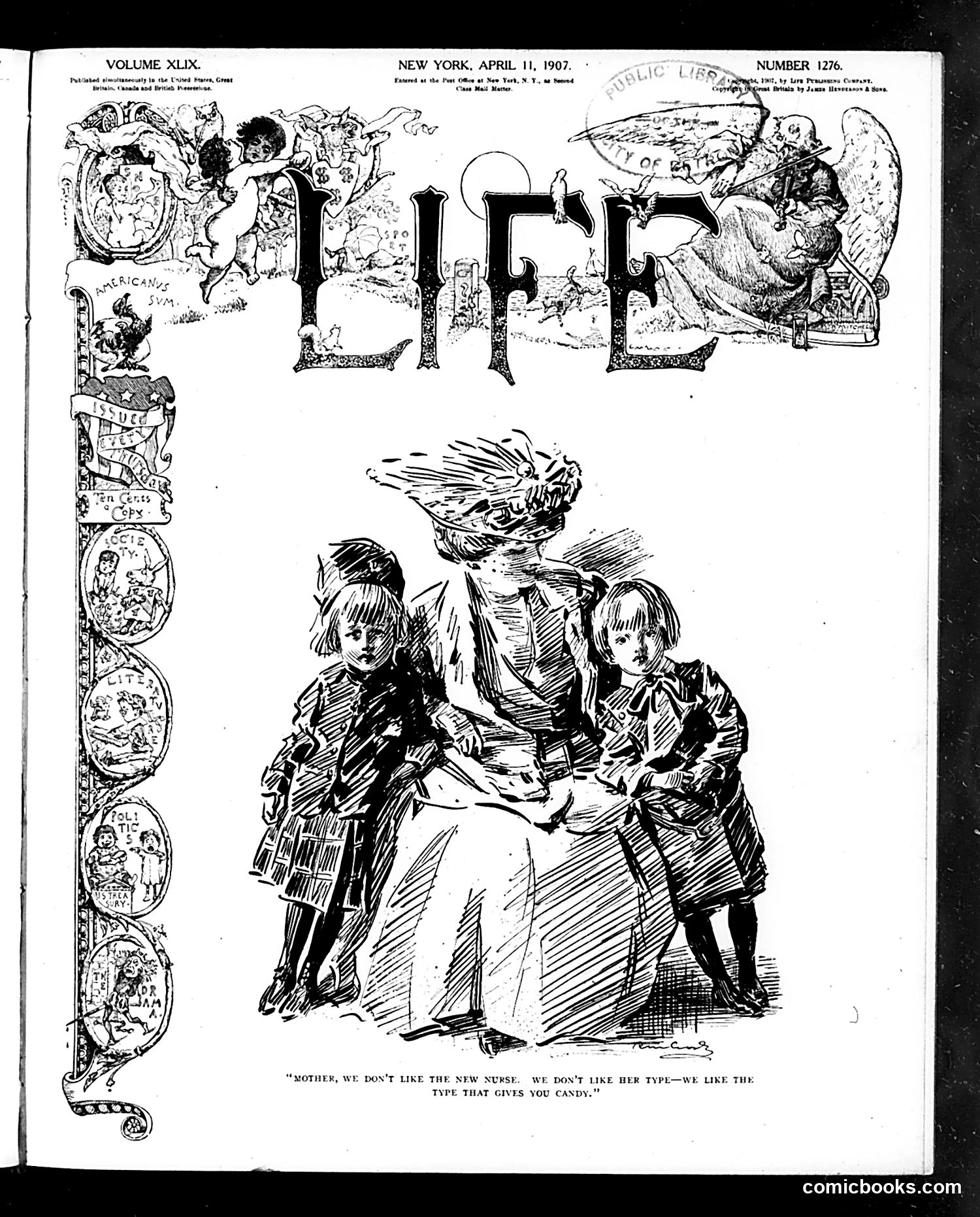
This cover depicts a domestic scene where two children complain to their mother about a new nurse, saying they dislike "her type" and prefer one "that gives you candy." The satire targets parenting standards of the era. The children's complaint—rejecting a presumably stricter, more disciplined nurse in favor of one who indulges them—mocks both: 1. **Permissive parenting**: The preference for candy-giving over proper child-rearing 2. **Class anxieties**: Debates about appropriate domestic service and childcare standards among the middle/upper classes The joke suggests that spoiled children (and perhaps their parents) lack proper values, prioritizing immediate gratification over genuine education and discipline. This reflects Progressive Era concerns about moral development and appropriate child-rearing practices among wealthy households.
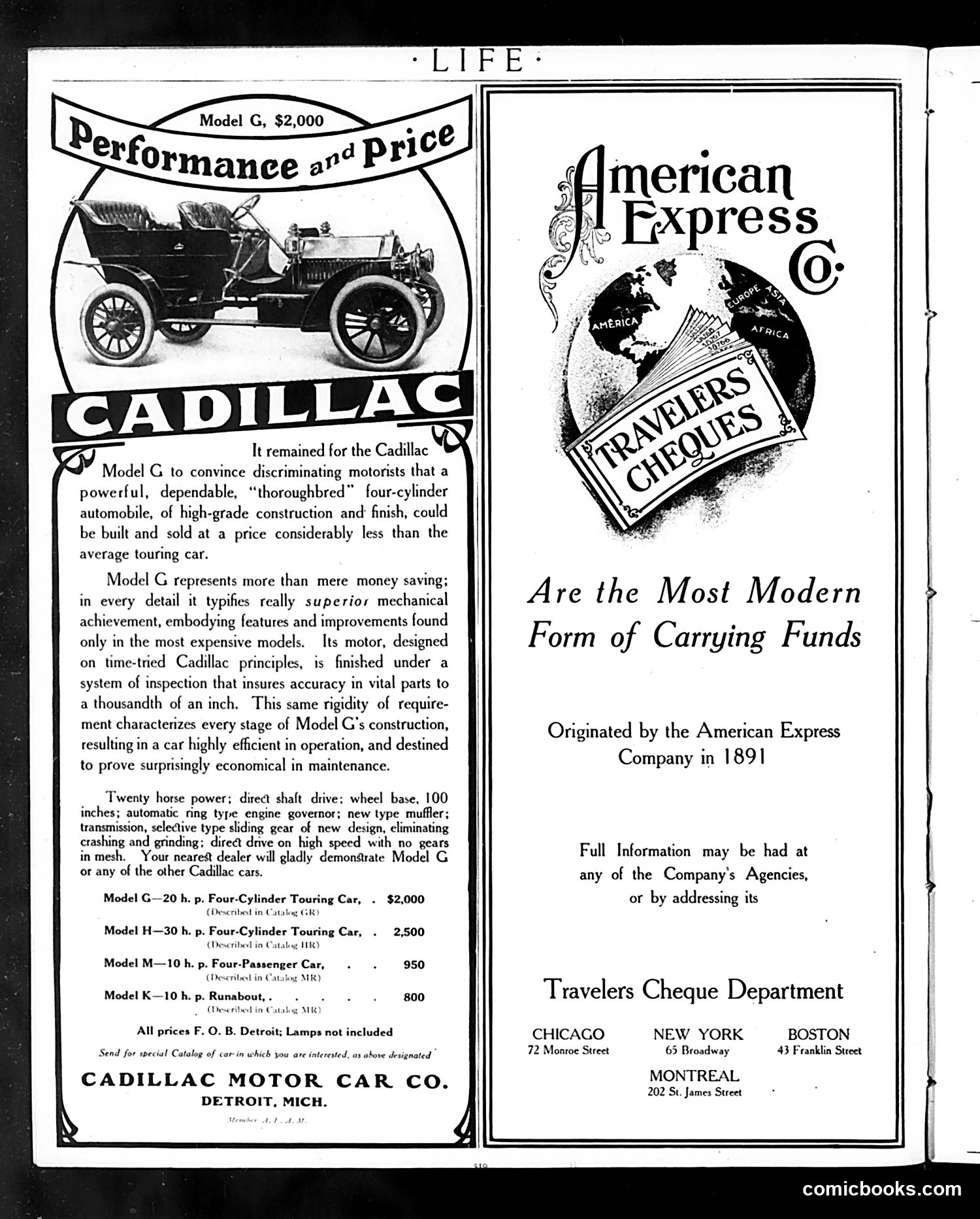
This page contains **two unrelated advertisements**, not political satire. **Left side:** Cadillac Motor Car Company advertises their Model G touring car at $2,000, emphasizing its "superior mechanical achievement" and affordability compared to other luxury cars. The ad stresses precision engineering and economical maintenance. **Right side:** American Express Company promotes its Travelers Cheques as "the Most Modern Form of Carrying Funds," noting the product originated in 1891. The advertisement includes a globe graphic and lists offices in Chicago, New York, Boston, and Montreal. Both ads target affluent readers—reflecting early 20th-century consumer culture for automobiles and international travel services. There is no cartoon, satire, or political commentary present on this page.
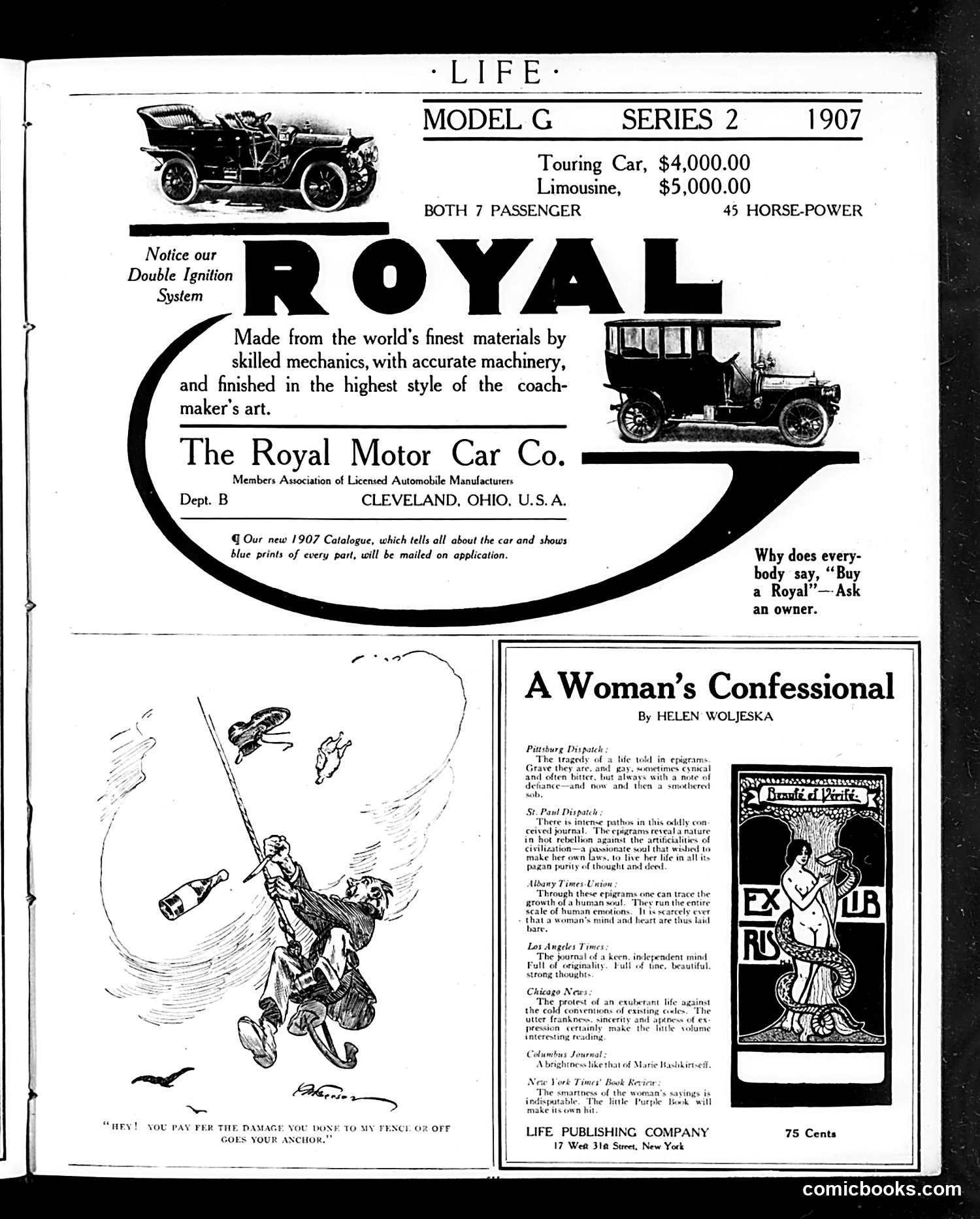
This page contains primarily **advertisements** rather than political cartoons. The top half features a Royal Motor Car advertisement from Cleveland, Ohio, showcasing 1907 automobiles with prices ($4,000-$5,000—substantial sums at that time). The ad emphasizes quality craftsmanship and invokes customer testimonials ("Why does everybody say, 'Buy a Royal'?—Ask an owner"). The bottom half shows a humorous illustration accompanying "A Woman's Confessional" by Helen Woljeska. The cartoon depicts a woman juggling bottles and other objects while suspended in a large rope or lasso, with the caption: "HEY! YOU PAY FOR THE DAMAGE YOU DONE TO MY FENCE 'O OFF GOES YOUR ANCHOR." The joke appears to reference marital or domestic conflict, likely satirizing women's independence or reckless behavior, reflecting early 20th-century gender attitudes.
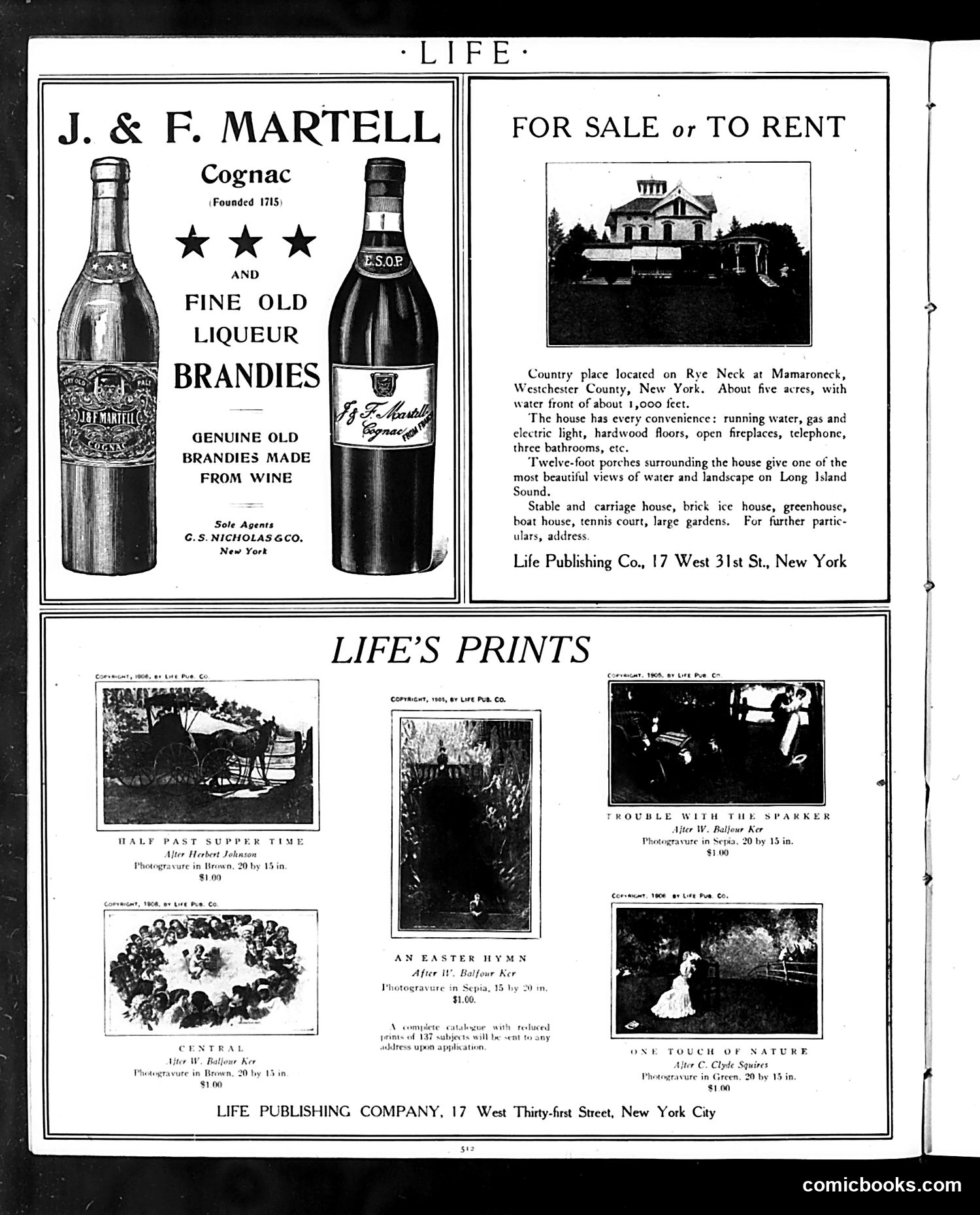
This page is primarily **advertising**, not satire or political commentary. The top left features an advertisement for **J. & F. Martell Cognac** (founded 1715), emphasizing "genuine old brandies made from wine" with three-star and V.S.O.P. bottles displayed. G.S. Nicholas & Co. are listed as sole agents in New York. The top right advertises a **country property for sale or rent** on Rye Neck at Mamaroneck, Westchester County, New York—a five-acre estate with modern conveniences and views of Long Island Sound. The bottom section showcases **Life Publishing Company's photographic prints** for sale, featuring theatrical or narrative scenes with titles like "Half Past Supper Time," "An Easter Hymn," and "Trouble with the Sparker." These are priced at $1.00 each.
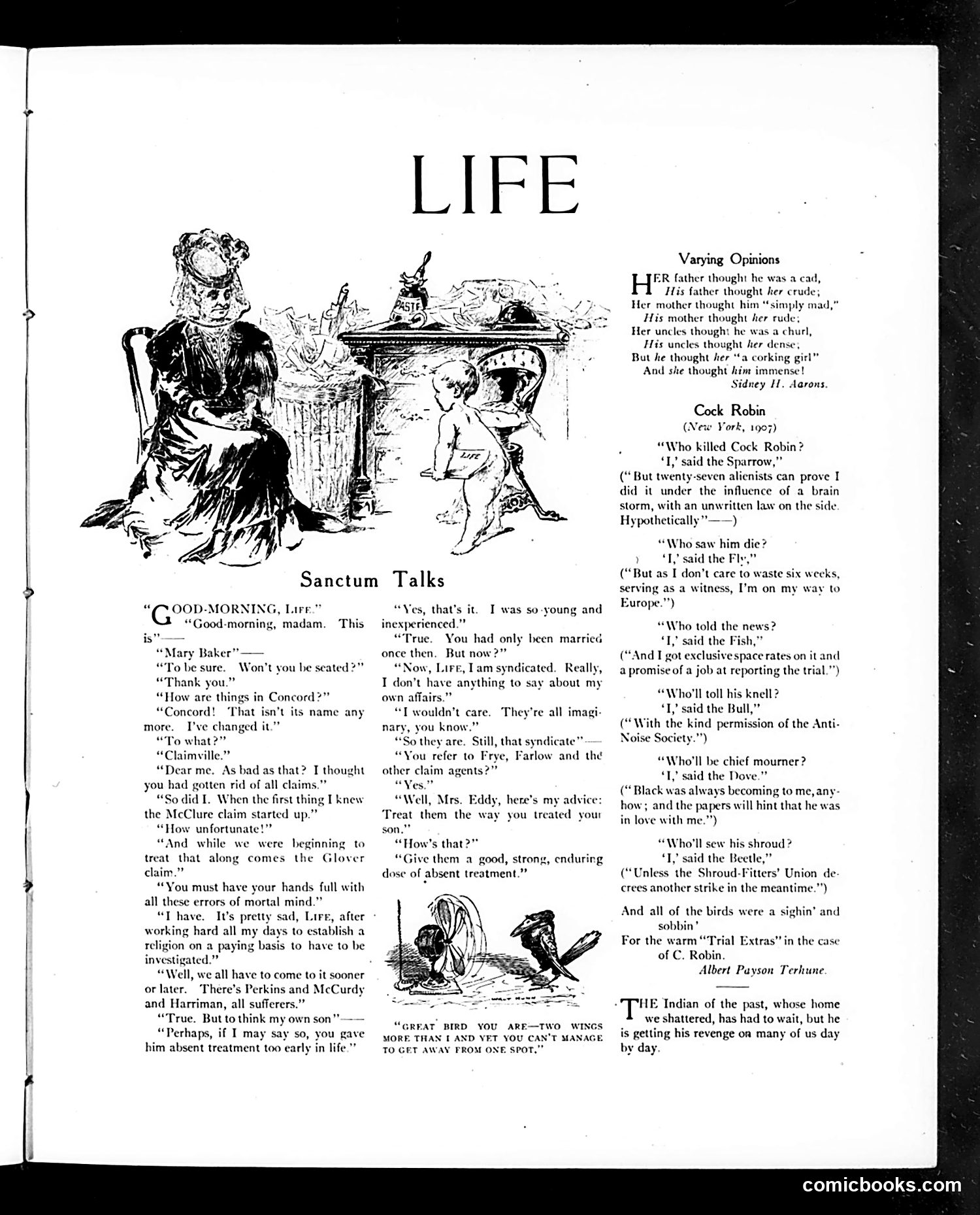
This page contains two distinct sections: **"Sanctum Talks"** (left) depicts a conversation between an older woman and younger woman about marriage and relationships. The dialogue humorously contrasts their experiences—the older woman has been married multiple times and advises treating husbands with "absent treatment," while the younger woman appears naive about matrimonial matters. The satire mocks both romantic inexperience and the cynical approach some took to marriage. **"Cock Robin" (right)** is a literary parody referencing the nursery rhyme. It humorously presents conflicting witness accounts about who killed Cock Robin, satirizing how multiple unreliable sources provide contradictory explanations—likely mocking sensationalist journalism or legal proceedings where testimony becomes absurd. Both sections use wordplay and exaggeration typical of Life's satirical style.
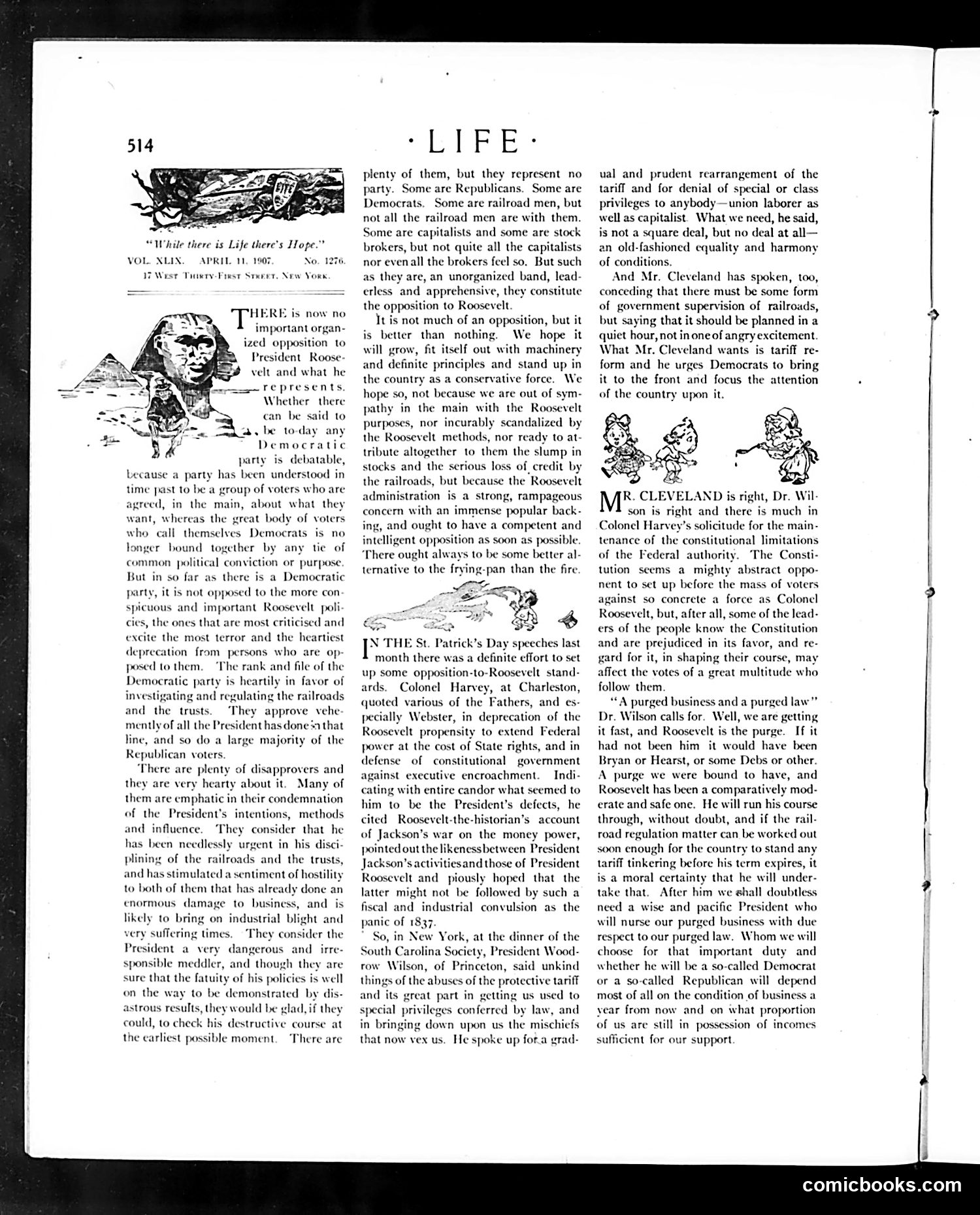
This page critiques President Theodore Roosevelt's opposition to railroad regulation. The left cartoon depicts Roosevelt as an aggressive, combative figure—reflecting contemporary criticism that he was reckless and dangerous to business interests. The article argues that while Roosevelt's administration is "strong and rampageous," organized opposition is necessary to restrain him. The text discusses St. Patrick's Day speeches where Colonel Harvey and others quoted the Founding Fathers to critique Roosevelt's expansion of federal power at the expense of states' rights and business privileges. The satire suggests Roosevelt poses a threat requiring political counterbalance—a conservative critique of progressive executive overreach, framing restraint as constitutionally prudent rather than obstructionist.
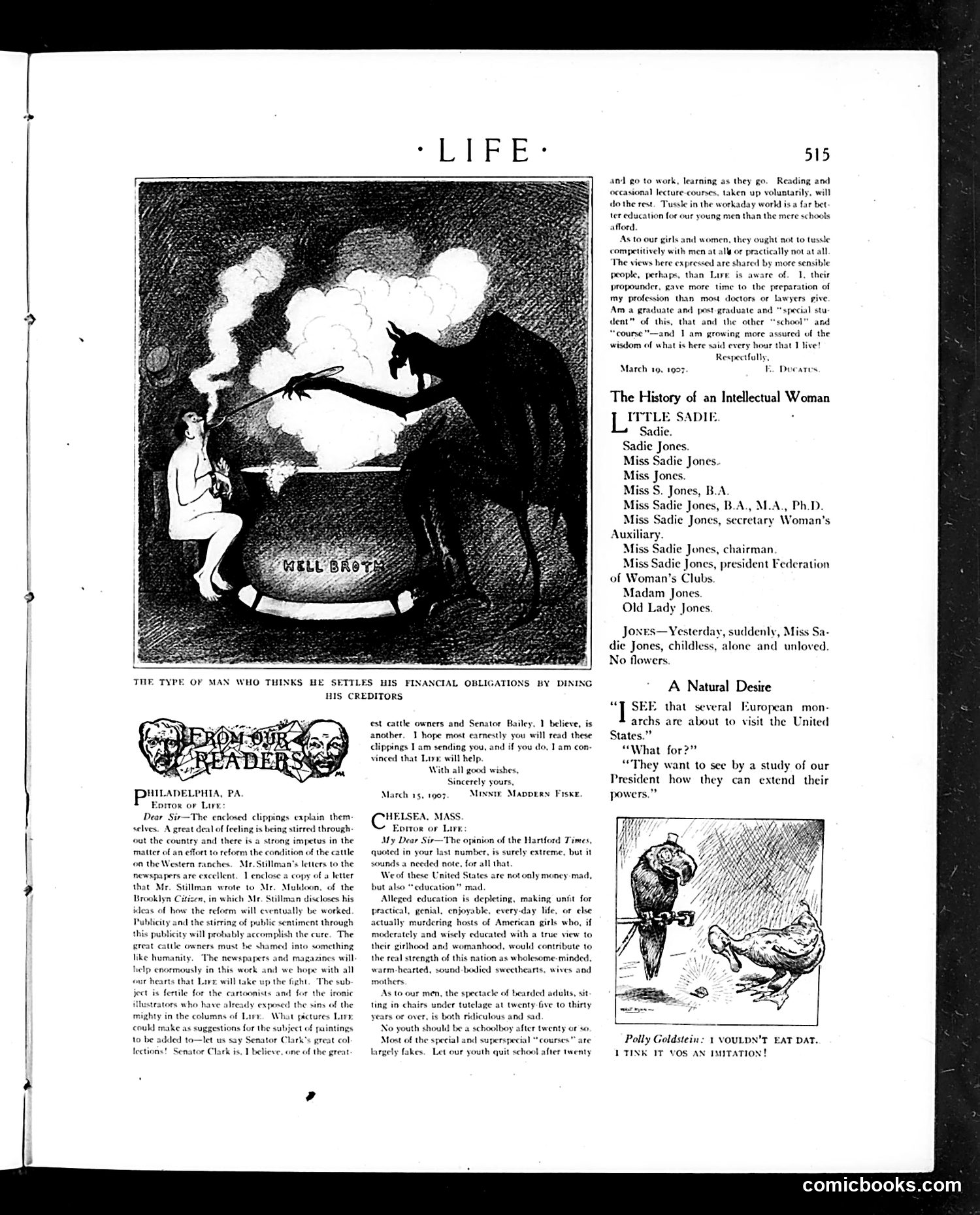
**The Main Cartoon** (top, captioned "THE TYPE OF MAN WHO THINKS HE SETTLES HIS FINANCIAL OBLIGATIONS BY DINING HIS CREDITORS"): This satirical cartoon depicts a silhouetted man hosting an elaborate dinner party in a cauldron labeled "WELL BROTH." A small figure (representing a creditor) sits trapped inside while the man entertains lavishly above. The joke targets wealthy debtors who attempt to charm or socially impress their creditors rather than actually paying money owed—suggesting that fancy hospitality is a substitute for financial responsibility. It's a commentary on the wealthy's evasion tactics during this era of economic inequality.
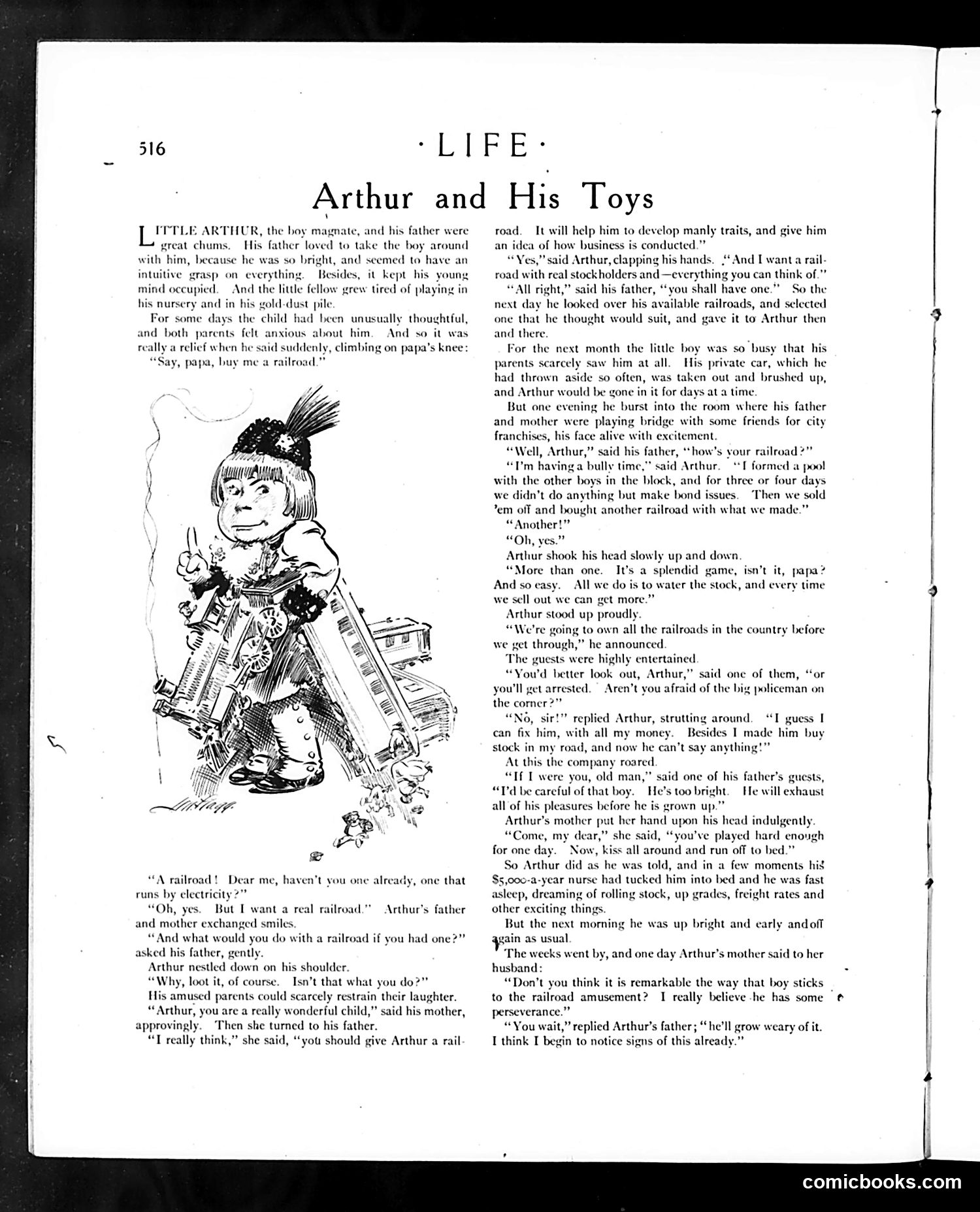
This is a humorous story about a boy named Arthur who becomes obsessed with toy railroads after his father mentions them. The illustration shows Arthur as a child surrounded by toy train equipment and accessories. The satire targets **wealthy parents and consumerism**: Arthur's indulgent mother and father enable his railroad obsession by continuously buying him more toys and stock. The story humorously warns that this excess will exhaust his pleasures before adulthood arrives—a critique of the era's affluent parenting and materialism. The text reveals the parents' amusement at their son's single-minded focus, while gently mocking the idea that unlimited purchasing power can sustain a child's interest indefinitely. It's a period commentary on childhood indulgence among the wealthy class.
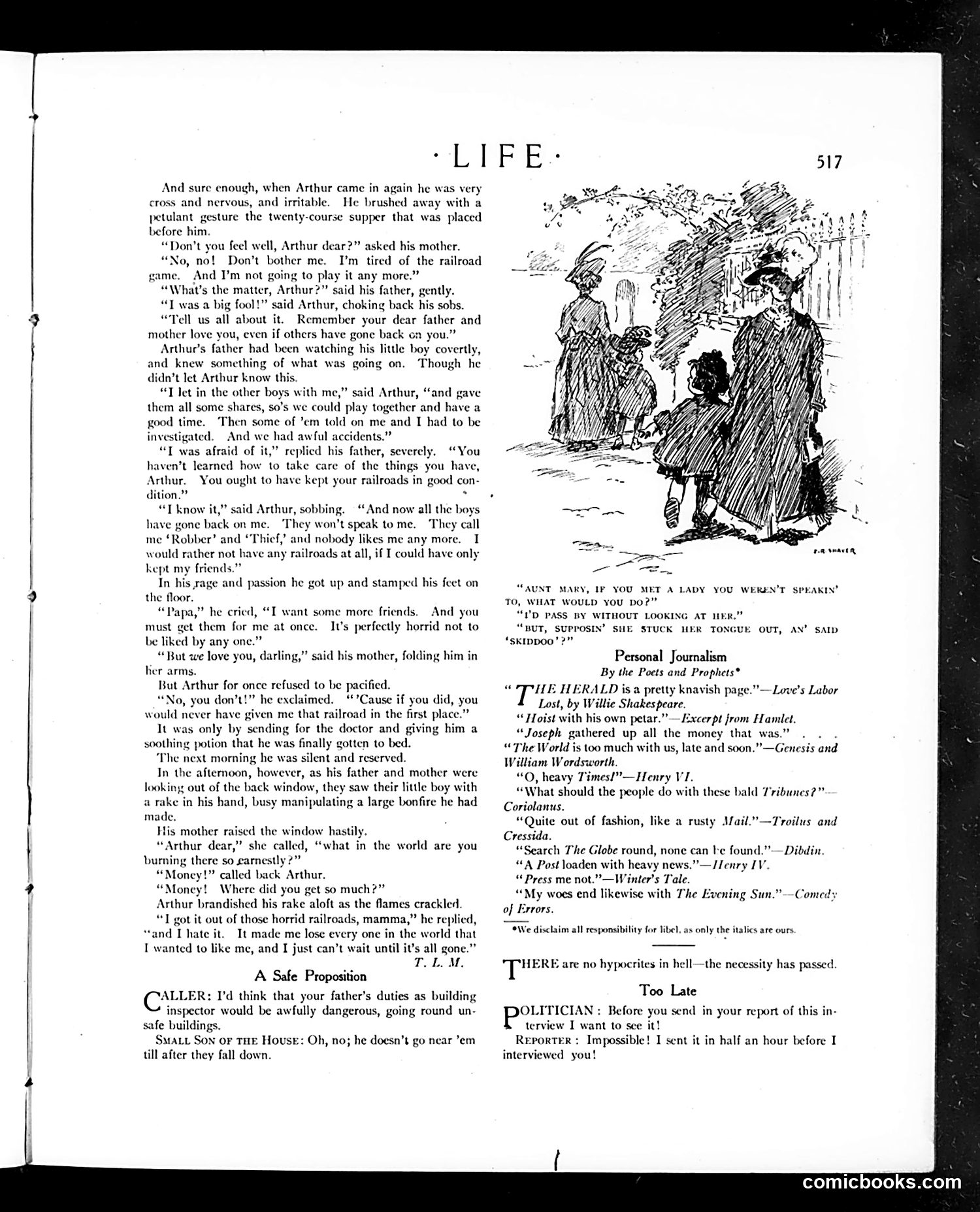
This page contains a narrative story about a boy named Arthur and his troubled railroads, accompanied by a sketch illustration showing two figures in period dress. The main cartoon/satirical content appears in the section titled "A Safe Proposition," featuring a brief dialogue between a "Caller" and a "Small Son of the House" about whether a building inspector's job is dangerous. The joke plays on the common assumption that inspecting buildings is perilous work—the child's response subverts this, suggesting the inspector faces no real danger. The illustration depicts what appears to be a Victorian-era domestic scene with adults and a child. The page also includes a "Personal Journalism" section quoting literary passages. Without clearer caption attribution or historical context visible in the image, the specific satirical targets remain unclear.
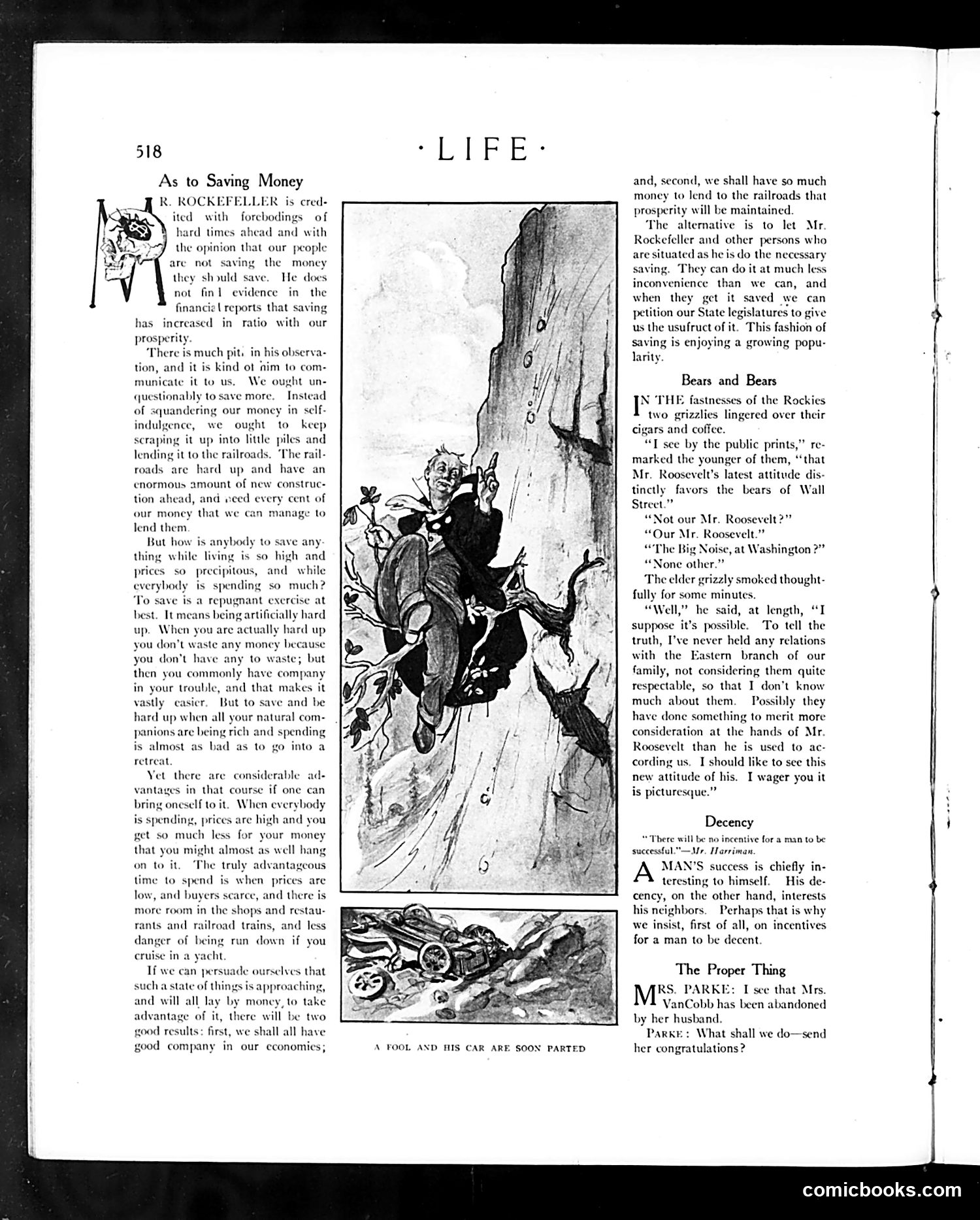
This page contains three separate satirical pieces. The main left-side article discusses Rockefeller's reputation for thriftiness and saving money, positioning him as a model for financial prudence during economically difficult times. The "Bears and Bears" cartoon depicts two bears smoking cigars and discussing Roosevelt's attitude toward Wall Street. The younger bear remarks that Roosevelt "distinctly favors the bears of Wall Street," playing on the double meaning of "bears" (investors expecting price declines) versus actual bears. The smaller illustrations show comedic scenes, including one captioned "A Fool and His Car Are Soon Parted," depicting automobile mishaps. The "Decency" and "The Proper Thing" sections are brief editorial vignettes offering social commentary on personal conduct and propriety.
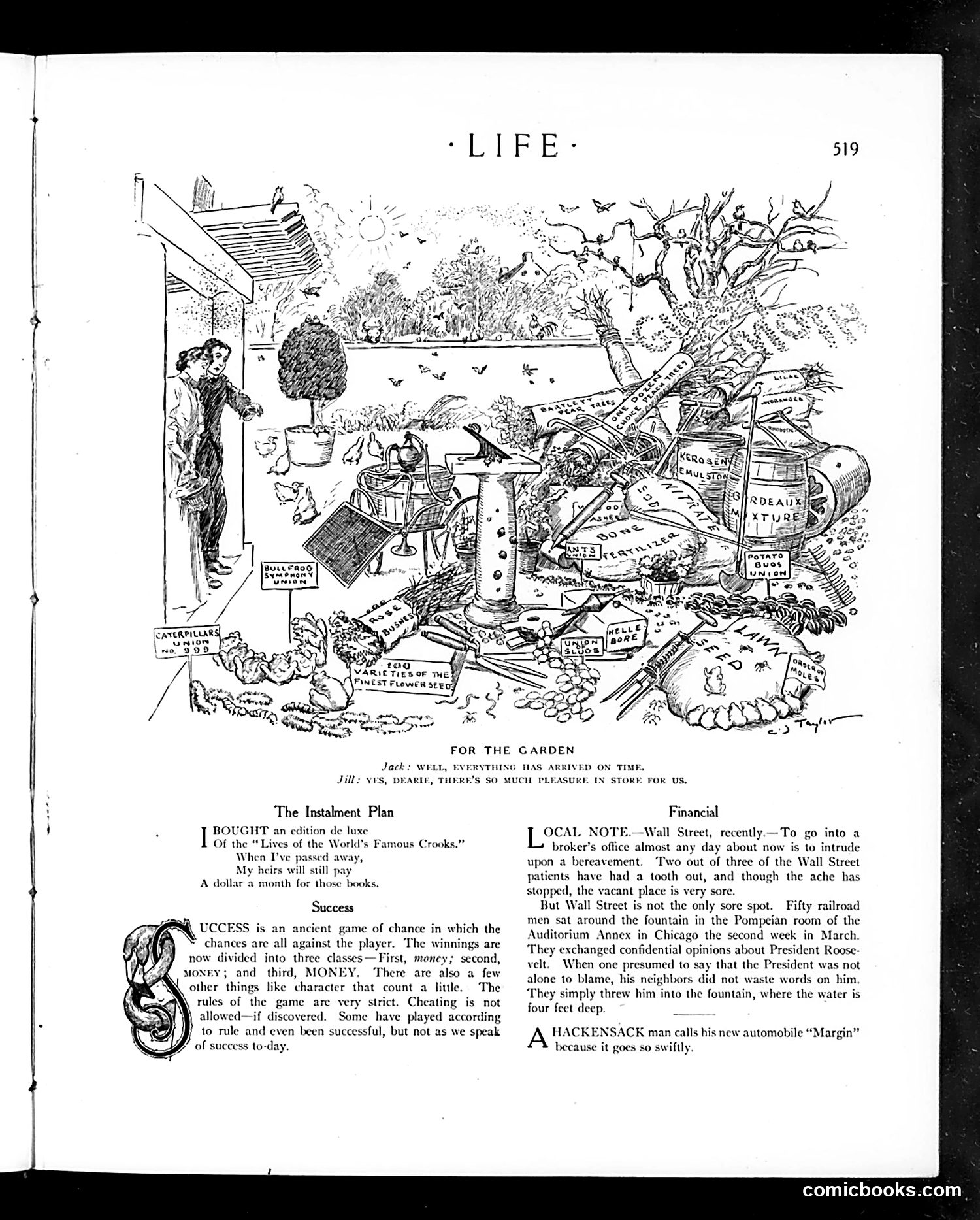
This illustration satirizes the absurdity of optimistic consumer spending during uncertain economic times. The cartoon shows a cluttered garden scene overflowing with gardening supplies, seed catalogs, and tools—labeled with brand names like "Burpee's Seeds" and " Guerande"—while a well-dressed man peers in from outside, apparently trying to find space or justify the purchases. The accompanying text's joke about the automobile "Margin" going "so swiftly" likely references buying on credit margin, a practice common before the 1929 stock market crash. The piece mocks how consumers eagerly purchase luxuries despite financial precarity, expecting perpetual prosperity. The garden represents aspirational, perhaps frivolous, domestic spending habits of the era.
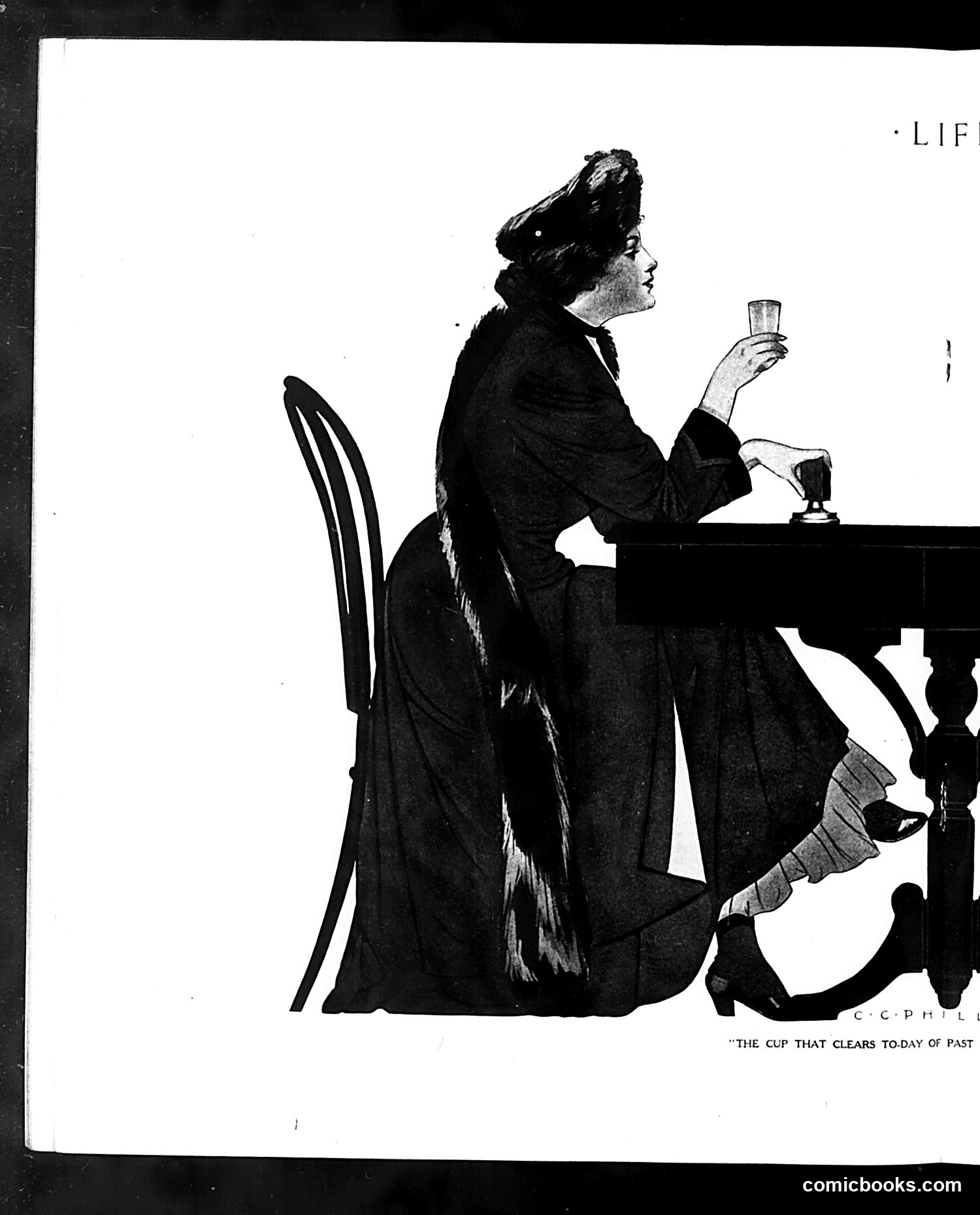
This appears to be a satirical illustration from *Life* magazine's early 20th-century period. The image shows a elegantly dressed woman seated at a small table, holding a drinking glass. The caption reads "THE CUP THAT CLEARS TO-DAY OF PAST." The illustration likely satirizes either: 1. **Prohibition-era drinking** — the woman's refined pose contrasts humorously with illicit alcohol consumption during Prohibition (1920-1933) 2. **Women's changing social roles** — depicting a woman drinking alcohol independently, which would have been socially transgressive for the era The sophisticated styling and the paradoxical caption suggest the cartoonist is mocking either hypocrisy around alcohol laws or evolving gender norms regarding women's public behavior. The exact political reference remains unclear without additional context.
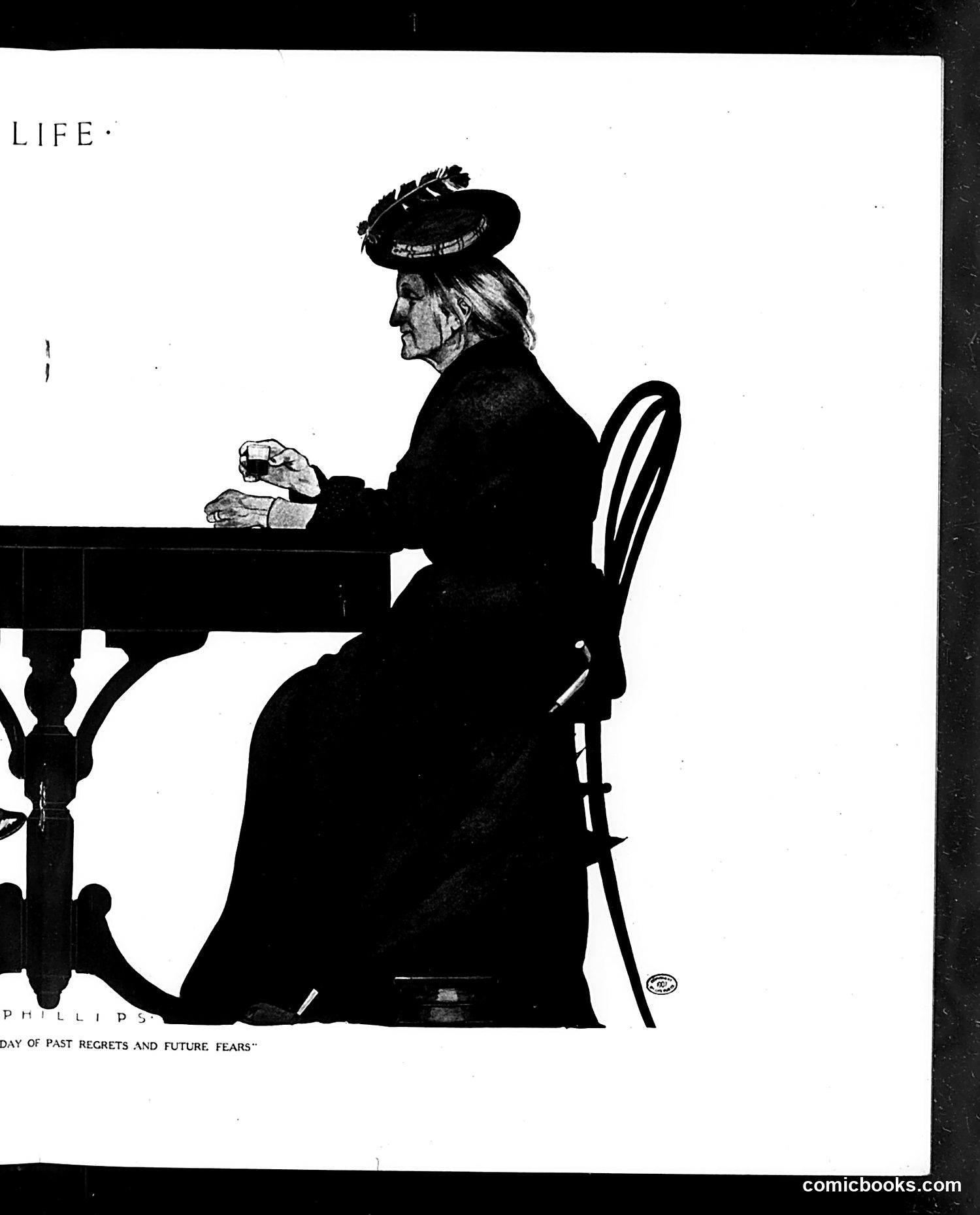
This is a silhouette illustration from *Life* magazine showing a woman seated at a table, wearing an elaborate hat with feathers and formal dark clothing. She appears contemplative or distressed, with her hands positioned on the table. The caption reads "DAY OF PAST REGRETS AND FUTURE FEARS," suggesting the illustration depicts psychological or emotional reflection. The artist signature indicates this is by Phillips (a cartoonist for *Life*). The silhouette style and formal dress suggest a woman of means, likely from the early 20th century. The specific social commentary—whether addressing women's roles, relationship anxieties, economic concerns, or another contemporary issue—is unclear without additional context about the publication date and surrounding articles on this page.
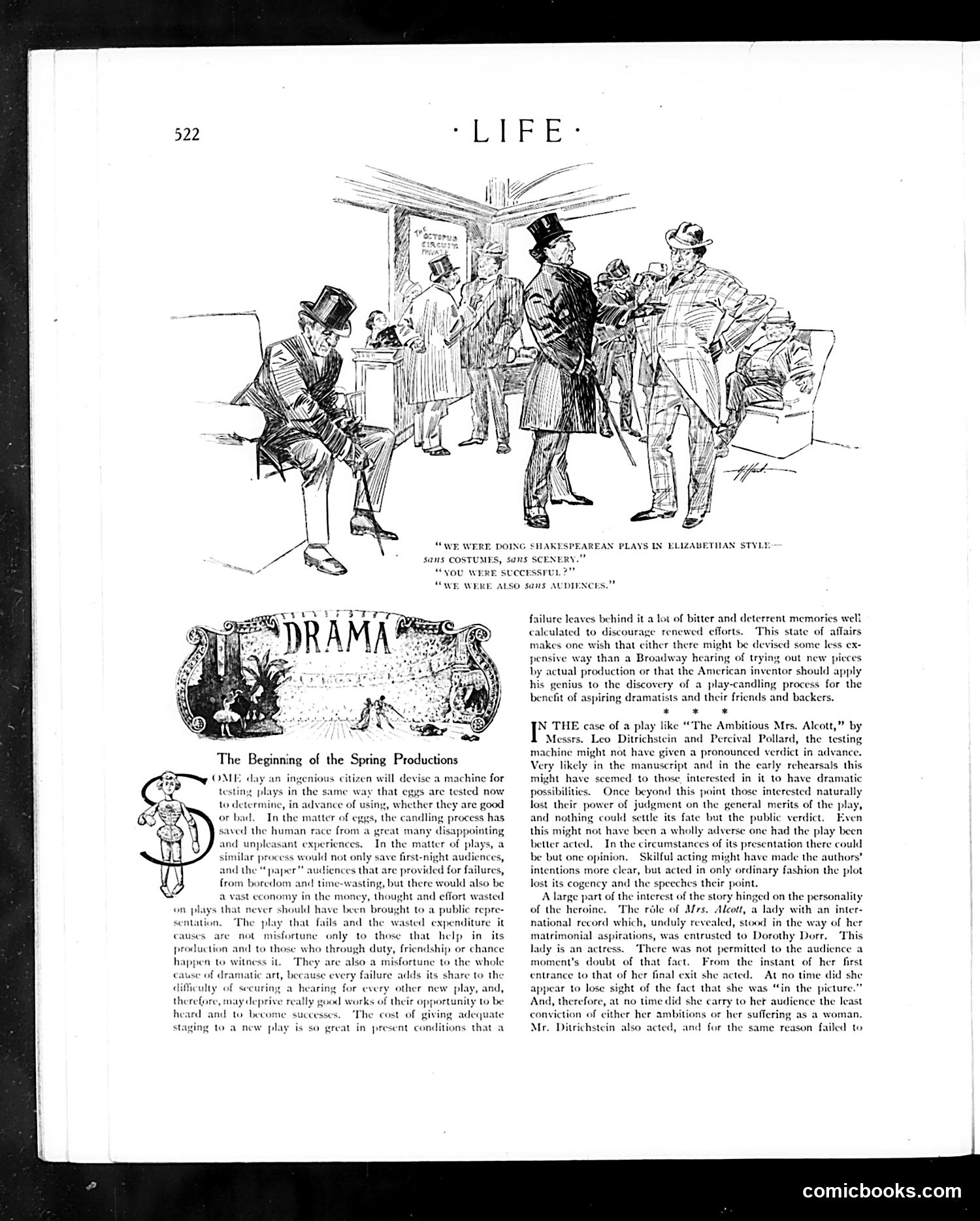
The top cartoon satirizes theatrical ambition. A man sitting alone represents a failed playwright pitching his "Shakespearean plays in Elizabethan style—sans costumes, sans scenery." When asked if he was successful, he replies they were also "sans audiences"—a joke about the production's complete failure to attract viewers. The article below discusses spring theatrical productions, lamenting failed plays' waste of money and effort. It then critiques "The Ambitious Mrs. Alcott," a contemporary play by Leo Ditrichstein and Percival Pollard. The reviewer faults actress Dorothy Dorr's performance as overly self-conscious—she appears perpetually aware she is "in the picture," performing rather than inhabiting her role. This artificial acting undermined the character's emotional authenticity, preventing audience connection to the heroine's ambitions and suffering. The satire targets both theatrical excess and bad acting that prioritizes spectacle over genuine character portrayal.
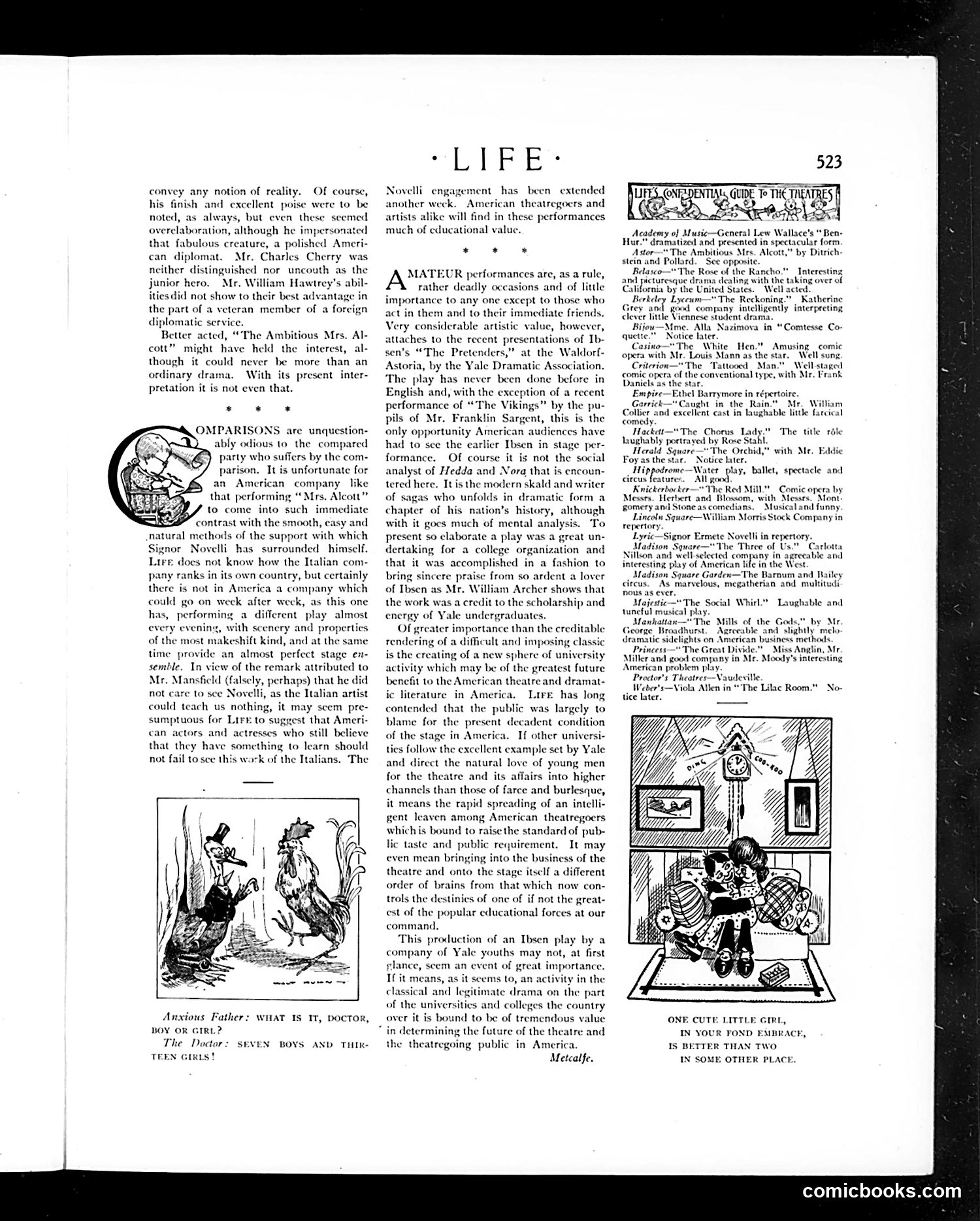
This page from Life magazine contains theater reviews and two cartoon panels. **The Cartoons:** The left panel shows two figures in what appears to be a comedic domestic scene—likely satirizing marital conflict or family dynamics, though specific identities are unclear from the image alone. The right panel depicts a domestic interior scene labeled "ONE CUTE LITTLE GIRL, IN YOUR FOND EMBRACE, IS BETTER THAN TWO IN SOME OTHER PLACE"—a joke about romantic preference or marital satisfaction. **The Text:** The reviews discuss theatrical performances: criticisms of amateur American productions versus praise for Italian actor Signor Novelli's company, and particular enthusiasm for Yale's dramatic association's production of Ibsen's "The Pretenders." The author argues university theater could elevate American dramatic standards and public taste, rather than relying on "farce and burlesque." The famous joke at bottom: A doctor announces "SEVEN BOYS AND THIRTEEN GIRLS!" to an anxious father—humor about large family size during this era.
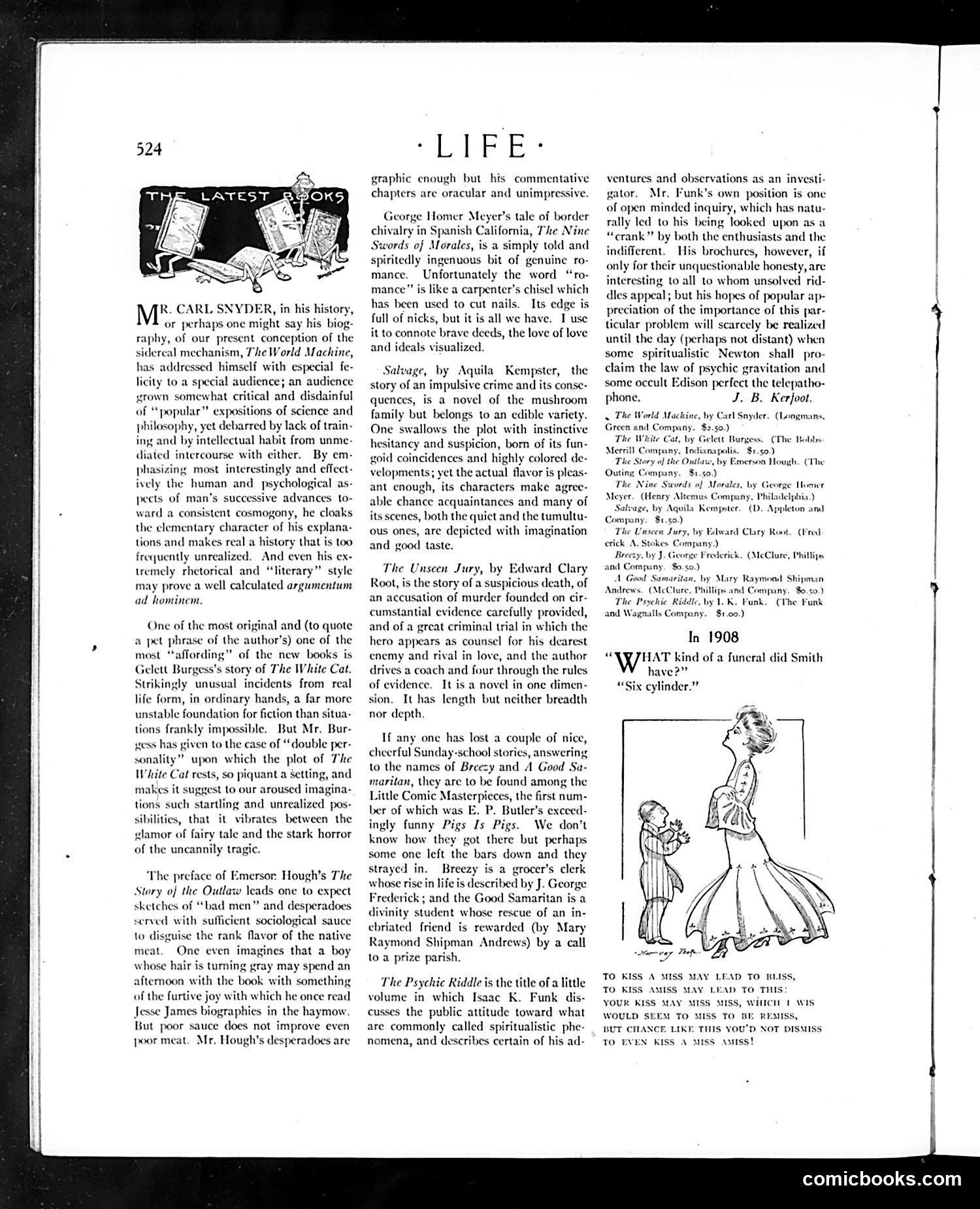
This page is a **book review section** from Life magazine, likely from the early 1900s (given the "In 1908" heading). It contains literary criticism of several new novels, not political cartoons. The small illustration at bottom right shows a humorous domestic scene: a tall woman bending down to kiss a child, with accompanying verse about kissing. This appears to be a light social commentary typical of Life's satirical approach—poking gentle fun at Victorian courtship rituals and domestic propriety. The reviews themselves critique contemporary fiction with Life's characteristic wit. The critic dismisses some works as overly sentimental or poorly constructed (Hough's *Story of the Outlaw*), praises others for originality (*The White Cat*), and notes that even well-intentioned social commentary ("sociological sauce") cannot redeem shallow narratives about outlaws. The page reflects Life's role as both literary arbiter and social satirist for educated American readers—offering sophisticated criticism while maintaining tongue-in-cheek humor about human nature and popular entertainment.
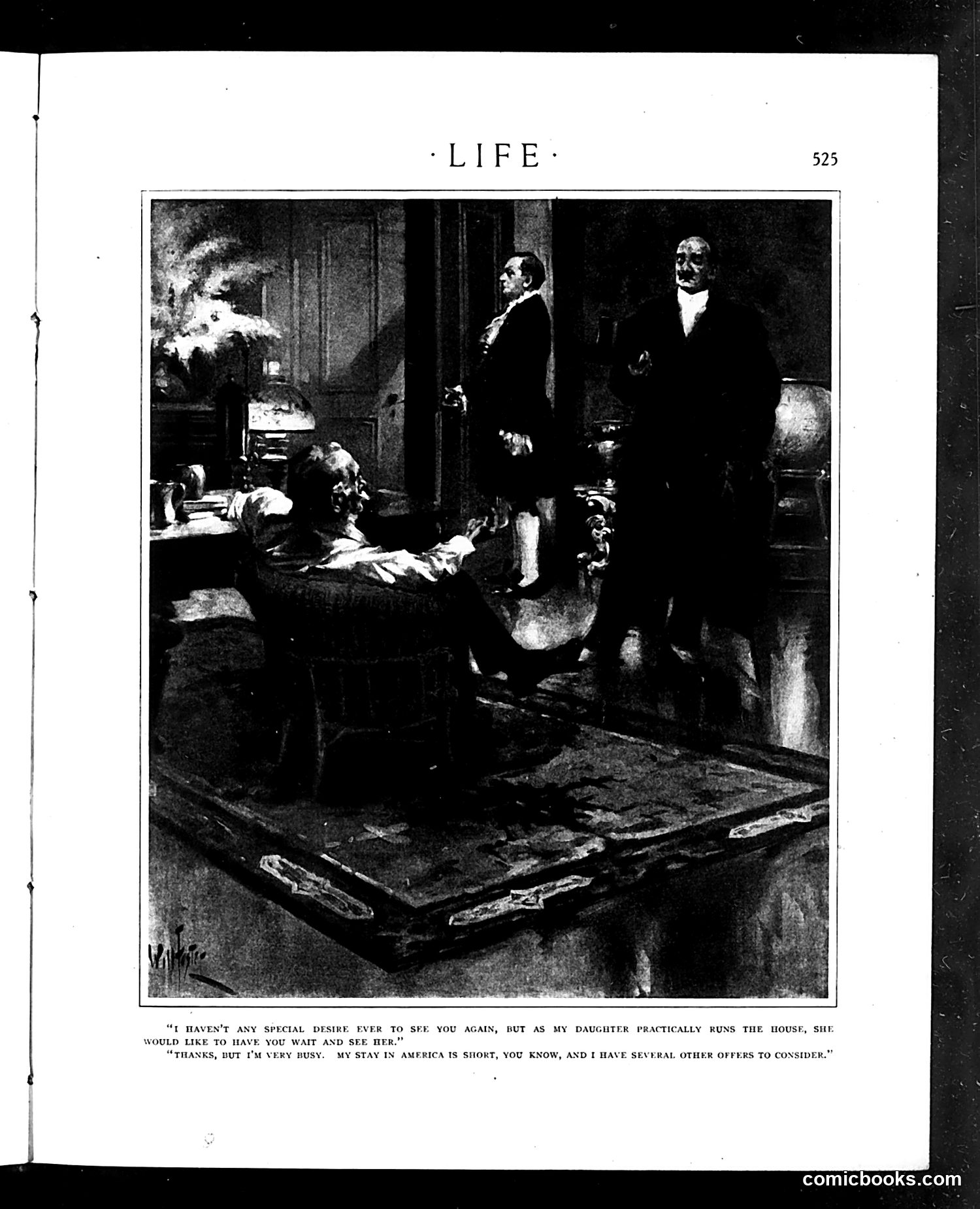
This page from *Life* magazine shows a dramatic interior scene with a man reclining on a couch while two well-dressed gentlemen stand nearby. The dialogue reveals a social satire about domestic power dynamics. The joke centers on a father's complaint that his daughter "practically runs the house," so he cannot invite a visitor to stay. His follow-up excuse—that he's "very busy" with "several other offers to consider"—appears to be a polite deflection masking his actual lack of authority in his own home. The satire targets early 20th-century social anxieties about generational shifts and women's increasing domestic influence. The wealthy setting suggests this critiques upper-class families where daughters wielded unexpected control, inverting traditional patriarchal household structures. The cartoon mocks both the father's emasculation and the daughter's presumed tyranny.
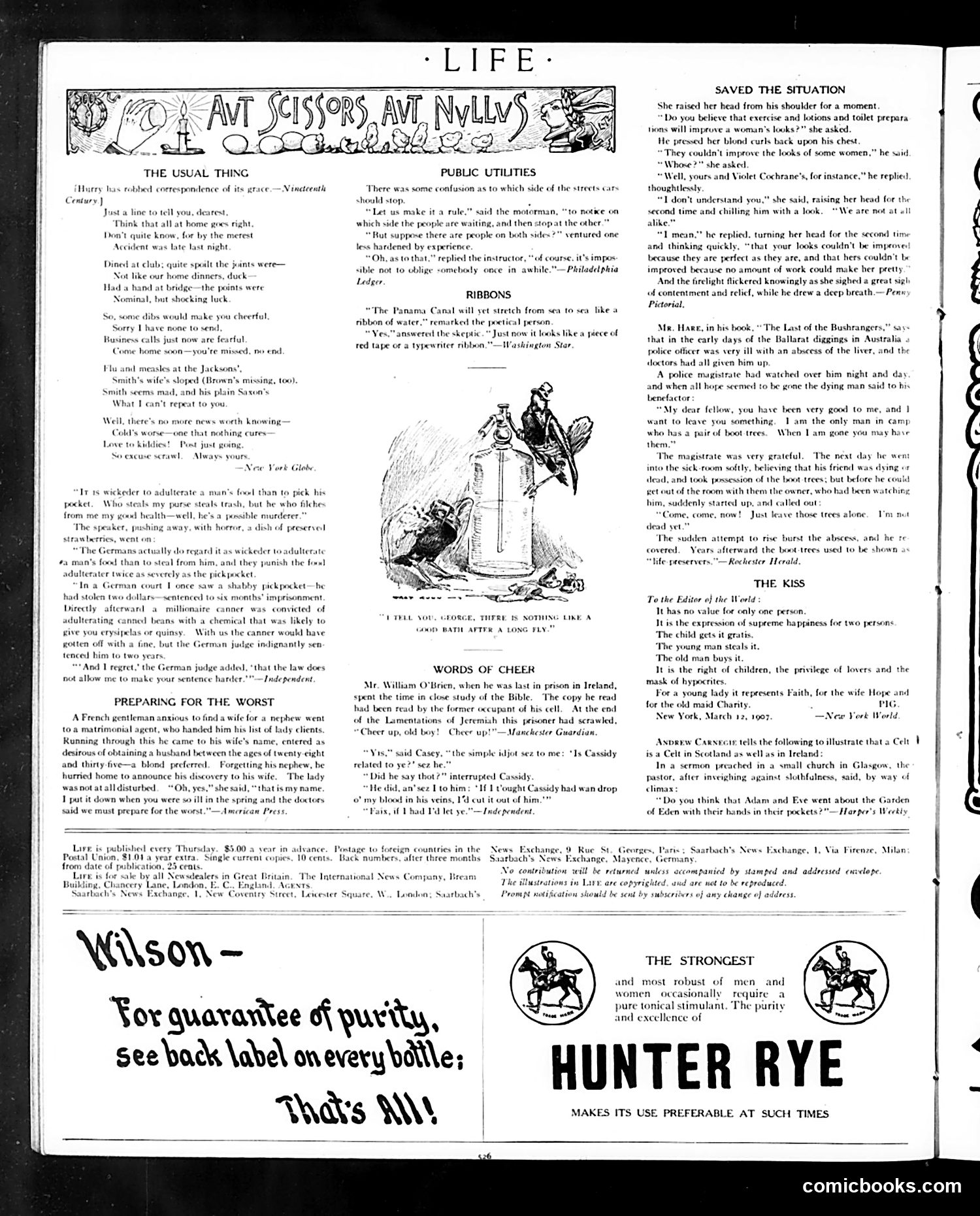
This is a satirical humor page from an early 20th-century American magazine, featuring multiple short comic pieces and anecdotes. **"The Usual Thing"** mocks the decline of personal correspondence—hurried, impersonal letters replacing thoughtful communication, listing mundane domestic crises (illness, affairs, accidents) with indifference. **"Public Utilities"** jokes about streetcar safety regulations: a motorman absurdly instructs passengers to board on one side and exit the other, then admits he cannot enforce which side people actually use. **"Words of Cheer"** celebrates imprisoned Irish nationalist William O'Brien's biblical encouragement to fellow inmates, contrasting with an Irish dialect joke about bloodlines. **"Preparing for the Worst"** presents a dark marital joke: a wife listed herself as marriageable during her husband's illness because doctors advised "prepare for the worst." The advertisements promote **Hunter Rye whiskey** and **Wilson** brand tonics, typical of period commercial content. The humor reflects era-specific concerns (immigration, domestic life, class distinctions) and conversational styles now archaic.
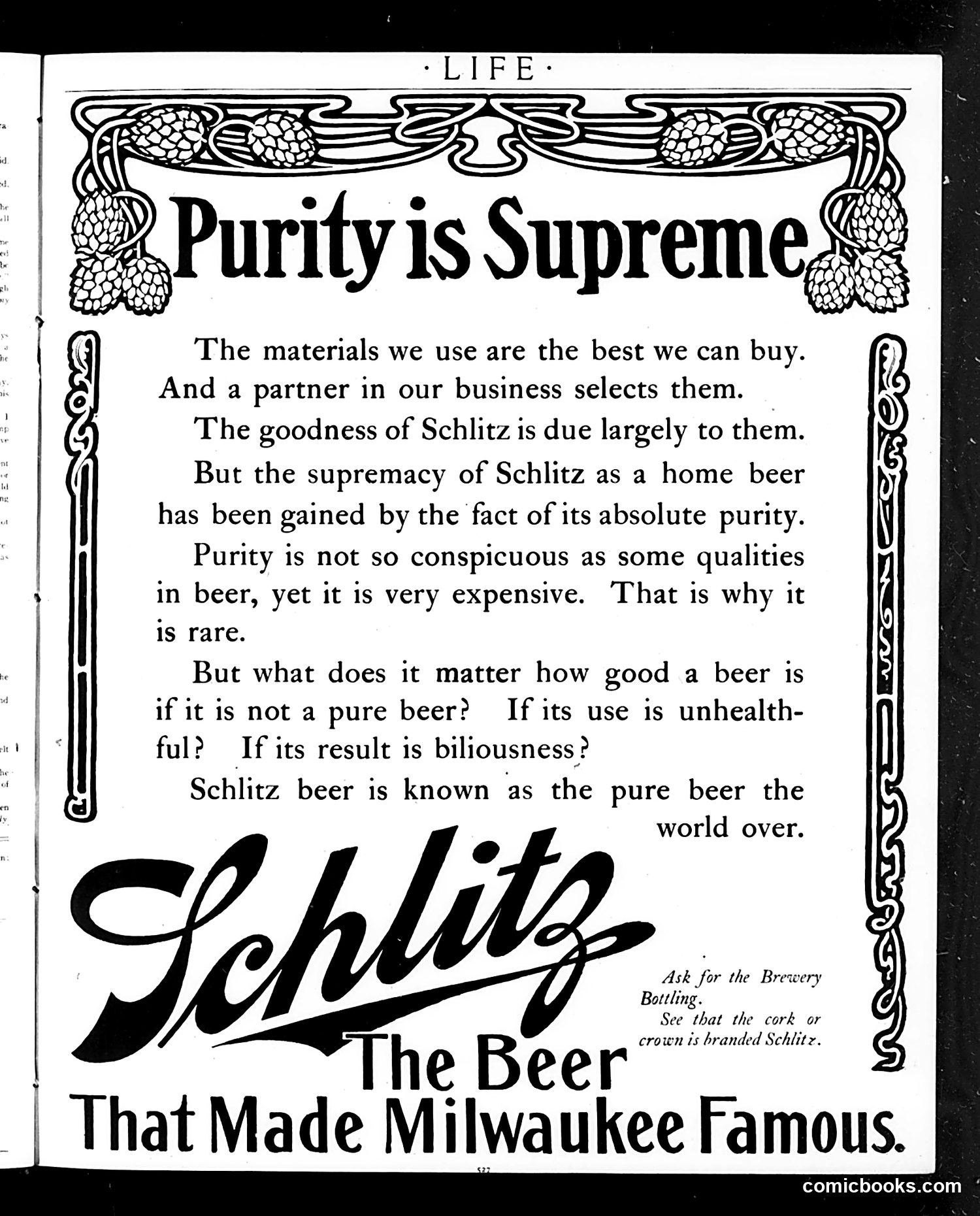
This is a **Schlitz beer advertisement**, not a political cartoon or satire. The page promotes Schlitz as "the pure beer the world over," emphasizing purity as its supreme selling point. The ad argues that while purity is expensive and "not so conspicuous as some qualities in beer," it's essential—questioning what good a beer is if impure, unhealthful, or causes "biliousness" (digestive upset). This messaging reflects early 20th-century concerns about contaminated or adulterated beverages. The decorative Art Nouveau border with hops and the formal typography suggest this is from Life magazine's advertising section. The tagline "That Made Milwaukee Famous" references Milwaukee's reputation as a major American brewing center. The instruction to "Ask for the Brewery Bottling" and verify the cork is "branded Schlitz" indicates concern about counterfeits—a real problem in that era when bottling standards were unregulated.
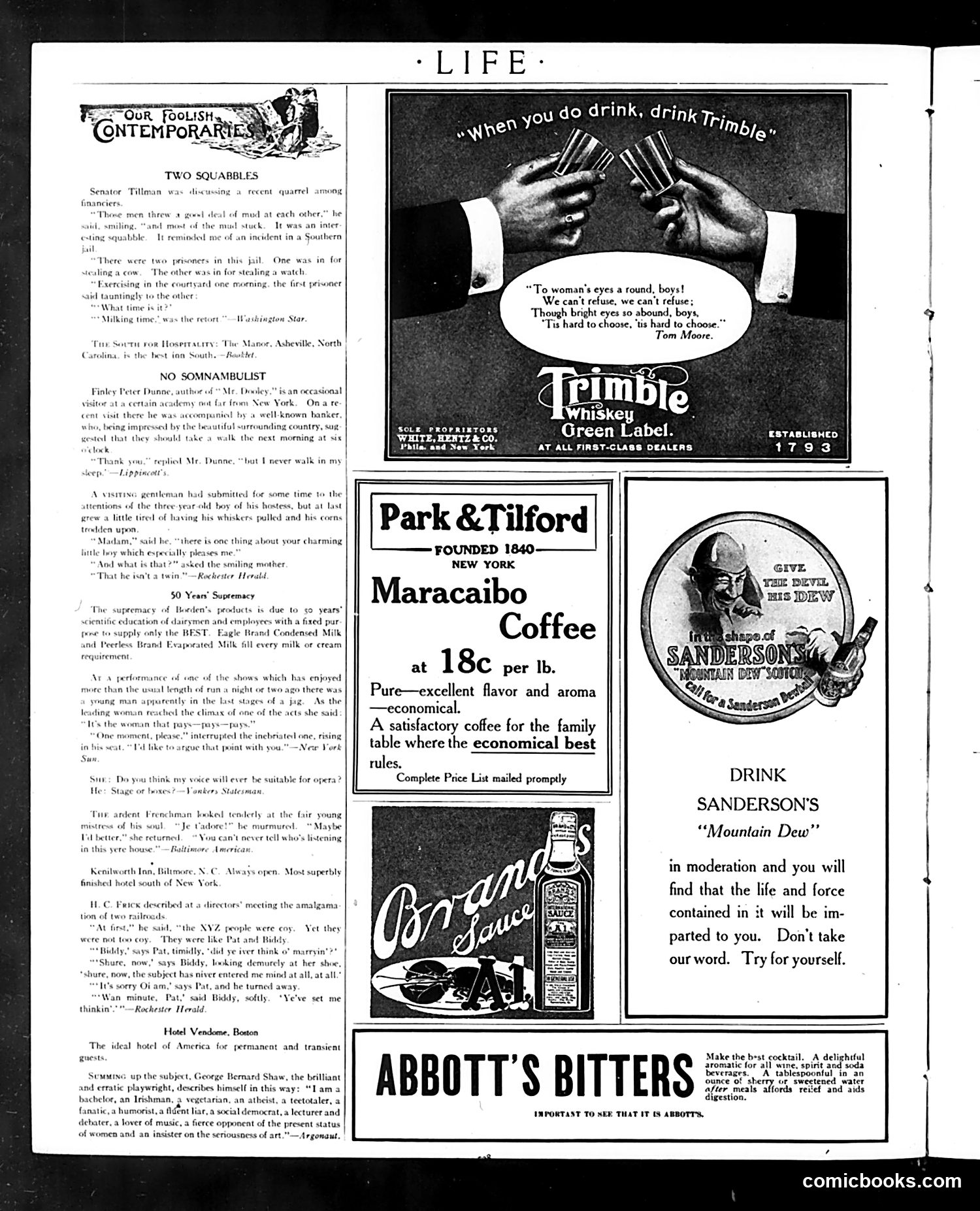
This page is primarily **advertisements and humor columns** rather than political satire. The content includes: **Humorous anecdotes** (left column): Brief jokes attributed to newspapers like the *Washington Star* and *Rochester Herald*, featuring everyday situations—Senator Tillman discussing jail prisoners, Mr. Dooley's sleepwalking incident, and exchanges between Irish characters "Pat and Biddy." **Advertisements** (right side): Trimble Whiskey, Park & Tilford Coffee, Sanderson's Mountain Dew liquor, and Abbott's Bitters—typical early-1900s ads emphasizing product quality and family use. **The Trimble ad** features a Tom Moore quote about women's eyes, using romantic poetry to sell whiskey—common advertising strategy of the era. The page lacks explicit political commentary. It reflects early-1900s American humor (Irish stereotypes, domestic situations) and the normalization of alcohol advertising before Prohibition. The tone is lighthearted rather than satirical.
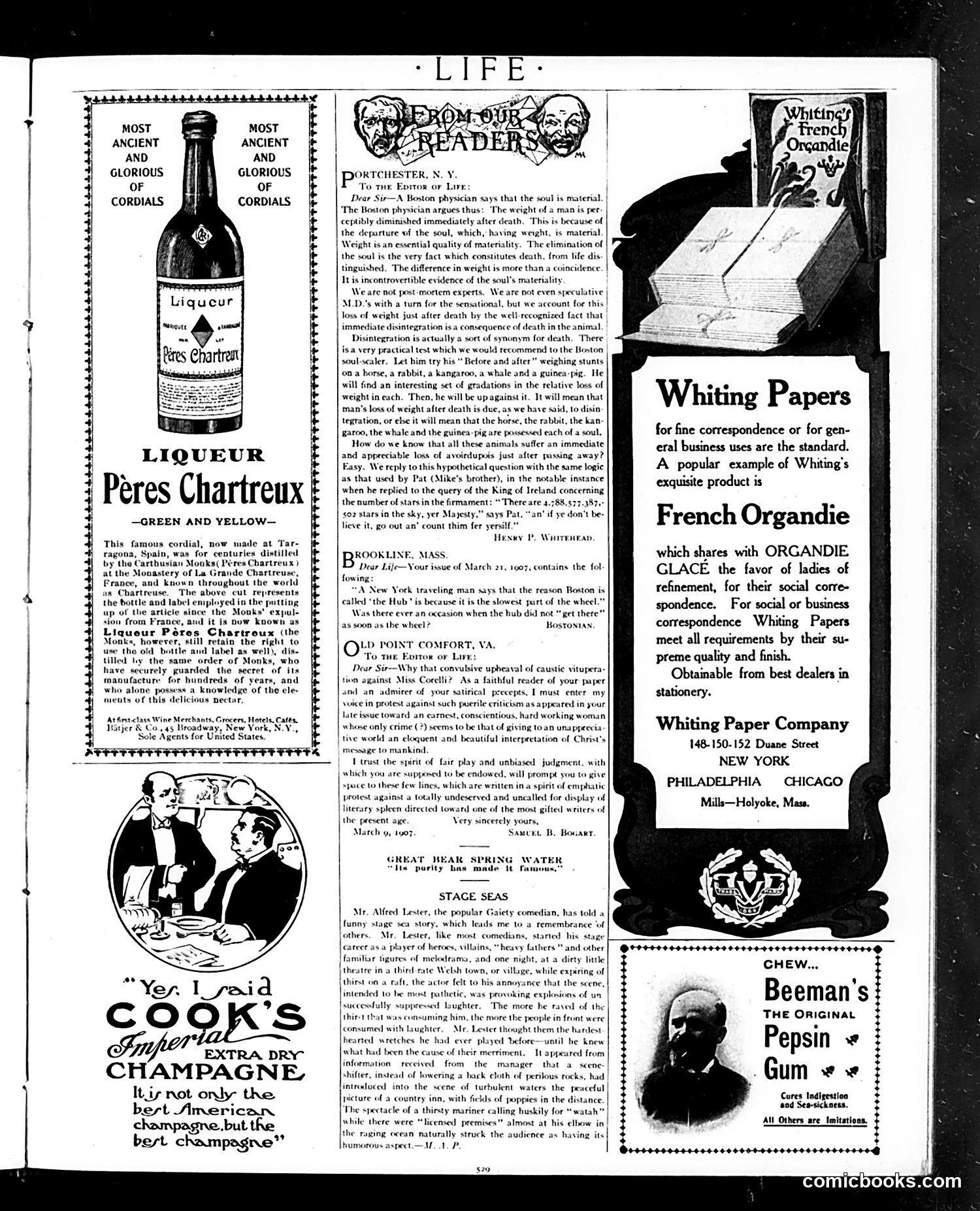
This page is primarily **advertisements and reader letters**, not political satire. The main content includes: **Advertisements:** Liqueurs (Pères Chartreux), Cook's Champagne, Whiting Papers, and Beeman's Pepsin Gum dominate the layout. **Reader Letters ("From Our Readers"):** Three letters to the editor discuss contemporary issues: 1. A Boston physician's claim that the soul is material because bodies lose weight after death—the editor mocks this pseudoscience by suggesting testing it on animals (horses, rabbits, whales), which would logically possess souls if the theory held. 2. A complaint about calling Boston "the Hub"—questioning why the hub wouldn't keep pace with a wheel. 3. A defense of author Marie Corelli against criticism in Life magazine. The satirical content is light social commentary typical of early 1900s Life magazine—poking fun at dubious scientific claims and local pride rather than major political issues. The page reflects the magazine's format of mixing advertising with humorous reader exchanges.
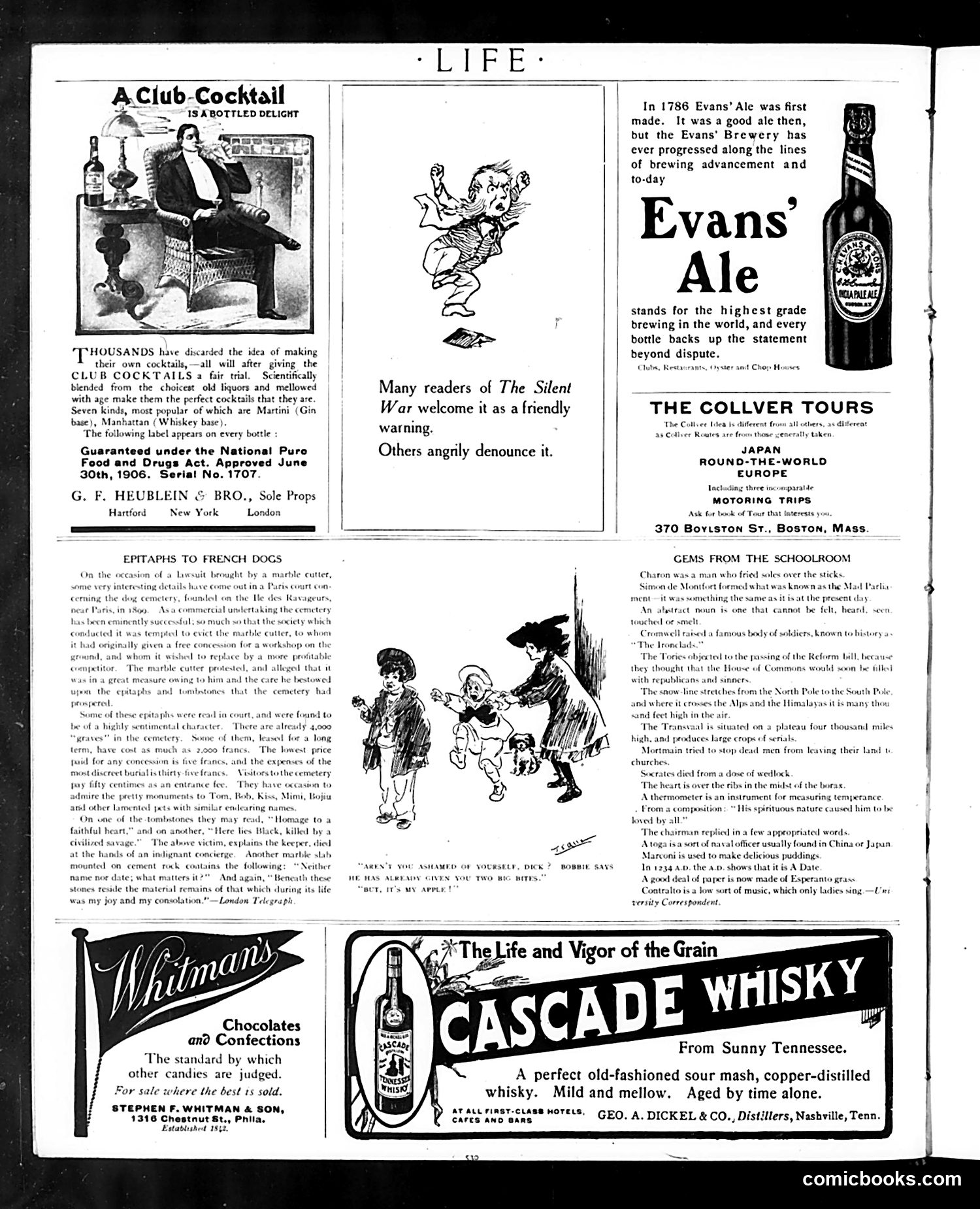
This page contains mostly **advertisements and filler content** rather than political satire. The key elements: **Main Cartoon:** A small sketch shows a child ("Dick") being scolded by "Bobbie" for taking apples, with Dick defensively claiming "it's MY apple!" This is gentle domestic humor about children's disputes over property. **"Epitaphs to French Dogs"** article describes a real lawsuit at a Paris pet cemetery where a marble cutter wanted payment for maintaining dog graves. The piece gently satirizes French sentimentality toward pets and the bureaucratic dispute that ensued. **"Gems from the Schoolroom"** collects humorous student exam answers and malapropisms—a common Life magazine feature mocking educational absurdities (e.g., "Socrates died from a dose of wedlock"). The remainder consists of period **product advertisements** for cocktails, ale, chocolates, whisky, and travel tours—typical magazine filler of the early 1900s. No significant political commentary or caricature appears on this page.
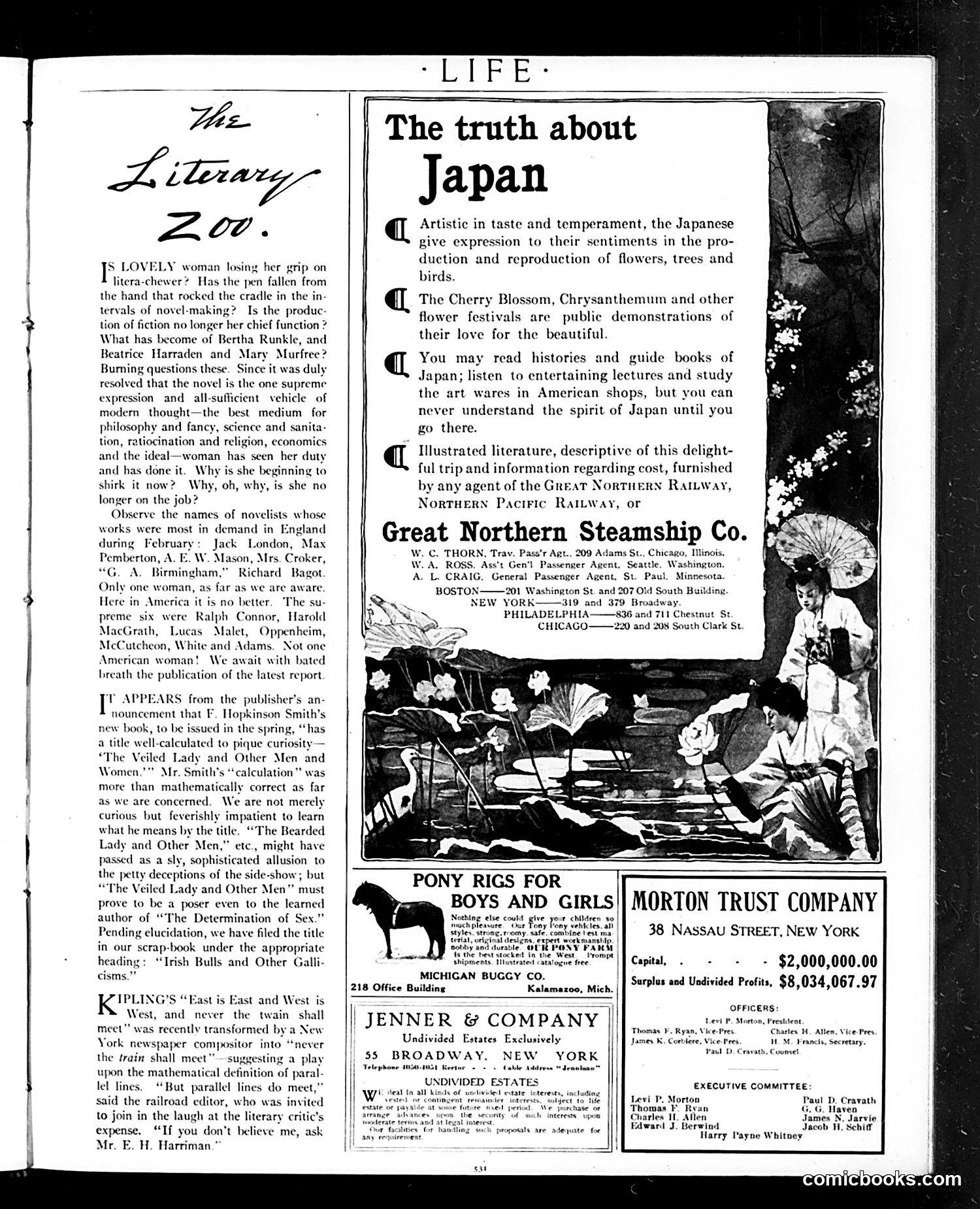
This page critiques the declining presence of female novelists in popular literature. The left column laments that prominent women writers like Bertha Runkle, Beatrice Harraden, and Mary Murfree have faded from prominence. The author notes that in February's best-selling novels in England, only one author was a woman; in America, "the supreme six" bestselling authors include none. The piece sarcastically questions: has the "lovely woman" lost her grip on novel-writing? Why has she abandoned what was deemed "the one supreme expression...of modern thought"? The satire targets both the male literary establishment's dominance and, implicitly, women's retreat from serious literary production. The remainder of the page contains advertisements and publishing industry commentary—primarily filler material around the central critique of gender disparity in popular fiction.
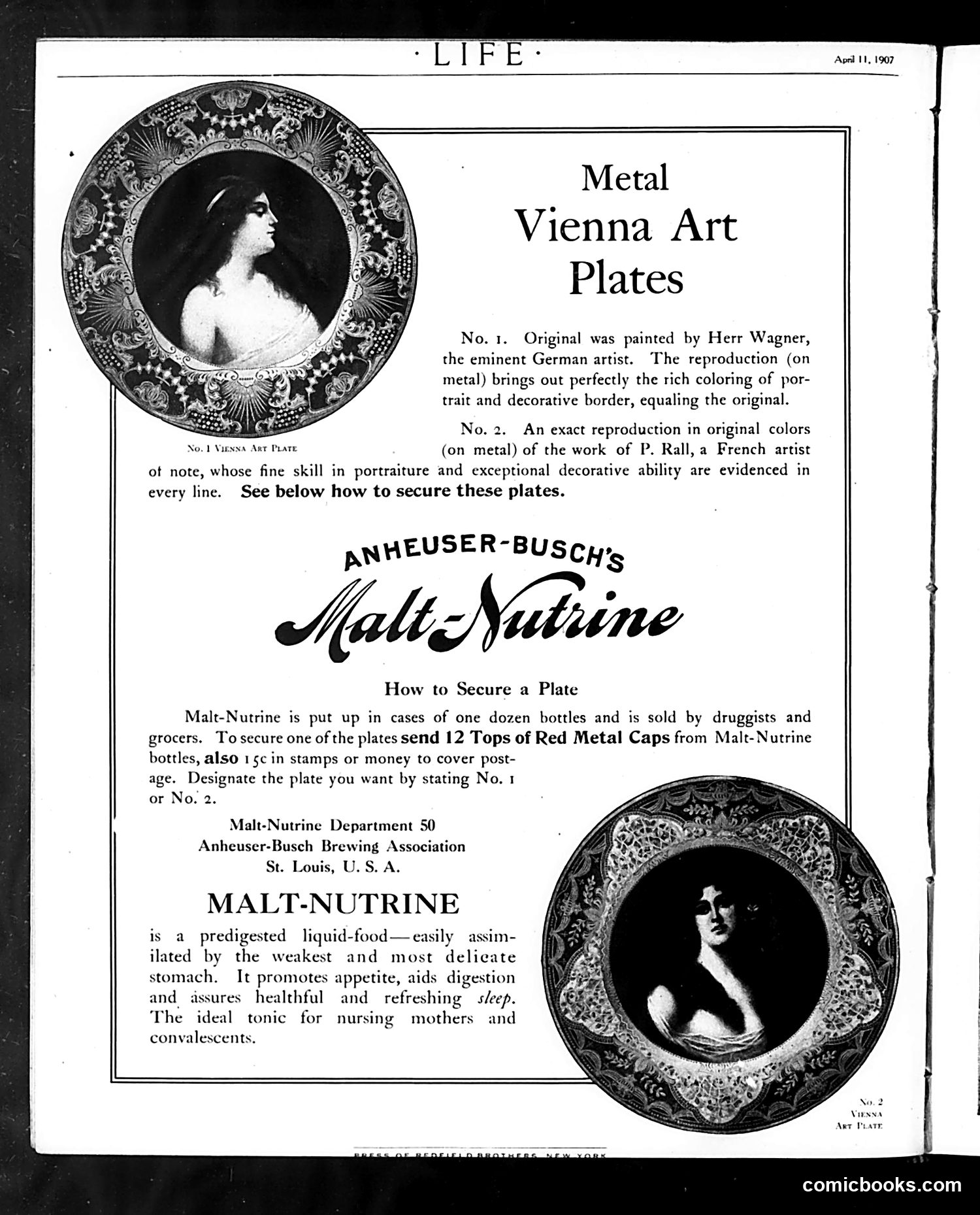
This page is primarily a commercial advertisement, not political satire. Anheuser-Busch's Malt-Nutrine—a liquid nutritional supplement—offered decorative metal plates as a premium incentive. Customers who collected 12 bottle caps plus 15 cents could obtain ornamental plates featuring classical portrait artwork: No. 1, a work by German artist Herr Wagner, and No. 2, by French artist P. Rall. The elaborate decorative borders suggest these were meant as parlor display pieces, appealing to genteel sensibilities. The advertisement positioned Malt-Nutrine as a health tonic for vulnerable populations—nursing mothers and convalescents—emphasizing its easy digestibility. This marketing strategy combined consumer incentives (collectible art plates) with claims of medicinal benefit, typical of early 1900s patent medicine advertising before stricter FDA regulations.