
Life, 1907-04-11 · page 10 of 24
Life — April 11, 1907 — page 10: what you’re looking at
What you’re looking at
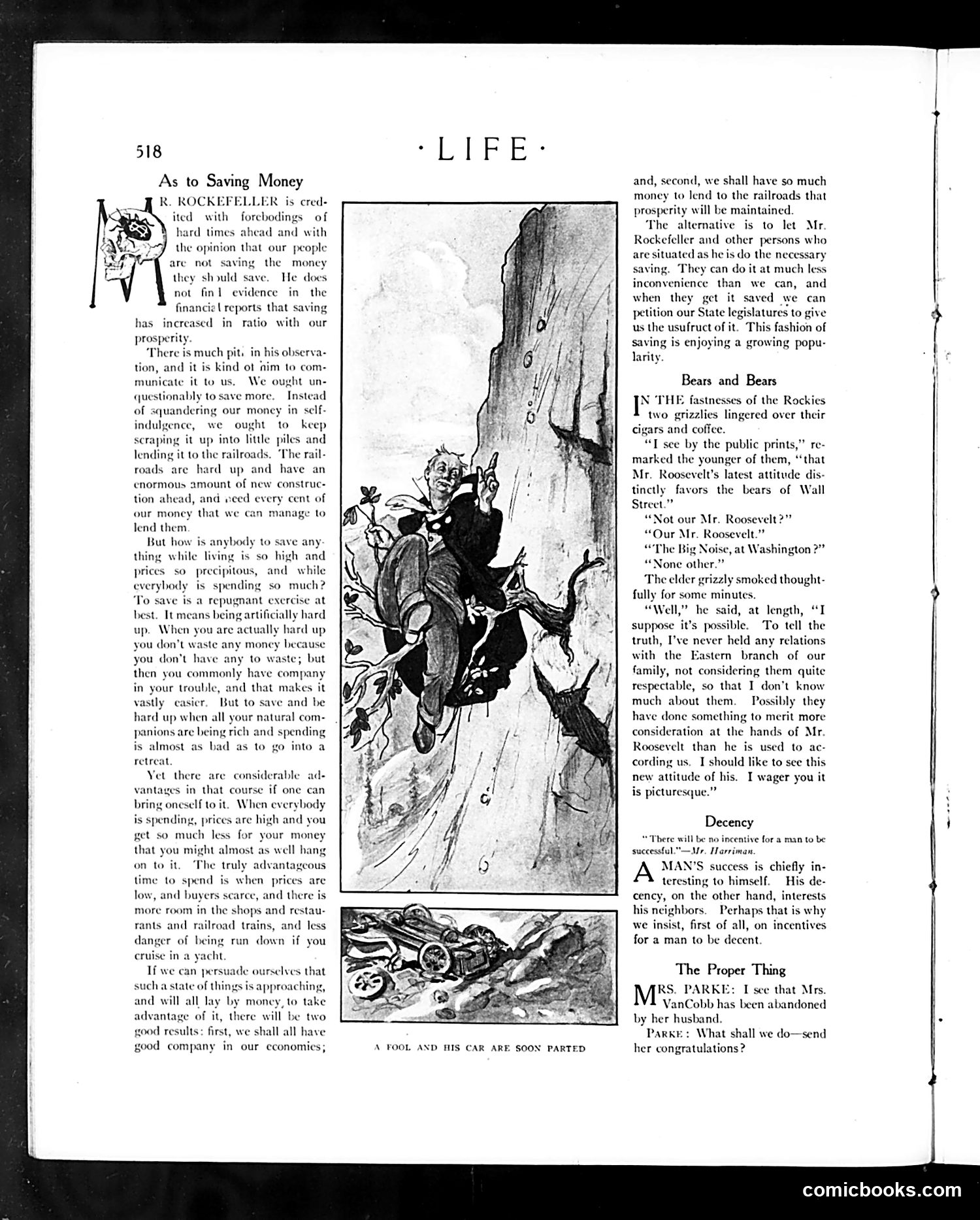
This page contains three separate satirical pieces. The main left-side article discusses Rockefeller's reputation for thriftiness and saving money, positioning him as a model for financial prudence during economically difficult times. The "Bears and Bears" cartoon depicts two bears smoking cigars and discussing Roosevelt's attitude toward Wall Street. The younger bear remarks that Roosevelt "distinctly favors the bears of Wall Street," playing on the double meaning of "bears" (investors expecting price declines) versus actual bears. The smaller illustrations show comedic scenes, including one captioned "A Fool and His Car Are Soon Parted," depicting automobile mishaps. The "Decency" and "The Proper Thing" sections are brief editorial vignettes offering social commentary on personal conduct and propriety.
📄 Transcribed text from this page (OCR, searchable)
Machine-transcribed from the original scan — historical spelling and the odd misread are preserved.
518 As to Saving Money R. ROCKE ited with hard times ahead and with the opinion that our people LLER is cred- forcbodings of are not saving the money they should save. He does not finl evidence in the financie | reports that saving has increased in ratio with our prosperity. ‘There is much pit. in his observa- tion, and it is kind ot him to com- municate it to us. We ought un- questionably to save more. Instead of squandering our money in self- indulgence, we ought to keep 4 it up into little piles and it to the railroads, ‘The rail- roads are hard up and have an nount of new construc: nd weed every cent of unage to enormous 2 tion ahead, our money that we cant lend them. But how is anybody to save any: thing while living is so high and prices so. precipitous, and. while everybody is spending so much? ‘To save is a repugnant exercise at best. It means being artificially hard up. When you are actually hard up you don’t waste any money because you don’t have any to waste; but then you commonly have company in your trouble, and that makes it vastly casier. But to save and be hard up when all your natural com- panions are being rich and spending is almost as bad as to go into a retreat Yet there are considerable ad- vantages in that course if one can bring oneself to it. When everybody is spending, prices are high and you get so much less for your money that you might almost as well hang on to it. The truly advantageous time to spend is when prices are low, and buyers scarce, and there more room in the shops and restau- rants and railroad trains, and less ng run down if you cruise in a yacht If we can persuade ourselves that such a state of things is approaching, and will all lay by money, to take advantage of it, there will be two good results: first, we shall all have good company in our economies; danger of be A FOOL AND HIS CAR ARE SOON PARTED and, second, we shall have so much money to lend to the railroads that prosperity will be maintained. The alternative is to let Mr Rockefeller and other persons who are situated as he is do the necessary aving. They can do it at much less. inconvenience than we can, and when the! t it saved we can petition our State legislatures to give us the usufruct of it. This fashion of saving is enjoying a growing popu- larity. Bears and Bears I \ THE fastnesses of the Rockit two grizzlies lingered over their cigars and coffee. “T see by the public prints,” re- marked the younger of them, ‘that Mr. Roosevelt's latest attitude di tinctly favors the bears of Wall Street.” “Not our Mr. Roosevelt?” “Our Mr. Roosevelt.” “The Big Noise, at Washington ?” “None other.” The elder grizzly smoked thought- fully for some minutes. “Well,” he said, at length, “I suppose it’s possible. To tell the truth, I’ve never held any relations with the Eastern branch of our family, not considering them quite respectable, so that I don’t know much about them. Possibly they have done something to merit more consideration at the hands of Mr. Roosevelt than he is used to ac- cording us. I should like to see this. new attitude of his. I wager you it is picturesque.” Decency “There will be no incentive for a man to be successful." Mr, Harriman. A MAN’S success is chiefly in- teresting to himself. His de- cency, on the other hand, interests his neighbors. Perhaps that is why we insist, first of all, on incentives for a man to be decent The Proper Thing RS. PARKE: I see that Mrs. VanCobb has been abandoned by her husband. Parke: What shall we do—send her congratulations? comicbooks.com