
Life, 1907-04-11 · page 16 of 24
Life — April 11, 1907 — page 16: what you’re looking at
What you’re looking at
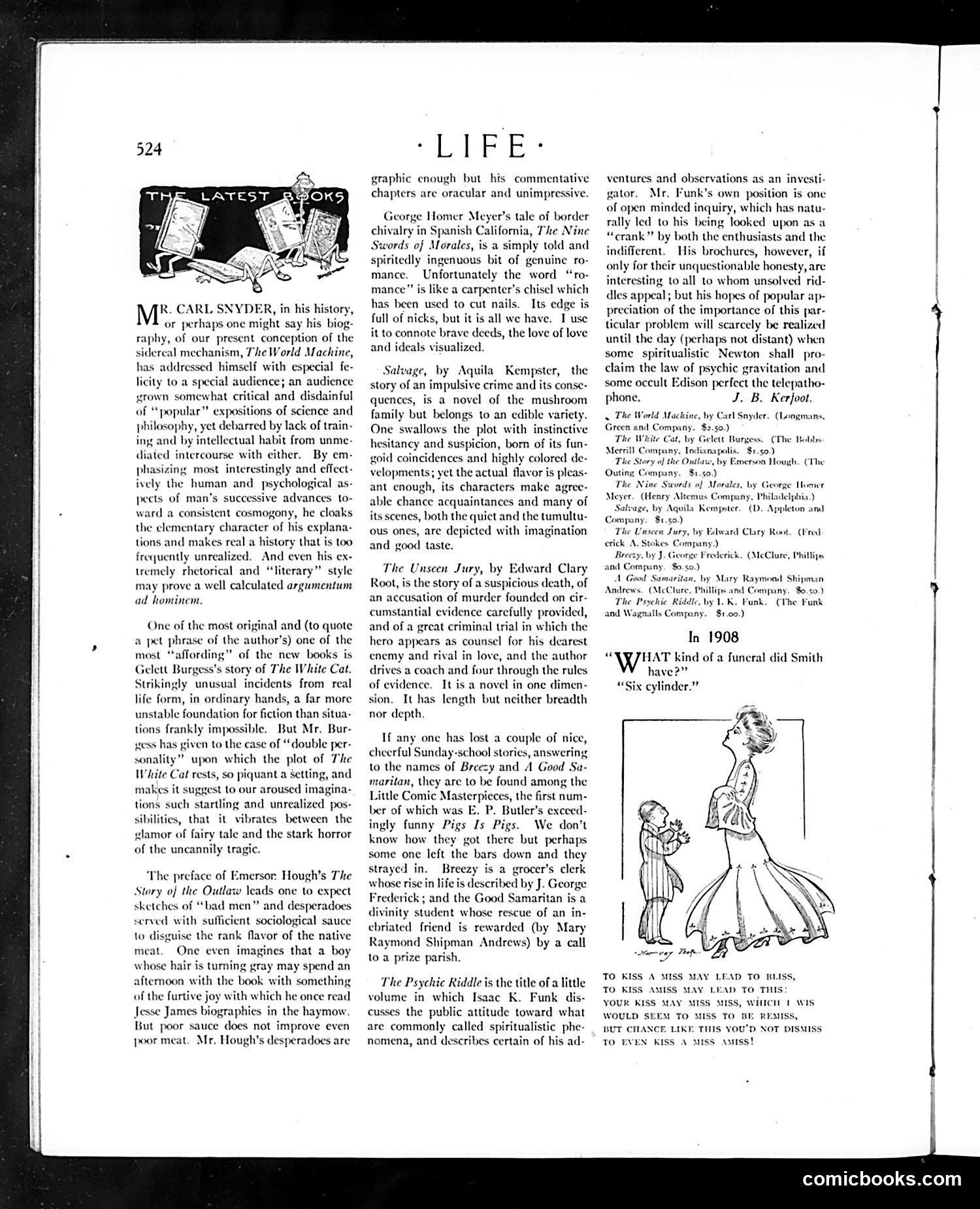
This page is a **book review section** from Life magazine, likely from the early 1900s (given the "In 1908" heading). It contains literary criticism of several new novels, not political cartoons. The small illustration at bottom right shows a humorous domestic scene: a tall woman bending down to kiss a child, with accompanying verse about kissing. This appears to be a light social commentary typical of Life's satirical approach—poking gentle fun at Victorian courtship rituals and domestic propriety. The reviews themselves critique contemporary fiction with Life's characteristic wit. The critic dismisses some works as overly sentimental or poorly constructed (Hough's *Story of the Outlaw*), praises others for originality (*The White Cat*), and notes that even well-intentioned social commentary ("sociological sauce") cannot redeem shallow narratives about outlaws. The page reflects Life's role as both literary arbiter and social satirist for educated American readers—offering sophisticated criticism while maintaining tongue-in-cheek humor about human nature and popular entertainment.
📄 Transcribed text from this page (OCR, searchable)
Machine-transcribed from the original scan — historical spelling and the odd misread are preserved.
R. CARL SNYDER, in his history, or perhaps one might say his biog- raphy, of our present conception of the sidereal mechanism, The World Machine, addressed himself with especial fe- ity to a special audience; an audience yrown somewhat critical and disdainful of “popular” expositions of science and philosophy, yet debarred by lack of train- ing, and by intellectual habit from unme- diated intercourse with either. By em- phasizing most interestingly and effect- ively the human and psychological as- pects of man’s successive advances to- ward a consistent cosmogony, he cloaks the elementary character of his explana- tions and makes real a history that is too frequently unrealized. And even his ex- tremely rhetorical and “literary” style may prove a well calculated argumentum ad hominem. One of the most original and (to quote a pet phrase of the author’s) one of the most “affording” of the new books is Gelett Burgess’s story of The White Cat. Strikingly unusual incidents from real life form, in ordinary hands, a far more unstable foundation for fiction than situa- tions frankly impossible. But Mr. Bur- yess has given to the case of “double per- sonality” upon which the plot of The White Cat rests, so piquant a setting, and makes it suggest to our aroused imagina- tions such startling and unrealized pos- sibilities, that it vibrates between the glamor of fairy tale and the stark horror of the uncannily tragic. The preface of Emerson Hough’s The Story oj Ure Outlaw leads one to expect sketches of “bad men” and desperadoes served with sufficient sociological sauce to disguise the rank flavor of the native meat. One even imagines that a boy whose hair is turning gray may spend an iternoon with the book with something of the furtive joy with which he once read Jesse James biographies in the haymow But poor sauce does not improve even poor meat. Mr. Hough's desperadoes are graphic enough but his commentative chapters are oracular and unimpressive. George Homer Meyer’s tale of border chivalry in Spanish California, The Nine Swords of Morales, is a simply told and spiritedly ingenuous bit of genuine ro- mance. Unfortunately the word “ro- mance” is like a carpenter's chisel which has been used to cut nails. Its edge full of nicks, but it is all we have. I us it to connote brave deeds, the love of love and ideals visualized. Salvage, by Aquila Kempster, the story of an impulsive crime and its conse- quences, is a novel of the mushroom family but belongs to an edible variety. One swallows the plot with instincti hesitancy and suspicion, born of its fun- goid coincidences and highly colored de- velopments; yet the actual flavor is pleas- ant enough, its characters make agree- able chance acquaintances and many of its scenes, both the quict and the tumultu- ous ones, are depicted with imagination and good taste, The Unseen Jury, by Edward Clary Root, is the story of a suspicious death, of an accusation of murder founded on cir- cumstantial evidence carefully provided, and of a great criminal trial in which the hero appears as counsel for his dearest enemy and rival in love, and the author drives a coach and four through the rules of evidence. It is a novel in one dimen- sion. It has length but neither breadth nor depth. If any one has lost a couple of nice, cheerful Sunday-school stories, answering, to the names of Breezy and A Good Sa- maritan, they are to be found among the Little Comic Masterpieces, the first num- ber of which was E. P. Butler’s exceed- ingly funny Pigs Is Pigs. We don’t know how they got there but perhap some one left the bars down and the strayed in. Breezy is a grocer’s clerk whose rise in life is described by J. George Frederick ; and the Good Samaritan is a divinity student whose rescue of an in- ebriated friend is rewarded (by Mary Raymond Shipman Andrews) by a cail to a prize parish. The Psychic Riddle is the title of a little volume in which Isaac K. Funk dis- cusses the public attitude toward what are commonly called spiritualistic phe- nomena, and describes certain of his ad- ventures and observations as an investi gator. Mr. Funk’s own position is one of open minded inquiry, which has natu- rally led to his being looked upon as a “crank” by both the enthusiasts and the indifferent. His brochures, however, if only for their unquestionable honesty, are interesting to all to whom unsolved rid- dles appeal; but his hopes of popular ap- preciation of the importance of this par- ticular problem will scarcely be realized until the day (perhaps not distant) when some spiritualistic Newton shall pro- claim the law of psychic gravitation and some occult Edison perfect the telepatho- phone. J. B. Kerjoot. = The World Machine, by Carl Snyder. (Longmans, Sreen and Company. $2.50.) The White Cat, by lett Burgess. (The Bobbys. Merrill Company, Indianapolis. $1.50.) The Story of the Outlaw, by Emerson Hough. (The 1.50.) Morales, by George Homer Meyer, = Compa Philadelphia.) Salvage, by Aquila Kempster. (D. Appleton and npany. $t.s0.) i (Fred by J. George Frederick. (McClure, Phillips. and Company. $0.50.) 1 Good Samaritan, by Mary Raymond Shipman Andrews. (McClure, Phillips and Company, $0.50.) The Psychic Riddle, by 1K. Funk. (The Funk and Wagnalls Company, 81.00.) In 1908 “NYJHAT kind of a funeral did Smith have?” “Six cylinder.” TO KISS A MISS MAY LEAD TO BLE TO KISS AMISS MAY LEAD TO THIS YOUR KISS MAY MISS MISS, WHICH 1 Wis WOULD SEEM TO MISS TO BE REMIS BUT CHANCE LIKE THIS YOU'D NOT DIS TO EVEN KISS A MISS Aauss! MISS comicbooks.com