
Life, 1907-04-11 · page 15 of 24
Life — April 11, 1907 — page 15: what you’re looking at
What you’re looking at
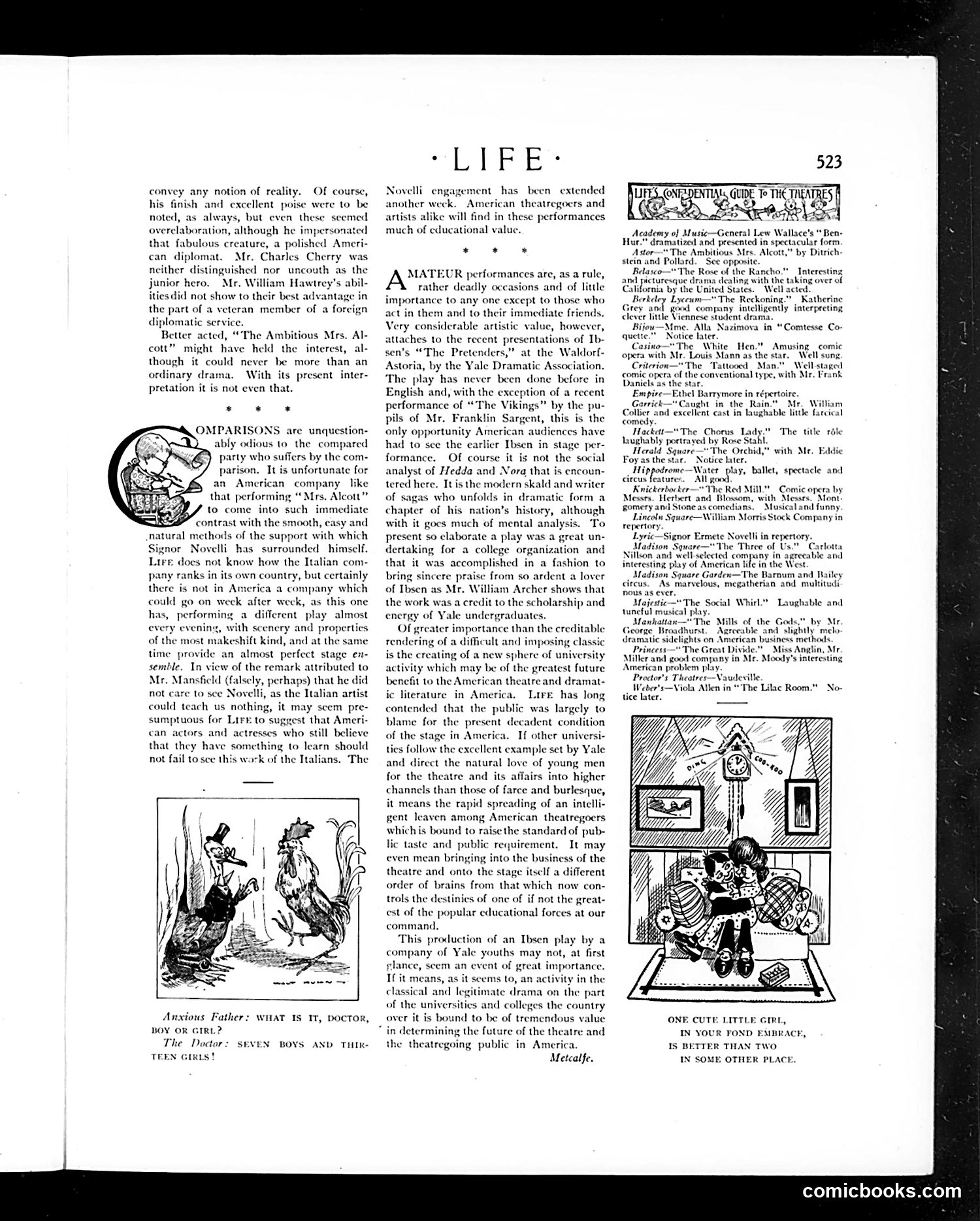
This page from Life magazine contains theater reviews and two cartoon panels. **The Cartoons:** The left panel shows two figures in what appears to be a comedic domestic scene—likely satirizing marital conflict or family dynamics, though specific identities are unclear from the image alone. The right panel depicts a domestic interior scene labeled "ONE CUTE LITTLE GIRL, IN YOUR FOND EMBRACE, IS BETTER THAN TWO IN SOME OTHER PLACE"—a joke about romantic preference or marital satisfaction. **The Text:** The reviews discuss theatrical performances: criticisms of amateur American productions versus praise for Italian actor Signor Novelli's company, and particular enthusiasm for Yale's dramatic association's production of Ibsen's "The Pretenders." The author argues university theater could elevate American dramatic standards and public taste, rather than relying on "farce and burlesque." The famous joke at bottom: A doctor announces "SEVEN BOYS AND THIRTEEN GIRLS!" to an anxious father—humor about large family size during this era.
📄 Transcribed text from this page (OCR, searchable)
Machine-transcribed from the original scan — historical spelling and the odd misread are preserved.
convey any notion of reality. Of course, his finish and excellent poise were to be noted, as always, but even these seemed overclaboration, although he impersonated that fabulous creature, a polished Ameri- can diplomat. Mr. Charles Cherry was neither distinguished nor uncouth as the junior hero. Mr. William Hawtrey’s abil- ities did not show to their best ad in the part of a veteran member of a foreign diplomatic service. Better acted, “The Ambitious Mrs. Al- cot” might have held the interest, though it could never be more tha With its present inter- pretation it is not even that. ordinary drama. * # # OMPARISONS are unqucestion- ably odious to. the compared party who suffers by the com- parison, It is unfortunate f an American company that performing, “Mrs. to come into such immediate contrast with the smooth, casy and natural methods of the support with which Signor Novelli has surrounded himsel Lire docs not know how the Italian com- pany ranks in its own country, but certainly there is not in America a company which could go on week after week, as this one forming a different play almost with scenery and propet eshift kind, and at the same time provide an almost perfect stage e- semble. In view of the remark attributed to Mr. Mansfield (falsely, perhaps) that he did not care to sce Novelli, as the Italian artist could teach us nothing, it may seem pre- sumptuous for Lire to suggest that Ameri- can actors and actresses who still believe that they have something to learn should not fail to sce this work of the Italians. The of the most ma Anxious Father: wat 18 11, poctor, BOY OR GIRL? The Doctor: TREN GiRLs! SEVEN BOYS AND THIK- “LIFE* engagement been extended another weck. American theatr ers and artists alike will find in these performances much of educational value. Novelli + 8 # MATEUR performances are, as a rule, rather deadly occasions and of little importance to any one except to those who act in them and to their immediate friends. Very considerable artistic value, however, attaches to the recent presentations of Ib- sen’s “The Pretenders,” at the Waldorf- Astoria, by the Yale Dramatic Association. The play has never been done before in English and, with the exception of a recent performance of “The Vikings” by the pu- pils of Mr. Franklin Sargent, this is the only opportunity American audiences have had to sce the earlier Ibsen in stage per- formance. Of course it is not the social nalyst of Hedda and Nora that is encoun- tered here. It isthe modern skald and writer of sagas who unfolds in dramatic form a chapter of his nation’s history, although with it gocs much of mental analysis. To present so elaborate a play was a great un- dertaking for a college organization and that it was accomplished in a fashion to bring sincere praise from so ardent a lov of Ibsen as Mr. William Archer shows that the work was a credit to the scholarship and energy of Yale undergraduates. Of greater importance than the creditable rendering of a difficult and inyposing classic is the creating of a new sphere of university activity which may be of the greatest future benefit to the American theatreand dramat- ic literature in America, Lire has long contended that the public was largely to blame for the present decadent condition of the stage in America. If other universi- tics follow the excellent example set by Yale and direct the natural love of young men for the theatre and its affairs into higher channels than those of farce and burlesque, it means the rapid spreading of an intelli- gent Icaven among American theatregoers whichis bound to raise the standard of pub- lic taste and public requirement. It may even mean bringing into the business of the theatre and onto the stage itself a different order of brains from that which now con- trols the destinies of one of if not the great- est of the popular educational forces at our command. This production of an Ibsen play by a company of Yale youths may not, at first glance, scem an event of great importance. If it means, as it seems to, an activity in the classical and legitimate drama on the part of the universitics and colleges the country over it is bound to be of tremendous value in determining the future of the theatre and the theatregoing public in America. Metcalfe. 523 @NFEDENTINY, GUIDE To THETIEATRES meee Sd Academy of Music—General Lew Wallace's “ Ben- Hur." dramatized and presented in spectacular form. Astor—"The Ambitious Mes. Alcott,” by Ditrich- stein and Pollard. Sce opposite Belasco— The Rose of the Rancho." Interesting and picturesque drama dealing with the taking over of California by the United States. Well acted. Berkeley Lyceum—"The Reckoning.” Katherine y and good company intelligently interpreting clever little Viennese student drama. Bijou—Mme. Alla Nazimova in “Comtesse Co- quette.” Notice later LIFES P. Casino—"The White Hen.” Amusing comic opera with Mr. Louis Mann as the star. Well sung. Criterion: ‘Tattooed Man.” Well st comic opera of the conventional type, with Mr. F Daniels as the star. Empire—Ethel Barrymore in répertoire. Garrick—*Caught in the Rain.” Mr. Willi Collier and excellent cast in Laughable little farcics comedy Hockett—"The Chorus Lady." laughably portrayed by Rose Stahl. Herald Square—"'The Orchid,” with Me. Foyasthe star. Notice later. Hippodrome—Water play, ballet, spectacle and circus features. All good Knickerbocker—""The Red Mill." Comic opera by Messrs. Herbert and Blossom, with Messrs. Mont: gomery and Stoneas comedians. Musical and funny Lincoln Square—William Mortis Stock Company in repertory, Lyric—Signor Exmete Novelli in repertory. Madison Square—"Vhe Three of Us." Carlotta Nilson and well-selected company in agreeable and interesting play of American life in the West Madison Square Garden—The Barnum and I. As marvelous, megatherian and multity ever. Majestic—"The Social Whirl.” tuneful musical play. Manhattan—"The Mills of the Gods." by Me George Broadhurst, Agreexble and slightly melo dramatic sidelights on American business methods Princess—" The Great Divide." Miss Anglin, Mr Miller and good company in Mr. Moody's interesting American problem pl. Proctor’s Theatres—Waulerille. Weber's—Viola Allen in “The Lilac Room." No- tice later. The title role Laughable and ONE CUTE LITTL IN YOUR FOND EMBRACE, IS BETTER THAN TWO IN SOME OTHER PLACE. comicbooks.com