
Life, 1907-04-11 · page 9 of 24
Life — April 11, 1907 — page 9: what you’re looking at
What you’re looking at
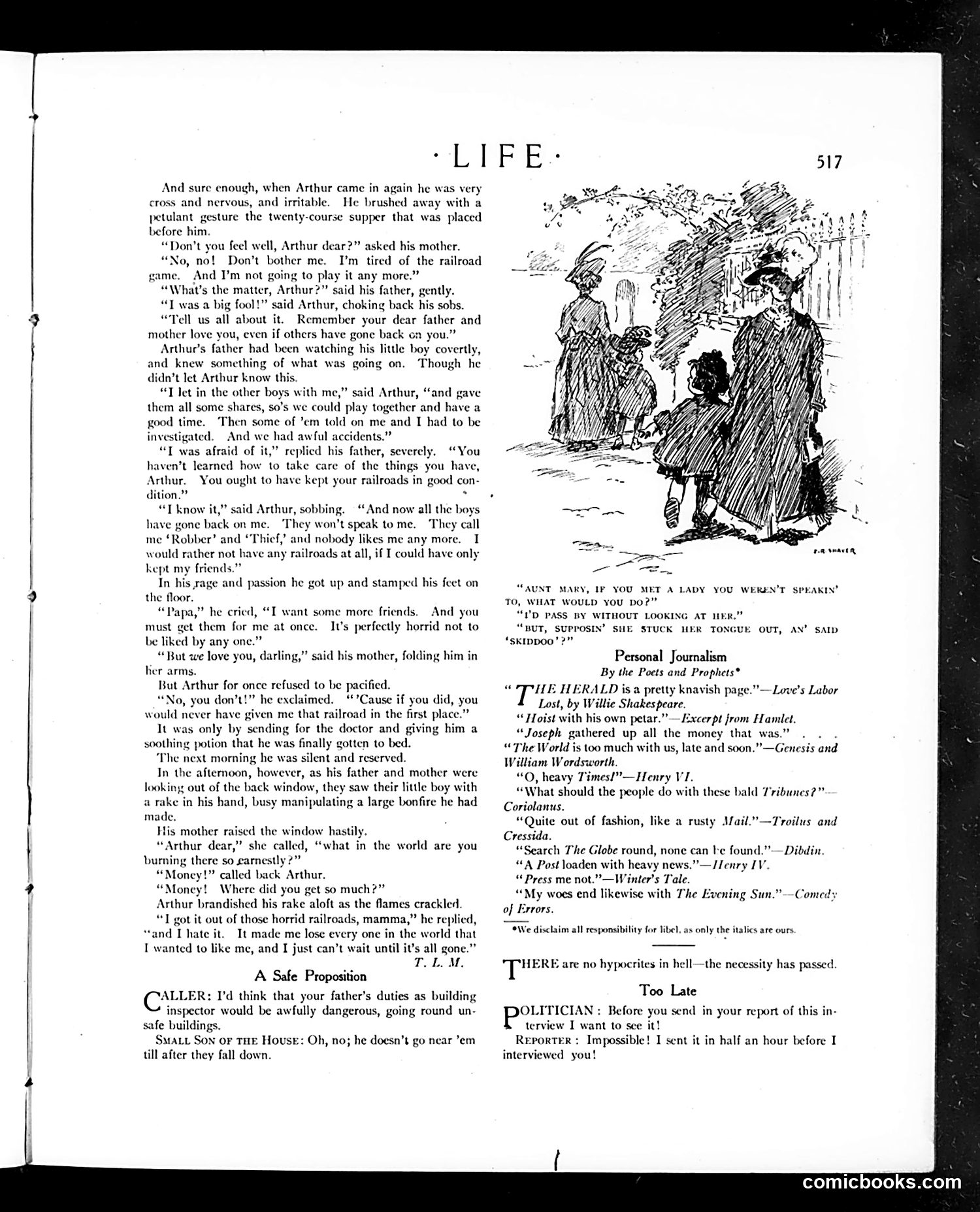
This page contains a narrative story about a boy named Arthur and his troubled railroads, accompanied by a sketch illustration showing two figures in period dress. The main cartoon/satirical content appears in the section titled "A Safe Proposition," featuring a brief dialogue between a "Caller" and a "Small Son of the House" about whether a building inspector's job is dangerous. The joke plays on the common assumption that inspecting buildings is perilous work—the child's response subverts this, suggesting the inspector faces no real danger. The illustration depicts what appears to be a Victorian-era domestic scene with adults and a child. The page also includes a "Personal Journalism" section quoting literary passages. Without clearer caption attribution or historical context visible in the image, the specific satirical targets remain unclear.
📄 Transcribed text from this page (OCR, searchable)
Machine-transcribed from the original scan — historical spelling and the odd misread are preserved.
~~ »- -LIFE- 517 And sure enough, when Arthur came in again he was very cross and nervous, and irritable. He brushed away with a petulant gesture the twenty-course supper that was placed before him. “Don’t you feel well, Arthur dear?” asked his mother. “No, no! Don’t bother me. I’m tired of the railroad game. And I’m not going to play it any more.” “What's the matter, Arthur?” said his father, gently. “I was a big fool!” said Arthur, choking back his sobs. “Tell us all about it. Remember your dear father and mother love you, even if others have gone back on you.” Arthur’s father had been watching his little boy covertly, and knew something of what was going on. Though he didn’t let Arthur know this. “T let in the other boys with me,” said Arthur, “and gave them all some shares, so’s we could play together and have a good time. Then some of ’em told on me and I had to be investigated. And we had awful accidents.” “I was afraid of it,” replied his father, severely. “You haven’t learned how to take care of the things you have, Arthur. You ought to have kept your railroads in good con- dition.” . “T know it,” said Arthur, sobbing. “And now all the boys have gone bi won't speak to me. They call me ‘Robber? and ‘Thief, and nobody likes me any more. I would rather not have any railroads at all, if I could have only kept my friends.” In his rage and passion he got up and stamped his feet on the floor, “Papa,” he cried, “I want some more friends. And you must get them for me at once. It’s perfectly horrid not to be liked by any one.” “But we love you, darling,” said his mother, folding him in her arms. But Arthur for once refused to be pacified. “No, you don’t!” he exclaimed. “Cause if you did, you would never have given me that railroad in the first place.” It was only by sending for the doctor and giving him a soothing potion that he was finally gotten to bed. ‘The next morning he was silent and reserved. In the afternoon, however, as his father and mother were looking out of the back window, they saw their little boy with a rake in his hand, busy manipulating a large bonfire he had made. His mother raised the window hastily. “Arthur dear,” she called, “what in the world are you burning there so carnestly ?”” “Money!” called back Arthur. “Money! Where did you get so much?” Arthur brandished his rake aloft as the flames crackled. “T got it out of those horrid railroads, mamma,” he replied, “and I hate it. It made me lose every one in the world that I wanted to like me, and I just can’t wait until it’s all gone.” T.L.M. A Safe Proposition ALLER: I'd think that your father’s duties as building inspector would be awfully dangerous, going round un- safe buildings. Saati Son or THE House: Oh, no; he doesn’t go near ’em till after they fall down. Fem yma, “AUNT MARY, IP YOU MET A LADY YOU WEREN'T SPEAKIN’ TO, WHAT WOULD you DO?” “{'D PASS BY WITHOUT LOOKING AT HER.” “BUT, SUPPOSIN’ SUE STUCK HER TONGUE OUT, AN’ SAID “skippoo! ?” Personal Journalism By the Poets and Prophets*® “ HE HERALD isa pretty knavish page.”— Love's Labor Lost, by Willie Shakespeare. “ Hoist with his own petar.””—Excerpt jrom Hamlct. “Joseph gathered up all the money that was.” . . . “The World is too much with us, late and soon.” —Genesis and William Wordsworth “O, heavy Times!” —Henry VI. “What should the people do with these bald Tribuncs?” Coriolanus. “Quite out of fashion, like a rusty Mail"—Troilus and Cressida. “Search The Globe round, none can be found.” Dibdin. “4 Post loaden with heavy news.” —Henry IV. “ Press me not.” —Winter’s Tale. “My woes end likewise with The Evening Sun.” —Comedy of Exrors: We disclaim all responsibility for libel, as only the italics are ours. “THERE are no hypocrites in hell—the necessity has passed Too Late OLITICIAN : Before you send in your report of this in- terview I want to see it! Reporter : Impossible! I sent it in half an hour before I interviewed you! comicbooks.com