
Life, 1907-04-11 · page 6 of 24
Life — April 11, 1907 — page 6: what you’re looking at
What you’re looking at
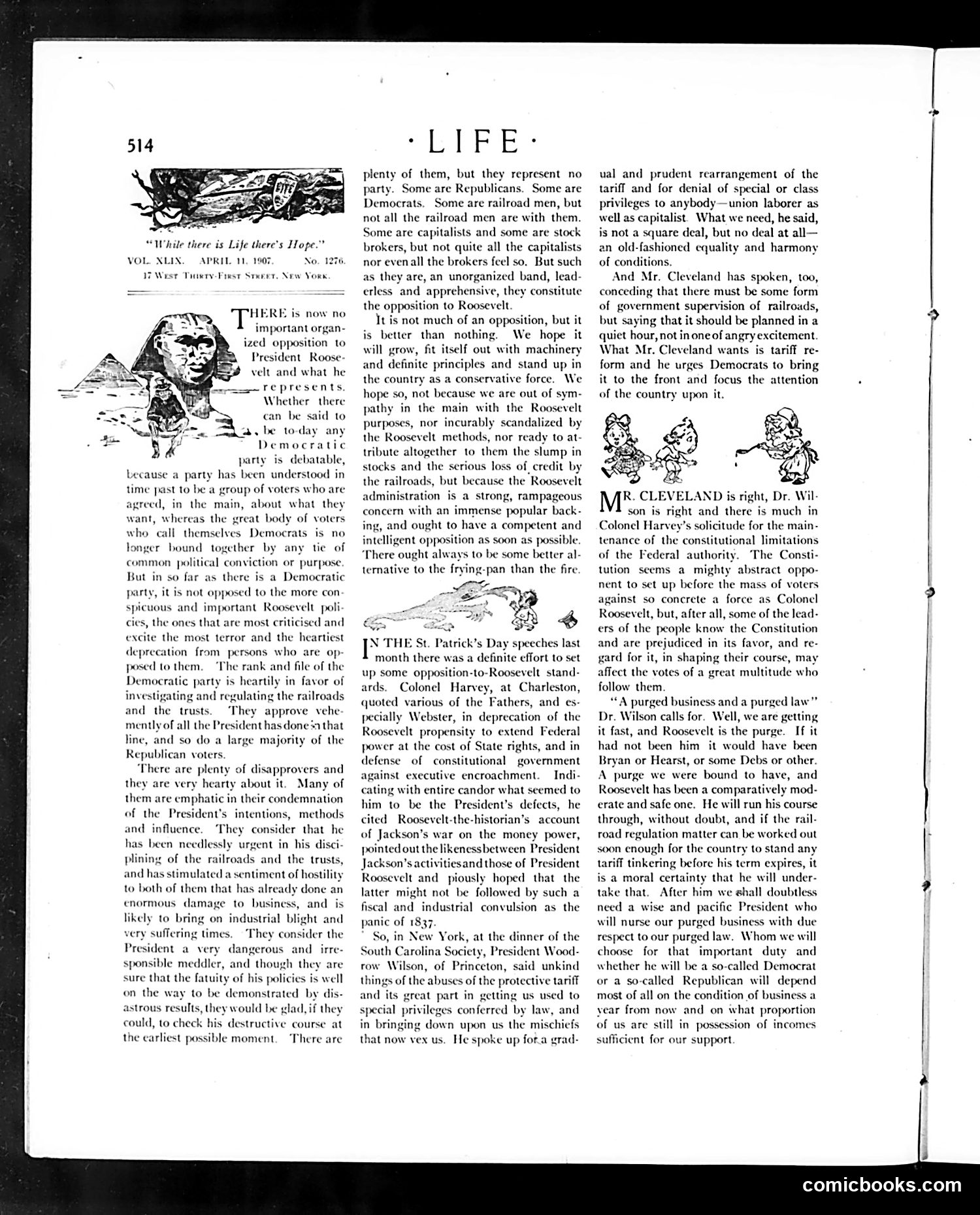
This page critiques President Theodore Roosevelt's opposition to railroad regulation. The left cartoon depicts Roosevelt as an aggressive, combative figure—reflecting contemporary criticism that he was reckless and dangerous to business interests. The article argues that while Roosevelt's administration is "strong and rampageous," organized opposition is necessary to restrain him. The text discusses St. Patrick's Day speeches where Colonel Harvey and others quoted the Founding Fathers to critique Roosevelt's expansion of federal power at the expense of states' rights and business privileges. The satire suggests Roosevelt poses a threat requiring political counterbalance—a conservative critique of progressive executive overreach, framing restraint as constitutionally prudent rather than obstructionist.
📄 Transcribed text from this page (OCR, searchable)
Machine-transcribed from the original scan — historical spelling and the odd misread are preserved.
“While there is Life there's Hope.” VOL. NLIN. APRIL 11, 1907, No 17 West Tinery-Pirst Srarer, New Vors, HERE is now no important organ- ized opposition to President Roose: velt and what he represents Whether there can be said to sbe today any Democratic party is debatable, because a party has been understood in time past to be a group of voters who are ced, in the main, about what they want, whereas the great body of voters who call themselves Democrats is no. longer bound together by any tie of common political conviction or purpose But in so far as there is a Democratic party, it is not opposed to the more con spicuous and important Roosevelt poli cies, the ones that are most criticised and excite the most terror and the heartiest deprecation from persons who are op posed to them. ‘The rank and file of the Democratic party is heartily in favor of investigating and regulating the railroads and the trusts. ‘They approve vehe mently of all the President has done that line, and so do a large majority of the Republican voters There are plenty of disapprovers and they are very hearty about it. Many of them are emphatic in their condemnation of the President's intentions, methods and influence. ‘They consider that he has been needlessly urgent in his disci- plining of the railroads and the trusts, and has stimulated a sentiment of hostility to both of them that has already done an enormous damage to business, and is likely to bring on industrial blight and ry suffering times. ‘They consider the President a very dangerous and_irre- sponsible meddler, and though they are sure that the fatuity of his policies is well on the way to be demonstrated by dis- trous results, they would be glad, if they could, to check his destructive course at the earliest possible moment. ‘There are *LIFE*« plenty of them, but they represent no party. Some are Republicans. Some are Democrats. Some are railroad men, but not all the railroad men are with them. Some are capitalists and some are stock brokers, but not quite all the capitalists nor evenall the brokers feel so, But such as they are, an unorganized band, lead- erless and apprehensive, they constitute the opposition to Roosevelt It is not much of an opposition, but it is better than nothing. We hope it will grow, fit itself out with machinery and definite principles and stand up in the country as a conservative force. We hope so, not because we are out of sym- pathy in the main with the Roosevelt purposes, nor incurably scandalized by the Roosevelt methods, nor ready to at- tribute altogether to them the slump in stocks and the serious loss of credit by the railroads, but because the Roosevelt administration is a strong, rampageous concern with an immense popular back- ing, and ought to have a competent and intelligent opposition as soon as possible. ‘There ought always to be some better al- ternative to the frying-pan than the fire. oS < o> IX THE St. Patrick’s Day speeches last month there was a definite effort to set up some opposition-to-Roosevelt stand- ards. Colonel Harvey, at Charleston, quoted various of the Fathers, and es- pecially Webster, in deprecation of the Roosevelt propensity to extend Federal power at the cost of State rights, and in defense of constitutional government against executive encroachment. Indi- cating with entire candor what seemed to him to be the President’s defects, he cited Roosevelt-the-historian’s account of Jackson’s war on the money power, pointed out the likeness between President Jackson’: jesand those of President Roosevelt and piously hoped that the latter might not be followed by such a fiscal and industrial convulsion as the panic of 1837 So, in New York, at the dinner of the South Carolina Society, President Wood- row Wilson, of Princeton, said unkind things of the abuses of the protective tariff and its great part in getting us used to special privileges conferred by law, and in bringing down upon us the mischiefs that now vex us. He spoke up for.a grad- ual and prudent rearrangement of the tariff and for denial of special or class privileges to anybody—union laborer as well as capitalist. What we need, he said, is not a square deal, but no deal at all— an old-fashioned equality and harmony of conditions. And Mr. Cleveland has spoken, too, conceding that there must be some form of government supervision of railroads, but saying that it should be planned in a quiet hour, not in one of angry excitement. What Mr. Cleveland wants is tariff re- form and he urges Democrats to bring it to the front and focus the attention of the country upon it. son is right and there is much in Colonel Harvey’s solicitude for the main- tenance of the constitutional limitations of the Federal authority. The Consti- tution seems a mighty abstract oppo- nent to set up before the mass of voters against so concrete a force as Colonel Roosevelt, but, after all, some of the lead- ers of the people know the Constitution and are prejudiced in its favor, and re- gard for it, in shaping their course, may affect the votes of a great multitude who follow them “(A purged business and a purged law”? Dr. Wilson calls for. Well, we are getting it fast, and Roosevelt is the pur; Tf it had not been him it would have been Bryan or Hearst, or some Debs or other. A purge we were bound to have, and Roosevelt has been a comparatively mod- erate and safe one. He will run his course through, without doubt, and if the rail- road regulation matter can be worked out soon enough for the country to stand any riff tinkering before his term expires, it is a moral certainty that he will unde take that. After him we shall doubtless need a wise and pacific President who will nurse our purged business with due respect to our purged law. Whom we will choose for that important duty and whether he will be a so-called Democrat or a so-called Republican will depend most of all on the condition of business a year from now and on what proportion of us are still in possession of incomes sufficient for our support comicbooks.com