
Life, 1907-04-11 · page 14 of 24
Life — April 11, 1907 — page 14: what you’re looking at
What you’re looking at
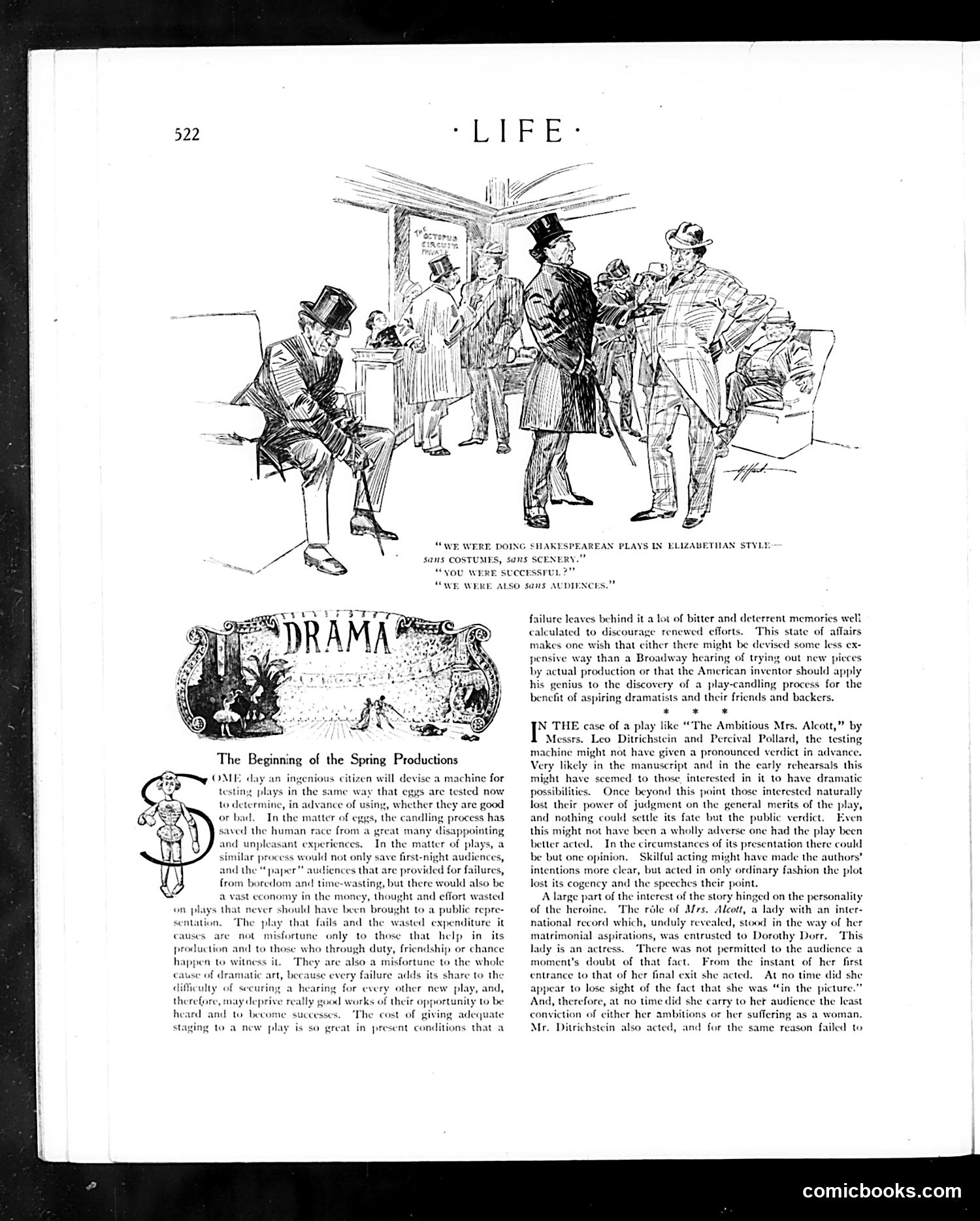
The top cartoon satirizes theatrical ambition. A man sitting alone represents a failed playwright pitching his "Shakespearean plays in Elizabethan style—sans costumes, sans scenery." When asked if he was successful, he replies they were also "sans audiences"—a joke about the production's complete failure to attract viewers. The article below discusses spring theatrical productions, lamenting failed plays' waste of money and effort. It then critiques "The Ambitious Mrs. Alcott," a contemporary play by Leo Ditrichstein and Percival Pollard. The reviewer faults actress Dorothy Dorr's performance as overly self-conscious—she appears perpetually aware she is "in the picture," performing rather than inhabiting her role. This artificial acting undermined the character's emotional authenticity, preventing audience connection to the heroine's ambitions and suffering. The satire targets both theatrical excess and bad acting that prioritizes spectacle over genuine character portrayal.
📄 Transcribed text from this page (OCR, searchable)
Machine-transcribed from the original scan — historical spelling and the odd misread are preserved.
“WE WERE DOING SHAKESPEAREAN PLAYS IN ELIZABETHAN STYLE San$ COSTUMES, sans SCENERY.” “YoU WERE SUCCESSFUL?” “WE WERE ALSO Sas AUDIENCES.” The Beginning of the Spring Productions apy OME day an ingenious citizen will devise a machine for test plays in th s are tested now to determine, in advance of using, whether they are good or bad. In the matter of eggs, the candling process has saved the human race from a great many disappointing In the matter of plays, a similar process would not only save first-night audiences, and the iences that are provided for failur from bored wasting, but there would also be a vast economy in the zht and effort wasted on plays that ht to a public rep The play that fails and the wasted expenditure it not misfortune only to those that help in its tion and to those who through duty, friendship or chance witness it. The: isfortune to the whole art, becau y failure adds its share to the difficulty of securing a hearing for every other new play, and, therefi ay deprive really good works of their opportunity to be heard and to become successes. and unpleasant experiences. aper”” auc mand ever should have been brow senta causes are are a ‘The cost of giving adequate staging to a new play is so great in present conditions that a failure leaves behind it a lot of bitter and deterrent memories welt calculated to discourage renewed efforts. This state of affairs makes one wish that cither there might be devised some less x- pensive way than a Broadway hearing of trying out new pieces by actual production or that the American inventor should apply his genius to the discovery of a play-candling process for the benefit of aspiring dramatists and their friends and backers. + * * N THE case of a play like “The Ambitious Mrs. Alcott,” by Messrs. Leo Ditrichstein and Percival Pollard, the testin| machine might not have given a pronounced verdict in advane Very likely in the manuscript and in the carly rehearsals th might have seemed to those. interested in it to have drama possibilities. Once beyond this point those interested natural lost their power of judgment on the general merits of the pla and nothing could settle its fate but the public verdict. this might not have been a wholly adverse one had the play been better acted. In the circumstances of its presentation there could be but one opinion. Skilful acting might have made the authors? intentions more clear, but acted in only ordinary fashion the plot lost its cogency and the speeches their point. ‘A large part of the interest of the story hinged on the personality of the heroine. The rdle of Mrs, Alcott, a lady with an inter- national record which, unduly rev stood in the way of her matrimonial aspirations, was entrusted to Dorothy Dorr. ‘This lady is an actress. There was not permitted to the audience a moment’s doubt of that fact. From the instant of her first entrance to that of her final exit she acted. At no time did she appear to lose sight of the fact that she was “in the picture.” And, therefore, at no time did she carry to her audience the least conviction of cither her ambitions or her suffering as a woman. Mr. Ditrichstein also acted, and for the same reason failed to ic comicbooks.com