
A complete issue · 24 pages · 1907
Life — March 14, 1907
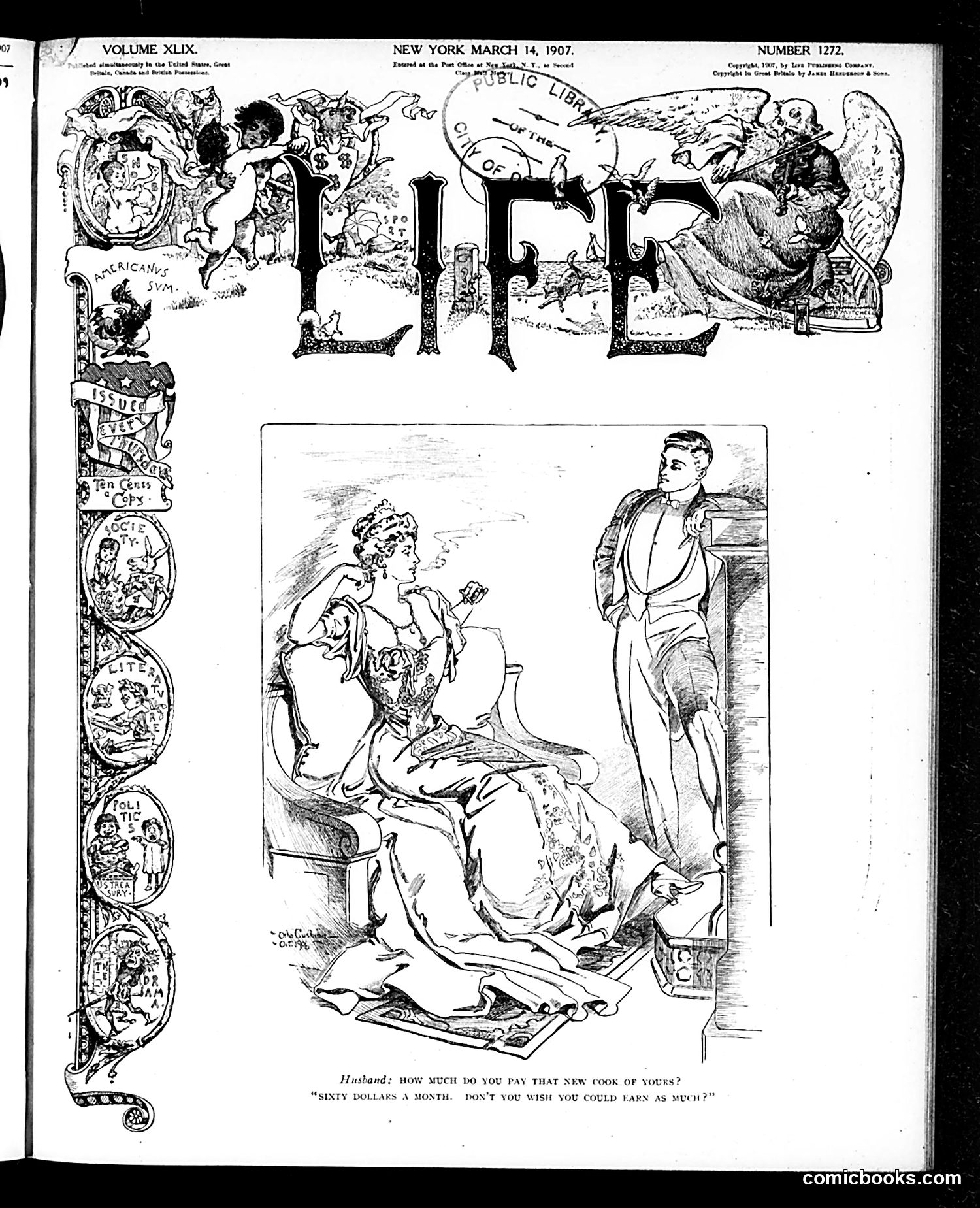
The main cartoon depicts a domestic scene satirizing wage inequality and marital dynamics of the Edwardian era. A husband, standing somewhat aloof, questions his wife—who sits surrounded by fashion magazines and luxury goods—about paying a new cook sixty dollars monthly. He sarcastically asks whether she wishes *she* could earn as much. The satire targets the hypocrisy of wealthy households: the wife enjoys luxury spending without earning income, while servants (the cook) command substantial wages that the husband resents. The joke highlights the economic absurdity and class tensions of early 20th-century domestic life—that a servant's wages exceeded what many considered reasonable, while idle wives' spending went unquestioned. It's social commentary on class, gender, and consumer culture.
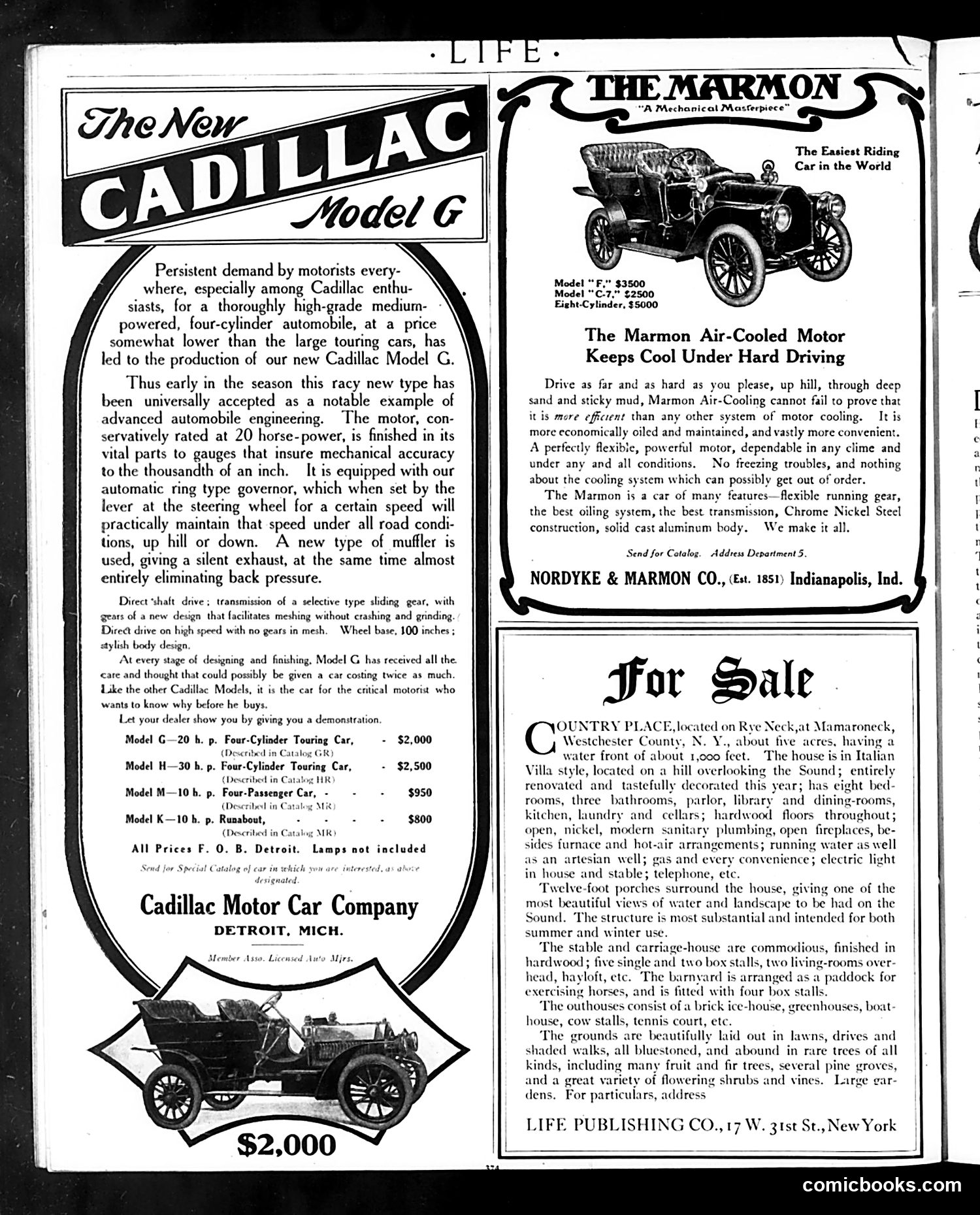
This page contains **no political cartoons or satire**—it is primarily **automobile advertising** from what appears to be an early 20th-century issue of *Life* magazine. The left side advertises the **Cadillac Model G**, a medium-powered, four-cylinder touring car priced at $2,000. The ad emphasizes its advanced engineering, including an automatic ring-type governor and new muffler design. The right side advertises the **Marmon automobile** and a property listing for a country estate in Rye Neck, New York. These are straightforward product advertisements typical of *Life* during the automotive industry's early expansion. There is no satirical content or political commentary present on this page.
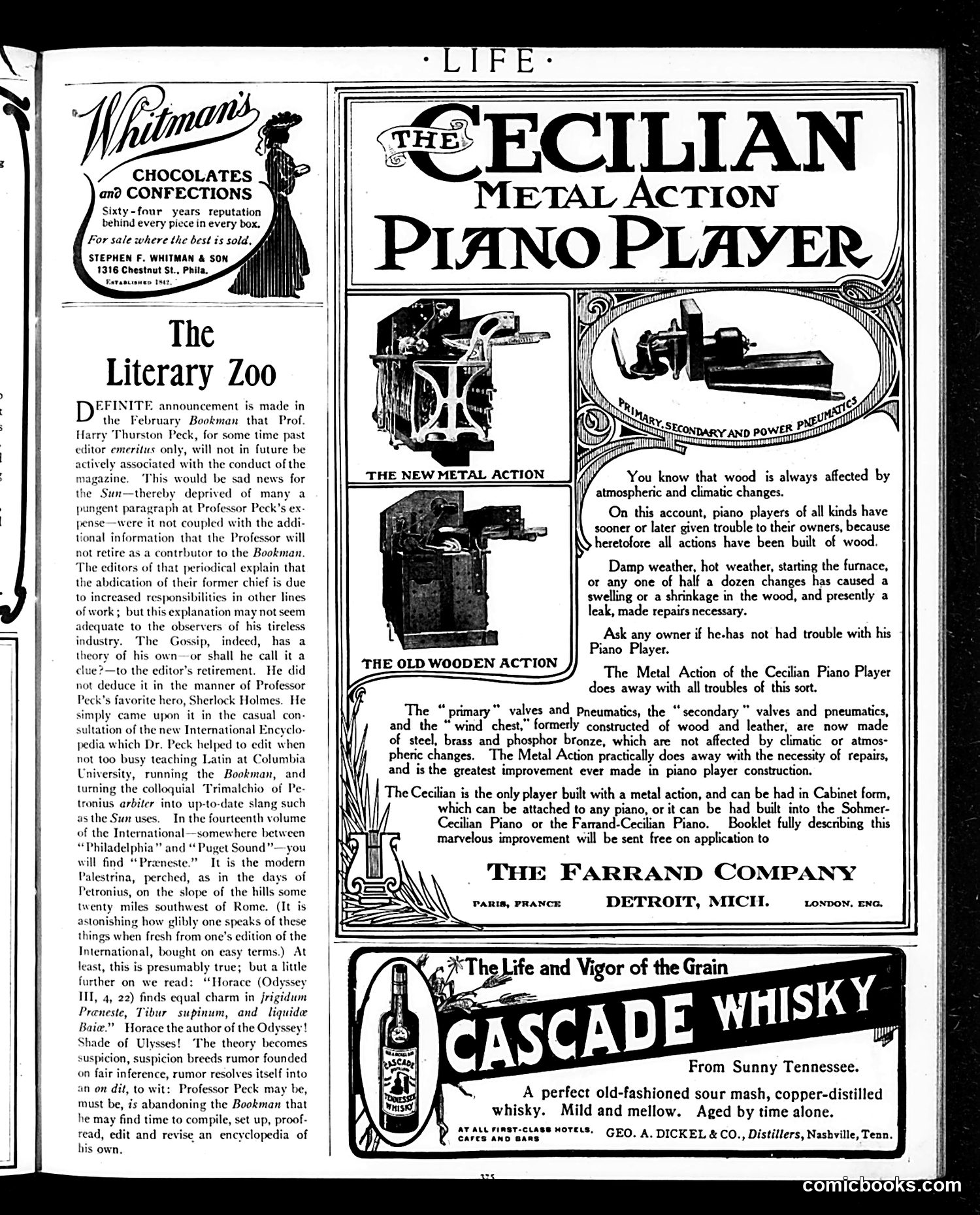
This page contains **no political cartoons or satire**. Instead, it features three advertisements and one article: 1. **"The Literary Zoo"** — A brief article about Professor Harry Thurston Peck retiring from *Bookman* magazine editorship, discussing how his withdrawal from the publication represents a loss to the field. 2. **Whitman's Chocolates** — A standard product advertisement. 3. **The Cecilian Metal Action Piano Player** — A detailed advertisement contrasting wooden piano mechanisms (susceptible to weather damage) with the Cecilian's new metal action system. It emphasizes durability and reduced maintenance needs. 4. **Cascade Whisky** — A Tennessee whiskey advertisement. The page is primarily commercial, with limited editorial content and no satirical or political messaging.
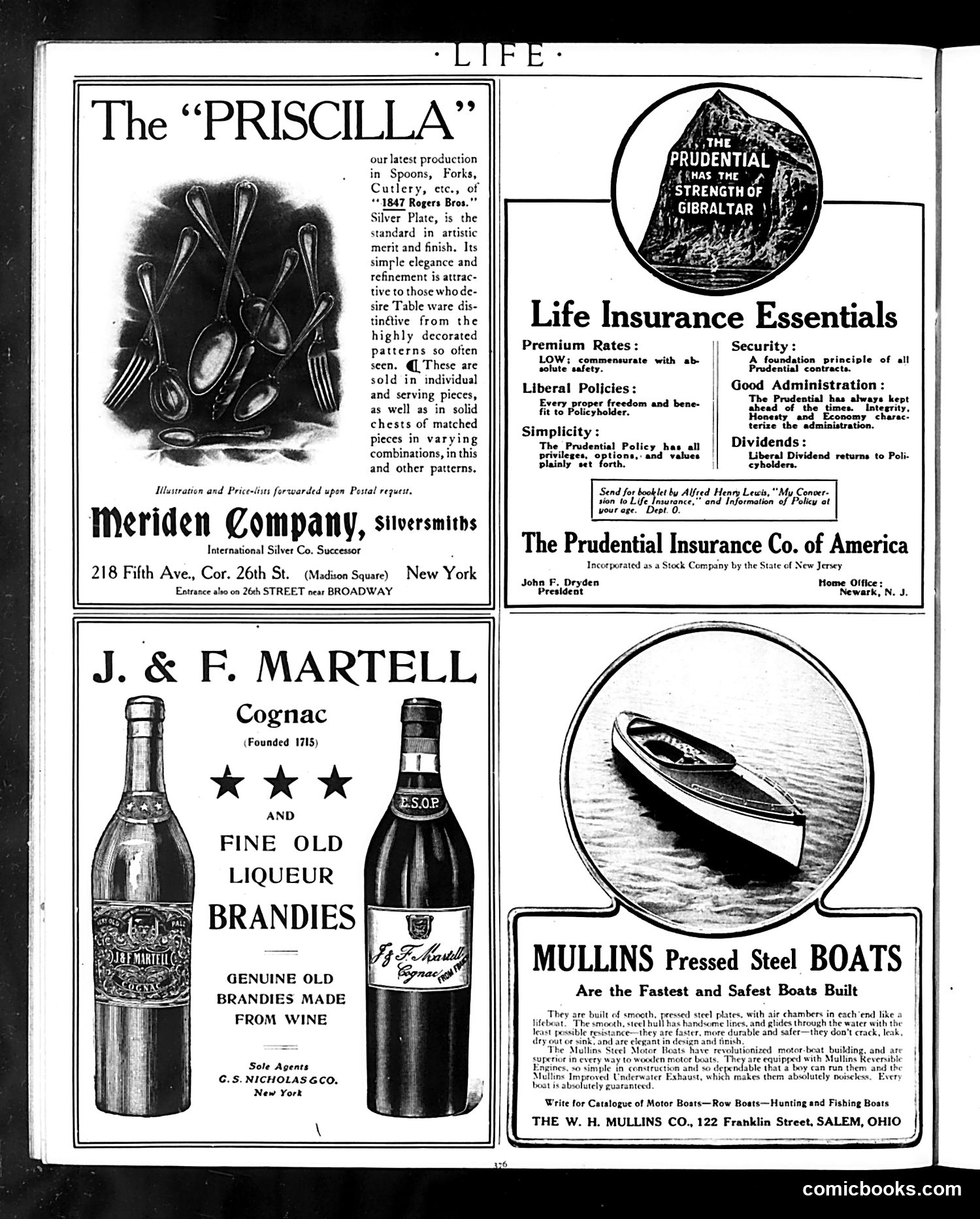
This page contains **primarily advertisements** rather than editorial cartoons or satirical content. The ads showcase luxury goods typical of the early 20th century: fine silverware (Meriden Company's "Priscilla" pattern), cognac and brandies (J. & F. Martell), life insurance (Prudential), and steel boats (Mullins). The only visual elements are product photographs and illustrations—silverware arrangements, liquor bottles, a boat on water, and the Gibraltar rock logo for Prudential Insurance. There is **no discernible political satire or cartoon commentary** on this particular page. It represents standard *Life* magazine advertising content, targeting affluent readers with merchandise and financial services. The magazine's satirical function appears on other pages; this one is devoted to commercial promotion.
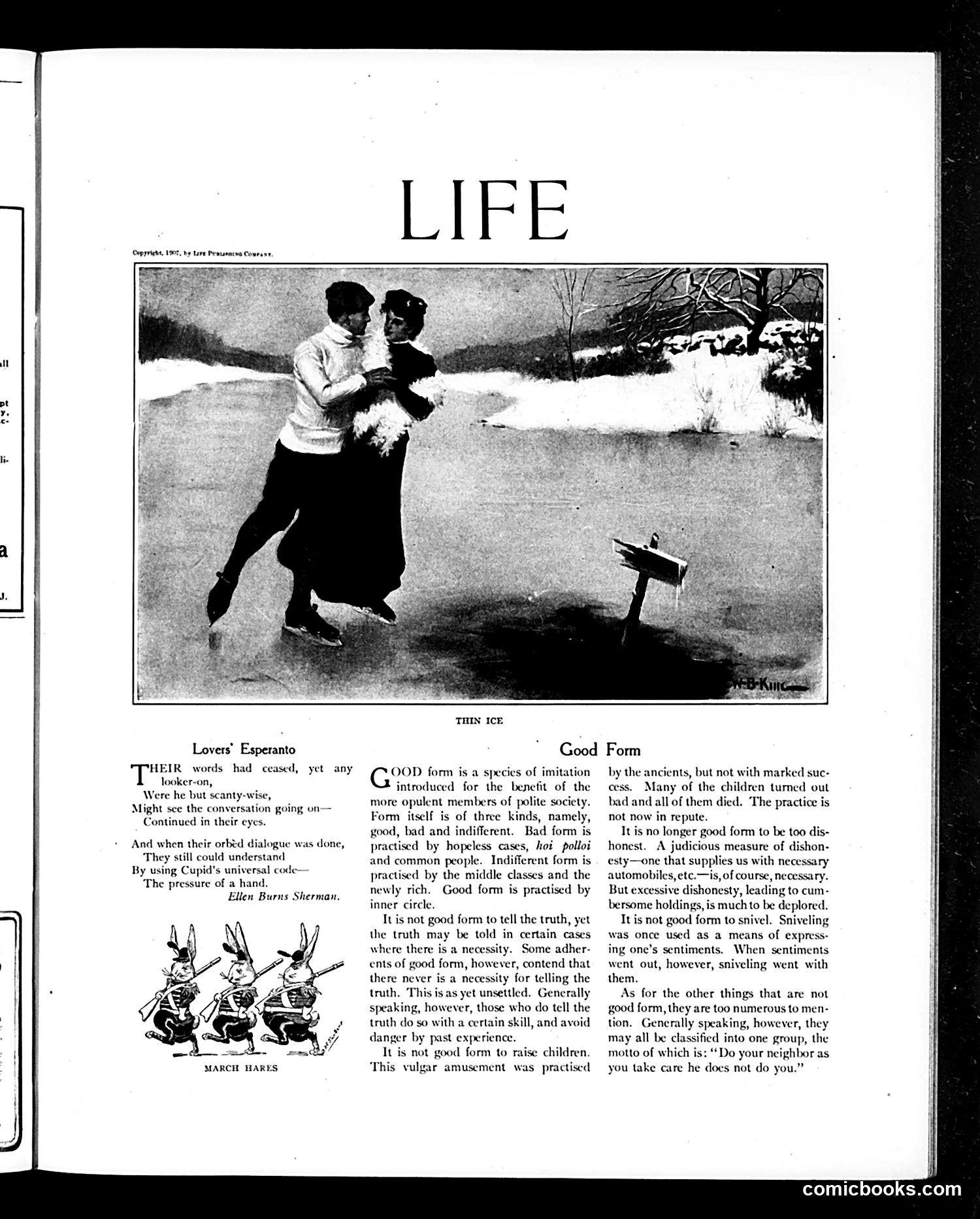
**Main Image ("Thin Ice"):** Two figures ice-skating on a frozen pond, with a sign visible in the background. The caption "Lovers' Esperanto" and poem by Ellen Burns Sherman suggest this illustrates romantic communication transcending language barriers—the "universal code" of physical affection ("pressure of a hand"). **"Good Form" Article:** A serious essay discussing social etiquette conventions across class levels. It explains that "good form" (proper behavior) is practiced by the upper classes, while "bad form" and "indifferent form" characterize lower and middle classes. The piece argues form serves social function but isn't necessary for truth-telling. **"March Hares" Illustration:** A small cartoon showing three hare-like figures in a line, likely referencing the "mad as a March hare" idiom about springtime animal behavior. The page mixes romantic sentiment with social commentary on class-based manners.
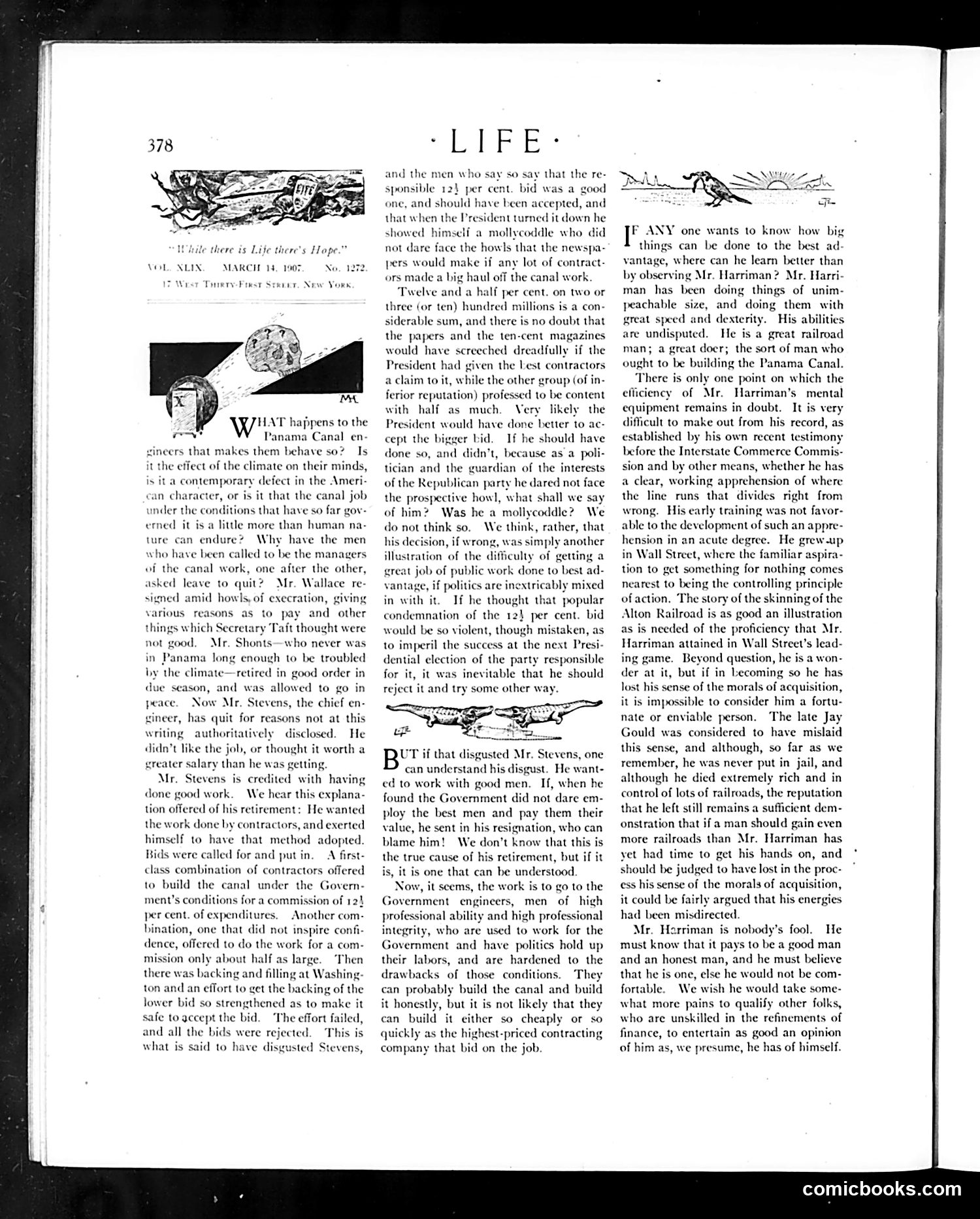
This page satirizes the Panama Canal construction's mismanagement under President Theodore Roosevelt's administration. The text criticizes the contract bidding process, suggesting Roosevelt rejected the lowest bid in favor of politically favored contractors, then appointed incompetent managers. The central cartoon (marked "PAC") appears to depict a mollusk or incompetent figure—likely representing the canal project's leadership or a specific official mentioned in the accompanying article. The satire targets the contradiction between Roosevelt's stated efficiency and the actual political favoritism corrupting the project. The author argues that while Roosevelt sought "good men," his political allegiances forced compromises that undermined competent administration, ultimately illustrating how politics corrupts ostensibly meritocratic public works projects.
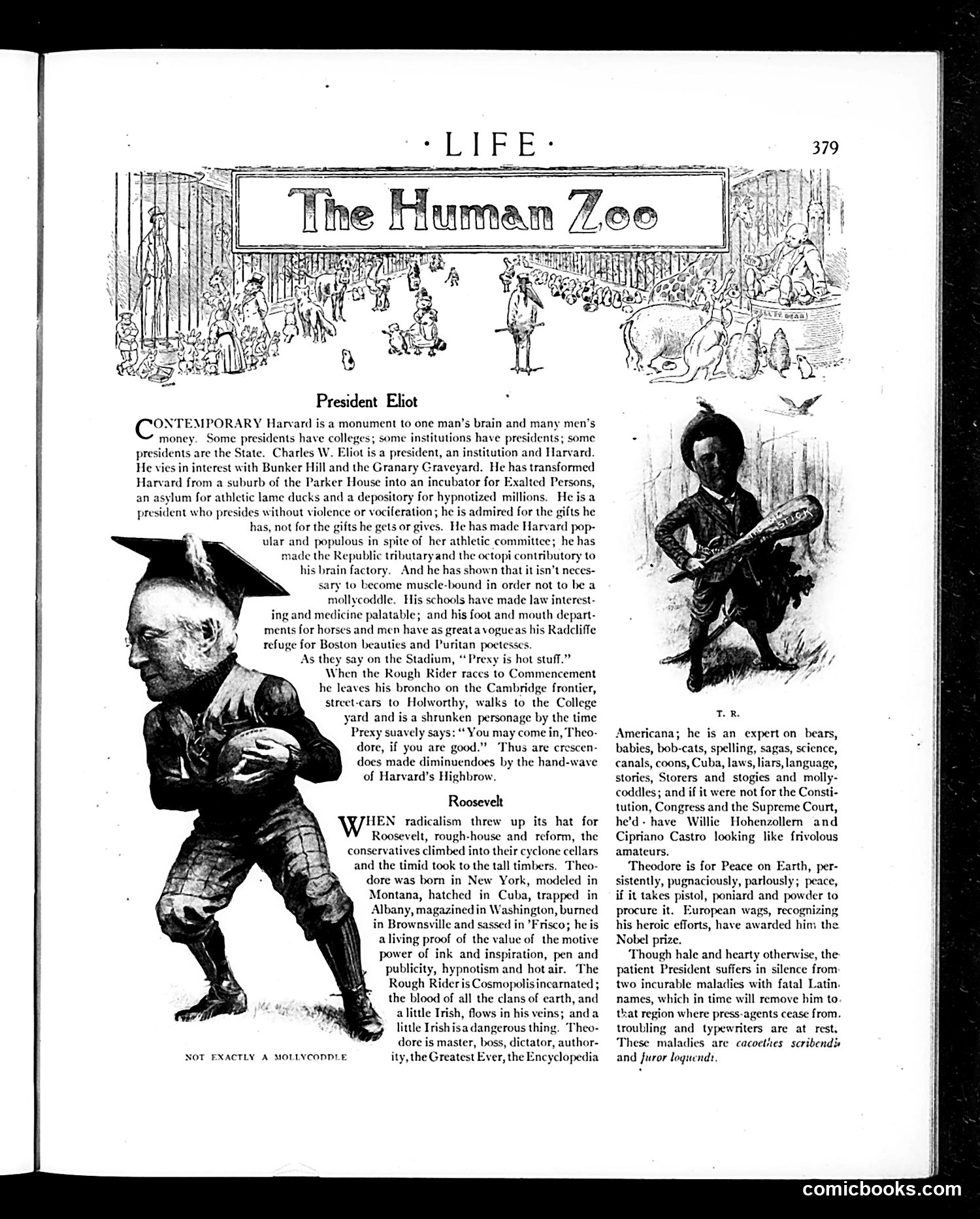
This page satirizes prominent early 20th-century American figures as specimens in a "human zoo." Two caricatures are shown: **President Eliot** (left): Harvard's president is depicted as an exotic creature—a critique of his intellectual pretensions and institutional dominance. The text notes he's transformed Harvard into "an incubator for Exalted Persons." **Theodore Roosevelt** (right, labeled "T.R."): Caricatured as an aggressive, untamed animal. The accompanying text mocks his radicalism, "rough house and reform" politics, and his dominating personality—calling him "Cosmopolitan incarnated" with blood "of all the class of earth." The satire compares these powerful figures to zoo animals on display, suggesting they're objects of public curiosity rather than serious statesmen—a common Progressive-era critique of influential personalities.
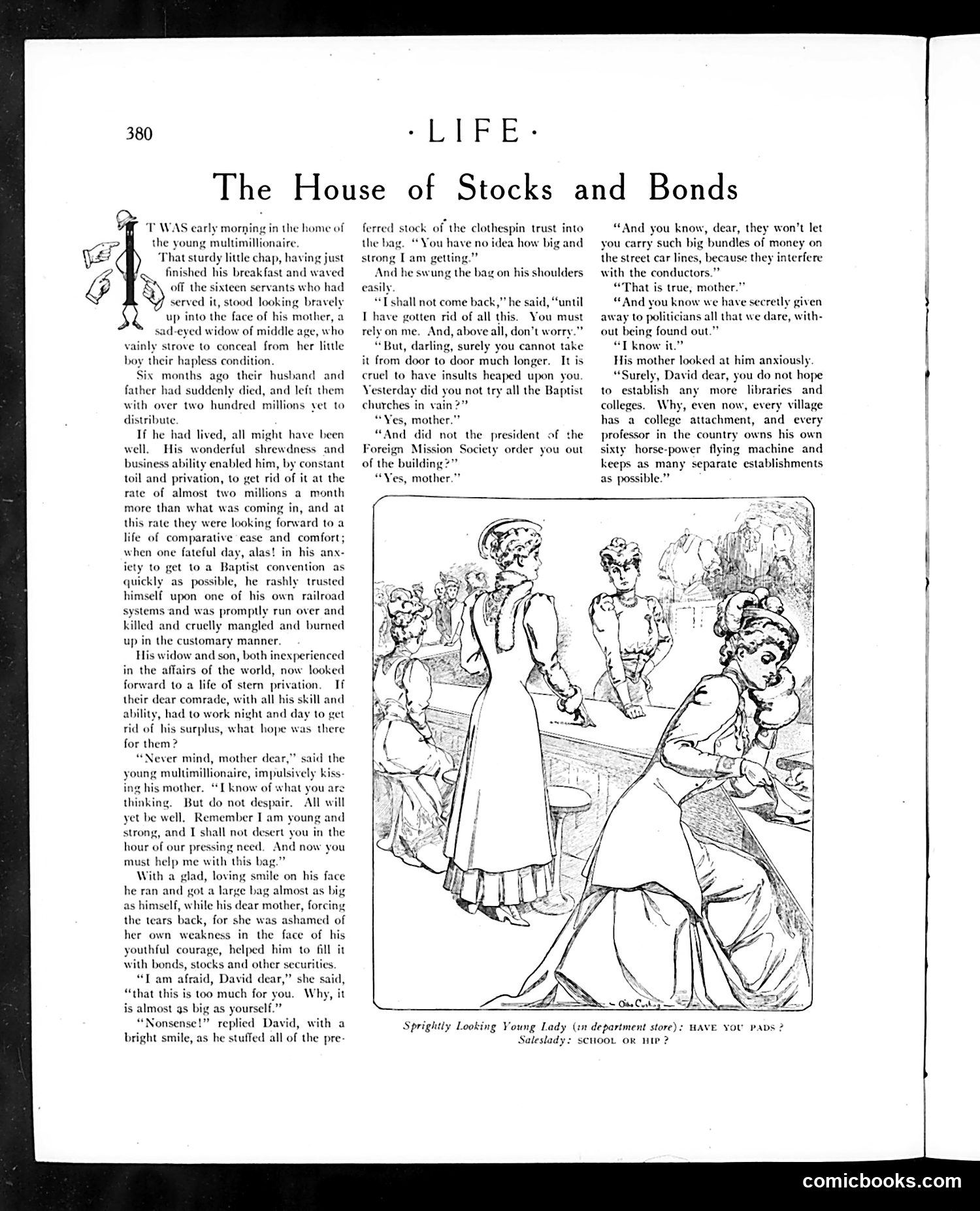
This story satirizes wealthy widows managing inherited fortunes. The narrative follows a young multimillionaire's widow navigating financial advice from her son David, who urges caution about charitable giving and institutional support (libraries, colleges, flying machines). The accompanying illustration shows a "sprightly looking young lady" in a department store, with the caption asking "HAVE YOU PAID?" and "SCHOOL OR HIP?" This appears to mock the tension between conspicuous consumption and social responsibility among the wealthy—suggesting privileged women shop freely while questions linger about their actual charitable contributions versus their spending habits. The satire critiques how the rich rationalize financial conservatism while maintaining lavish lifestyles.
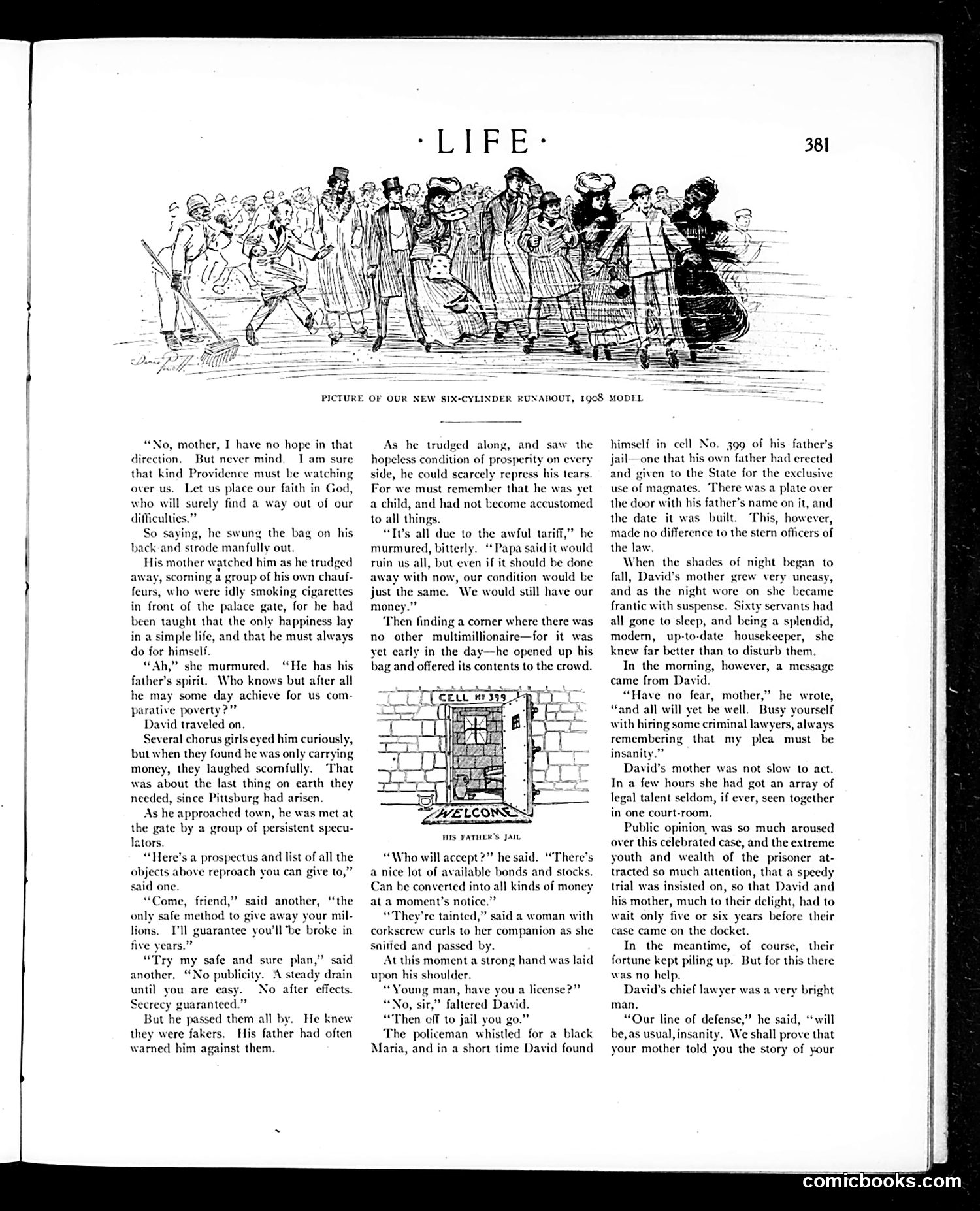
The top illustration depicts a diverse crowd of people, labeled "PICTURE OF OUR NEW SIX-CYLINDER RUNABOUT, 1908 MODEL." This is a visual pun: the "automobile" is actually composed of six human figures arranged in a line, suggesting commentary on either mass production, human mechanization, or perhaps the accessibility of automobiles to ordinary people rather than the wealthy. The page's text contains a narrative about David, apparently a young man facing legal troubles. The story discusses his family's financial struggles, legal representation, and court proceedings. The content appears to be serialized fiction rather than political satire, exploring themes of poverty, justice, and social hardship during the early 20th century.
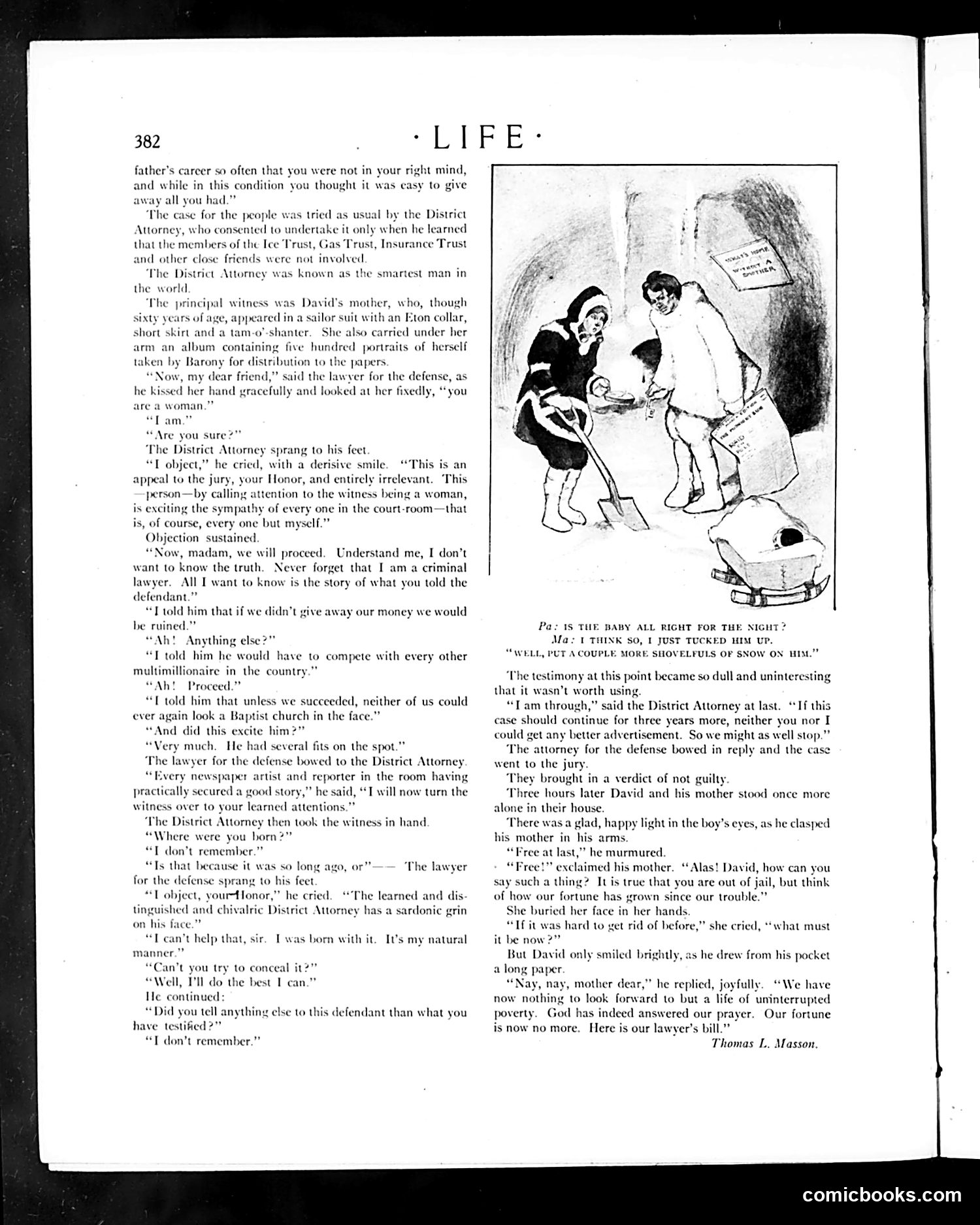
The single illustration depicts a domestic scene where parents and children are discussing a baby in what appears to be a snow-covered carriage or pram. The caption reads: "Pa: IS THE BABY ALL RIGHT FOR THE NIGHT? / Ma: I THINK SO. I JUST TUCKED HIM UP. / 'WELL, PUT A COUPLE MORE SHOVELFULS OF SNOW ON HIM.'" The cartoon satirizes overly protective parenting practices of the era, likely early 20th century. It mocks the trend of exposing infants to extreme cold as a supposed health measure—a common but misguided belief in that period. The absurd suggestion to bury the baby in snow exaggerates this dangerous practice to ridiculous proportions, critiquing parental gullibility regarding pseudoscientific child-rearing advice that was fashionable at the time.
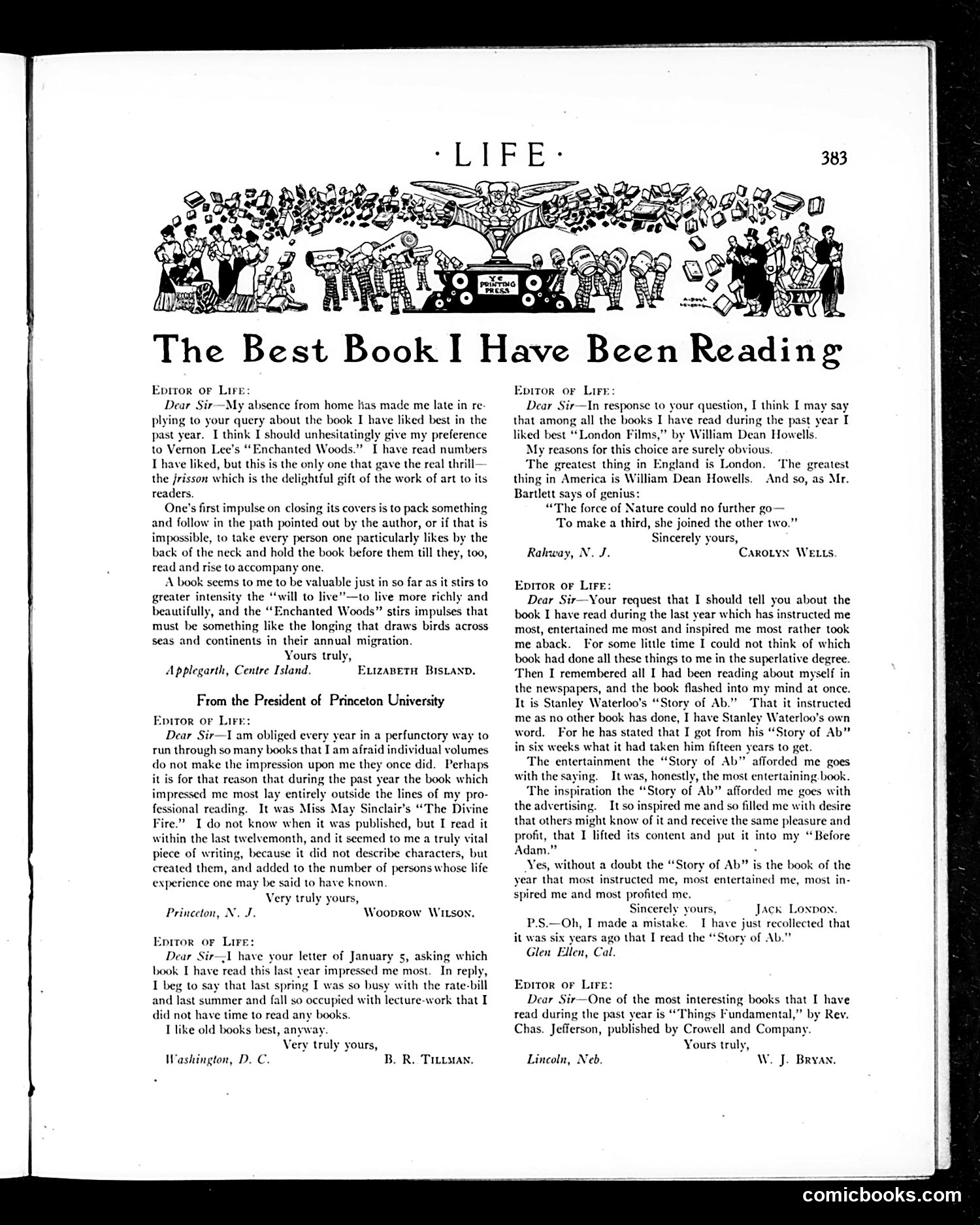
This page is primarily **reader correspondence**, not satire or political cartooning. It features letters to the editor of *Life* magazine responding to a query about "The Best Book I Have Been Reading." The decorative header illustration shows a crowd of diverse people beneath a winged figure, symbolizing aspiration and shared culture—typical *Life* magazine styling. The letters discuss various books: Vernon Lee's "Enchanted Woods," William Dean Howells' "London Films," Stanley Waterloo's "Story of Ab," and "Things Fundamental" by Rev. Chas. Jefferson. Writers include notable figures like **Woodrow Wilson** (then-President of Princeton University) and **Carolyn Wells** (a popular author). This represents *Life*'s role as a middlebrow cultural forum, encouraging educated readers to share literary recommendations—reflecting early 20th-century American intellectual discourse.
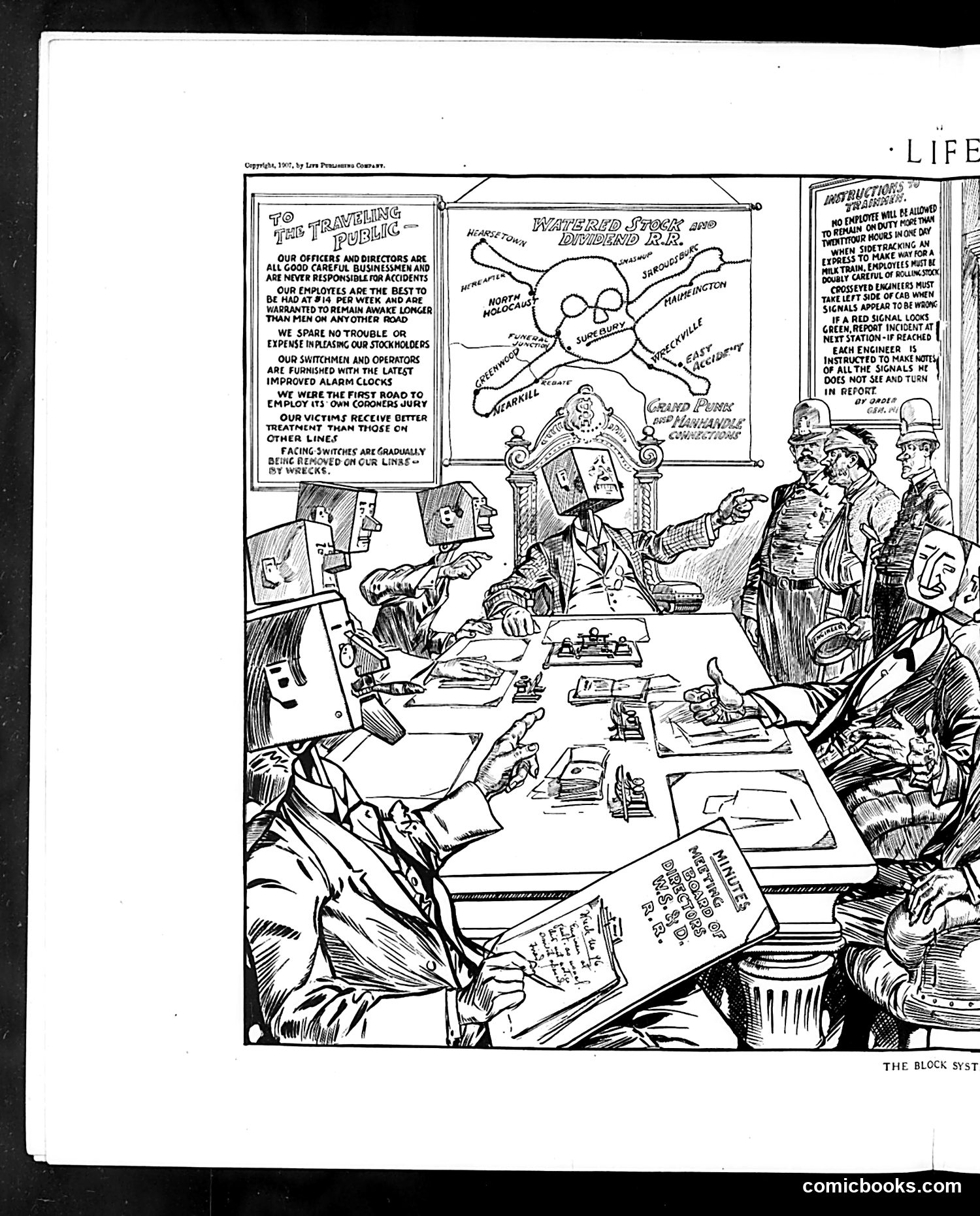
This page satirizes railroad management and operations during the early 20th century. The main cartoon depicts a boardroom meeting where executives discuss railroad efficiency improvements. Two text boxes promote "The Traveling Public" railroad and outline management's claims about officer competence, employee quality, and safety innovations—including being "the first road to employ our own consulting experts" and having "the latest improved Alco locomotives." The satire targets corporate self-promotion and boastfulness. While management congratulates itself on progressive practices, the cartoon's tone suggests skepticism about these claims. The railroad industry was a major subject of public criticism during this era regarding safety, labor practices, and consumer treatment, making such corporate advertising ripe for mockery in Life's satirical pages.
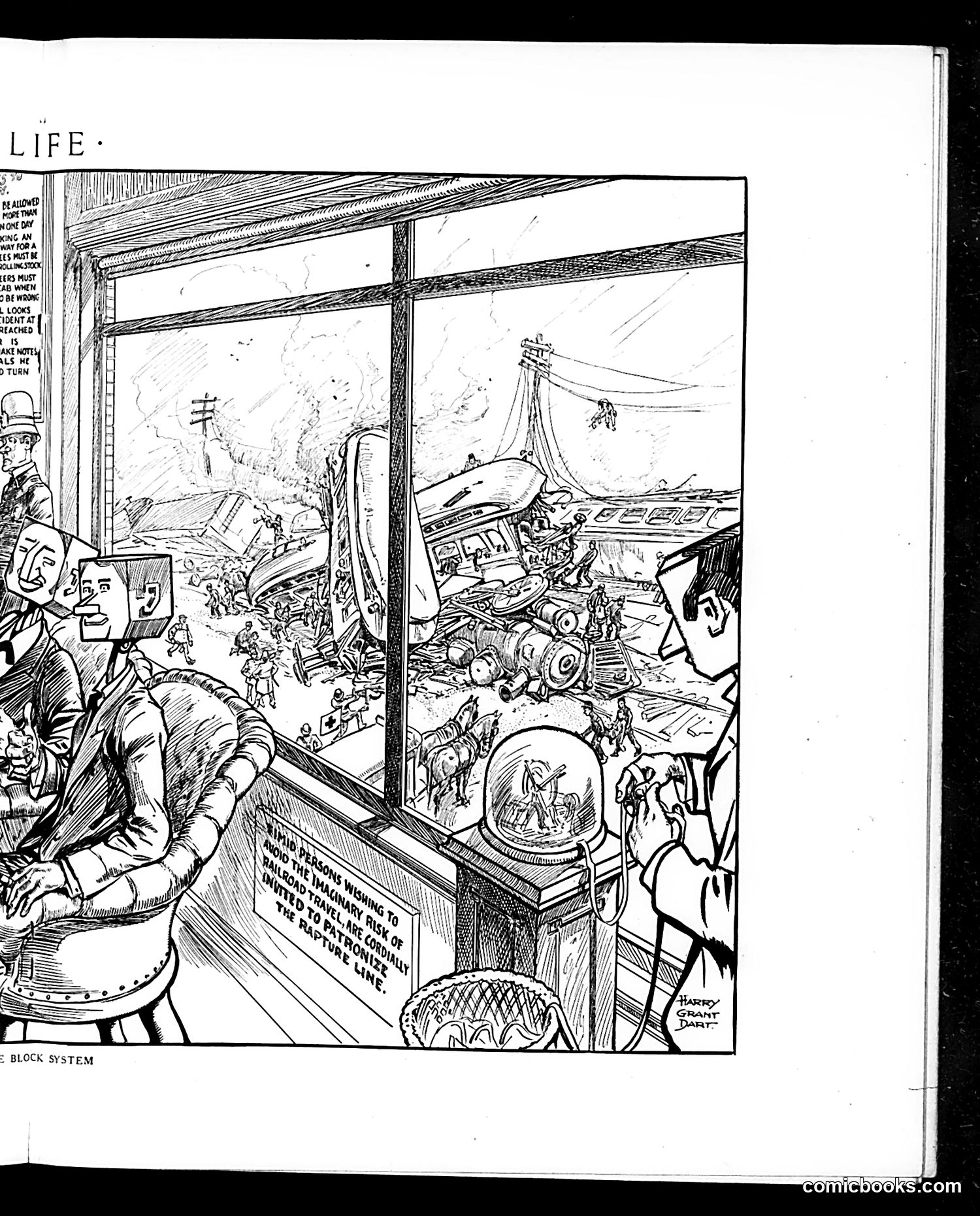
This is a satirical cartoon from *Life* magazine depicting a futuristic window display or exhibition. On the left, well-dressed observers peer through glass at an elaborate diorama showing what appears to be a dystopian or post-apocalyptic scene—complete with crashed spacecraft, mechanical wreckage, and small figures among ruins. The visible text on the display reads something about "warning to risk of..." and references to "particularly prized," suggesting this is a cautionary exhibition, possibly about technological disaster or war consequences. The cartoon likely satirizes either: - Contemporary anxieties about advanced technology and warfare (possibly WWI-era, given the style) - Museum exhibits presenting dystopian futures as entertainment - Public fascination with catastrophic scenarios The artist is credited as Harry Grant Dart. Without additional context, the specific historical reference remains unclear.
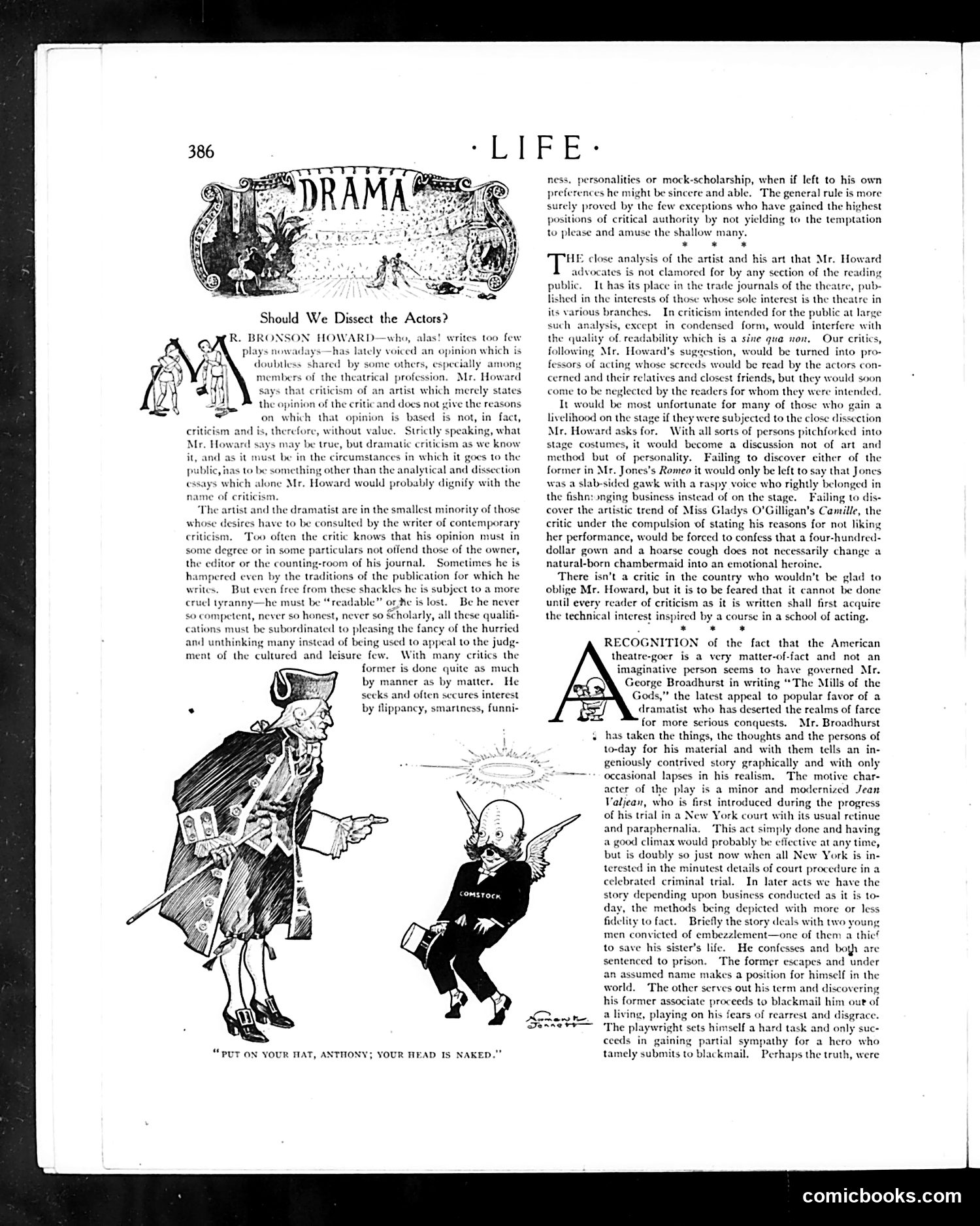
This piece debates dramatic criticism standards. Playwright Bronson Howard (identified in text) argues critics should provide analytical reasoning, not mere opinion. Life's editors counter that such rigorous "dissection" of actors is impractical and undesirable. The satirical cartoons mock actors by exaggerating their physical features—typical of period caricature. The caption "Put on your hat, Anthony; your head is naked" suggests actors rely on costumes to mask lack of substance. Life's argument: thorough critical analysis would force critics to expose performers' actual limitations (poor physiques, voices, personalities) rather than praising artistic merit. Readable, entertaining criticism serves general audiences better than scholarly treatises for theater professionals alone. The satire ridicules both pretentious actors and Howard's idealistic critical standards as incompatible with commercial theater's realities.
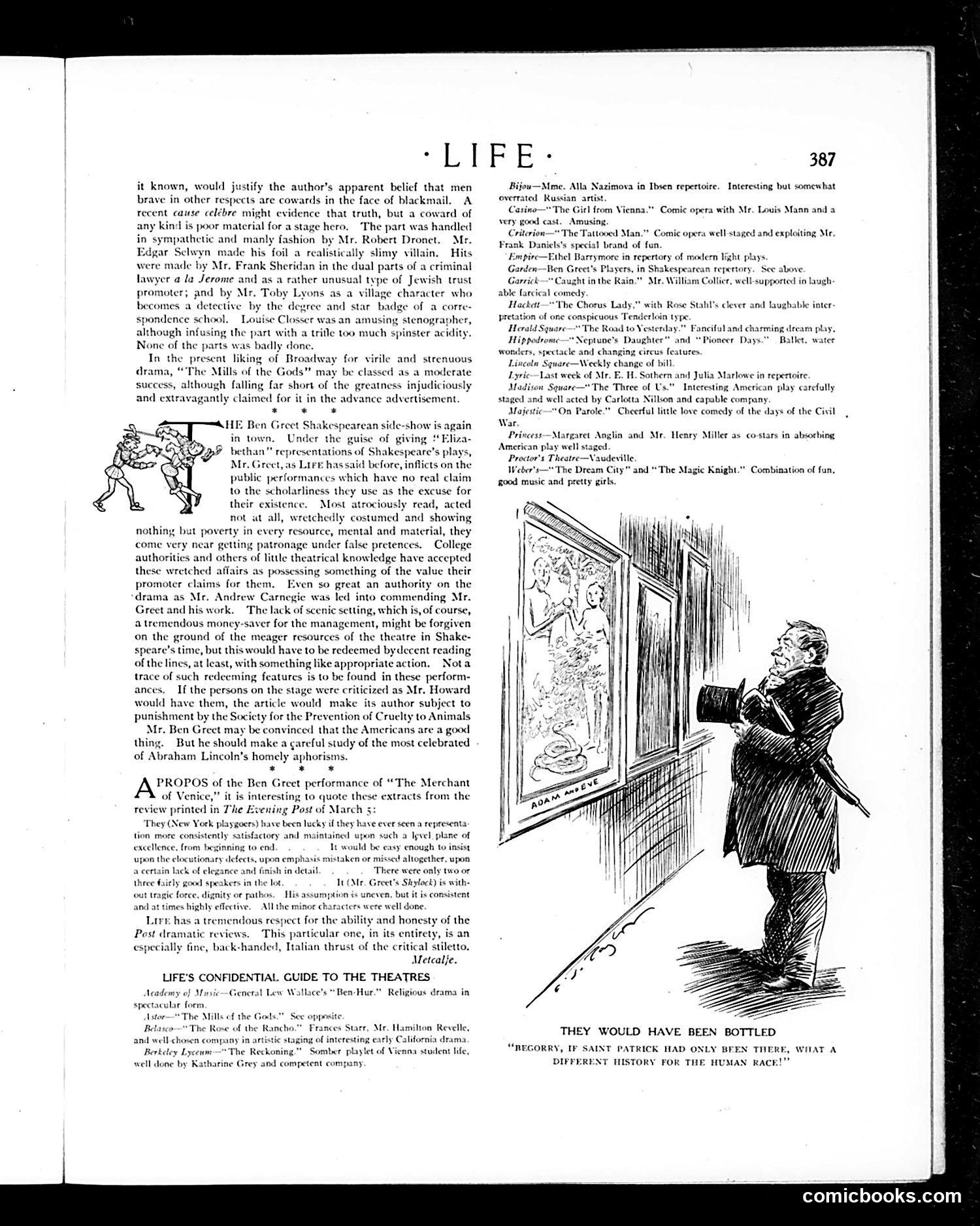
This page contains theater reviews and a cartoon about cultural pretension. The main cartoon depicts a man gazing admiringly at a Renaissance painting through a museum window, with the caption: "They would have been bottled 'Gregory, if Saint Patrick had only been there. What a different history for the human race!'" The joke satirizes Irish-American pride and drinking stereotypes. "Saint Patrick" (the patron saint of Ireland) is invoked as if his presence at a moment of great artistic creation would have prevented people from being "bottled" (getting drunk). It's a backhanded compliment—suggesting Irish people are inherently prone to drinking, and implying that if Saint Patrick had intervened in European history, Irish culture might have achieved greater artistic refinement. The reviews above discuss Broadway productions, including criticism of Ben Greet's Shakespeare performances for being poorly acted and costumed despite claims of scholarly authenticity. The page reflects early-20th-century attitudes toward both artistic merit and ethnic stereotypes.
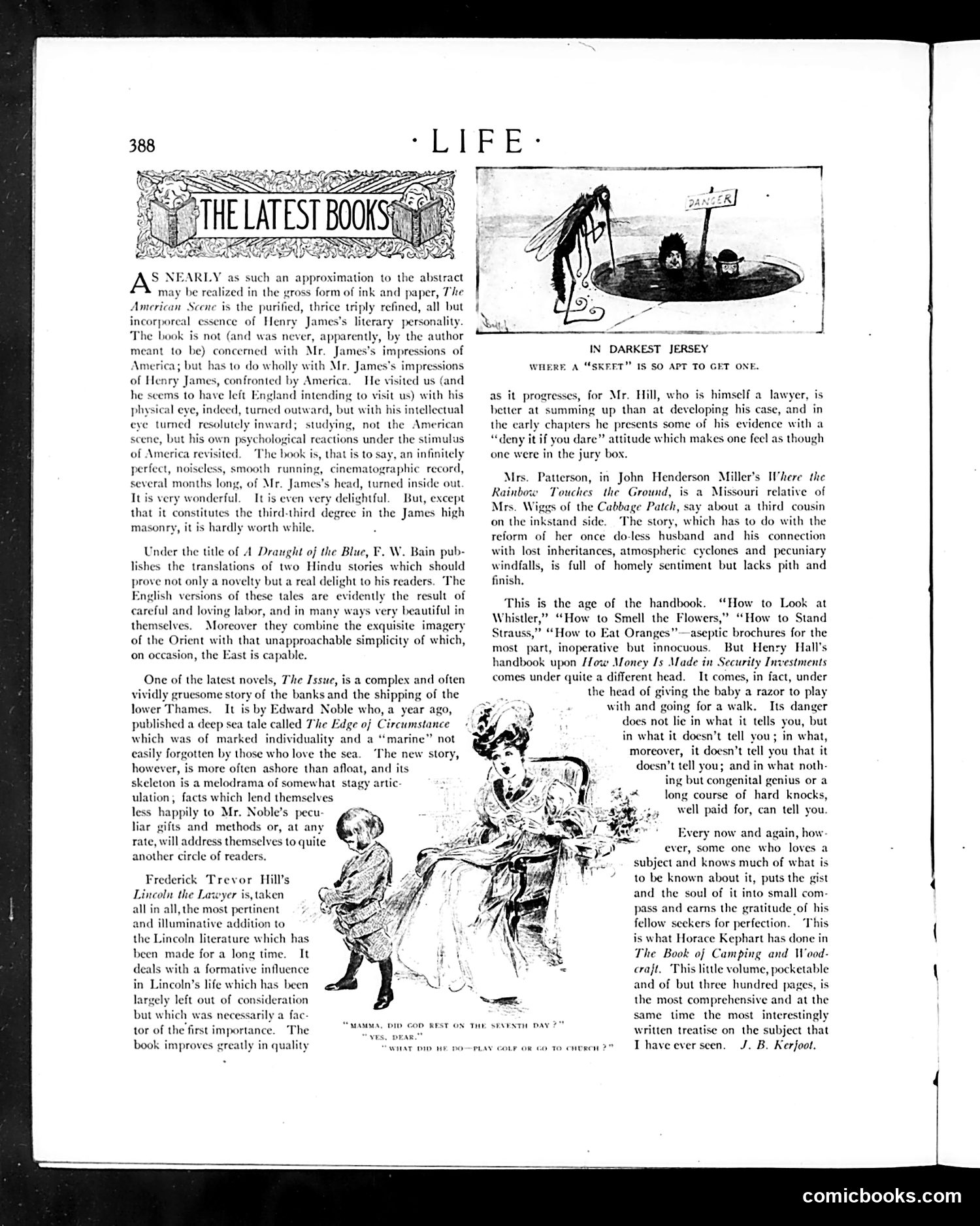
This is a book review section featuring several literary critiques. The main cartoon, titled "In Darkest Jersey," satirizes rural New Jersey life, depicting what appears to be a rustic family scene with the caption suggesting that a "skeet" (unclear reference, possibly slang) is easily obtained there. The text reviews Henry James's *The American Scene*, describing it as James examining his own psychological reactions rather than America itself—a subtle criticism of his self-absorbed introspection. Other reviews discuss novels about lawyers, rural life, and various "how-to" handbooks that the author mocks as "aseptic brochures." The cartoon caption shows a parent asking a child about God resting on the seventh day, with the child's response cut off—likely a joke about childish literalism or irreverent theology. The overall tone is satirical toward both pretentious literature and American earnestness.
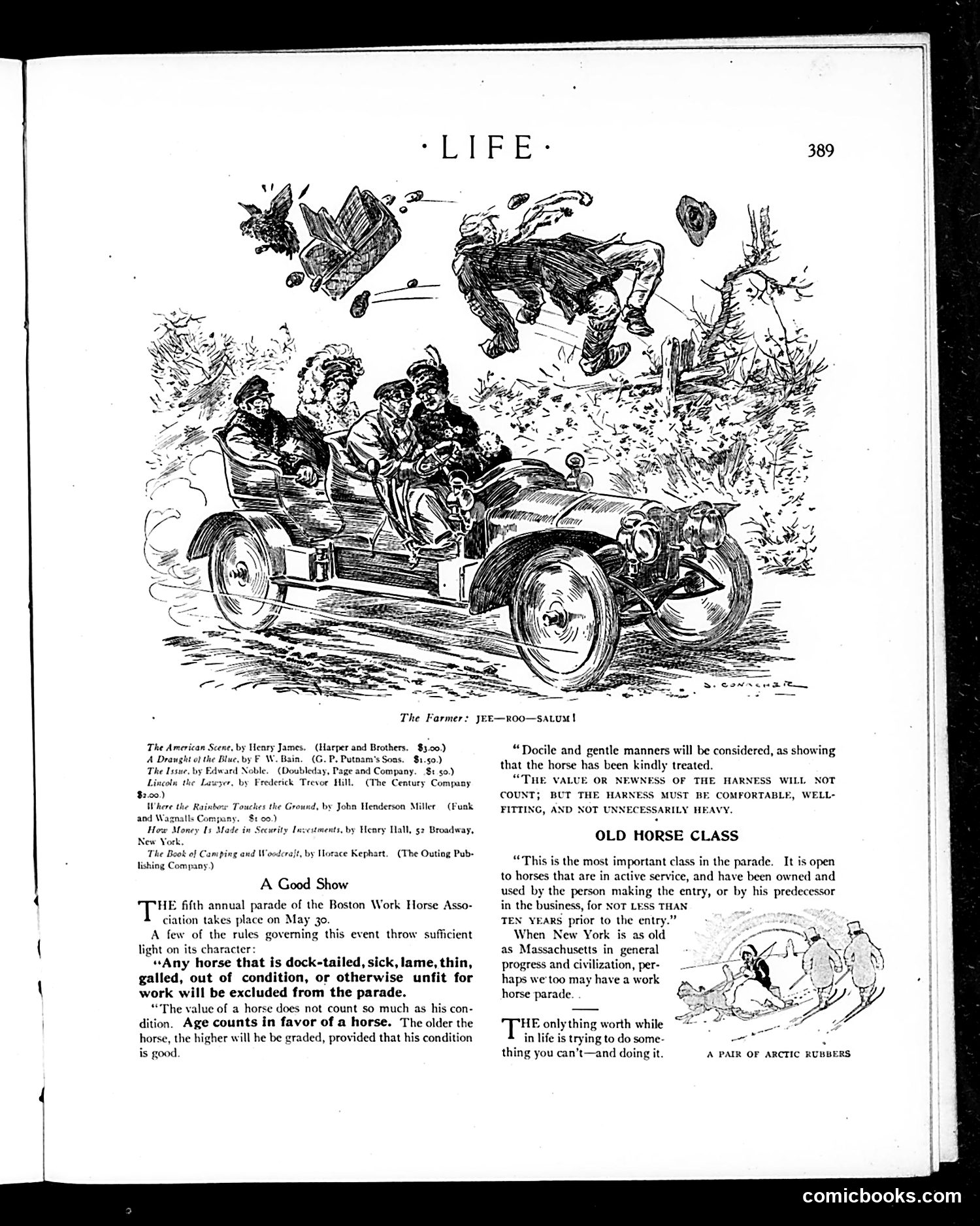
The main cartoon depicts a chaotic automobile scene where a car full of well-dressed passengers is being chased by a runaway horse and cow. The caption reads "The Farmer: JEE—ROO—SALUM!" (mimicking farm dialect for controlling animals). This satirizes the collision between rural and modern urban life—the farmer's traditional animals represent the old world, while the automobile represents the new industrial age. The joke plays on culture clash and the absurdity of these worlds literally crashing into each other. The accompanying article about the Boston Work Horse Association's parade provides context: it establishes standards for old, working horses still in active service, emphasizing age and condition over monetary value. The satirical editorial comment suggests that New York, being younger than Massachusetts, lacks the sophistication to appreciate such traditions. The humor critiques American industrialization and urban pretension while defending rural values and the dignity of working animals.
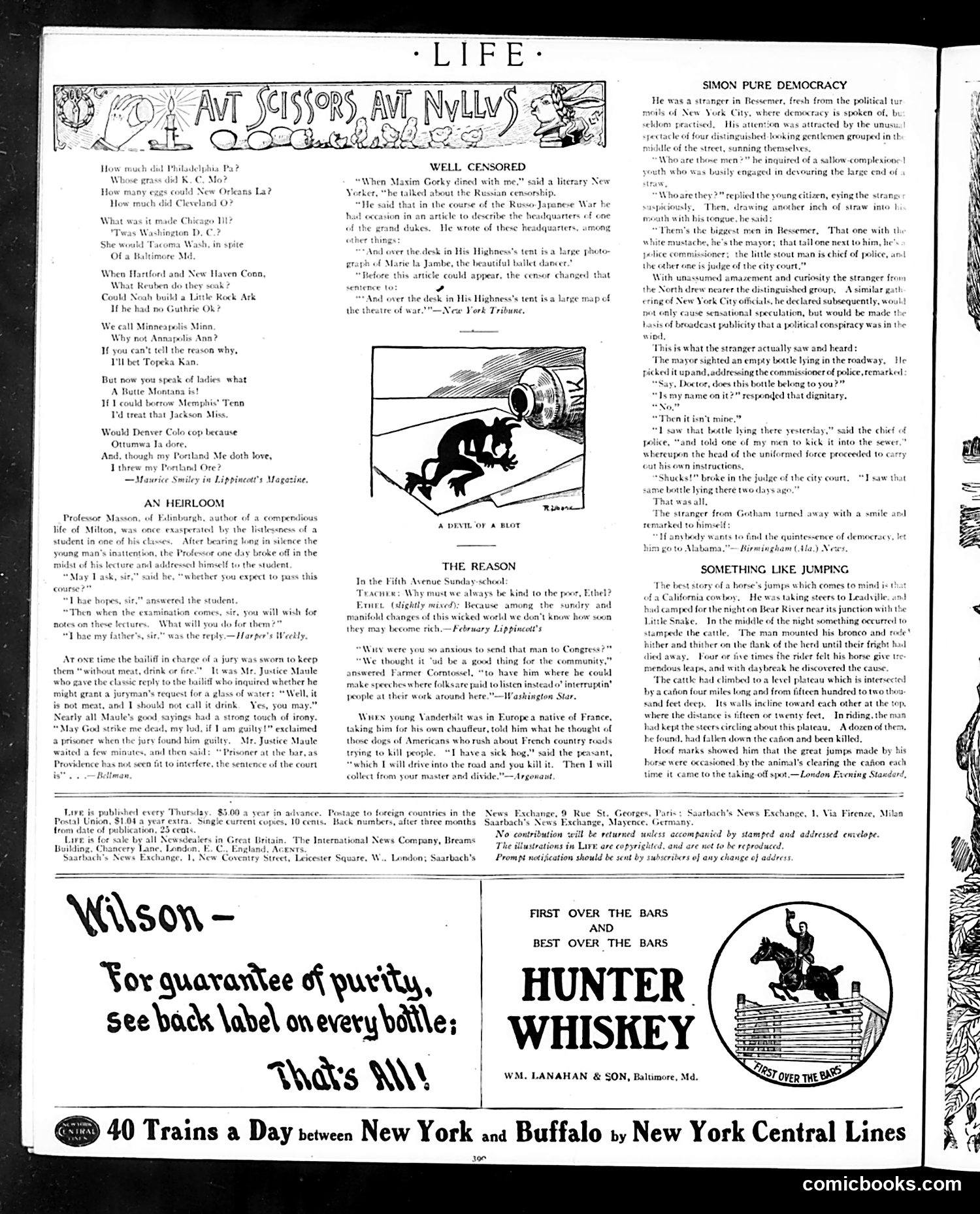
This page contains three distinct satirical pieces typical of early 20th-century Life magazine: **"Simon Pure Democracy"** (top right): A narrative mocking American political corruption. A stranger observes four New York City officials—a mayor, police commissioner, police judge, and uniformed officer—arguing over a bottle found in the street. Each claims it isn't his. The satire targets how city officials deny responsibility and contradict each other's statements, suggesting widespread dishonesty in urban government. **"An Heirloom"** (left column): A brief anecdote about Professor Masson at Edinburgh who scolds an inattentive student, then asks what notes the student will take. The student replies he'll borrow his father's—implying laziness and intellectual complacency pass generationally. **"Something Like Jumping"** (bottom right): An incomplete anecdote about a cowboy herding cattle to Leadville, apparently setting up a humorous story (text cuts off). The page also includes period advertisements for Wilson whiskey and New York Central Lines trains. The humor relies on observational satire about bureaucratic dysfunction and personal failings.
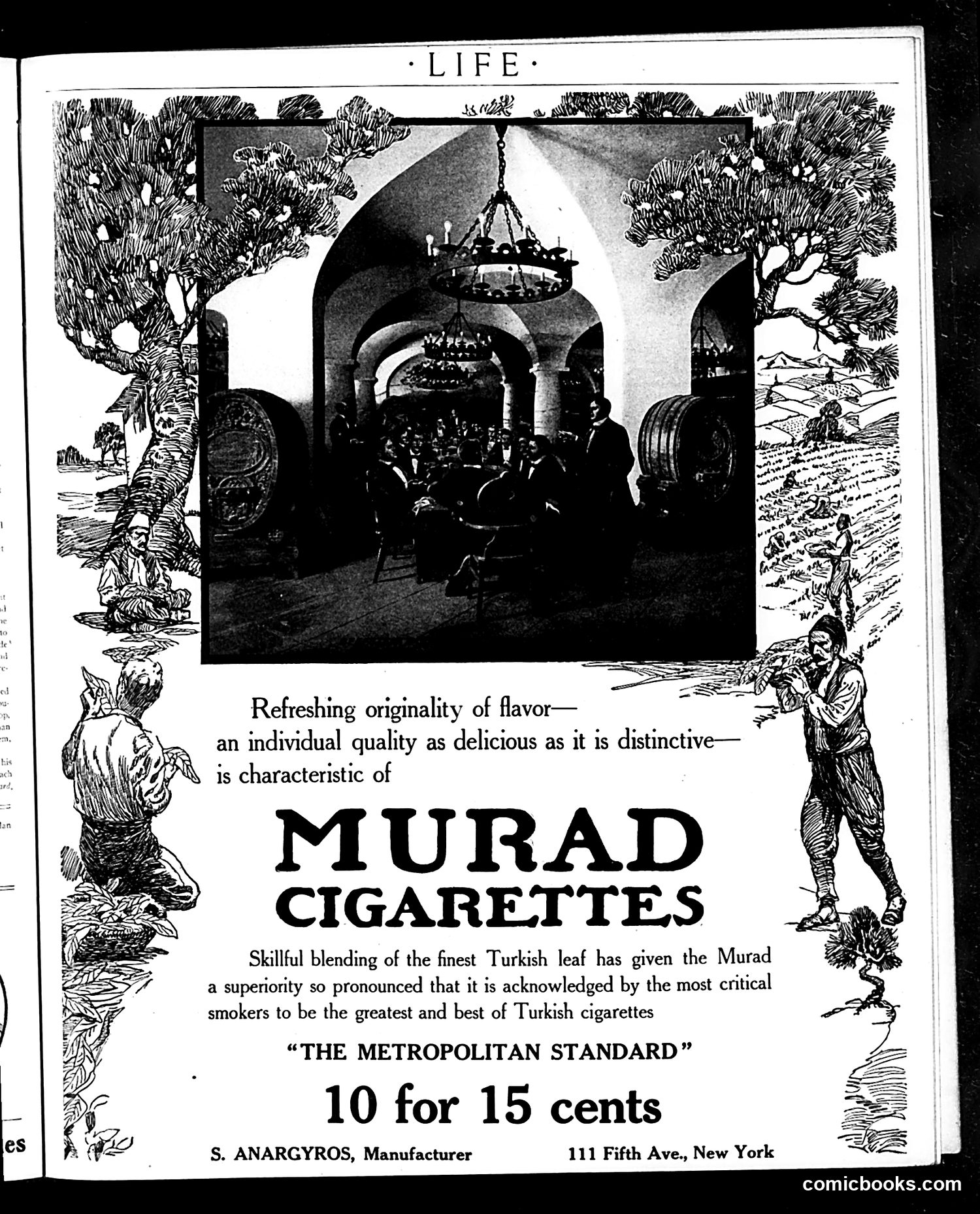
This page is **primarily an advertisement**, not satire or political commentary. It's a full-page ad for Murad cigarettes from Life magazine, promoting Turkish cigarettes as a premium product. The decorative border features stylized illustrations of figures in what appear to be classical or exotic poses—likely meant to evoke the "Turkish" origin of the product and suggest sophistication and worldliness. The central photograph shows an ornate interior with hanging chandeliers and well-dressed people, presumably depicting a refined social setting where such cigarettes would be enjoyed. The ad emphasizes exclusivity and critical acclaim ("acknowledged by the most critical smokers") while offering an accessible price point (10 for 15 cents). The manufacturer, S. Anargyros, is listed at a Fifth Avenue address—implying New York prestige. This reflects early 20th-century marketing strategy: associating cigarettes with elegance, exoticism, and status.
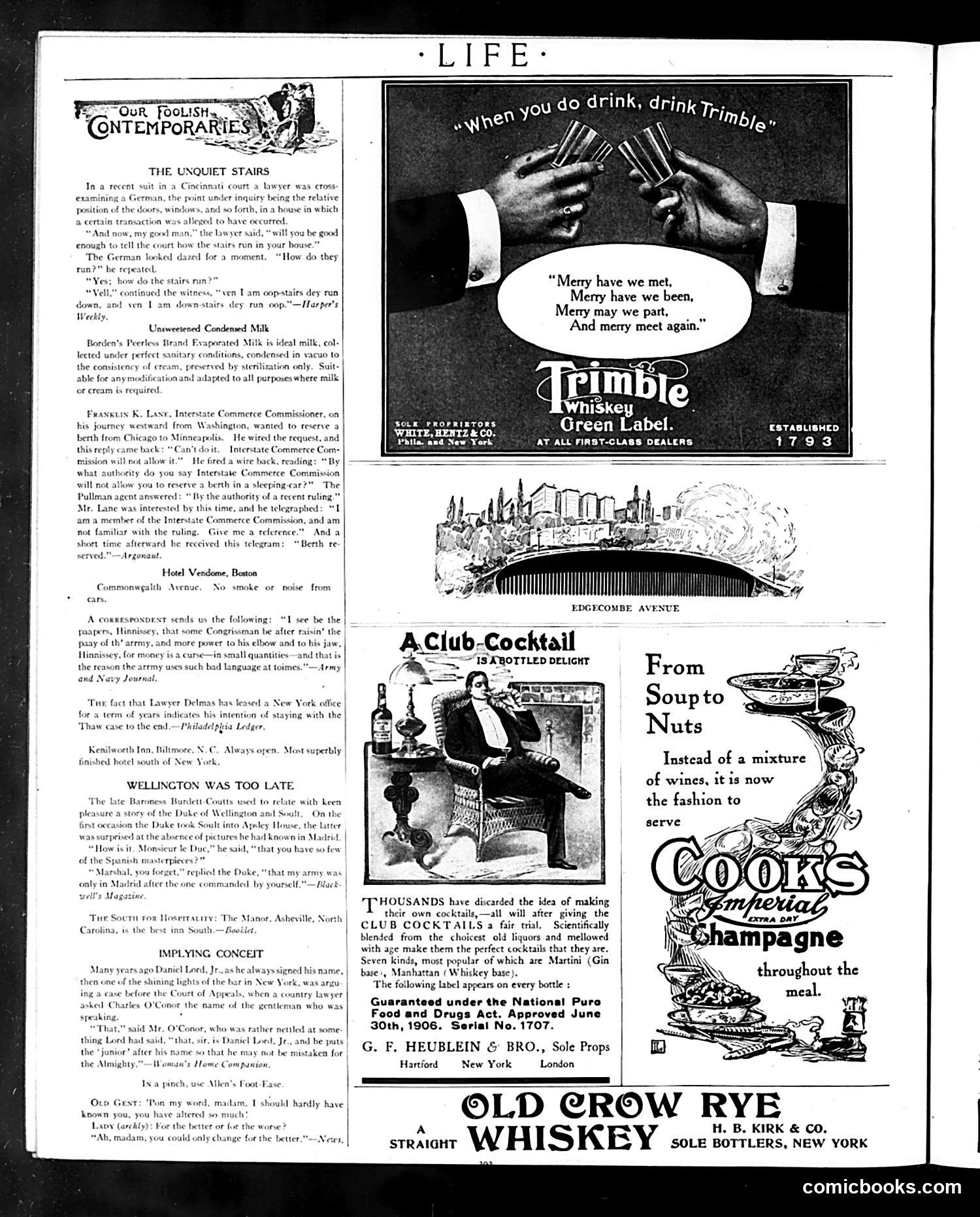
This page showcases **Life magazine's satirical humor section**, featuring three brief anecdotes mocking contemporary figures and situations: 1. **"The Unquiet Stairs"**: A German is cross-examined about stairs in a Cincinnati courthouse. The joke plays on his accent ("oop-tairs dey run oop"), satirizing immigrant speech patterns common in American humor of this era. 2. **"Unsweetened Condensed Milk"** and **"Wellington Was Too Late"**: Brief, witty stories about bureaucratic absurdity and social pretension—typical of Life's satirical style targeting American institutions and high society. 3. **"Implying Conceit"**: A short joke about a lawyer who always signs his name in full, fearing confusion with other lawyers—mocking professional vanity. The page is dominated by **period advertisements** for whiskey, champagne, and cocktails, reflecting early 1900s consumer culture. The satirical content targets immigrants, bureaucrats, and the upper classes through gentle mockery rather than harsh political commentary.
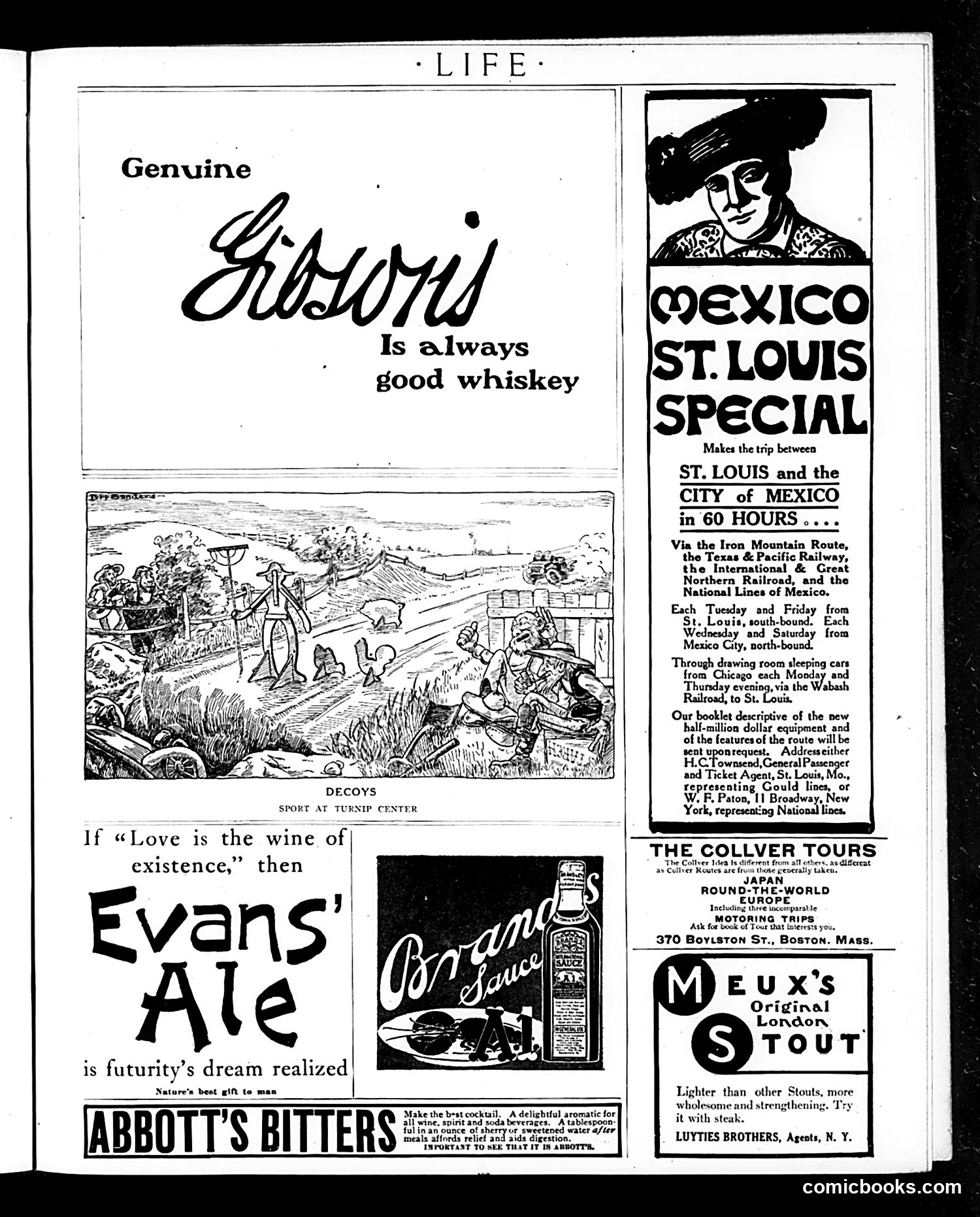
This page is primarily **advertising**, not political satire. It features multiple commercial advertisements for alcoholic beverages and travel services typical of early 20th-century Life magazine. The main advertisements are: 1. **Gilbey's Whiskey** - a straightforward product endorsement 2. **Evans' Ale** - using romantic language ("Love is the wine of existence") 3. **Abbott's Bitters** - promoting a cocktail mixer 4. **Mexico St. Louis Special** - a railway service advertisement 5. **Colliver Tours** - travel packages 6. **Meux's Stout** - an imported beer The small illustration labeled "Decoys - Sport at Turnip Center" appears to be a humorous rural scene, but without clearer visibility, its specific satirical point is unclear. The page reflects the era's acceptance of alcohol advertising and the leisure travel industry, rather than containing pointed political commentary.
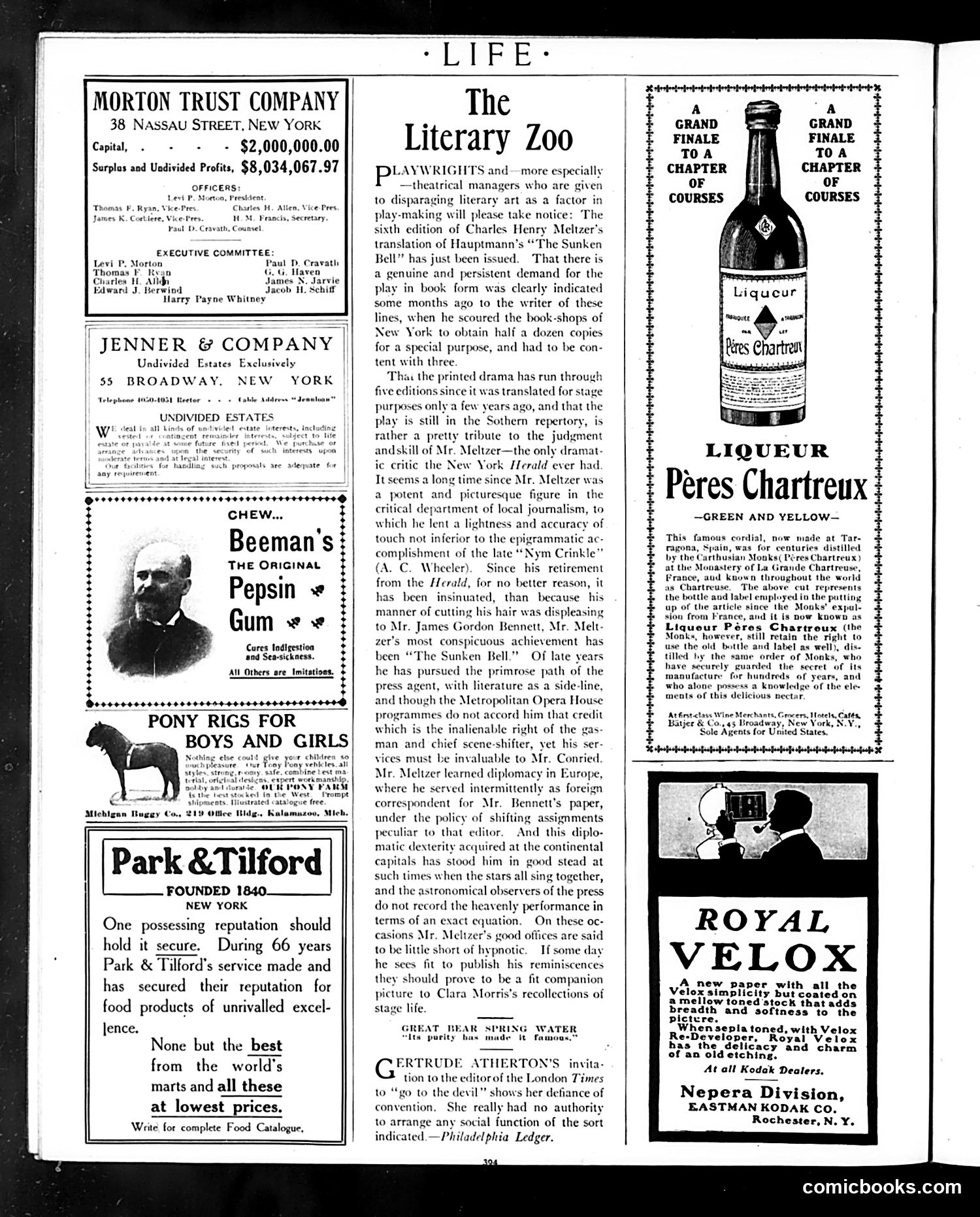
This satirical piece celebrates Charles Henry Meltzer's translation of Gerhart Hauptmann's play "The Sunken Bell," which has reached its sixth edition. The satire targets theatrical managers who dismiss literary merit in favor of commercial appeal. The author uses Meltzer as a case study in fallen prominence. Once a respected drama critic for the *New York Herald*, Meltzer allegedly fell from favor because his haircut displeased publisher James Gordon Bennett—a sardonic jab at Bennett's capricious management. The piece tracks Meltzer's decline: from influential critic to press agent for the Metropolitan Opera House, where his contributions go uncredited despite being "invaluable." The humor lies in the contrast between Meltzer's actual diplomatic skills (learned as a foreign correspondent) and his reduced circumstances. The author suggests Meltzer's "hypnotic" abilities manage difficult opera personalities, implying he's squandered real talent on theatrical politics rather than serious journalism.
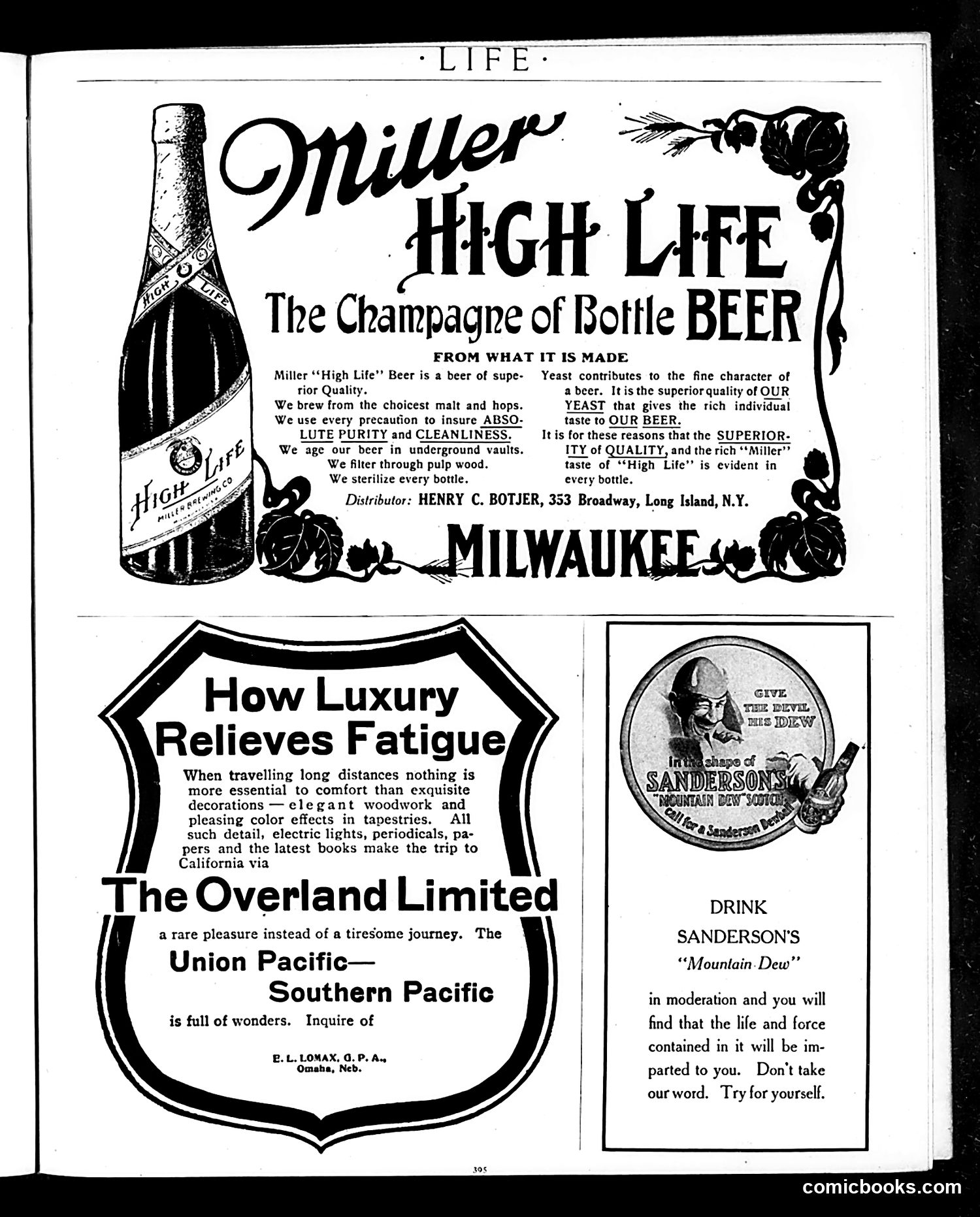
This page contains three advertisements from what appears to be an early 20th-century *Life* magazine issue—no political cartoons or satire. **Miller High Life Beer** dominates the top half, marketing itself as premium beer through claims of purity, quality ingredients, and careful production. The "Champagne of Bottle Beer" slogan positions it as an upscale product. The distributor address (Long Island, NY) suggests regional distribution. **The Overland Limited** (bottom left) advertises a luxury train journey by Union Pacific and Southern Pacific railroads to California, emphasizing comfort over speed—elegant furnishings, electric lights, and reading materials. **Sanderson's Mountain Dew** (bottom right) advertises a non-alcoholic beverage ("in moderation") as a health tonic, claiming it imparts "life and force." The page illustrates period advertising strategies: positioning products as quality/luxury goods, emphasizing purity and health benefits, and using decorative typography. These are straightforward commercial advertisements rather than satirical commentary.
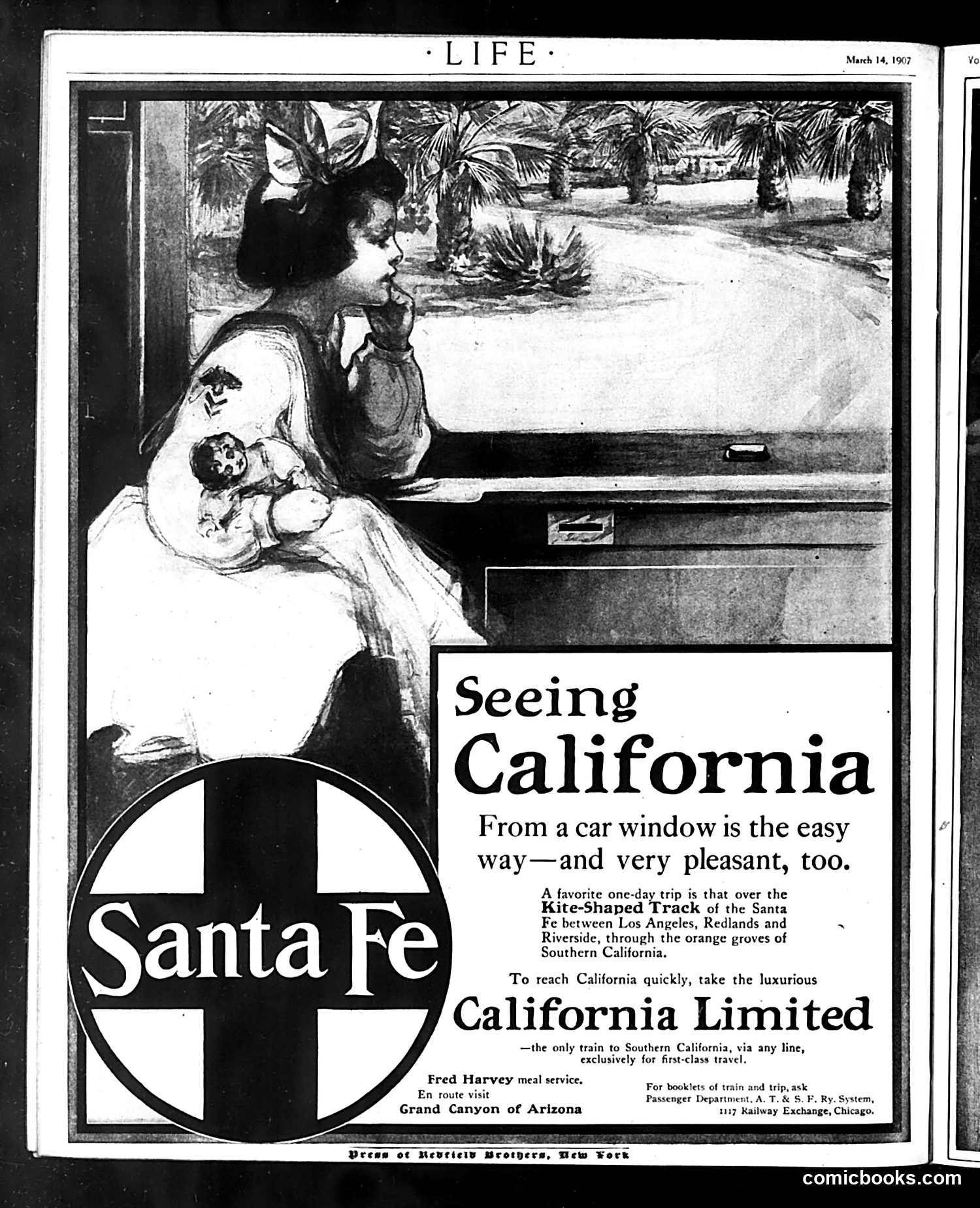
This page is primarily a **Santa Fe Railway advertisement**, not political satire. It depicts a well-dressed woman with a child gazing from a train window at a California landscape with palm trees and orange groves. The advertisement promotes leisure travel on the "California Limited," marketed as an exclusive first-class train service. It emphasizes scenic viewing ("from a car window is the easy way"), luxury amenities (Fred Harvey meal service), and tourist attractions like the Grand Canyon. The illustration's artistic style is typical of early 1900s commercial imagery—idealized, aspirational depictions of modern travel and leisure. There is no apparent political satire or caricature. This reflects the era's emerging automobile and rail tourism industry, when California destinations were becoming fashionable getaways for affluent Americans. The page represents Life magazine's commercial content rather than its satirical editorial material.