
Life, 1907-03-14 · page 16 of 24
Life — March 14, 1907 — page 16: what you’re looking at
What you’re looking at
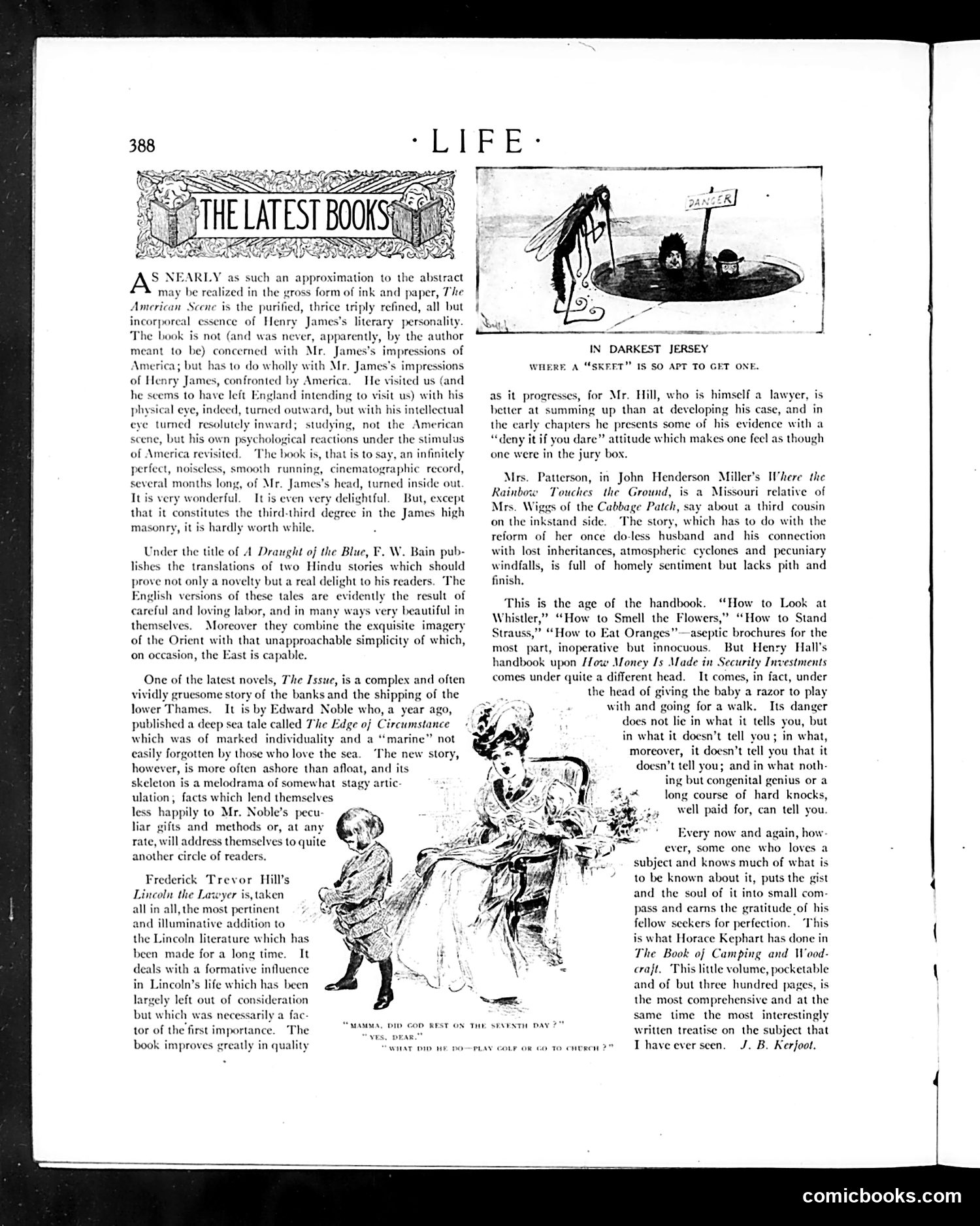
This is a book review section featuring several literary critiques. The main cartoon, titled "In Darkest Jersey," satirizes rural New Jersey life, depicting what appears to be a rustic family scene with the caption suggesting that a "skeet" (unclear reference, possibly slang) is easily obtained there. The text reviews Henry James's *The American Scene*, describing it as James examining his own psychological reactions rather than America itself—a subtle criticism of his self-absorbed introspection. Other reviews discuss novels about lawyers, rural life, and various "how-to" handbooks that the author mocks as "aseptic brochures." The cartoon caption shows a parent asking a child about God resting on the seventh day, with the child's response cut off—likely a joke about childish literalism or irreverent theology. The overall tone is satirical toward both pretentious literature and American earnestness.
📄 Transcribed text from this page (OCR, searchable)
Machine-transcribed from the original scan — historical spelling and the odd misread are preserved.
ASS NEARLY as such an approximation to the abstract may be realized in the gross form of ink and paper, The American Scene is the purified, thrice triply refined, all but incorporeal essence of Henry James's literary personality. The book is not (and was never, apparently, by the author meant to be) concerned with Mr. James's impressions of America; but has to do wholly with Mr. James's impressions of Henry James, confronted by America. He visited us (and he scems to have left England intending to visit us) with his physical eye, indeed, turned outward, but with his intellectual eye tured resolutely inward; studying, not the American scene, but his own psychological reaction of America revisited s under the stimulus The book is, that is to say, an infinitely perfect, noiseless, smooth running, cinematographic record, several months long, of Mr. James’s head, turned inside out It is very wonderful. It is even very delightful. But, except that it constitutes the third-third degree in the James high masonry, it is hardly worth while. Under the title of A Draught of the Blue, F. W. Bain pub- lishes the translations of two Hindu stories which should prove not only a novelty delight to his readers. The English versions of these tales are evidently the result of careful and loving labor, and in many ways very beautiful in themselves. Moreover they combine the exquisite imagery of the Orient with that unapproachable simplicity of which, ‘on occasion, the i One of the latest novels, The Issue, is a complex and often vividly gruesome story of the banks and the shipping of the lower Tham It is by Edward Noble who, a year ago, published a deep sea tale called The Edge oj Circumstance which was of marked individuality and a ‘‘marine” not easily forgotten by those who love the sea. ‘The new story, however, is more often ashore than afloat, and its skeleton is a melodrama of somewhat stagy artic. ulation, facts which lend themselves. less happily to Mr. Noble’s pecu liar gifts and methods or, at any rate, will address themselves to quite another circle of readers. Frederick Trevor Hill’s Lincoln the Lawyer is,taken all in all, the most pertinent and illuminative addition to the Lincoln literature which h: been made for a long time. It deals with a formative influence in Lincoln’s life which has been largely left out of consideration but which was necessarily a fac- tor of the first importance. The book improves greatly in quality “ agaanaes VES, DEAR “WIA pip HE Do DID COD REST ON THE SEVENTH DAY ?” PLAY CoLY OR ' ——————————— IN DARKEST JERSEY WHERE A “SKEET” IS SO APT TO GET ONE. as it progresses, for Mr. Hill, who is himself a lawyer, is better at summing up than at developing his case, and in the early chapters he presents some of his evidence with a “deny it if you dare” attitude which makes one feel as though one were in the jury box. Mrs. Patterson, in John Henderson Miller's Where the Rainbow Touches the Ground, is a Missouri relative of Mrs. Wiggs of the Cabbage Patch, say about a third. cousin on the inkstand side. The story, which has to do with the reform of her once do-less husband and his connection with lost inheritances, atmospheric cyclones and pecuniary windfalls, is full of homely sentiment but lacks pith and finish. This is the age of the handbook. “How to Look at Whistler,” “How to Smell the Flowers,” “How to Stand Strauss,” “How to Eat Oranges” —aseptic brochures for the most part, inoperative but innocuous. But Henry Hall's handbook upon How Money Is Made in Security Investments comes under quite a different head. It comes, in fact, under the head of giving the baby a razor to play with and going for a walk. Its danger does not lie in what it tells you, but in what it doesn’t tell you; in what, moreover, it doesn’t tell you that it doesn’t tell you; and in what noth- ing but congenital genius or a long course of hard knocks, well paid for, can tell you Every now and again, how ever, some one who loves a subject and knows much of what is to be known about it, puts the gist and the soul of it into small com- pass and earns the gratitude of his fellow seckers for perfection. ‘This is what Horace Kephart has done in The Book oj Camping and Wood- crajt. This little volume, pocketable and of but three hundred pages, is the most comprehensive and at the same time the m interestingly written treatise on the subject that ro envecn?” ‘T haveeverseen. J. B. Kerjoot. comicbooks.com