
Life, 1907-03-14 · page 5 of 24
Life — March 14, 1907 — page 5: what you’re looking at
What you’re looking at
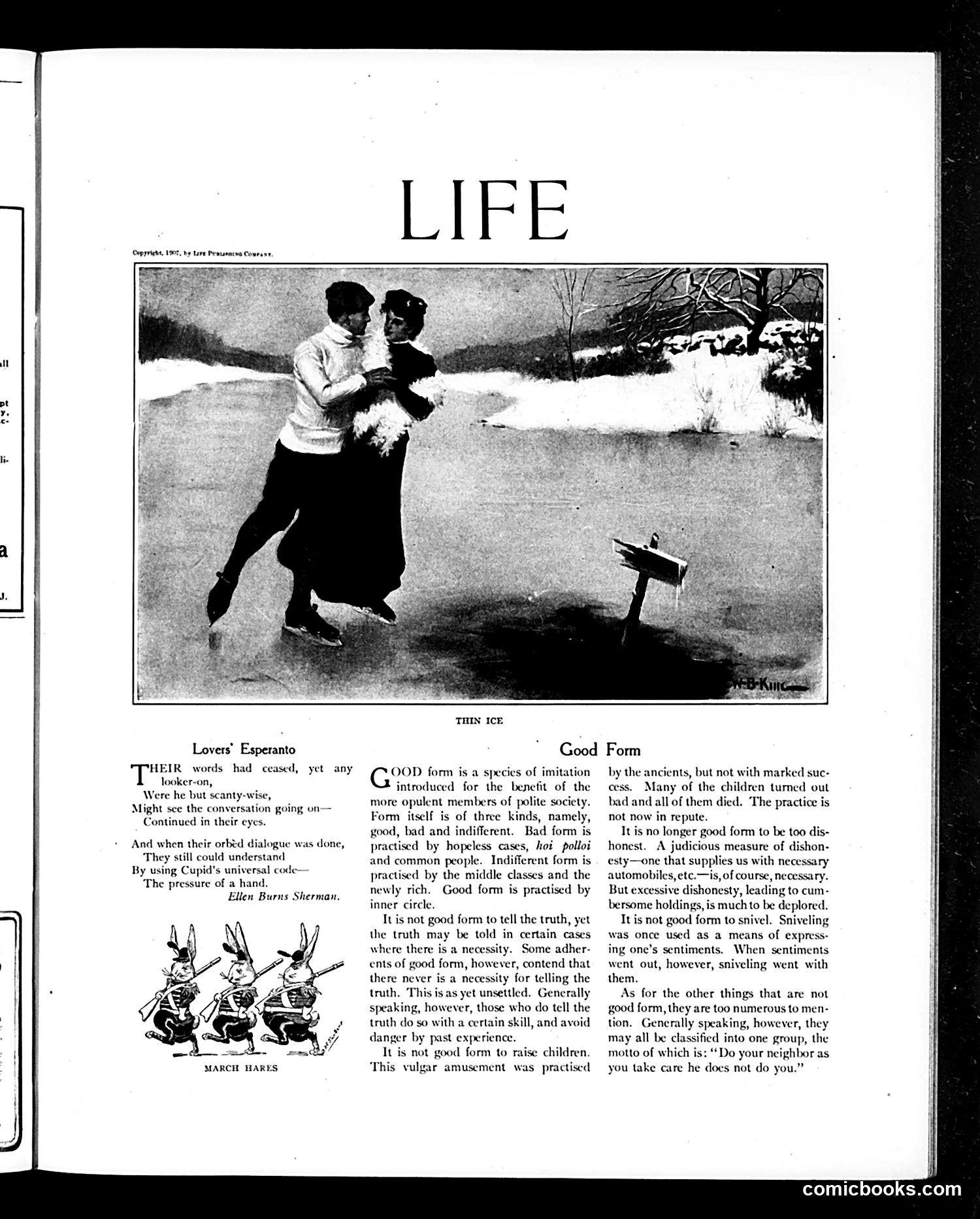
**Main Image ("Thin Ice"):** Two figures ice-skating on a frozen pond, with a sign visible in the background. The caption "Lovers' Esperanto" and poem by Ellen Burns Sherman suggest this illustrates romantic communication transcending language barriers—the "universal code" of physical affection ("pressure of a hand"). **"Good Form" Article:** A serious essay discussing social etiquette conventions across class levels. It explains that "good form" (proper behavior) is practiced by the upper classes, while "bad form" and "indifferent form" characterize lower and middle classes. The piece argues form serves social function but isn't necessary for truth-telling. **"March Hares" Illustration:** A small cartoon showing three hare-like figures in a line, likely referencing the "mad as a March hare" idiom about springtime animal behavior. The page mixes romantic sentiment with social commentary on class-based manners.
📄 Transcribed text from this page (OCR, searchable)
Machine-transcribed from the original scan — historical spelling and the odd misread are preserved.
Coprriebt. 1807, by Lert Pratunaise Comeasr. Lovers’ Esperanto HEIR words lecker-on, Were he but scanty-wise, Might see the conversation going on— Continued in their ey had ceased, yet any And when their orbid dialogue was done, They still could understand By using Cupid’s universal code- ‘The pressure of a hand. Ellen Burns Sherman. oe MARCH HARES Good Form a species of imitation introduced for the benefit of the more opulent members of polite society. Form itself is of three kinds, namely, good, bad and indifferent. Bad form is practised by hopeless cases, hoi polloi and common people. Indifferent form is practised by the middle classes and the newly rich. Good form is practised by inner circle. It is not good form to tell the truth, yet the truth may be told in certain cases where there is a necessity. Some adher- ents of good form, however, contend that there never is a necessity for telling the truth. This is as yet unsettled. Generally speaking, however, those who do tell the truth do so with a certain skill, and avoid danger by past experience. It is not good form to raise children. vulgar amusement was practised by the ancients, but not with marked suc- cess. Many of the children tumed out bad and all of them died. The practice is not now in repute. It is no longer good form to be too dis- honest. A judicious measure of dishon- esty—one that supplies us with necessary automobiles, etc.—is, of course, necessary. But excessive dishonesty, leading to cum- bersome holdings, is much to be deplored. It is not good form to snivel. Sniveling was once used as a means of express- ing one’s sentiments. When sentiments went out, however, sniveling went with them. As for the other things that are not good form, they are too numerous to men- tion. Generally speaking, however, they may all be classified into one group, the motto of which is: “Do your neighbor as you take care he does not do you.” comicbooks.com