
Life, 1907-03-14 · page 6 of 24
Life — March 14, 1907 — page 6: what you’re looking at
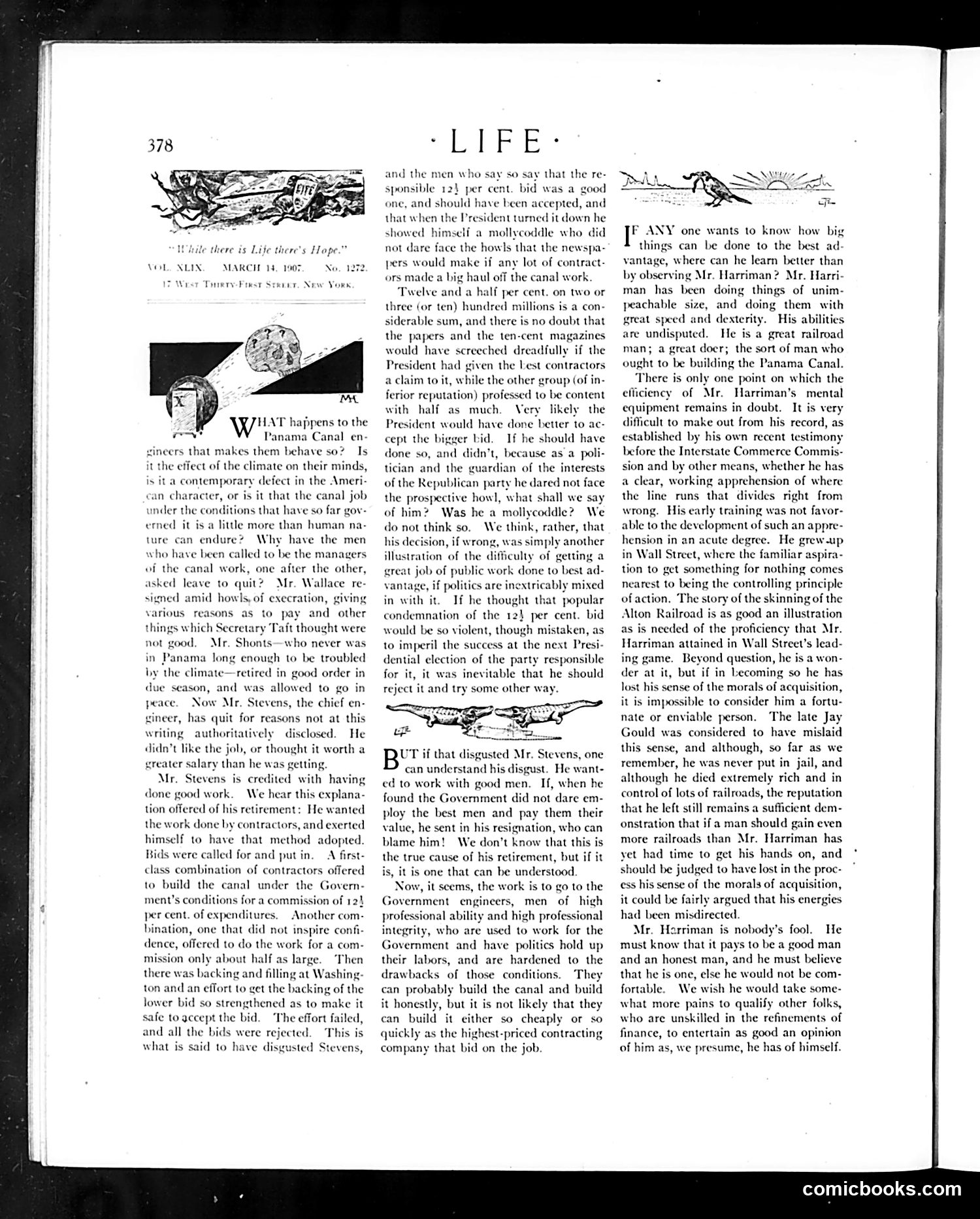
What you’re looking at
This page satirizes the Panama Canal construction's mismanagement under President Theodore Roosevelt's administration. The text criticizes the contract bidding process, suggesting Roosevelt rejected the lowest bid in favor of politically favored contractors, then appointed incompetent managers. The central cartoon (marked "PAC") appears to depict a mollusk or incompetent figure—likely representing the canal project's leadership or a specific official mentioned in the accompanying article. The satire targets the contradiction between Roosevelt's stated efficiency and the actual political favoritism corrupting the project. The author argues that while Roosevelt sought "good men," his political allegiances forced compromises that undermined competent administration, ultimately illustrating how politics corrupts ostensibly meritocratic public works projects.
📄 Transcribed text from this page (OCR, searchable)
Machine-transcribed from the original scan — historical spelling and the odd misread are preserved.
LONLIN, MARCHE 14, 1907, No. 1272, Vest Tuiery-Frest Steuer, New ¥ wer happens to the Eee Panama Canal en- eers that makes them behave so? Is the effect of the climate on their minds, is it a contemporary defect in the Ameri- can character, or is it that the canal job under the conditions that have so far gov- ered it is a lite more than human na- ture can endure? Why have the men who have been called to be the managers of the canal work, one after the other, asked leave to quit?) Mr. Wallace re- amid howls, of execration, giving arious reasons as to pay and other which Secretary Taft thought were Mr. Shonts—who never was in Panama long enough to be troubled by the climate—retired in good order in due season, and was allowed to go in peace. Now Mr, Stevens, the chief en- gineer, has quit for reasons not at this writing authoritatively disclosed. He didn’t like the job, or thought it worth a greater salary than he was getting. Mr. Stevens is credited with having done good work. We hear this explana tion offered of his retirement: He wanted the work done by contractors, and exerted himself to have that method adopted. I for and put in. A first- class combination of contractors offered to build the canal under the Govern- ment’s conditions for a commission of 124 per cent. of expenditures. Another com- bination, one that did not inspire confi- dence, offered to do the work for a com- mission only about half as large. Then there was backing and filling at Washing- ton and an effort to get the backing of the lower bid so strengthened as to make it safe to accept the bid. ‘The effort failed, and all the bids were rejected. This is what is said to have disgusted Stevens, signed thing not good Bids were call “LIFE: and the men who say so say that the re- sponsible 124 per cent. bid was a good one, and should have been accepted, and that when the President turned it down he showed himself a mollycoddle who did not dare face the howls that the newspa- pers would make if any lot of contract- ors made a big haul off the canal work. Twelve and a half per cent. on two or three (or ten) hundred millions is a con- siderable sum, and there is no doubt that the papers and the ten-cent magazin would e screeched dreadfully if the President had given the best contractors a claim to it, while the other group (of in- ferior reputation) professed to be content with half as much. Very likely the President would have done better to ac- cept the bigger bid. If he should have done so, and didn’t, because as a poli- tician and the guardian of the interests of the Republican party he dared not face the prospective howl, what shall we say of him? Was he a mollycoddle?, We do not think so. We think, rather, that his decision, if wrong another illustration of the difficulty of getting a great job of public work done to best ad- vantage, if politics are inextricably mixed in with it. If he thought that popula condemnation of the 12} per cent. bid would be so violent, though mistaken, a to imperil the success at the next Presi- dential election of the party responsible for it, it was inevitable that he should reject it and try some other way. ae 7. BY if that disgusted Mr. Stevens, one can understand his disgust. He want- ed to work with good men. If, when h found the Government did not dare em- ploy the best men and pay them their value, he sent in his resignation, who can blame him! We don’t know that this is the true cause of his retirement, but if it is, it is one that can be understood. Now, it scems, the work is to go to the Government engineers, men of high professional ability and high professional integrity, who are used to work for the Government and have politics hold up their labors, and are hardened to the drawbacks of those conditions. They can probably build the canal and build it honestly, but it is not likely that they can build it either so cheaply or so quickly as the highest-priced contracting company that bid on the job. was simp] qe ANY one wants to know how big things can be done to the best ad- vantage, where can he learn better than by observing Mr. Harriman? Mr. Harri- man has been doing things of unim- peachable size, and doing them with great speed and dexterity. His abilities are undisputed. He is a great railroad man; a great doer; the sort of man who ought to be building the Panama Canal. There is only one point on which the efiiciency of Mr. Harriman’s mental equipment remains in doubt. It is very difficult to make out from his record, as established by his own recent testimony before the Interstate Commerce Commis sion and by other means, whether he has a clear, working apprehension of where the line runs that divides right from wrong. His early training was not favor- able to the development of such an appre- hension in an acute degree. He grew-up in Wall Street, where the familiar aspira- tion to get something for nothing comes nearest to being the controlling principle of action. The story of the skinning of the Alton Railroad is as good an illustration as is needed of the proficiency that Mr. Harriman attained in Wall Street’s lead- ing game. Beyond question, he is a won- der at it, but if in Lecoming so he has lost his sense of the morals of acquisition, it is impossible to consider him a fortu- nate or enviable person, ‘The late Jay Gould was considered to have mislaid this sense, and although, so far as we remember, he was never put in jail, and although he died extremely rich and in control of lots of railroads, the reputation that he left still remains a sufficient dem- onstration that if a man should gain even more railroads than Mr. Harriman has yet had time to get his hands on, and should be judged to have lost in the proc- ess his sense of the morals of acqui it could be fairly argued that his energies had been misdirected. Mr. Harriman is nobody’s fool. He must know that it pays to be a good man and an honest man, and he must believe that he is one, else he would not be com- fortable. We wish he would take some- what more pains to qualify other folks, who are unskilled in the refinements of finance, to entertain as good an opinion of him as, we presume, he has of himself. comicbooks.com