
Life, 1907-03-14 · page 14 of 24
Life — March 14, 1907 — page 14: what you’re looking at
What you’re looking at
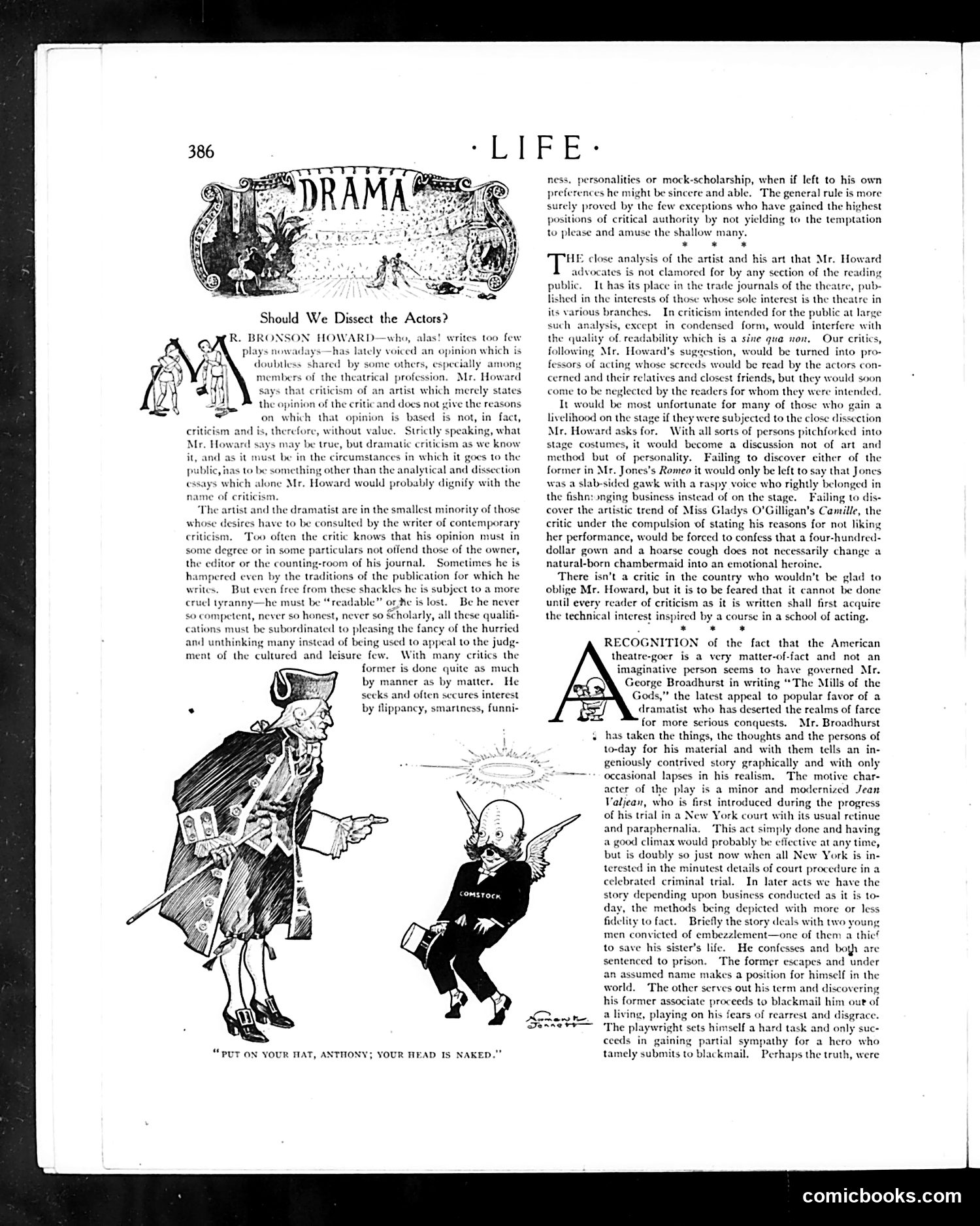
This piece debates dramatic criticism standards. Playwright Bronson Howard (identified in text) argues critics should provide analytical reasoning, not mere opinion. Life's editors counter that such rigorous "dissection" of actors is impractical and undesirable. The satirical cartoons mock actors by exaggerating their physical features—typical of period caricature. The caption "Put on your hat, Anthony; your head is naked" suggests actors rely on costumes to mask lack of substance. Life's argument: thorough critical analysis would force critics to expose performers' actual limitations (poor physiques, voices, personalities) rather than praising artistic merit. Readable, entertaining criticism serves general audiences better than scholarly treatises for theater professionals alone. The satire ridicules both pretentious actors and Howard's idealistic critical standards as incompatible with commercial theater's realities.
📄 Transcribed text from this page (OCR, searchable)
Machine-transcribed from the original scan — historical spelling and the odd misread are preserved.
Should We Dissect the Actors? R. BRONSON HOWARD—who, alas! writes too few plays nowadays—has lately voiced an opinion which is doubtless shared by some others, especially among n. Mr. Howard says that criticism of an artist which merely states the opinion of the critic and does not give the reasons on which that opinion is based is not, in fact, criticism and is, therefore, without value. Strictly speaking, what Mr. Howard says may be true, but dramatic criticism as we know it, and as it must be in the circumstances in which it gocs to the public, iias to be something other than the analytical and dissection essays which alone Mr, Howard would probably dignify with the ame of criticism. ‘The artist and the dramatist are in the smallest minority of those whose desires have to be consulted by the writer of contemporary criticism. ‘Too often the critic knows that his opinion must in some degree or in some particulars not offend those of the owner, the editor or the counting-room of his journal. Sometimes he is hampered even by the traditions of the publication for which he writes. But even free from these shackles he is subject to a more crucl tyranny—he must be “readable” of he is lost. Be he never so competent, never so honest, never so Scholarly, all these qualifi- ast be subordinated to pleasing the fancy of the hurried and unthinking many instead of being used to appeal to the judg- ment of the cultured and leisure few. With many critics the former is done quite as much by manner as by matter. He secks and often secures interest by flippancy, smartness, funni- members of the theatrical professi cations PUT ON YOUR HAT, ANTHONY; YOUR HEAD IS NAKED.” ‘LIFE ness. personalities or mock-scholarship, when if left to his own preferences he might be sincere and able. ‘The general rule is more surely proved by the few exceptions who have gained the highest positions of critical authority by not yielding to the temptation se and amuse the shallow many. . + 8 to plea HE close analysis of the artist and his art that Mr. Howard advocates is not clamored for by any section of the reading public. It has its place in the trade journals of the theatre, pub- lished in the interests of those whose sole interest is the theatre in its various branches. In criticism intended for the public at large such analysis, except in condensed form, would interfere with the quality of. readability which is a sine qua non, Our critics, following Mr. Howard's suggestion, would be turned into pro- fessors of acting whose screeds would be read by the actors con- cerned and their relatives and closest friends, but they would soon come to be neglected by the readers for whom they were intended. It would be most unfortunate for many of those who gain a livelihood on the stage if they were subjected to the close dissection Mr. Howard asks for. With all sorts of persons pitchforked into stage costumes, it would become a discussion not of art and method but of personality, Failing to discover either of the former in Mr. Jones's Romeo it would only be left to say that Jones was a slab-sided gawk with a raspy voice who rightly belonged in the fishn: nging business instead of on the stage. Failing to dis- cover the artistic trend of Miss Gladys O'Gilligan’s Camille, the critic under the compulsion of stating his reasons for not liking her performance, would be forced to confess that a four-hundred- dollar gown and a hoarse cough does not necessarily change a natural-born chambermaid into an emotional heroine. There isn’t a critic in the country who wouldn’t be glad to oblige Mr. Howard, but it is to be feared that it cannot be done until every reader of criticism as it is written shall first acquire the technical interest inspired by a course in a school of acting. 3 * es RECOGNITION of the fact that the American theatre-goer is a very matter-of-fact and not an imaginative person scems to have governed Mr. George Broadhurst in writing “The Mills of the Gods,” the latest appeal to popular favor of a dramatist who has deserted the realms of farce for more serious conquests. Mr. Broadhurst + has taken the things, the thoughts and the persons of to-day for his material and with them tells an in- geniously contrived story graphically and with only occasional lapses in his realism. The motive char- acter of the play is a minor and modernized Jean Valjean, who is first introduced during the progress of his trial in a New York court with its usual retinue and paraphernalia. ‘This act simply done and having a good climax would probably be eficctive at any time, but is doubly so just now when all New York is in- terested in the minutest details of court procedure in a celebrated criminal trial. In later acts we have the story depending upon business conducted as it is to- day, the methods being depicted with more or less fidelity to fact. Briefly the story deals with two young men convicted of embezzlement—one of them a thief to save his sister’s life. He confesses and bogh are sentenced to prison. ‘The former escapes and under n assumed name makes a position for himself in the world. The other serves out his term and discovering his former associate proceeds to blackmail him our of a living, playing on his fears of rearrest and disgra ‘The playwright sets himself a hard task and only suc- ceeds in gaining partial sympathy for a hero who tamely submits to blackmail. Perhaps the truth, were comicbooks.com