
Life, 1907-03-14 · page 17 of 24
Life — March 14, 1907 — page 17: what you’re looking at
What you’re looking at
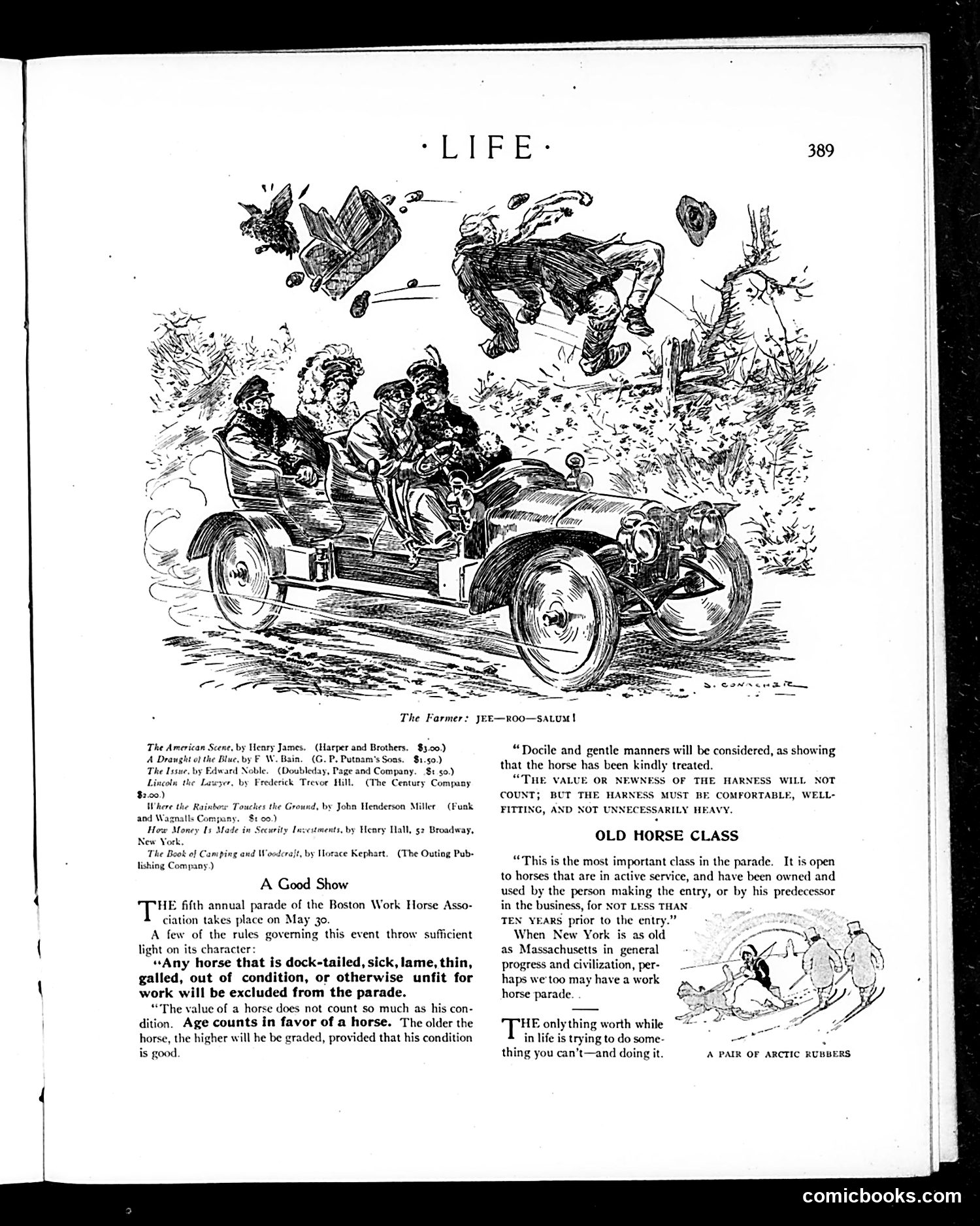
The main cartoon depicts a chaotic automobile scene where a car full of well-dressed passengers is being chased by a runaway horse and cow. The caption reads "The Farmer: JEE—ROO—SALUM!" (mimicking farm dialect for controlling animals). This satirizes the collision between rural and modern urban life—the farmer's traditional animals represent the old world, while the automobile represents the new industrial age. The joke plays on culture clash and the absurdity of these worlds literally crashing into each other. The accompanying article about the Boston Work Horse Association's parade provides context: it establishes standards for old, working horses still in active service, emphasizing age and condition over monetary value. The satirical editorial comment suggests that New York, being younger than Massachusetts, lacks the sophistication to appreciate such traditions. The humor critiques American industrialization and urban pretension while defending rural values and the dignity of working animals.
📄 Transcribed text from this page (OCR, searchable)
Machine-transcribed from the original scan — historical spelling and the odd misread are preserved.
Re Sy uy ANG QO uae Se The Farmer: ykE—RKoo—satust! The American Scene, by Henry James. (Harper and Brothers, $3.00.) A Draught o} the Blue, by F W. Bain. (G.P. Putnam's Soas. $1.50.) The Issue, by Edward Noble. (Doubleday, Page and Company. $t so.) Lincoln the Lawyer, by Frederick Trevor Hill. (The Century Company $2.00.) Where the Rainbow Touches the Ground, by Joba Henderson Miller (Funk How Money 1s Made in Security Investments, by Henry Hall, 52 Broadway, New York. The Book of Camping and Woodcra|t, by Horace Kephart. (The Outing Pub- lishing Company.) A Good Show T' fifth annual parade of the Boston Work Horse Asso- ciation takes place on May 30. A few of the rules governing this event throw sufficient light on its character: «Any horse that is dock-tailed, sick, lame, thin, galled, out of condition, or otherwise unfit for work will be excluded from the parade. “The value of a horse does not count so much as his con- dition. Age counts in favor of a horse. The older the horse, the higher will he be graded, provided that his condition is good. “Docile and gentle manners will be considered, as showing that the horse has been kindly treated. “THE VALUE OR NEWNESS OF THE HARNESS WILL NOT COUNT; BUT THE HA MUST BE COMFORTABLE, WELL- FITTING, AND NOT UNN |ARILY HEAVY. OLD HORSE CLASS “This is the most important class in the parade. It is open to horses that are in active service, and have been owned and used by the person making the entry, or by his predecessor in the b S THAN TEN YEARS prior to the entry.” When New York is as old as Massachusetts in general progress and civilization, per- haps we'too may have a work horse parade. "THE only thing worth while A in life is trying to do some- thing you can’t—and doing it. comicbooks.com