
A complete issue · 28 pages · 1907
Life — February 28, 1907
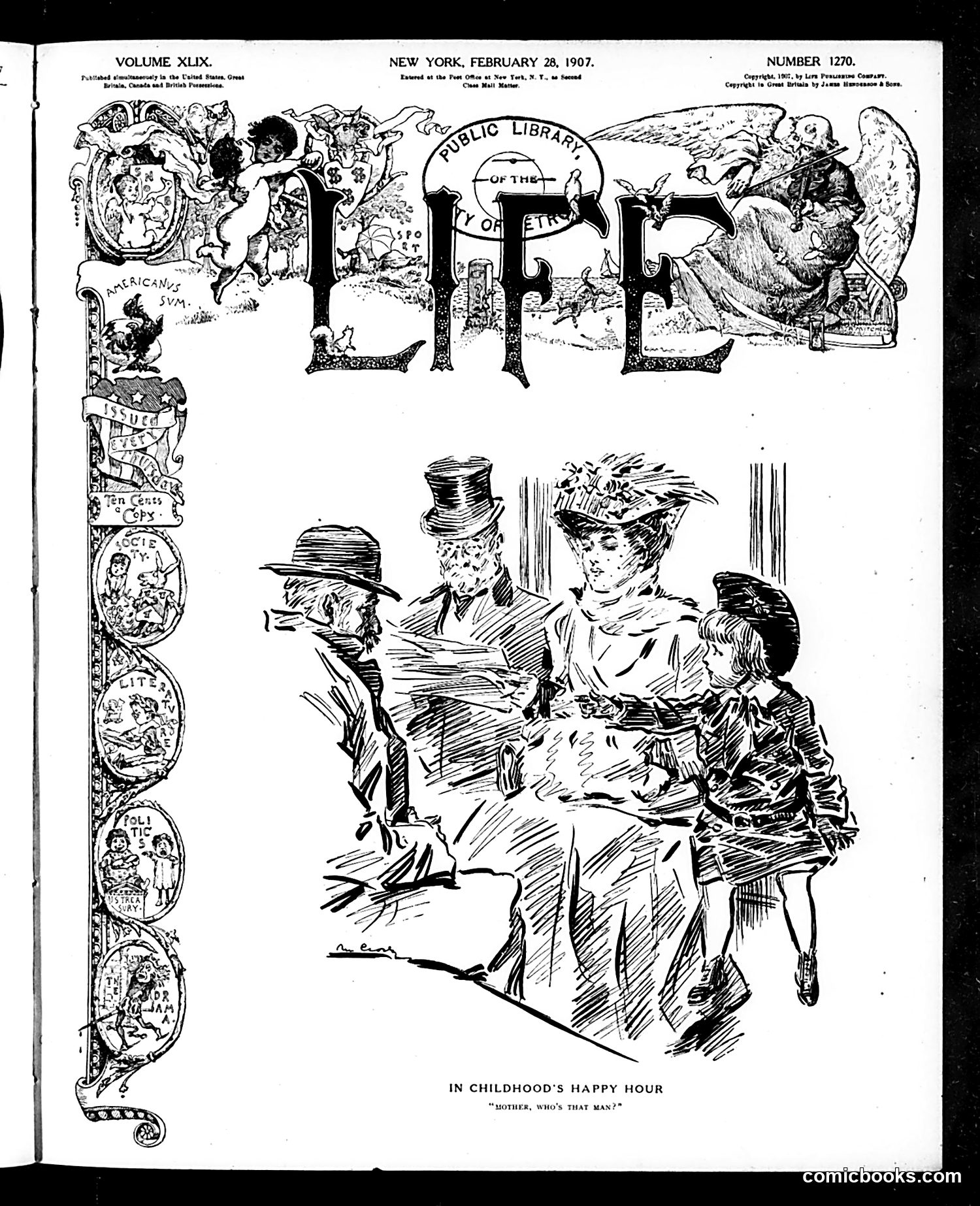
The main illustration, captioned "In Childhood's Happy Hour—'Brother, Who's That Man?'" depicts a domestic scene with a woman and children encountering a man in formal dress (top hat and morning coat). The satire appears to target absent or estranged fathers—a social commentary on parental neglect or divorce, which was becoming a notable issue in early 20th-century America. The woman's surprised question "Who's that man?" suggests the children don't recognize their own father, implying either prolonged absence or lack of parental involvement. This was a period of increasing social concern about family dissolution and masculine responsibility. The decorative border on the left contains classical references and text fragments, though most are illegible in reproduction.
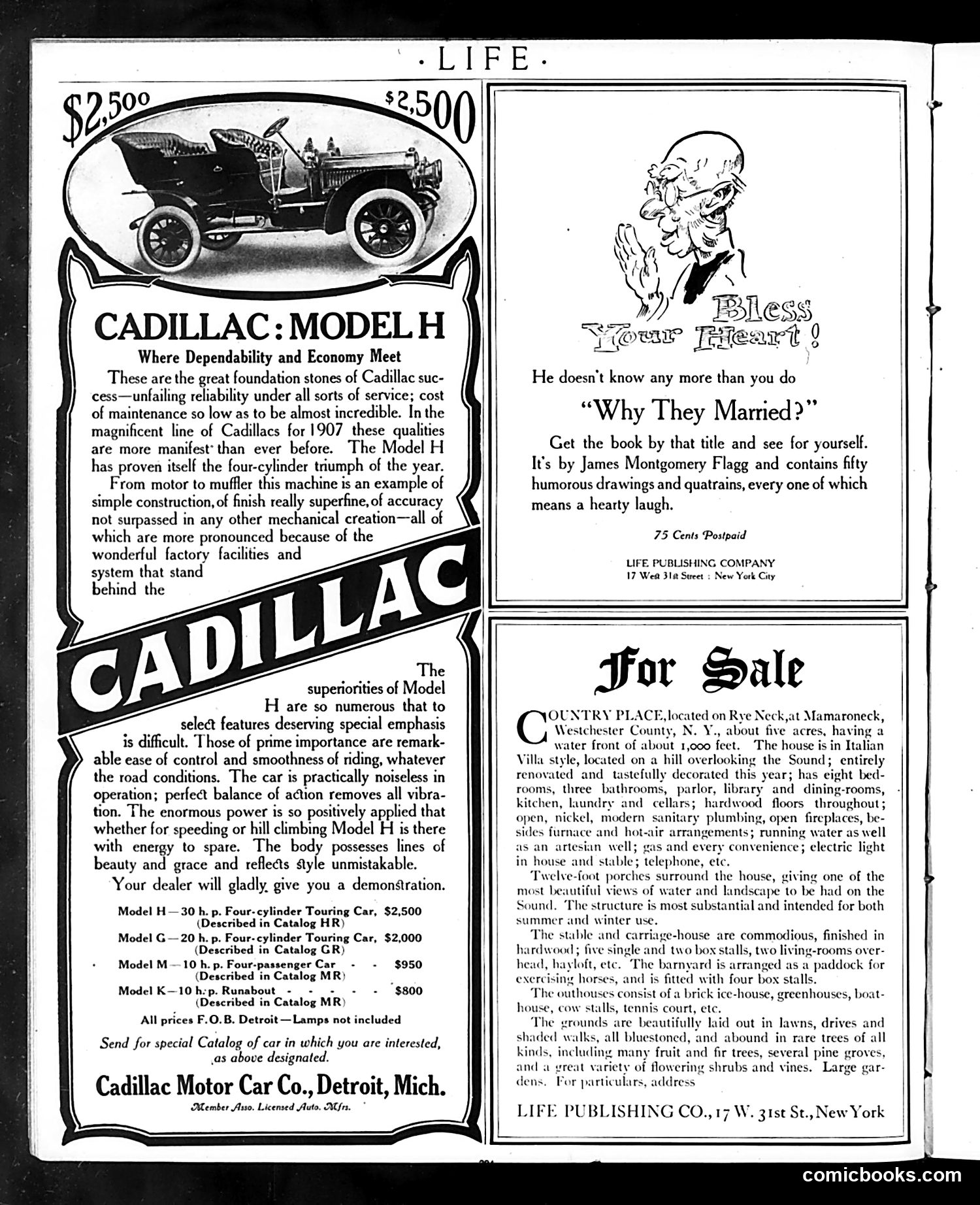
This page is primarily **advertisements**, not political satire. The left side advertises the **Cadillac Model H automobile** ($2,500), emphasizing reliability, economy, and engineering quality—typical early automotive marketing emphasizing mechanical superiority. The right side contains two unrelated items: 1. **"Bless Your Heart!"** — A small cartoon advertising **"Why They Married?"**, a humorous book by James Montgomery Flagg featuring witty drawings about marriage. The cartoonish figure's exaggerated expression conveys comedy about matrimonial mysteries. 2. **"For Sale"** — A real estate listing for a country estate in Westchester County, New York, describing a substantial villa with extensive grounds and amenities. This is a typical magazine page mixing commercial advertisements with occasional illustrations, rather than satirical political content.
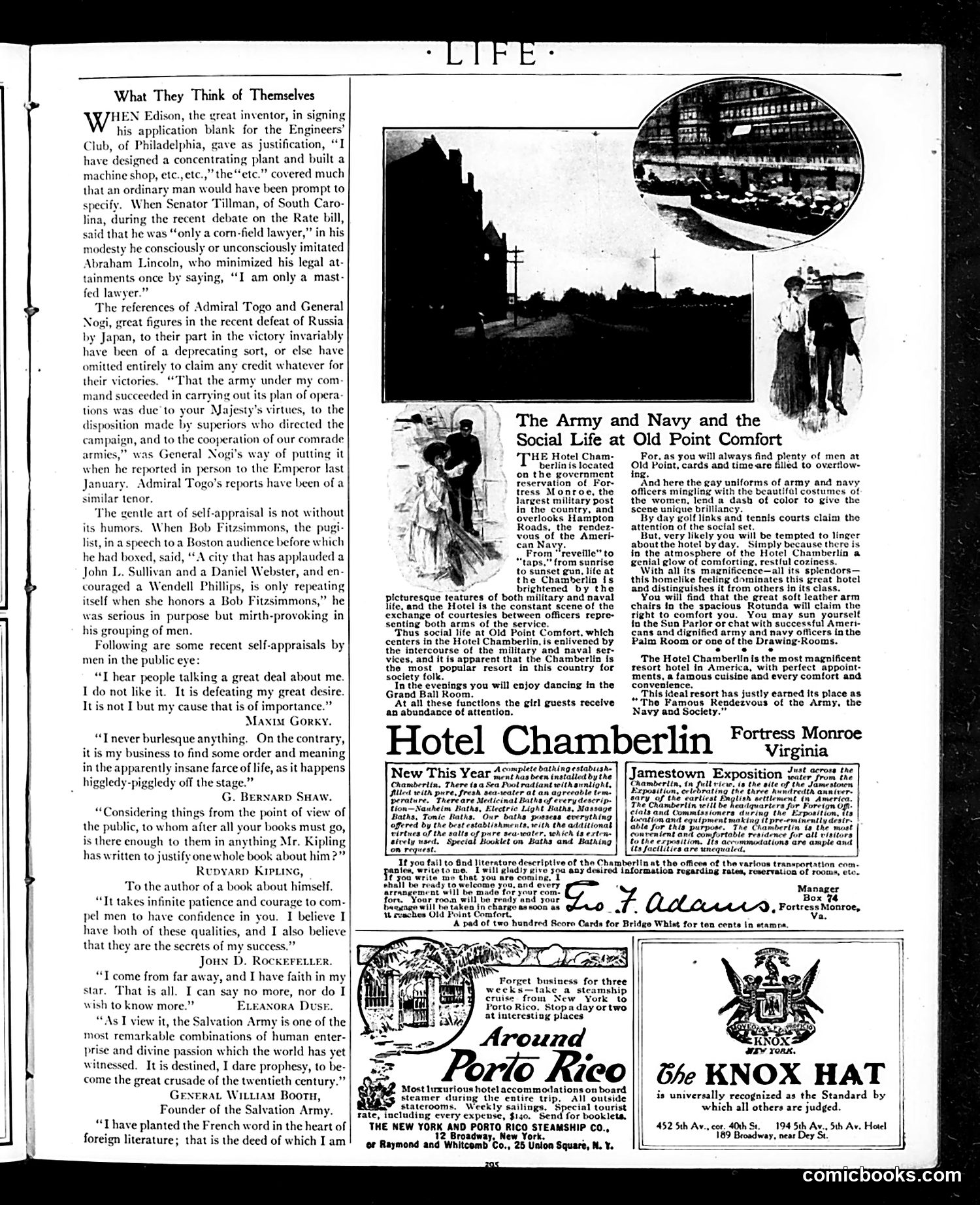
This page is primarily **advertising and self-promotion** rather than satirical content. The left column features self-appraisals by prominent men of the era—Edison, Senator Tillman, Admiral Togo, and others—each offering humble or modest statements about their accomplishments. This appears to be Life's gentle satire on the "art of self-appraisal," mocking how even famous figures engage in false modesty. The remainder comprises advertisements: the Hotel Chamberlin in Virginia, the Knox Hat company, and a Puerto Rico steamship line. The only visual element is a photograph of what appears to be a military or naval gathering, likely illustrating the Hotel Chamberlin's appeal to officers. The page demonstrates Life's common practice of mixing satirical commentary with substantial advertising revenue.
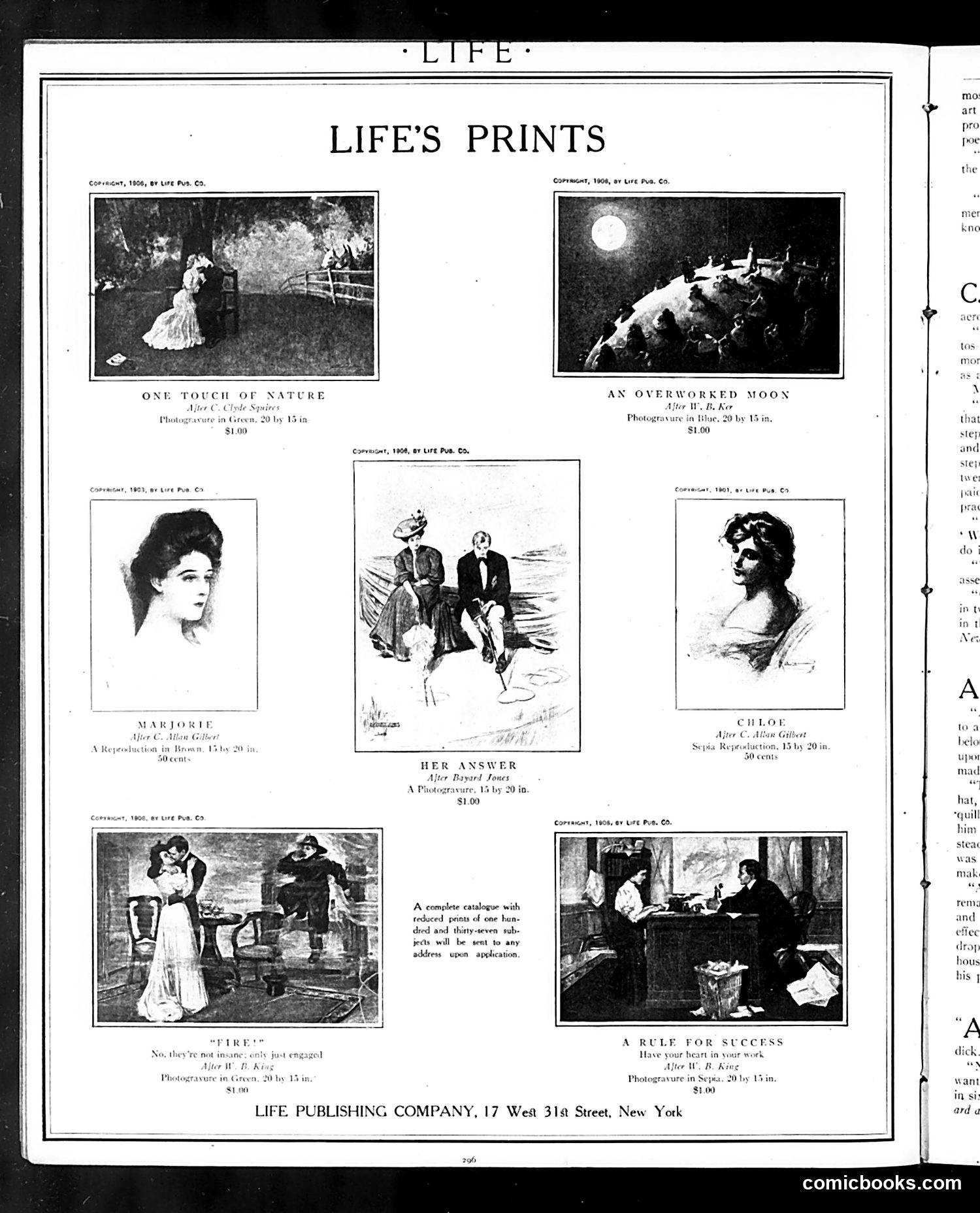
This page is primarily **advertising**, not satire. It showcases art reproductions and photographs available for purchase from Life Publishing Company, priced at 50 cents to $1.00 each. The offerings include romantic and dramatic scenes—"One Touch of Nature," "An Overworked Moon," and portrait studies of women ("Marjorie," "Chloe")—alongside narrative pieces like "Fire" and "A Rule for Success." These appear to be reproductions of popular contemporary artwork, likely by illustrators associated with Life magazine. The page demonstrates early 1900s commercial publishing: Life sold decorative prints to middle-class consumers seeking affordable art for home display. No political content or satire is evident—this is straightforward product marketing.
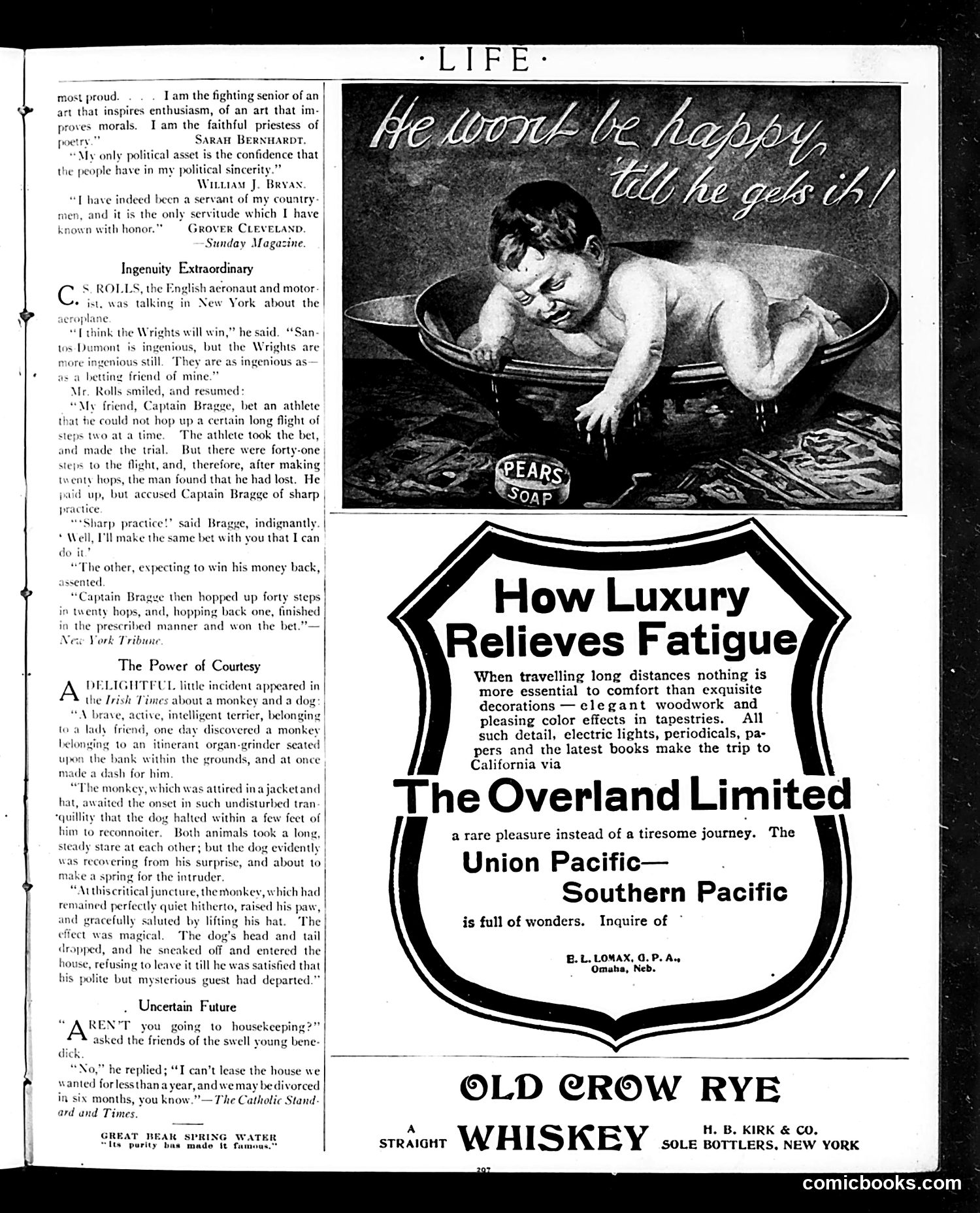
This page is primarily **advertising rather than political satire**. The dominant content features: 1. **Pears Soap Advertisement** (top): A cherubic baby in a bathtub with the slogan "he won't be happy till he gets it!" — typical early 20th-century advertising using idealized childhood imagery. 2. **The Overland Limited Train Advertisement** (center): Promotes luxury rail travel on the Union Pacific-Southern Pacific line to California, emphasizing comfort and elegance as relief from travel fatigue. 3. **Old Crow Rye Whiskey Advertisement** (bottom): Standard spirits advertising. The left column contains brief literary anecdotes ("Ingenuity Extraordinary," "The Power of Courtesy," "Uncertain Future") with attributed quotes from public figures, but these appear to be humorous filler content rather than political commentary. The page functions primarily as a vehicle for upscale consumer advertising.
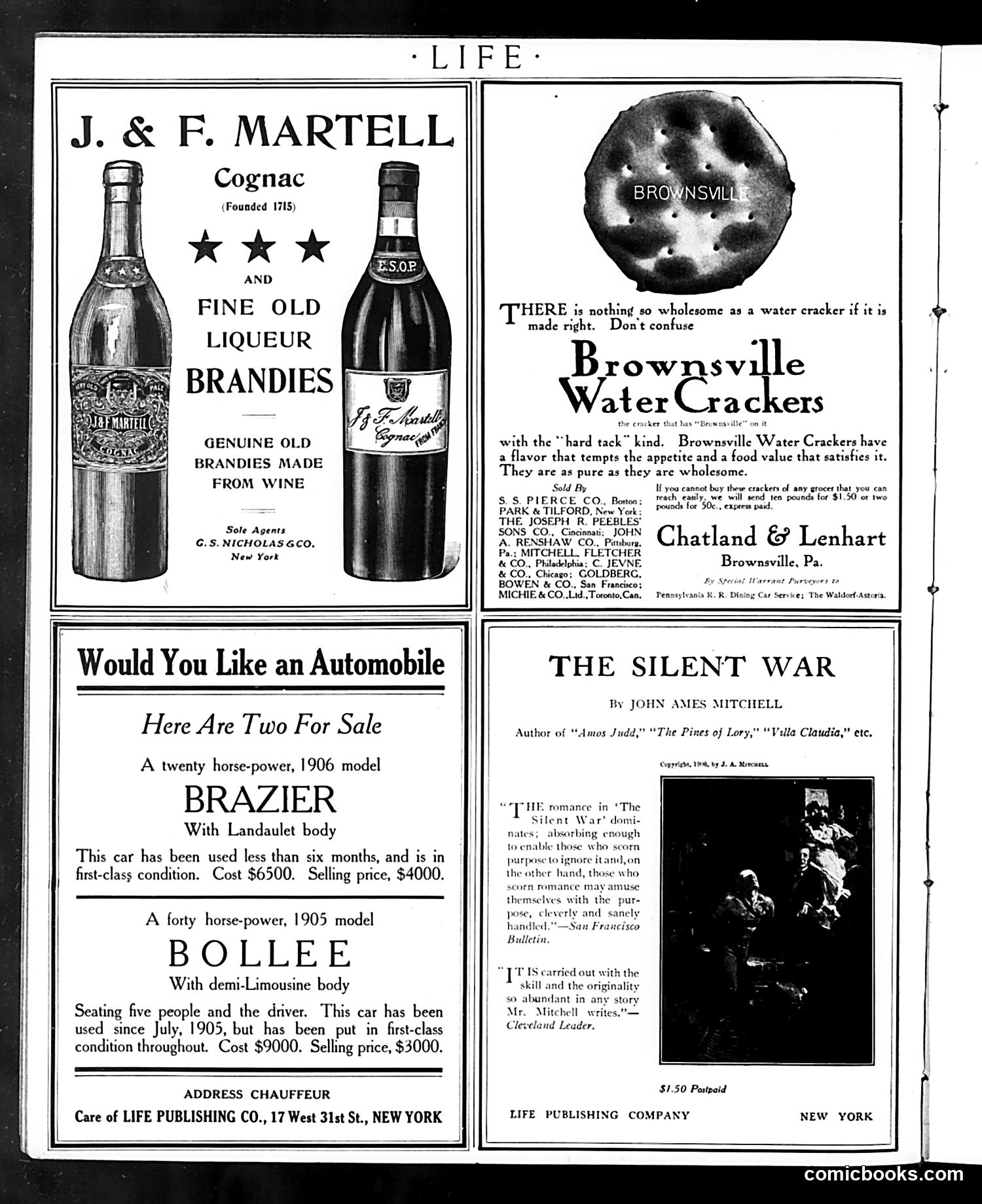
This page is primarily **advertising**, not satire or political commentary. It contains four distinct ads: 1. **J. & F. Martell Cognac** — promoting French brandy as "genuine old brandies made from wine" 2. **Brownsville Water Crackers** — a food product advertisement emphasizing quality and availability through mail order 3. **Automobiles for Sale** — two used cars (a 1906 Brazier and 1905 Bollee) with prices and specifications, directed to Life's wealthy readership 4. **"The Silent War"** — a serialized story by John James Mitchell, with illustration and publication details The page reflects early 20th-century Life magazine's mixed content of light fiction, consumer advertising, and editorial material targeted at affluent readers. There is no political cartoon or satire present here.
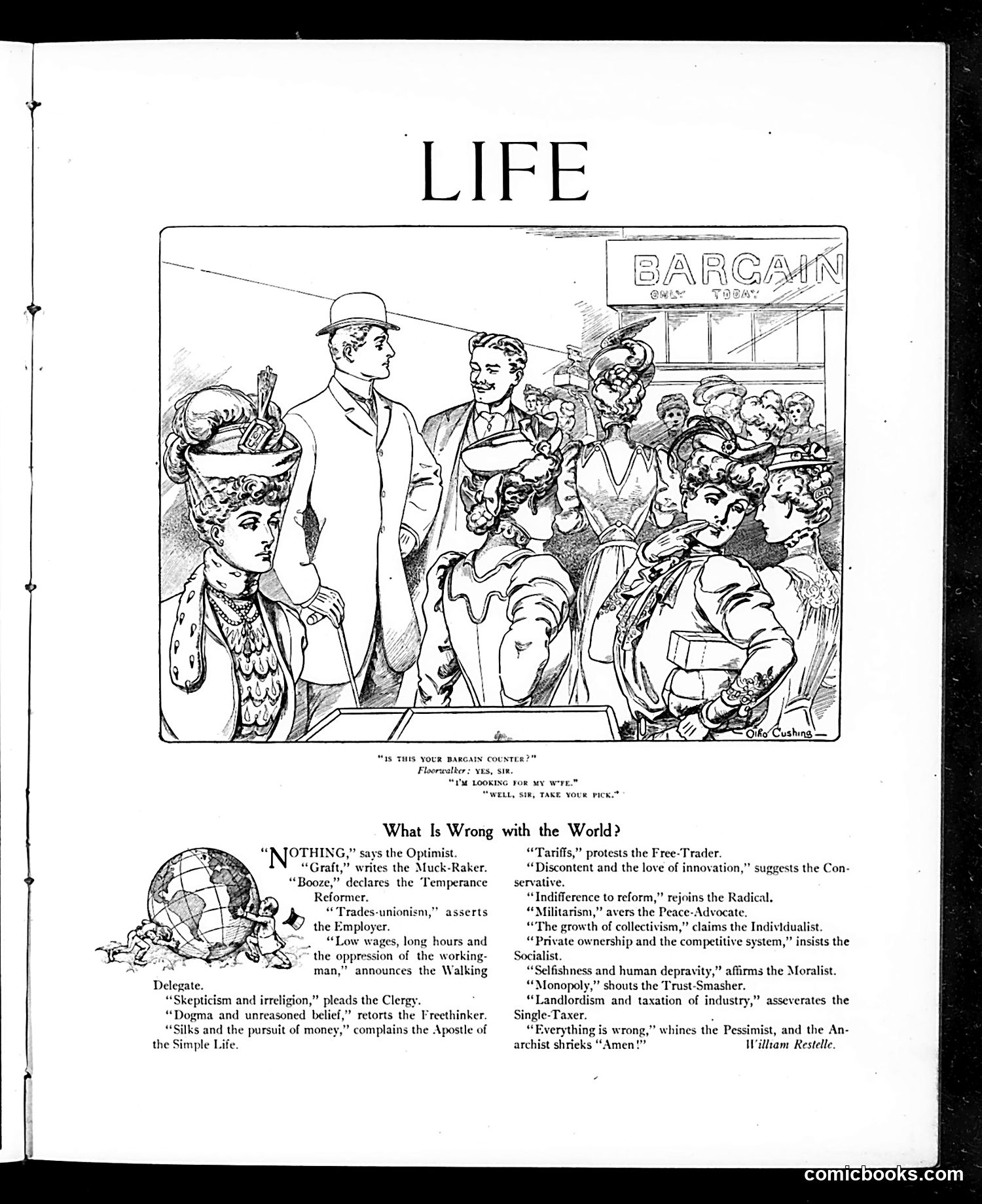
This satirical page presents a cartoon showing well-dressed figures at a "Bargain" counter, with dialogue about "your bargain counter" and "looking for my wife." Below, the text catalogs various political and social critiques attributed to different ideological groups. Each group—from Optimists and Free-Traders to Socialists, Reformers, and Anarchists—blames society's problems on different causes: tariffs, greed, lack of innovation, militarism, monopolies, taxation, and so forth. The satire suggests that every political faction has its own diagnosis for society's ills, making the collective complaints seem both universal and somewhat absurd. The cartoon's bargain-counter setting appears to reinforce themes of commercialism and social disorder. The page mocks the proliferation of competing ideological explanations for contemporary problems.
This page contains editorial commentary on West Point Military Academy, apparently responding to a recent controversy involving Colonel Larned and newspaper reports about the institution. **The cartoons** show simplified figures of soldiers or cadets in uniform, likely illustrating the discussion of military discipline and training. **The satire targets**: debates about how to handle scandals at West Point—specifically whether publicizing misconduct through courts-martial damages the institution's reputation. The text argues that systematic exposure of wrongdoing, while painful, serves the public interest better than covering it up. **Key point**: The piece defends West Point's educational mission while suggesting that colleges shouldn't be coercive but rather should cultivate character through discipline and personal responsibility in cadets. The historical context involves institutional accountability and military reform debates of the era.
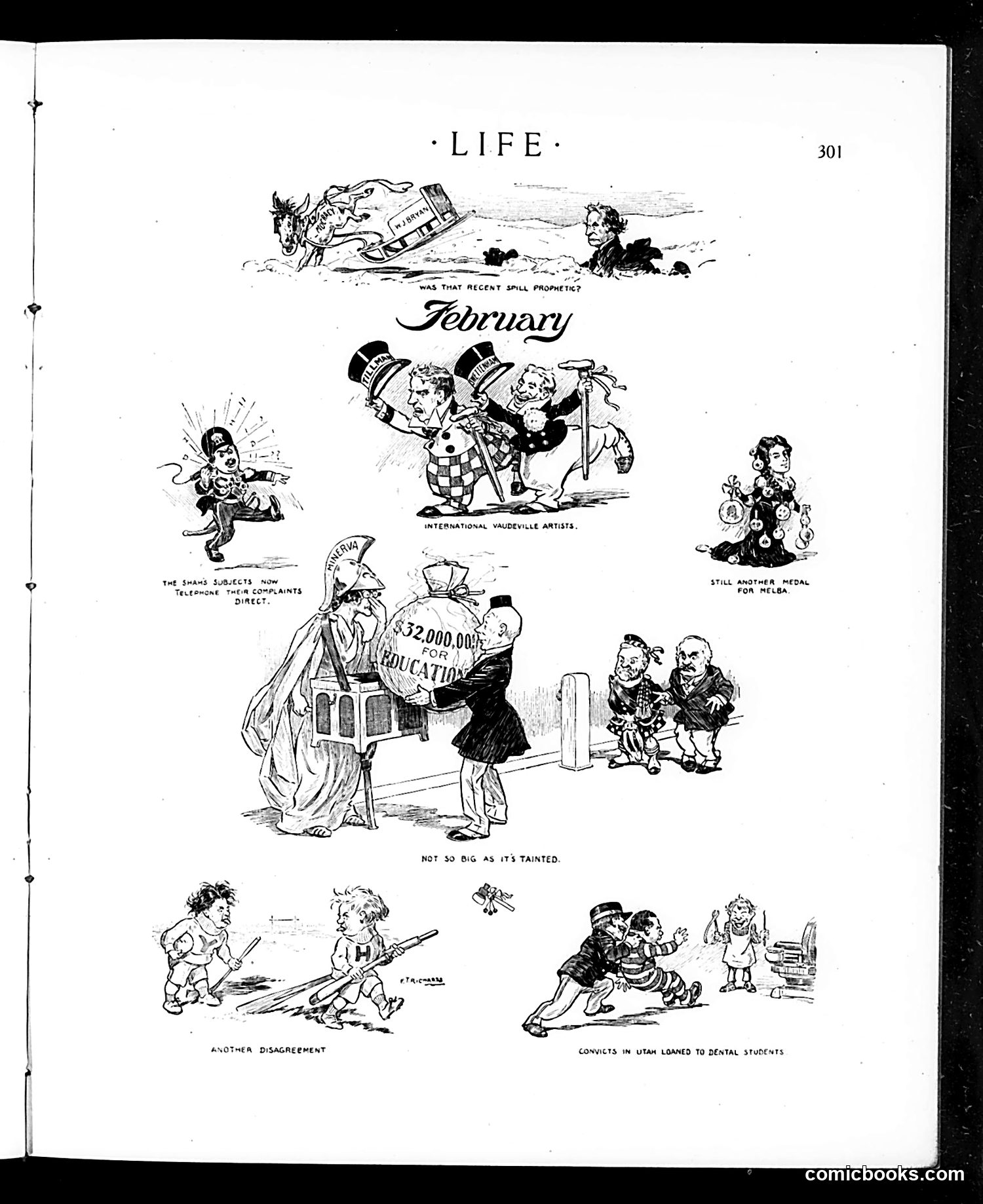
This satirical page features multiple cartoons commenting on February 1912 events. The top cartoon references "a recent spill prophecy," likely satirizing failed predictions. The "International Vaudeville Artists" sketch mocks entertainers with top hats. A central cartoon showing "$32,000,000 for foundation" appears to critique wealthy philanthropists donating large sums—"not so big as it's tainted" suggests skepticism about the morality of their wealth sources. Other cartoons ridicule contemporary issues: telephone complaints, a medal for Melbourne (unclear reference), and "another disagreement" showing conflict. The final panel references "convicts in Utah loaned to dental students," satirizing the practice of using prisoners for medical training. The overall tone is cynical toward institutions, wealth, and social practices of the era.
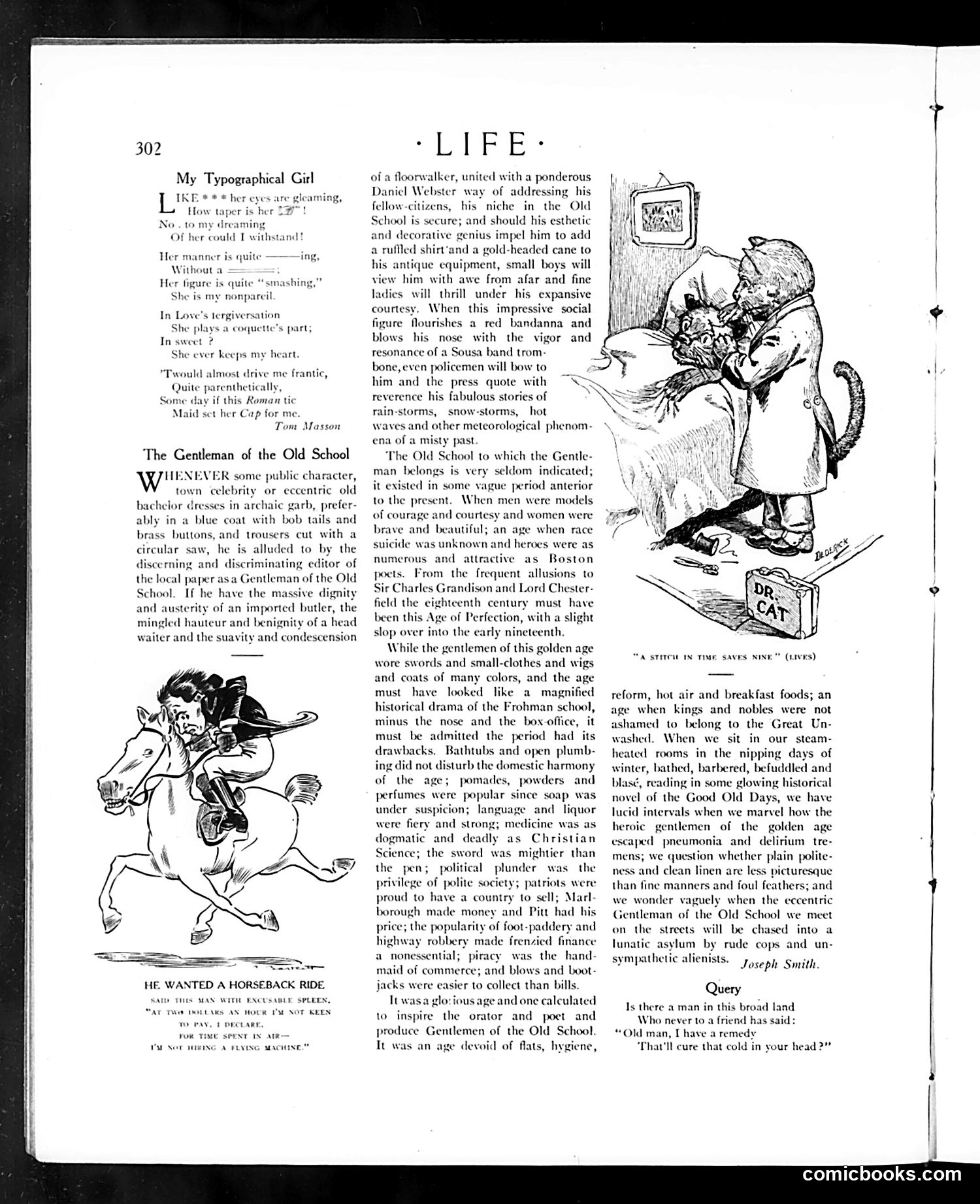
This page contains two distinct pieces of social satire: 1. **"My Typographical Girl"** (top left): A short humorous poem mocking a woman whose primary qualities are superficial—her eyes are "gleaming," her manner "quite ___ing," her figure "smashing." It satirizes shallow romantic attraction. 2. **"The Gentleman of the Old School"** (main article): A lengthy critique of an anachronistic social type—the elderly man who clings to outdated Victorian manners, dress, and attitudes. The text mocks his pretensions to courtliness while highlighting how absurd these affectations appear in a modern era. 3. **The cartoon** (left side) shows a man on a bucking horse, labeled "He wanted a horseback ride," satirizing the gap between expectation and reality—likely commenting on romanticized notions of old-fashioned masculine pursuits.
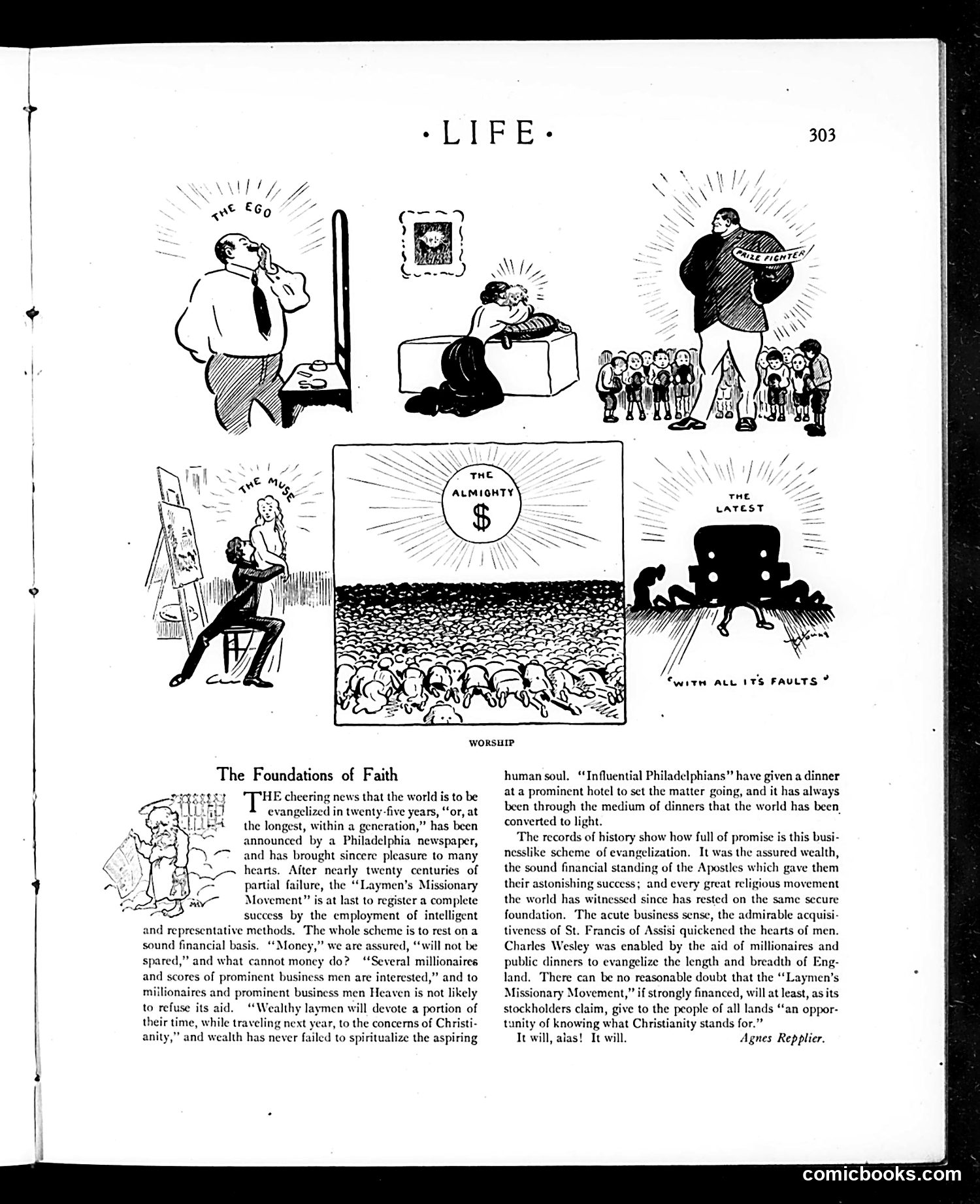
This page contains satirical cartoons critiquing American materialism and religious hypocrisy. The top panels mock various forms of ego and self-importance: "The Ego" shows vanity; another depicts greed ("The Almighty $"); "The Latest" ridicules fashionable trends "with all its faults." The central text, "The Foundations of Faith," satirizes the "Layman's Missionary Movement"—a wealthy businessmen's initiative to evangelize globally within 25 years. The author (Agnes Repplier) argues that while millionaires fund religious campaigns claiming charitable motives, true Christianity requires spiritual commitment beyond financial donation. She suggests wealthy donors use charity to avoid deeper moral obligations, ending pessimistically: "It will, alas! It will." The satire targets disconnect between capitalist wealth accumulation and Christian values.
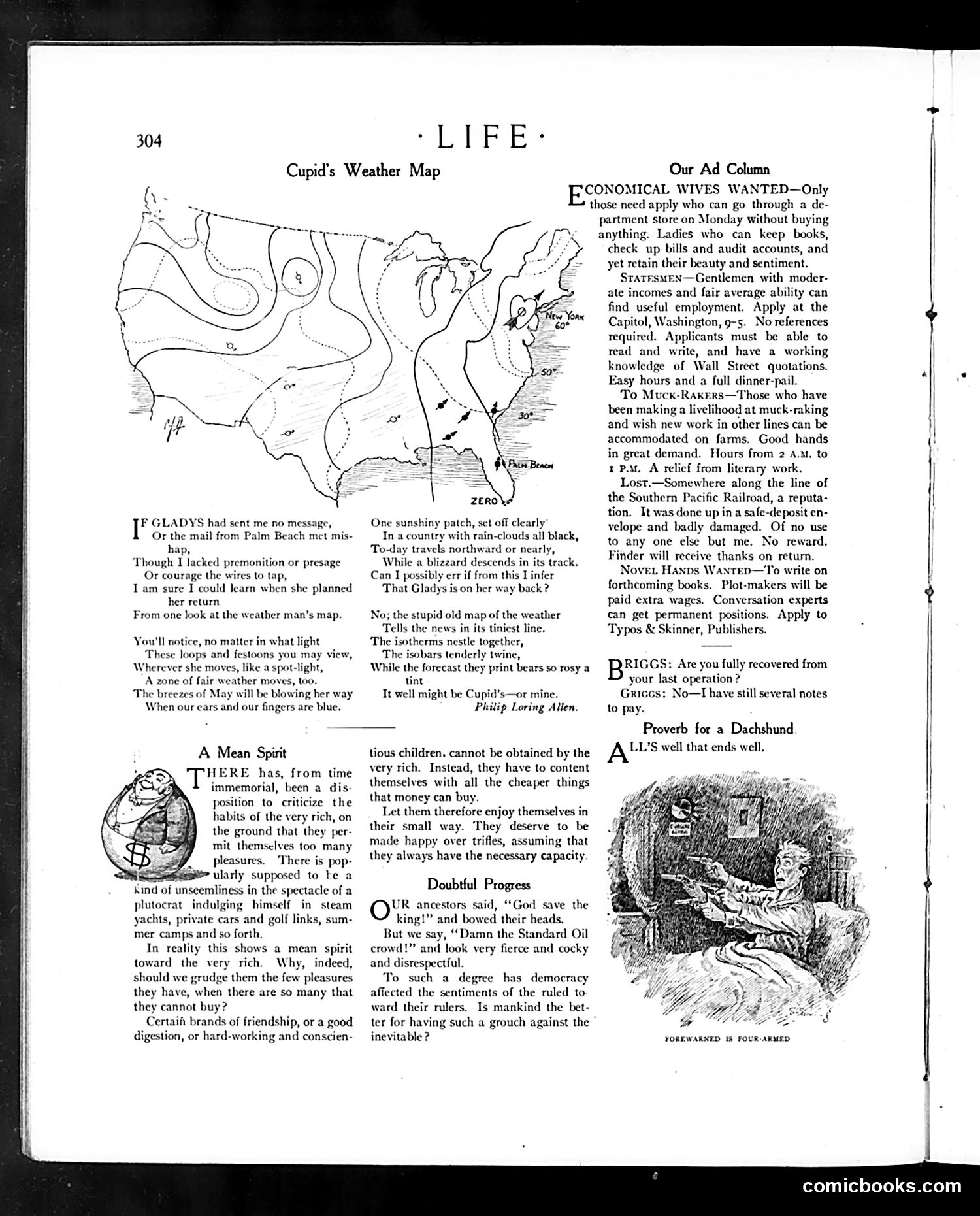
This page contains satirical content rather than political cartoons. The top features "Cupid's Weather Map," a humorous poem by Philip Loring Allen about using weather forecasts to locate a missing woman named Gladys. Below is "A Mean Spirit," a social commentary piece criticizing wealthy people for enjoying luxuries while refusing modest pleasures to the poor. It argues the rich should share happiness rather than hoard it. "Doubtful Progress" questions whether democracy has truly improved society, contrasting old expressions like "God save the king!" with modern curses against the Standard Oil Company, suggesting cynicism about whether rule by the people genuinely represents progress. The illustration labeled "FOREWARNED IS FOUR-ARMED" appears unrelated to the text. The right column contains classified employment advertisements typical of the era.
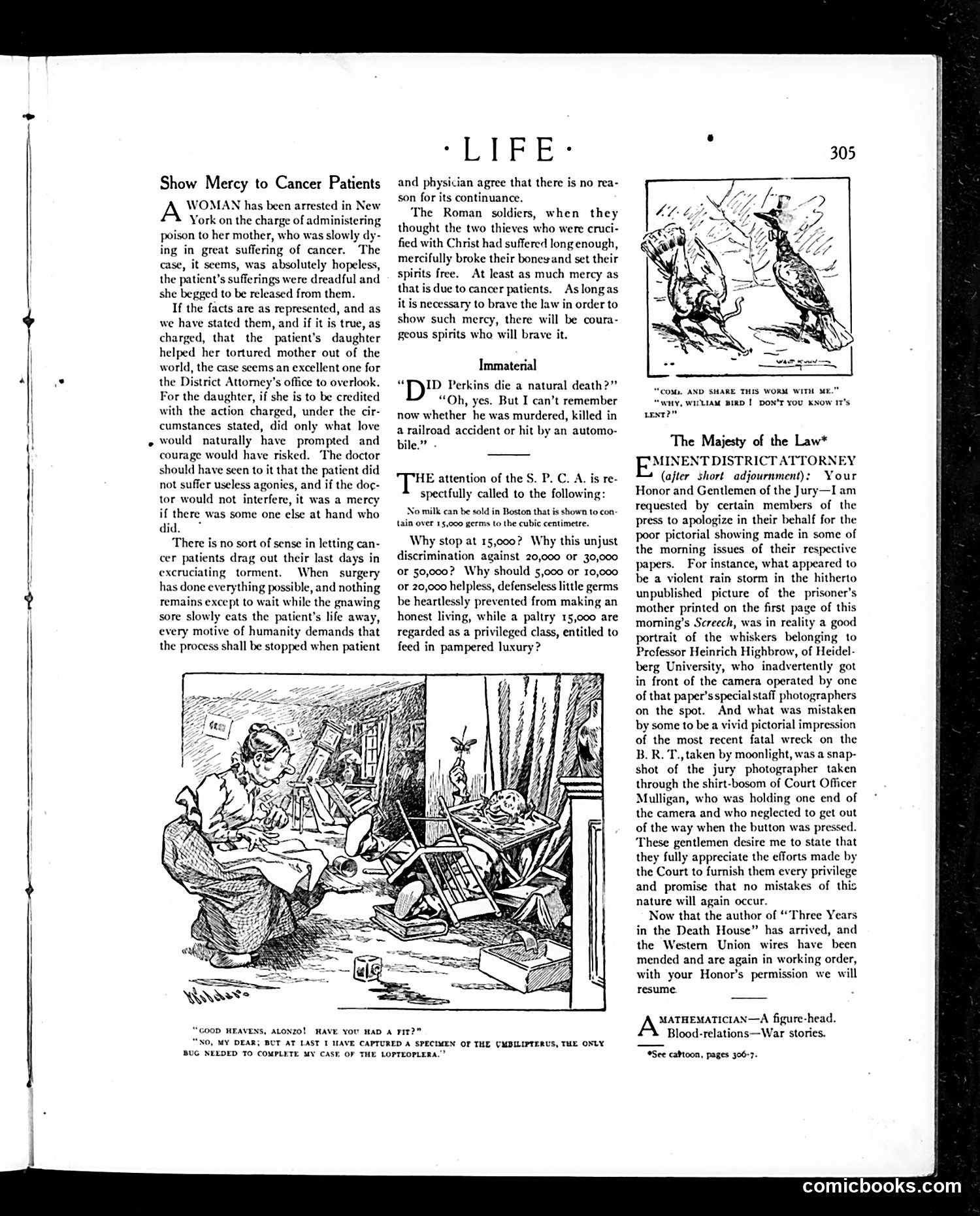
**Main Content:** The page contains three distinct sections: an article "Show Mercy to Cancer Patients" advocating against euthanasia; a humorous illustration depicting a scientist or doctor excitedly showing a specimen (labeled as capturing "the only bug needed to complete my case of the lepidoptera"); and a section titled "The Majesty of the Law" addressing courtroom photography ethics. **The Cartoon's Humor:** The large illustration satirizes scientific obsession—a disheveled researcher has apparently captured an insect specimen for his collection and celebrates this achievement, apparently indifferent to other concerns. The caption's mention of "lepidoptera" (butterflies/moths) suggests the scientist's narrow focus on completing his entomological collection. **Historical Context:** This appears to reflect early 20th-century attitudes toward scientific earnestness and the sometimes-comic single-mindedness of researchers.
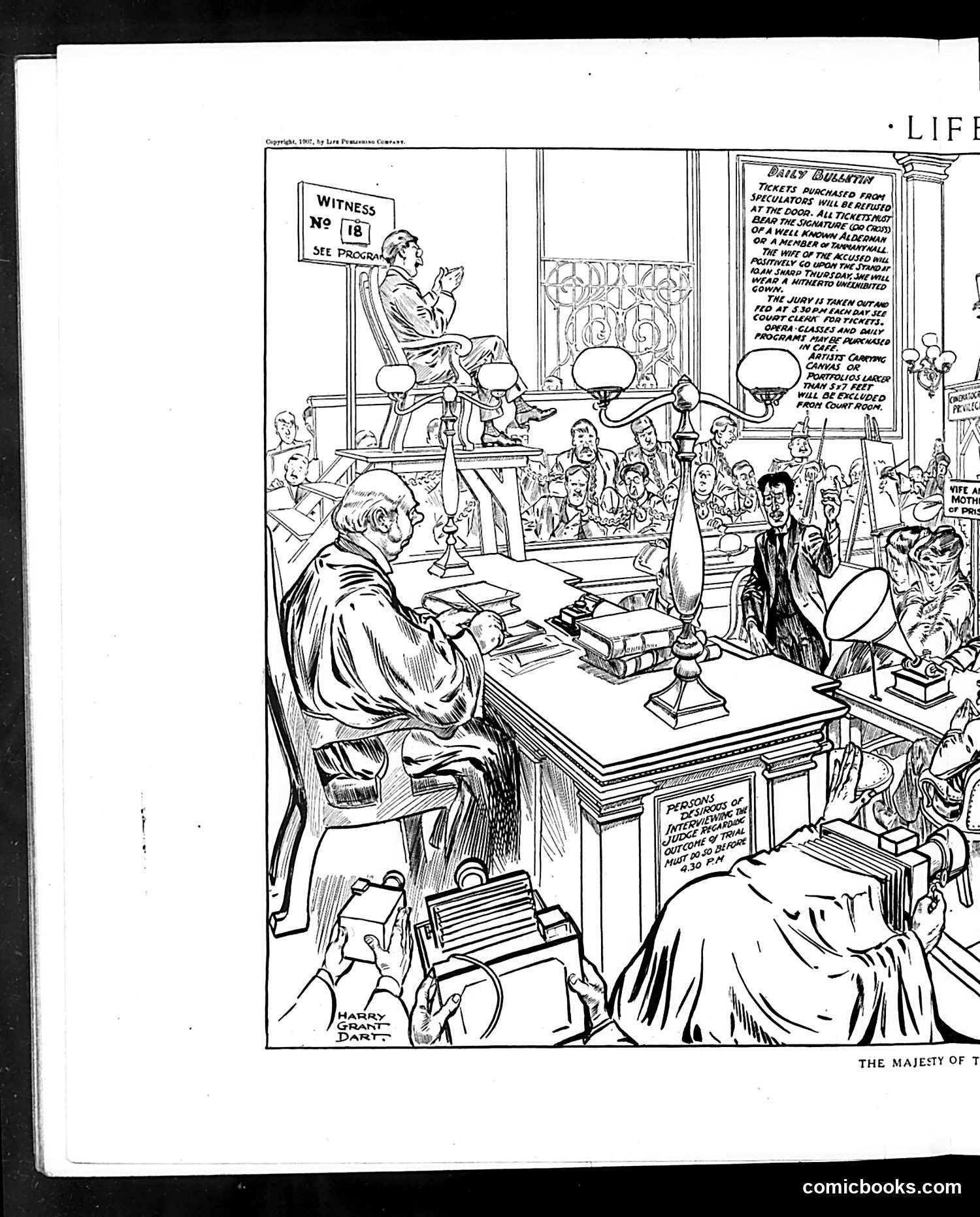
This is a courtroom scene satirizing a high-profile trial, likely from the early 1900s. The cartoon depicts a witness (#18) testifying while crowds pack the gallery and windows. The detailed text boxes mock the excessive public spectacle: tickets are being scalped, the accused's wife will wear an "uneximhibited gown," jury members are paraded daily, and courtroom procedures are treated like entertainment rather than justice. The satire targets how sensational trials become public theater, with attendees prioritizing fashion and novelty over legal proceedings. The crowded, chaotic courtroom—with onlookers practically hanging from the windows—emphasizes how justice has become a spectator sport. The artist is Harry Grant Dart, a Life cartoonist known for social commentary. Without clearer identification of the case, the specific trial remains unclear, though the style suggests a notable early-20th-century trial.
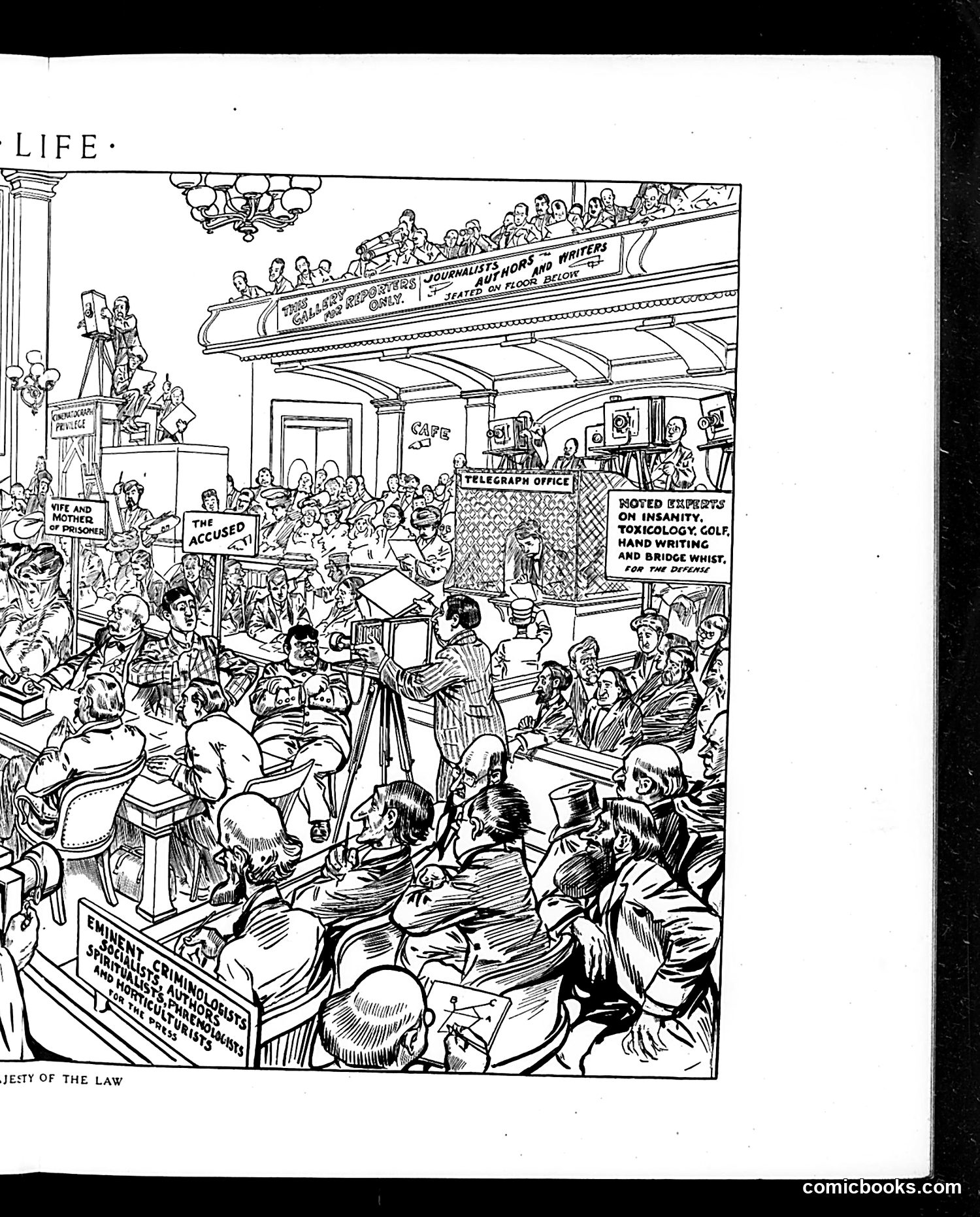
This is a satirical cartoon titled "Majesty of the Law" depicting a crowded courtroom scene. The illustration shows a judge's bench, telegraph office, and cafe within what appears to be a chaotic legal proceeding. A sign reading "The Accused" points to figures among the crowd. The cartoon satirizes the judicial system's inefficiency and circus-like atmosphere—combining elements of commerce (telegraph office, cafe) with justice, suggesting courts had become entertainment spectacles or were corrupted by commercial interests. The dense crowd of observers and the casual mixing of legal proceedings with everyday business mocks the dignity supposedly associated with law. The reference to "noted experts on insanity" examining various physical characteristics (hand-writing, wrist measurements) likely satirizes pseudoscientific criminal psychology or phrenology popular in the early 20th century—the false belief that physical traits revealed criminal tendencies.
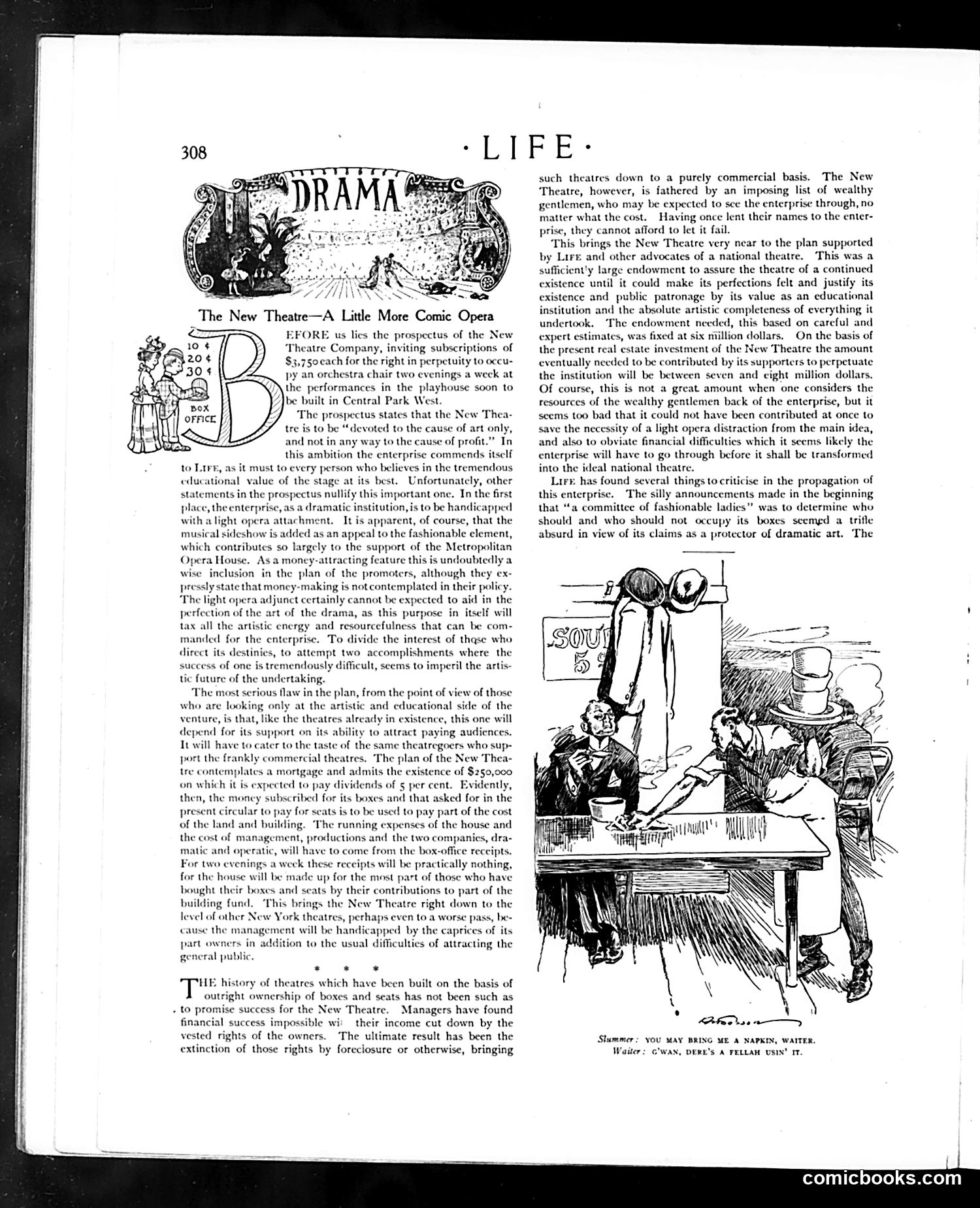
This satirical piece critiques the newly-proposed New Theatre Company in New York (to be built in Central Park West), which solicited wealthy subscribers at $3,750 each for permanent orchestra seats. **The satire's main points:** The theatre claims devotion to art "and not in any way to the cause of profit"—yet immediately contradicts itself by requiring dividend payments and relying on box-office income. Life mocks this hypocrisy. The accompanying light opera component is attacked as a money-grabbing concession to fashionable audiences, diluting serious dramatic art. Most damning: the financial model is unsustainable. Running costs must come from ticket sales, but most seats will be occupied by subscribers who've already paid via the building fund—leaving little box-office revenue. **The cartoon** (bottom right) shows a waiter bringing a napkin to a diner, captioned with dialogue about bringing "a napkin"—likely satirizing the theatre's pretensions or the wealthy subscribers' obliviousness. Life concludes that despite wealthy backers' reputations being at stake, the theatre will inevitably fail or devolve into commercial operation like ordinary Broadway theatres.
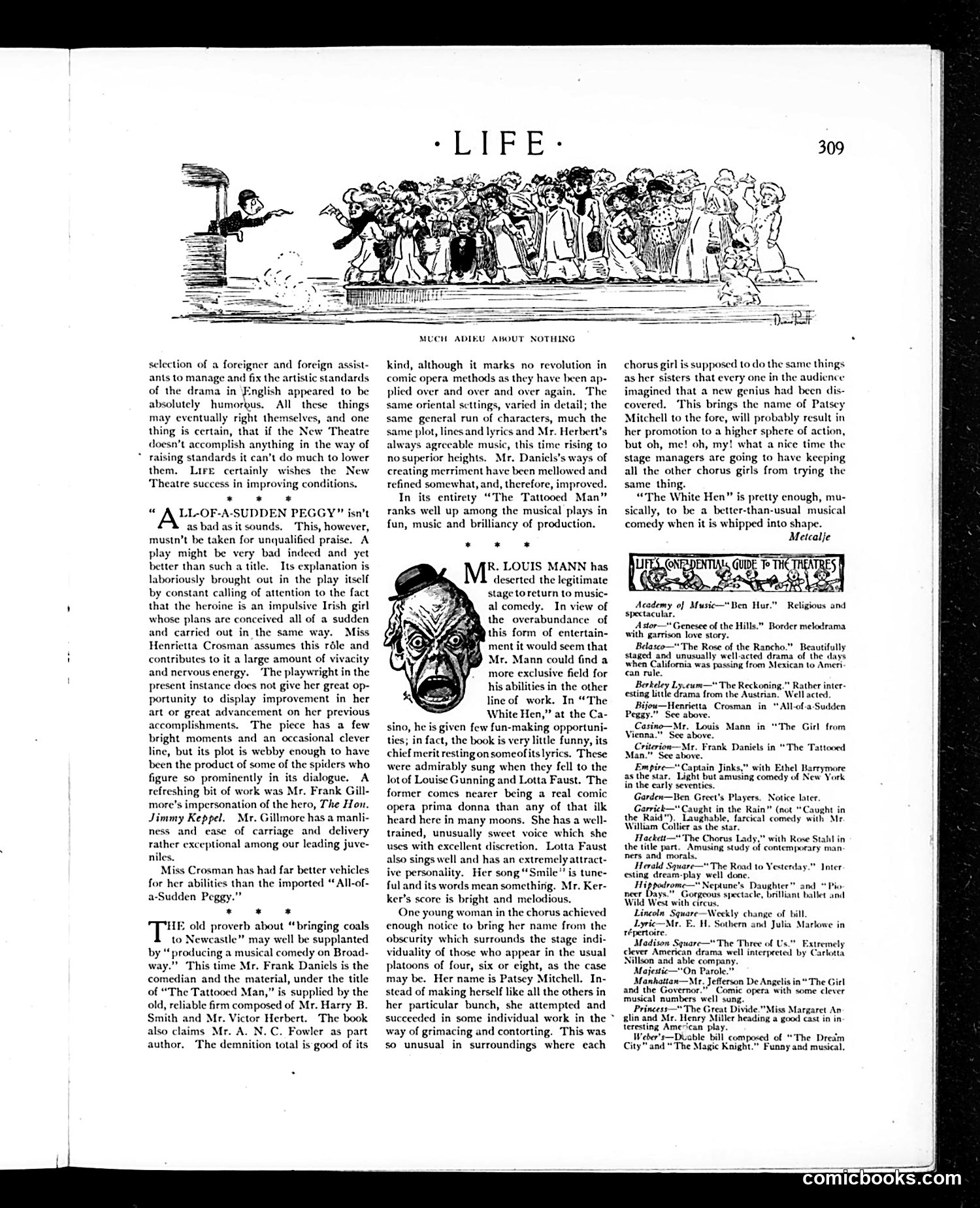
This Life magazine page (page 309) reviews three theatrical productions. The main cartoon at top, titled "Much Adieu About Nothing," satirizes Broadway's obsession with theatrical production—likely mocking the excessive fuss and expense involved in staging shows. The text reviews three shows: "All-of-a-Sudden Peggy" (starring Henrietta Crosman), "The Tattooed Man" (a comic opera with Frank Daniels), and "The White Hen" (featuring Louis Mann). The reviews are mixed—praising performances while criticizing formulaic plots and recycled comic opera conventions. The satire targets Broadway's creative stagnation: producers repeatedly use the same oriental settings, character types, and predictable narratives. The joke is that bringing coal to Newcastle (importing goods where they're already abundant) is less wasteful than producing another generic Broadway musical comedy.
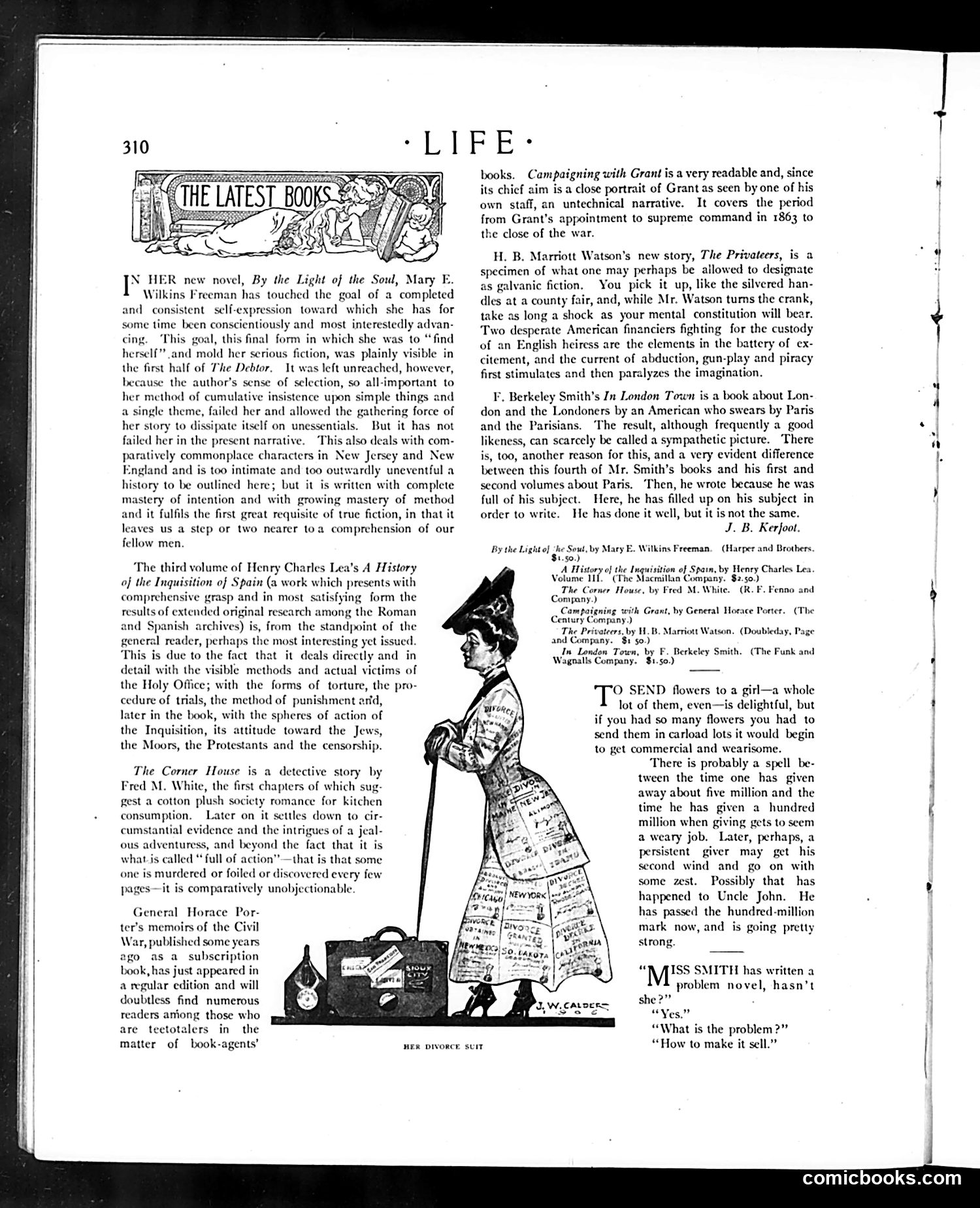
The central cartoon depicts a woman whose dress is covered with labels of financial burdens and legal documents—a visual metaphor for how divorce proceedings expose and devastate a woman's economic situation. The figure carries luggage and a flower, suggesting she's left with only personal possessions while her finances are stripped bare by litigation. The satire targets the legal and social systems that left women financially vulnerable during divorce. The detailed labeling on her dress implies the complexity and cost of divorce proceedings, while her burdened appearance criticizes how the system disadvantaged women economically. The accompanying text about sending flowers being "delightful but...if you had so many flowers you had to send them in carload lots it would begin to get commercial and wearisome" suggests ironic commentary on how even gestures of sympathy become hollow when facing such financial devastation. This reflects genuine Progressive Era concerns about women's economic rights in marriage dissolution.
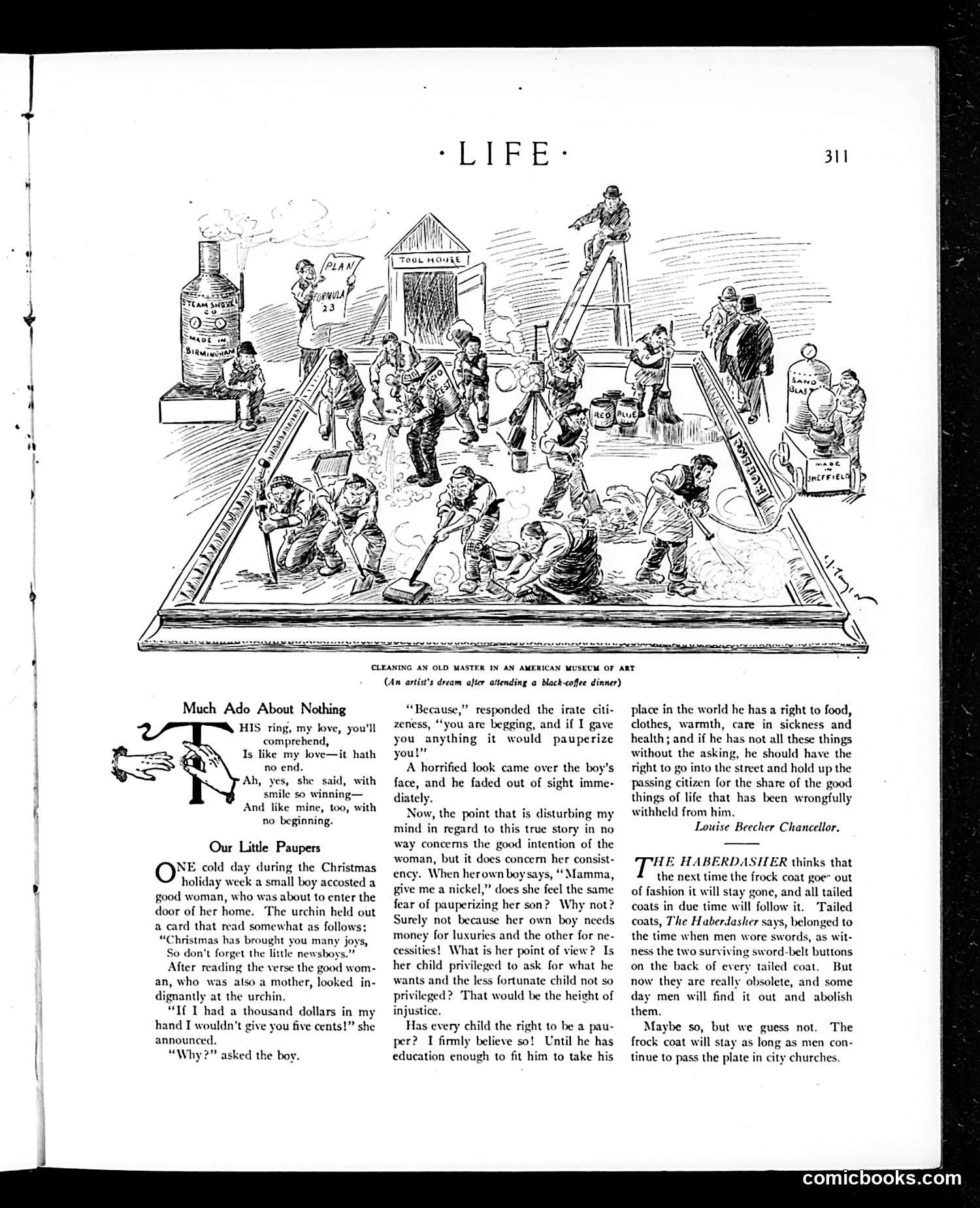
The top illustration satirizes museum art restoration. The surreal scene shows tiny workers cleaning a painting inside a giant wine bottle labeled "Made in Burgundy"—a joke about an artist's surreal hallucinations after attending a dinner with only black coffee (no food). It mocks both pretentious art restoration practices and the eccentric creative mind. Below are three opinion pieces: one about romantic love using a ring metaphor; one critiquing class hypocrisy regarding charity (a woman refuses to give a poor newsboy money to avoid "pauperizing" him, yet gives her own son money freely); and one predicting formal tailed coats will never disappear because men wear them to church while "passing the plate" (collecting donations)—implying religious tradition and social conformity override logic.
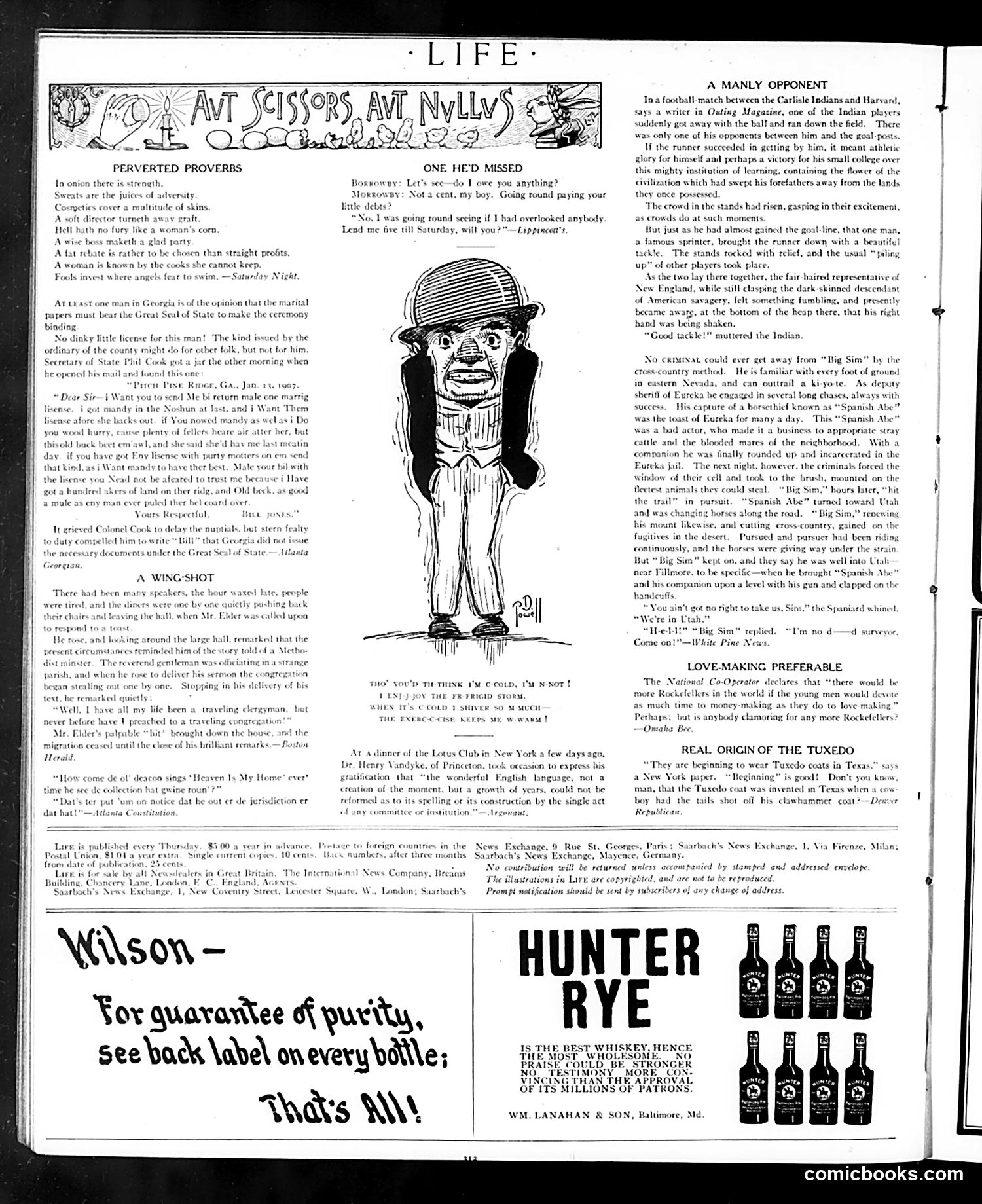
This page contains several distinct pieces of satirical content: **"Perverted Proverbs"** (left column): A humorous section inverting familiar sayings—"Cosmetics cover a multitude of skins," "Hell hath no fury like a woman's corn"—typical of Life's wordplay humor. **"A Manly Opponent"** (right column): A sentimental story about a football match between Carlisle Indians and Harvard. An Indian player nearly scores against the prestigious Harvard team, but is tackled by a Harvard sprinter. The satire's point: after the brutal tackle, the Indian player compliments his opponent's sportsmanship ("Good tackle!"), highlighting the irony that Indigenous peoples face displacement by the very "civilization" that Harvard represents, yet respond with dignity. **Other sections** include anecdotes about licenses, a sheriff named "Big Sim," and standard period humor. The advertisements (Wilson whiskey, Hunter Rye) occupy the lower portion—typical for Life's revenue model. The overall tone reflects early 20th-century American satire: mixing gentle social commentary with casual racial stereotyping that modern readers would find offensive.
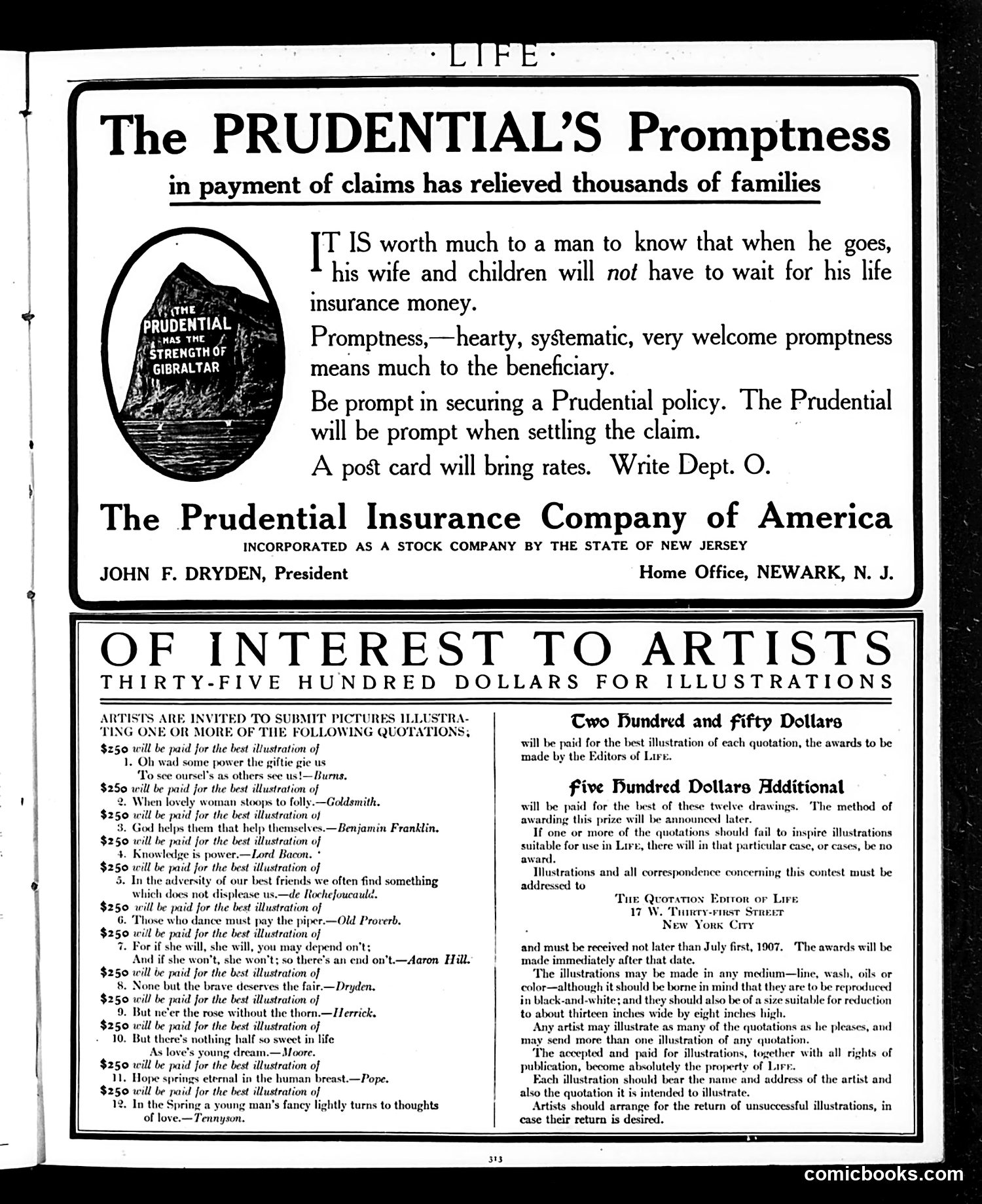
This is primarily **advertising and a contest announcement** from *Life* magazine, not satirical content. The top half features a **Prudential Insurance Company advertisement** emphasizing prompt claim payments to widows and families—a selling point for life insurance in an era before social safety nets. The "Rock of Gibraltar" logo conveys stability and strength. The bottom half announces a **$3,500 artistic competition** inviting illustrators to create paintings interpreting famous literary quotations (from Burns, Pope, Tennyson, etc.). Winners receive $250 per illustration, with an additional $500 prize for the best overall submission. Entries must arrive by July 1, 1907. This reflects *Life*'s dual role as both satirical magazine and vehicle for advertising and cultural competitions targeting educated, middle-class readers. The quotations emphasize moral virtue and romantic idealism—typical themes for early-twentieth-century illustrated journalism.
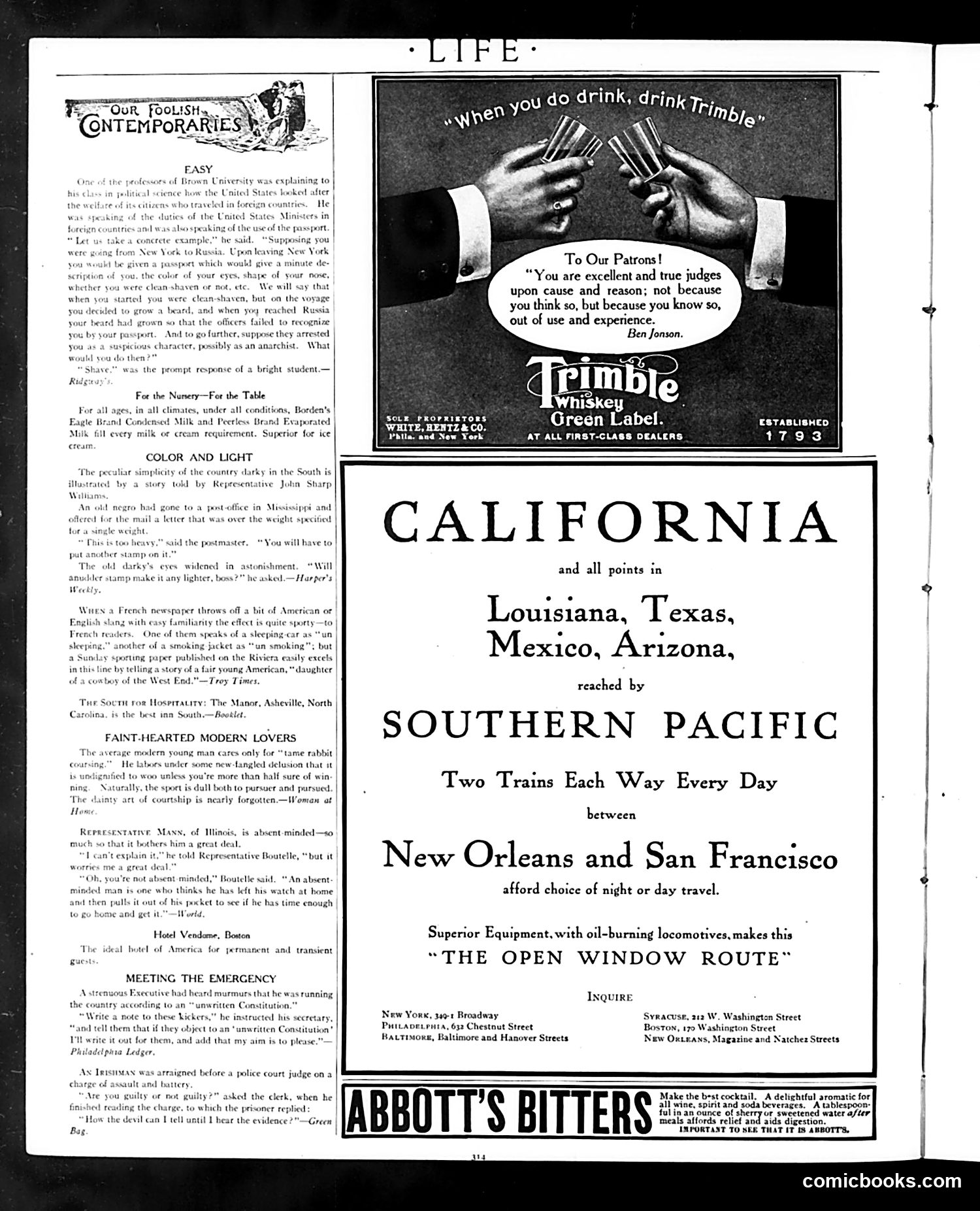
This page mixes satirical humor columns with advertisements typical of early 1900s Life magazine. **Left Column ("Our Foolish Contemporaries"):** Short anecdotes mocking people's behavior. One story ridicules a Southern Black postal worker who doesn't understand that adding a stamp won't make a letter lighter—playing on racist stereotypes of assumed ignorance. Another satirizes an absent-minded congressman. These were common racist and classist jokes in the era. **Central Advertisement:** Trimble Whiskey uses a Ben Jonson quote about "true judges," positioning the product as a mark of refined taste. **Right Column:** Southern Pacific Railroad advertisement promoting trains between New Orleans and San Francisco, highlighting "THE OPEN WINDOW ROUTE" and oil-burning locomotives as modern amenities. **Bottom:** Abbott's Bitters advertisement claiming medicinal benefits for cocktails and spirits. The page reflects period attitudes: casual racism, trust in alcohol's purported health properties, and railroad expansion as progress. Most content is advertising revenue masked as editorial.
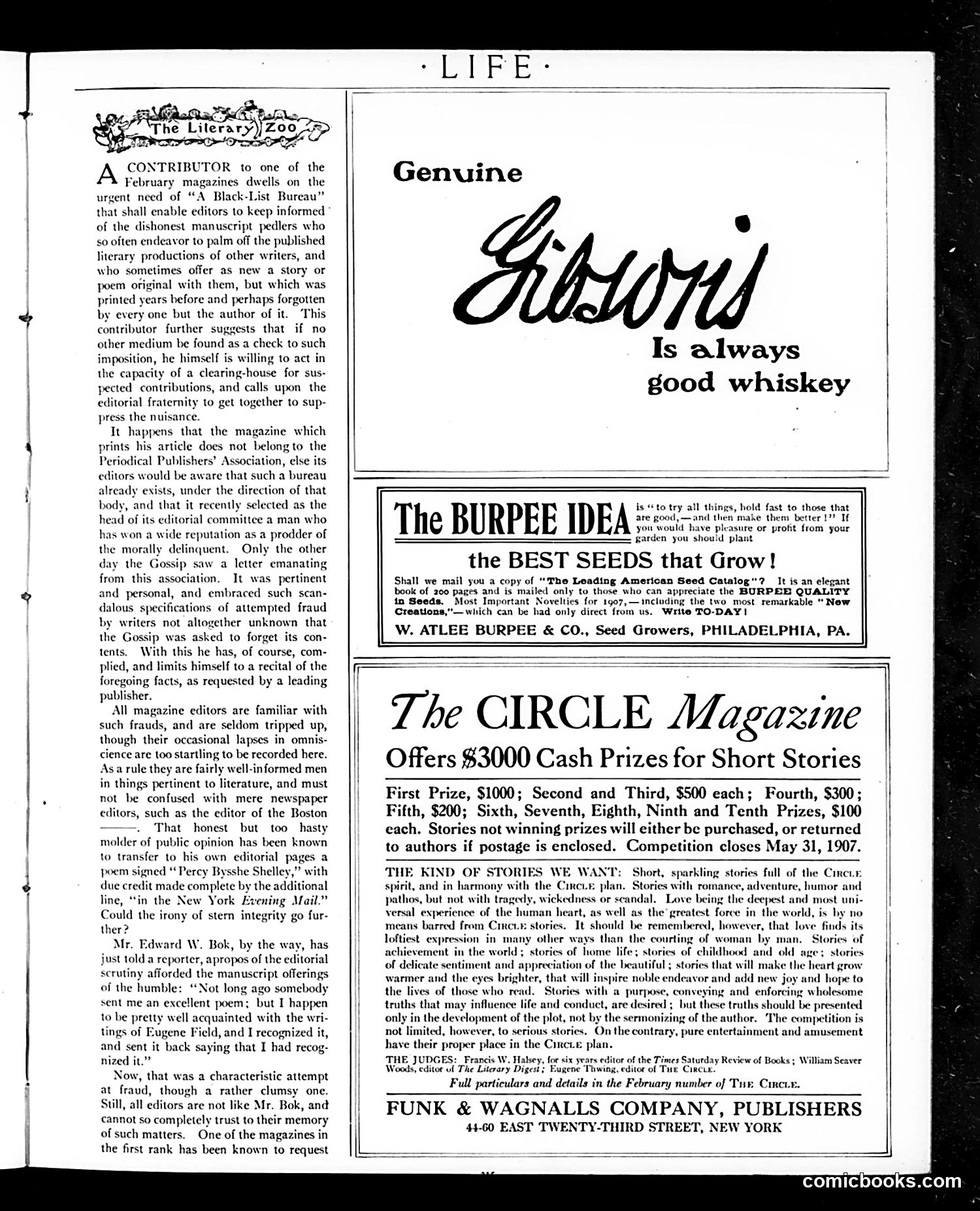
This page's main content is a satirical editorial about literary fraud in magazine publishing. The piece criticizes manuscript plagiarism—writers submitting previously published works as originals—and discusses the magazine industry's efforts to combat it through a "Black-List Bureau." The editorial specifically names **Edward W. Bok** (editor of *The Ladies' Home Journal*) as an example of an editor vigilant enough to catch plagiarism, recounting how Bok recognized a submitted poem as Eugene Field's work. The satire targets lazy or inattentive editors, mocking one Boston newspaper editor who accidentally published a poem credited to "Percy Bysshe Shelley" via the *New York Evening Mail*—a humorous example of editorial carelessness. The page is primarily advertising (Gibbon's whiskey, Burpee seeds, *The Circle Magazine* short-story contest), typical of *Life*'s format, but the editorial critiques real publishing industry practices and specific editors' competence.
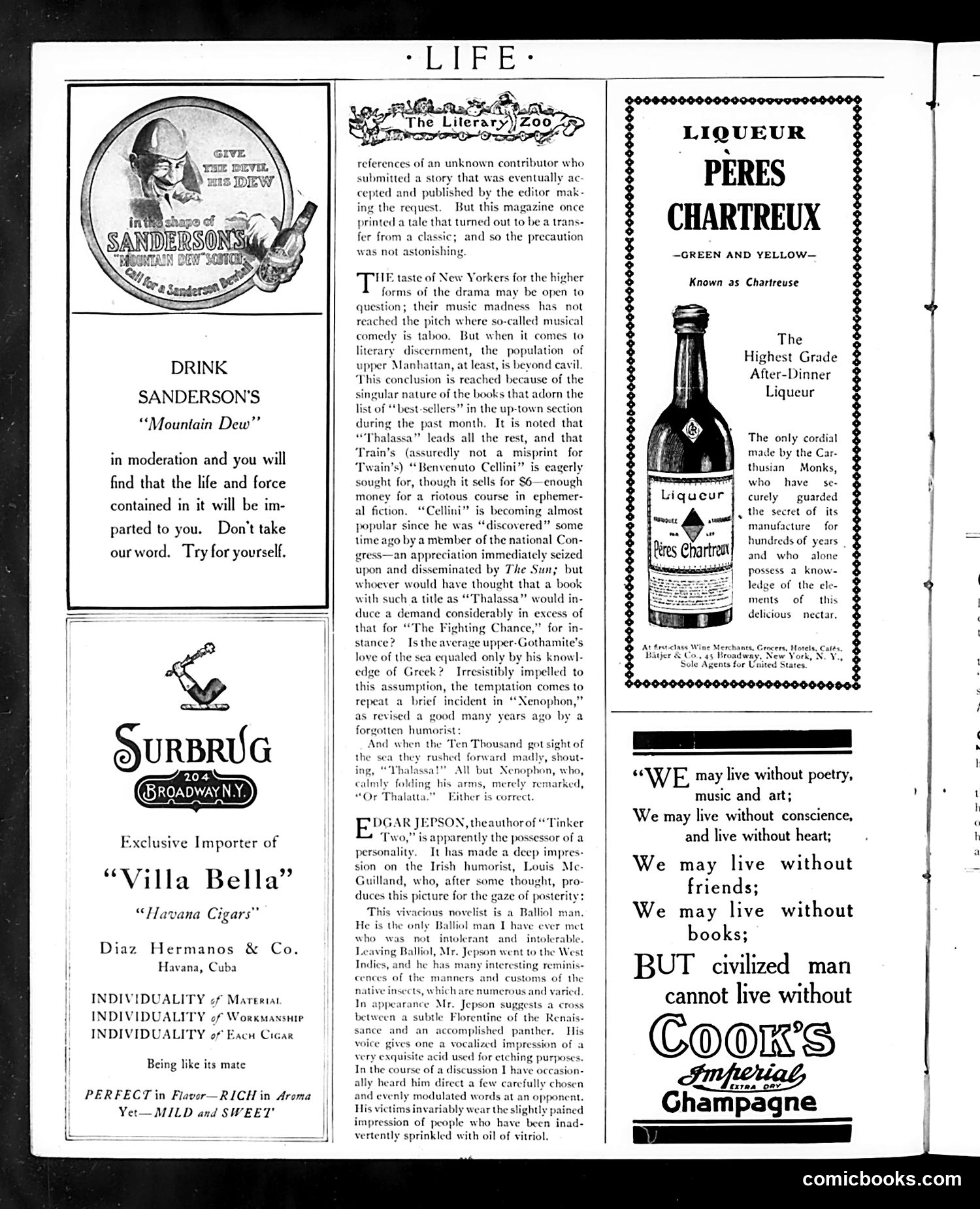
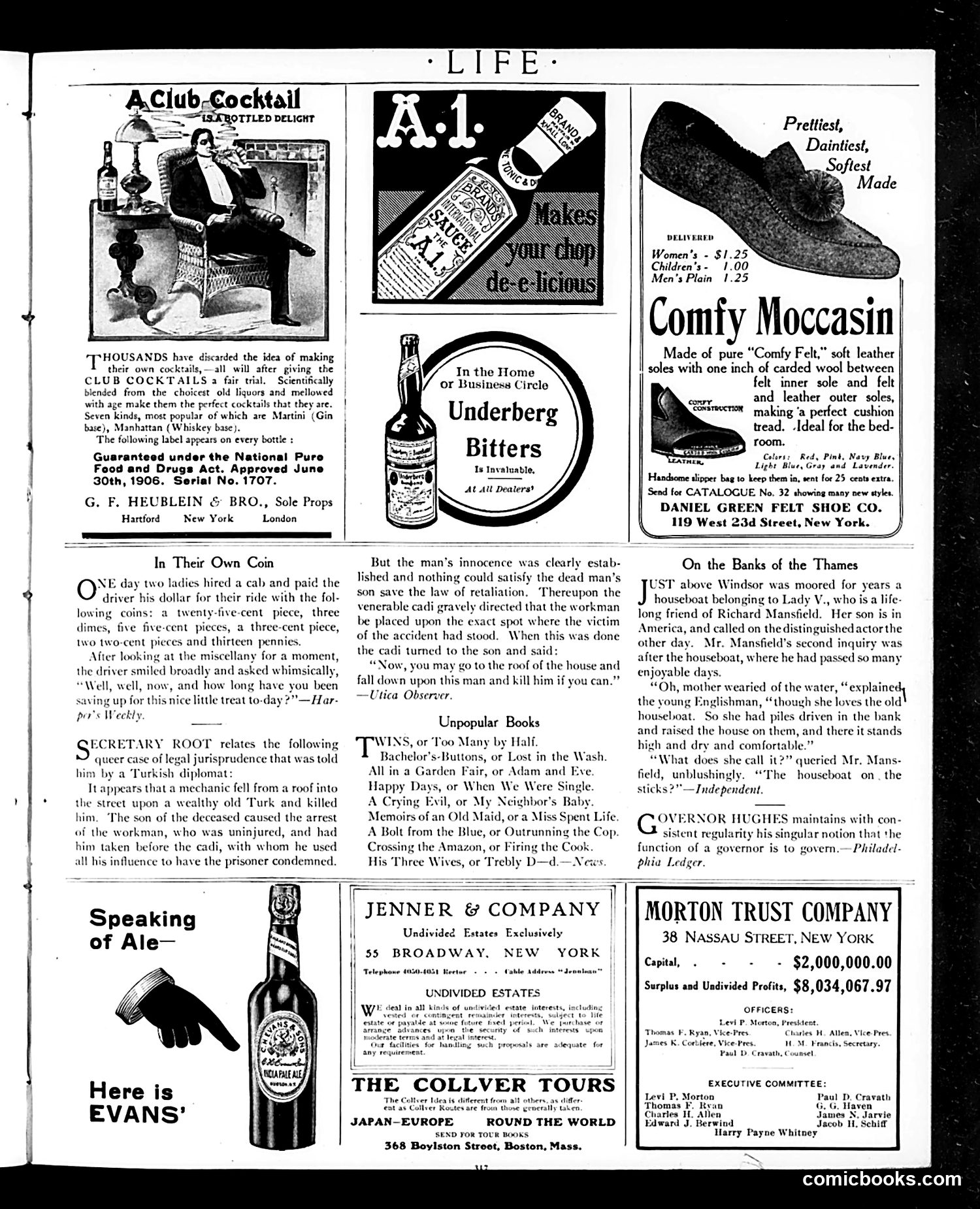
This page is primarily **advertising with scattered short humor pieces** rather than political cartoons. The top features ads for beverages (Club Cocktail, Underberg Bitters, A.I. sauce) and Comfy Moccasin slippers—typical early 1900s product marketing. The humor pieces are light social commentary: - **"In Their Own Coin"**: A joke about ladies paying a cab driver with excessive small change—satire on penny-pinching behavior. - **"Secretary Root's anecdote"**: A Turkish legal story about a cadi (judge) applying literal "eye for an eye" justice, mocking rigid adherence to law over reason. - **"On the Banks of the Thames"**: A quip about Lady V. moving her houseboat onto land and removing it from water—implying she's given up the lifestyle. - **"Unpopular Books"**: A humorous list of absurd book titles parodying sentimental Victorian literature titles. None contain specific political figures or dated references requiring historical context beyond understanding early 20th-century social conventions around class, excess, and literary taste.
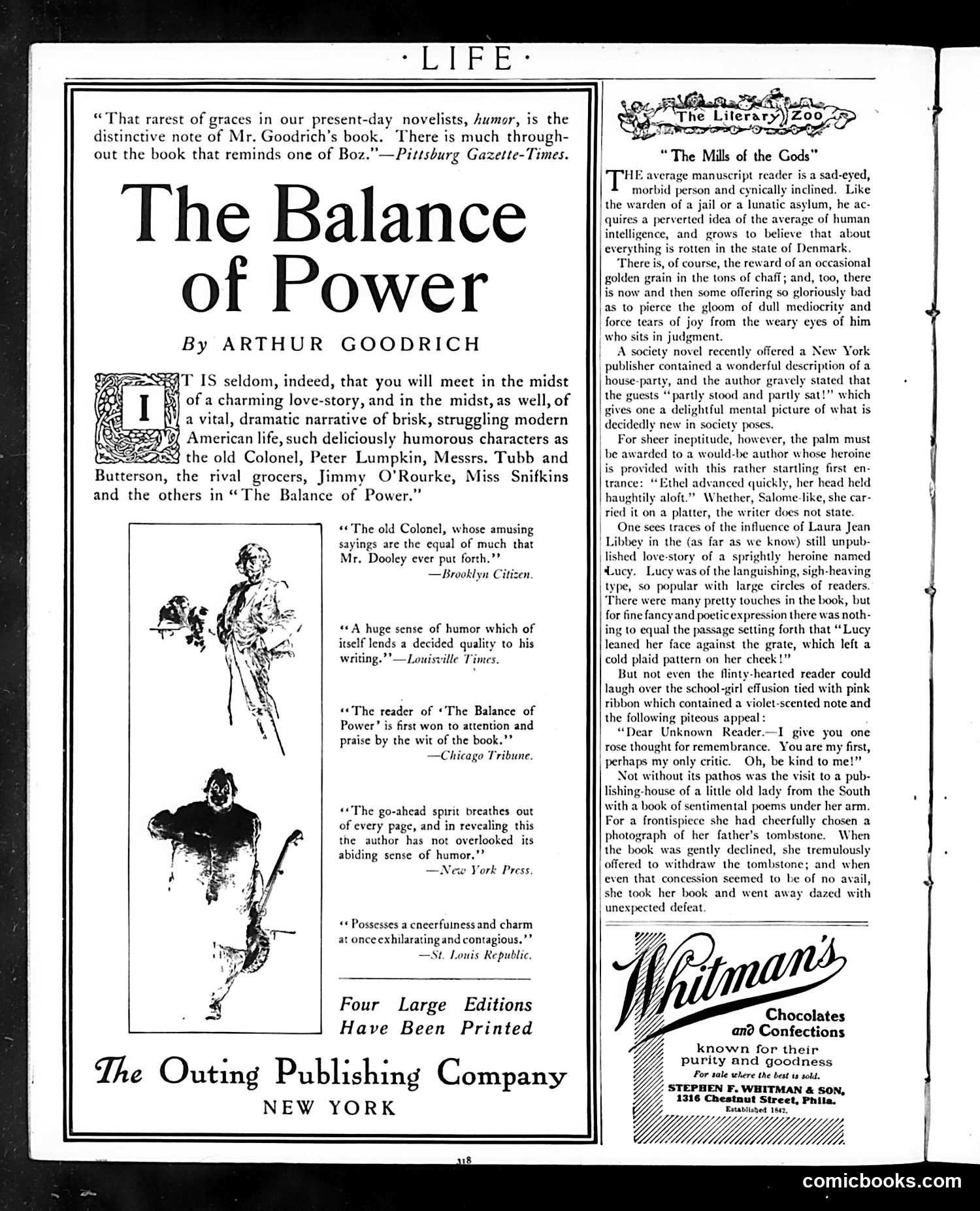
This page is primarily a **book advertisement** for Arthur Goodrich's novel "The Balance of Power," published by Outing Publishing Company. The left side features favorable critical quotes praising the book's humor and wit, comparing Goodrich favorably to "Boz" (Charles Dickens). The sketched illustrations appear to be character types from the novel—depicting comedic figures representing American life. The right column, "The Literary Zoo," is satirical commentary on manuscript readers and amateur writers. It mocks the clichéd, poorly-written submissions publishers receive—including absurd descriptions like a character's head "held haughtily aloft" (possibly on a platter, like Salome) and a girl's face creating a "cold plaid pattern" against a grate. The piece gently ridicules literary incompetence while celebrating Goodrich's actual skill with humor and characterization.
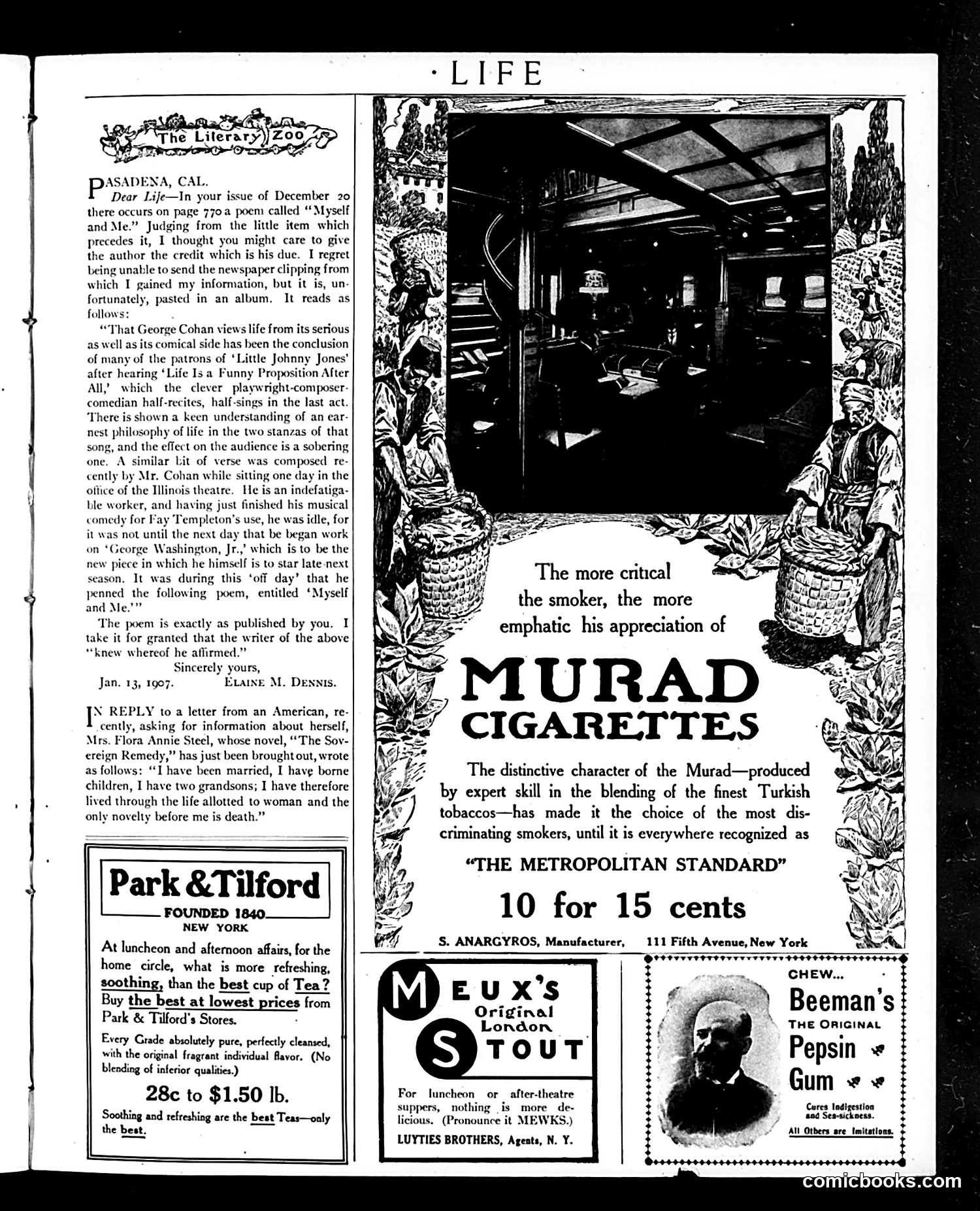
This is primarily a **letters-to-editor page with advertisements**—not a political cartoon. The content addresses **George Cohan**, the famous playwright-composer-performer. A reader credits Cohan with writing the poem "Myself and Me" published in Life's December 20 issue, noting it reflects his serious philosophical side despite his reputation for comedy. The letter establishes that Cohan composed this verse during a day off between theatrical projects. A second letter quotes novelist Flora Annie Steel on women's lives—marriage, motherhood, and grandchildren constitute a woman's allotted existence, with only death remaining as novelty. **The advertisements**—for Park & Tilford tea, Murad cigarettes ("the metropolitan standard"), Meux's stout, and Beeman's pepsin gum—represent typical early-1900s luxury goods marketing. These reflect the era's consumer culture and relatively unregulated advertising claims (notably Beeman's gum's digestive benefits). The page offers glimpses of period entertainment, gender expectations, and commercial culture rather than satire.
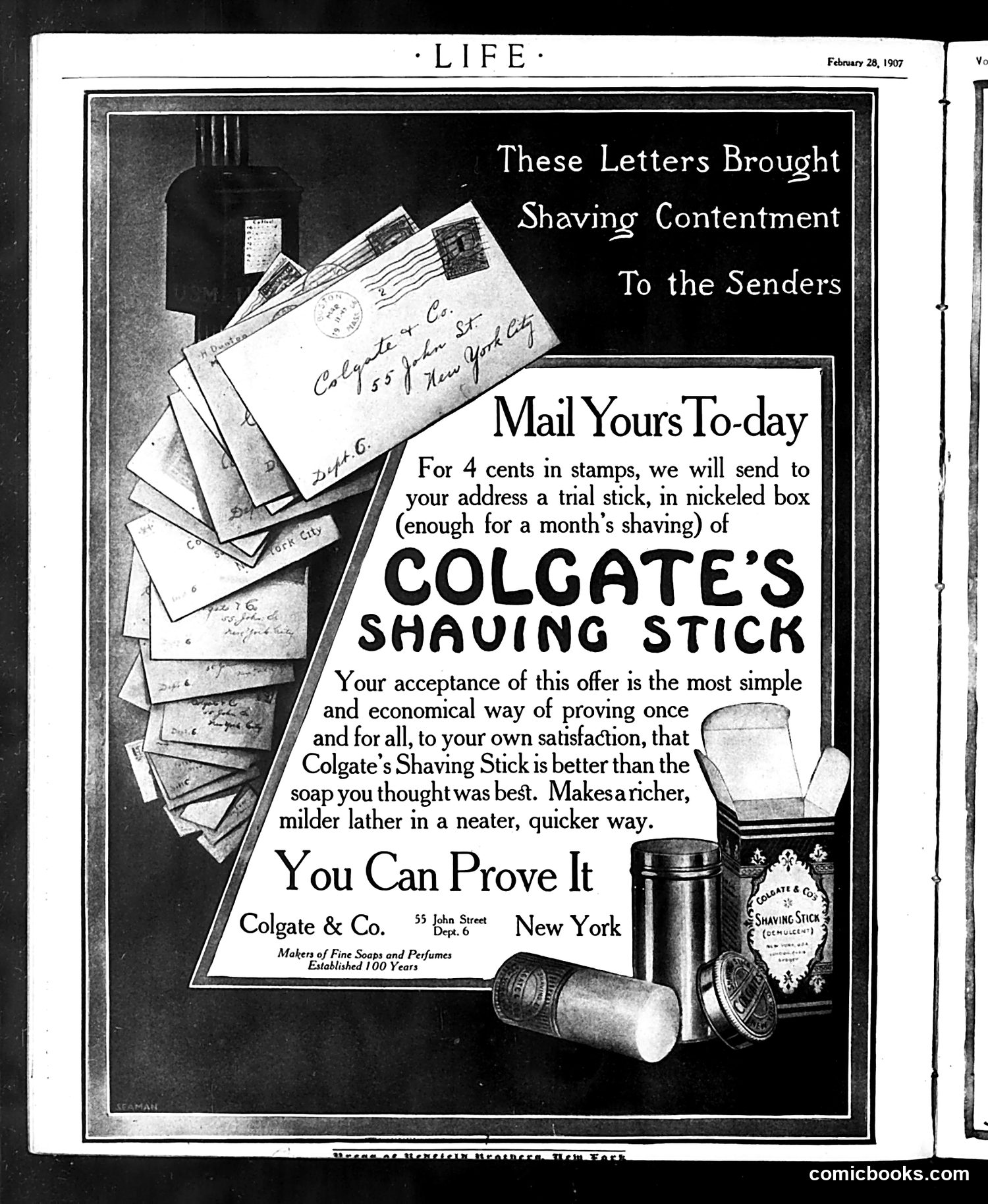
This is a **product advertisement**, not a political cartoon. It's a Colgate & Co. advertisement for their shaving stick from the *Life* magazine issue of February 28, 1907. The page features testimonial letters (shown as a stack of envelopes at left) claiming satisfaction with the product. The advertisement emphasizes that for 4 cents in stamps, readers can request a trial stick to prove Colgate's superiority over competing soaps. The key selling points are: richer lather, milder formula, and faster preparation compared to traditional bar soap. The product itself is shown at bottom right with its packaging. There is **no satire or political content** here—this is straightforward early 20th-century advertising using the common marketing strategy of customer testimonials and trial offers to build consumer confidence in a branded product.