
Life, 1907-02-28 · page 16 of 28
Life — February 28, 1907 — page 16: what you’re looking at
What you’re looking at
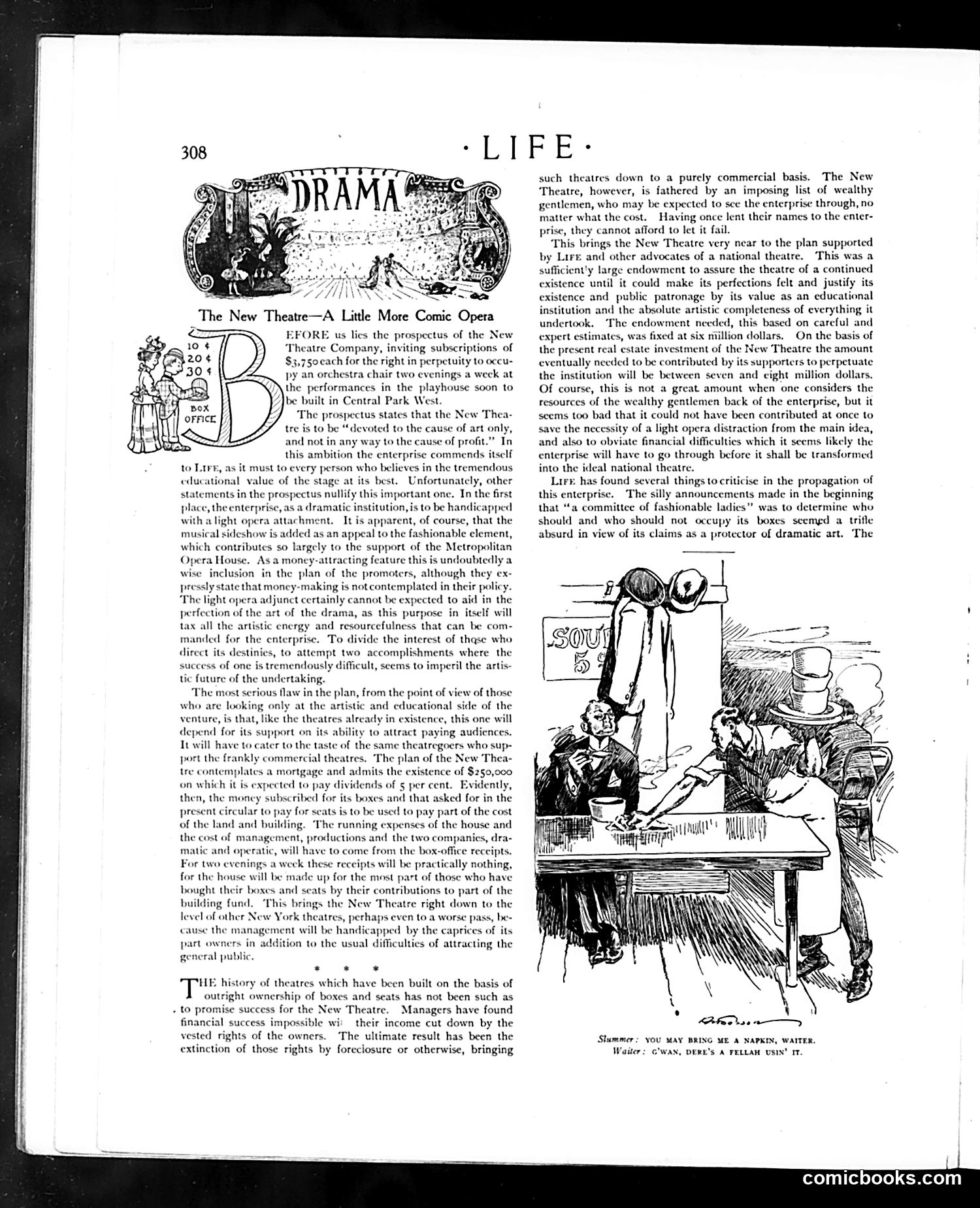
This satirical piece critiques the newly-proposed New Theatre Company in New York (to be built in Central Park West), which solicited wealthy subscribers at $3,750 each for permanent orchestra seats. **The satire's main points:** The theatre claims devotion to art "and not in any way to the cause of profit"—yet immediately contradicts itself by requiring dividend payments and relying on box-office income. Life mocks this hypocrisy. The accompanying light opera component is attacked as a money-grabbing concession to fashionable audiences, diluting serious dramatic art. Most damning: the financial model is unsustainable. Running costs must come from ticket sales, but most seats will be occupied by subscribers who've already paid via the building fund—leaving little box-office revenue. **The cartoon** (bottom right) shows a waiter bringing a napkin to a diner, captioned with dialogue about bringing "a napkin"—likely satirizing the theatre's pretensions or the wealthy subscribers' obliviousness. Life concludes that despite wealthy backers' reputations being at stake, the theatre will inevitably fail or devolve into commercial operation like ordinary Broadway theatres.
📄 Transcribed text from this page (OCR, searchable)
Machine-transcribed from the original scan — historical spelling and the odd misread are preserved.
_ The New Theare—A Little More Comic Opera ORE us lies the prospectus of the New Theatre Company, inviting subscriptions of $3,750 cach for the right in perpetuity to occu- py an orchestra chair two evenings a week at the performances in the playhouse soon to Noe built in Central Park West. ‘The prospectus states that the New ‘Thea- tre is to be “devoted to the cause of art on and not in any way to the cause of profit. this ambition the enterpris it must to every person who believes in the tremendous ational value of the’stage at its best. Unfortunately, other statements in the prospectus nullify this important one. In the first place, the enterprise, as a dramatic institution, is to be handicapped with @ light opera attachment. It is apparent, of course, that the musical sideshow is added as an appeal to the fashionable clement, which contributes so largely to the support of the Metropolitan Opera House. Asa money-attracting feature this is undoubtedly a wise inclusion in the plan of the promoters, although they ex- pressly state that money-making is not contemplated in their policy. ‘The light opera adjunct certainly cannot be expected to aid in the perfection of the art of the drama, as this purpose in itself will tax all the artistic energy and resourcefulness that can be com- manded for the enterprise. To divide the interest of thase who direct its destinies, to attempt two accomplishments where the success of one is tremendously difficult, seems to imperil the artis- tic future of the undertaking. The most serious flaw in the plan, from the point of view of those who are looking only at the artistic and educational side of the venture, is that, like the thea in existence, this one will depend for its support « tract paying audiences, It will have to me theatregocrs who sup= k The plan of the New Thea- ind admits the existence of $250,000 y dividends of 5 per cent. Evidently, noncy subscribed for its boxes and that asked for in the present circular to pay for seats is to be used to pay part of the cost of the land and building. ‘The running expenses of the house and the cost of management, productions and the two companies, d matic and operatic, will have to come from the box-office rece For two evenings a weck these receipts will be practically nothing, for the house will be made up for the most part of those who have bought their box ats by their contributions to part of the building fund. ings the New Theatre right down to the level of other New York theatres, perhaps even to a worse pass, be- cause the management will be handicapped by the caprices of its part owners in addition to the usual difficulties of attracting the gencral public. In commends itself ommercial theatr tre contemplates a mortg: on which it is expected to then, the . 8 «@ HIE history of theatres which have been built on the basis of outright ownership of boxes and seats has not been such as - to promise success for the New Theatre. Managers have found financial success impossible wi their income cut down by the vested rights of the owners. The ultimate result has been the extinction of those rights by foreciosure or otherwise, bringing LIFE The New ‘Theatre, however, is fathered by an imposing list of wealthy gentlemen, who may be expected to sce the enterprise through, no such theatres down to a purely commercial basis. matter what the cost. Having once lent their names to the enter- prise, they cannot afford to let it fail. This brings the New Theatre very near to the plan supported by Lire and other advocates of a national theatre. This was a flicient'y large endowment to assure the theatre of a continued istence until it could make its perfections felt and justify its existence and public patronage by its value as an educational institution and the absolute artistic completeness of everything it undertook. The endowment needed, this based on careful and expert estimates, was fixed at six million dollars. On the basis of the present real estate investment of the New Theatre the amount eventually needed to be contributed by its supporters to perpetuate the institution will be between seven and eight million dollars. Of course, this is not a great amount when one considers the resources of the wealthy gentlemen back of the enterprise, but it seems too bad that it could not have been contributed at once to save the necessity of a light opera distraction from the main i and also to obviate financial difficulties which it seems likely the enterprise will have to go through before it shall be transformed into the ideal national theatre. Lire: has found several things to criticise in the propagation of this enterprise. The silly announcements made in the beginning that “a committce of fashionable ladies” was to determine who. should and who should not occupy its boxes scemgd a trifle absurd in view of its claims as a protector of dramatic art. The 4 ‘ Aeots1 a> Slummer: YOU MAY BRING ME A NAPKIN, WAITER. Waiter: G'WAN, DERL’S A FELLA USIN’ IT. comicbooks.com