
Life, 1907-02-28 · page 8 of 28
Life — February 28, 1907 — page 8: what you’re looking at
What you’re looking at
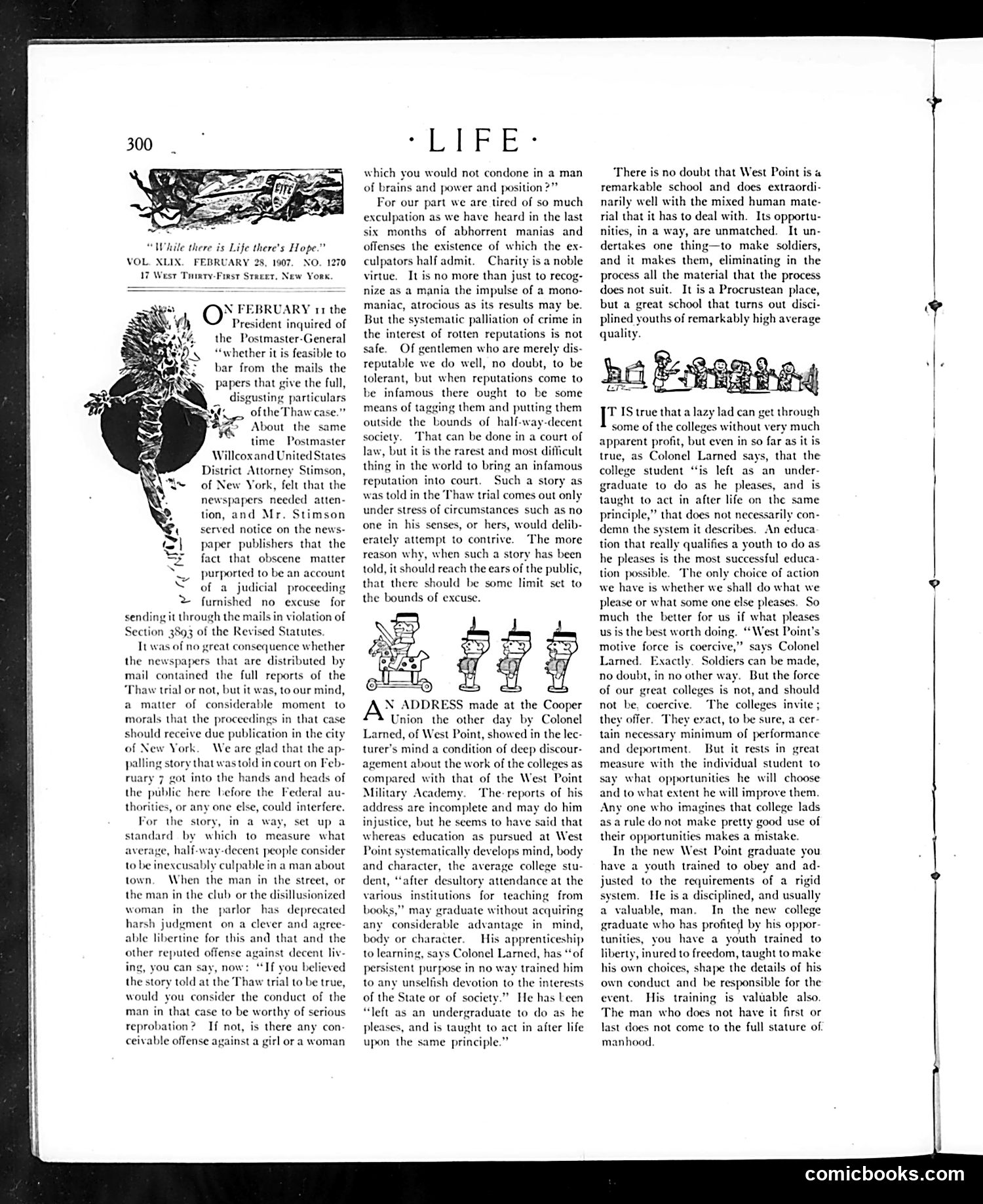
This page contains editorial commentary on West Point Military Academy, apparently responding to a recent controversy involving Colonel Larned and newspaper reports about the institution. **The cartoons** show simplified figures of soldiers or cadets in uniform, likely illustrating the discussion of military discipline and training. **The satire targets**: debates about how to handle scandals at West Point—specifically whether publicizing misconduct through courts-martial damages the institution's reputation. The text argues that systematic exposure of wrongdoing, while painful, serves the public interest better than covering it up. **Key point**: The piece defends West Point's educational mission while suggesting that colleges shouldn't be coercive but rather should cultivate character through discipline and personal responsibility in cadets. The historical context involves institutional accountability and military reform debates of the era.
📄 Transcribed text from this page (OCR, searchable)
Machine-transcribed from the original scan — historical spelling and the odd misread are preserved.
“While there VOL. XLIX 17 West 's Life there's Hope.” FEBRUARY 1907. NO. 1270 ‘Winty-First Srrerr, New York. N FEBRUARY 11 the President inquired of the Postmaster-General “whether it is feasible to bar from the mails the ~ papers that give the full, disgusting particular: of the Thaw cast > About the same time Postmaster Willcox and United States District Attorney Stimson, of New York, felt that the newspapers needed atten- tion, and Mr. Stimson served notice on the news- paper publishers that the fact that obscene matter purported to be an account of a judicial proceeding > furnished no excuse for sending it through the mails in violation of Section 3893 of the Revised Statutes. Tt was of no great consequence whether the newspapers that are distributed by mail contained the full reports of the ‘Thaw trial or not, but it was, to our mind, a matter of considerable moment to morals that the proceedings in that case should receive due publication in the city of New York. We are glad that the ap- palling story that was told in court on Feb- ruary 7 got into the hands and heads of the public here before the Federal au- thorities, or any one else, could interfere. For the story, in a way, set up a standard by which to what average, half-way-decent people consider to be inexcusably culpable in a man about town. When the man in the street, or the man in the club or the disillusioniz woman in the parlor has depre harsh judgment on a clever and a able libertine for this and that and the other reputed gainst decent liv- ing, you can say, “If you believed the story told at the Thaw trial to be true, would you consider the conduct of the man in that case to be worthy of serious reprobation? If not, is there any con- ceivable offense against a girl or a woman -LIPE- you would not condone in a man orains and power and position?” our part we are tired of so much exculpation as we have heard in the last six months of abhorrent manias and offenses the existence of which the ex- culpators half admit. Charity is a noble virtue. It is no more than just to recog- nize as a mania the impulse of a mono- maniac, atrocious as its results may be. But the systematic palliation of crime in the interest of rotten reputations is not safe. Of gentlemen who are merely dis- reputable we do well, no doubt, to be tolerant, but when reputations come to be infamous there ought to be some means of tagging them and putting them outside the bounds of half-way-decent society. ‘That can be done in a court of law, but it is the rarest and most difficult thing in the world to bring an infamous reputation into court. Such a story a was told in the Thaw trial comes out only under stress of circumstances such as no one in his senses, or hers, would delib- erately attempt to contrive. The more reason why, when such a story has been told, it should reach the ears of the public, that there should be some limit set to the bounds of excuse. A DDRESS made at the Cooper Union the other day by Colonel Lamed, of West Point, showed in the lec- turer’s mind a condition of deep discour- agement about the work of the colleges as compared with that of the West Point Military Academy. ‘The: reports of his. address are incomplete and may do him injustice, but he seems to have said that whereas education as pursued at West Point systematically develops mind, body and character, the average college stu- dent, “after desultory attendance at the various institutions for teaching from books,” may graduate without acquiring any considerable advantage in mind, body or character. His apprenticeship to learning, says Colonel Larned, has ‘‘of persistent purpose in no way trained him to any unselfish devotion to the interests of the State or of society.” He has Leen “left as an undergraduate to do as he pleases, and is taught to act in after life upon the same principle.” There is no doubt that West Point is a remarkable school and does extraordi- narily well with the mixed human mate- rial that it has to deal with. Its opportu- nities, in a way, are unmatched. It un- dertakes one thing—to make soldiers, and it makes them, eliminating in the process all the material that the process does not suit. It isa Procrustean plac but a great school that turns out disci- plined youths of remarkably high average quality. 'T IS true that a lazy lad can get through some of the colleges without very much apparent profit, but even in so far as it is true, as Colonel Larned says, that the college student “is left as an under- graduate to do as he pleases, and is taught to act in after life on the same principle,” that does not necessarily con- demn the system it describes. An educa tion that really qualifies a youth to do as he pleases is the most successful educa tion possible. The only choice of action we have is whether we shall do what we please or what some one else pleases. So much the better for us if what pleases us is the best worth doing. ‘West Point's motive force is coercive, ays Colonel Lamed. Exactly. Soldiers can be made, no doubt, in no other way. But the force of our great colleges is not, and should not be. coercive. The colleges invite ; they offer. They evact, to be sure, a cer tain necessary minimum of performance and deportment. But it rests in great measure with the individual student to say what opportunities he will choose and to what extent he will improve them. Any one who imagines that college lads asa rule do not make pretty good use of their opportunities makes a mistake. In the new West Point graduate you have a youth trained to obey and ad- justed to the requirements of a rigid system. He is a disciplined, and usually a valuable, man. In the new college graduate who has profited by his oppor- tunities, you have a youth trained to liberty, inured to freedom, taught to make his own choices, shape the details of his own conduct and be responsible for the event. His training is valuable also. The man who does not have it first or last does not come to the full stature of, manhood. comicbooks.com