
Life, 1907-02-28 · page 23 of 28
Life — February 28, 1907 — page 23: what you’re looking at
What you’re looking at
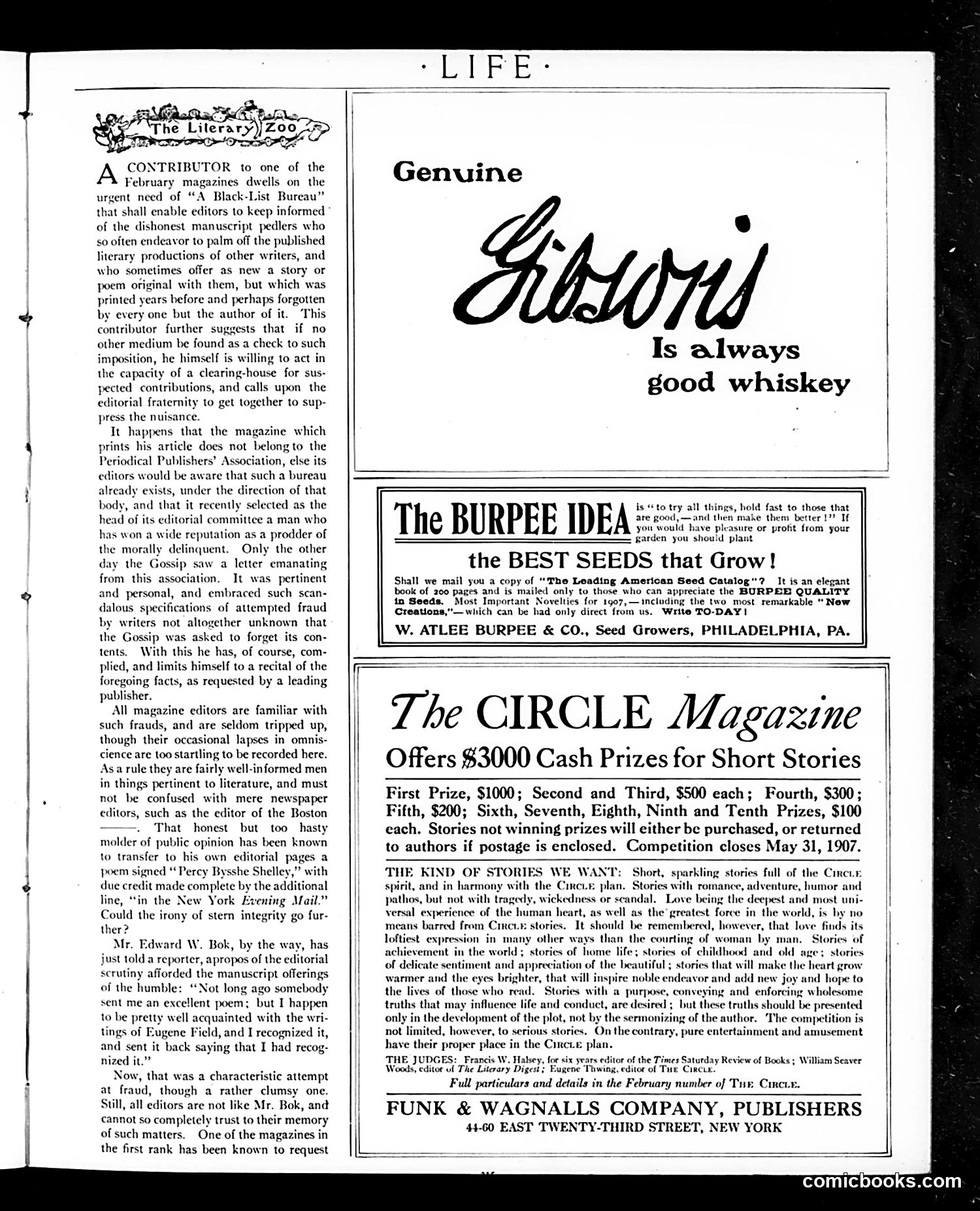
This page's main content is a satirical editorial about literary fraud in magazine publishing. The piece criticizes manuscript plagiarism—writers submitting previously published works as originals—and discusses the magazine industry's efforts to combat it through a "Black-List Bureau." The editorial specifically names **Edward W. Bok** (editor of *The Ladies' Home Journal*) as an example of an editor vigilant enough to catch plagiarism, recounting how Bok recognized a submitted poem as Eugene Field's work. The satire targets lazy or inattentive editors, mocking one Boston newspaper editor who accidentally published a poem credited to "Percy Bysshe Shelley" via the *New York Evening Mail*—a humorous example of editorial carelessness. The page is primarily advertising (Gibbon's whiskey, Burpee seeds, *The Circle Magazine* short-story contest), typical of *Life*'s format, but the editorial critiques real publishing industry practices and specific editors' competence.
📄 Transcribed text from this page (OCR, searchable)
Machine-transcribed from the original scan — historical spelling and the odd misread are preserved.
0 CONTRIBUTOR to one of the February magazines dwells on the urgent need of “A Black-List Bureau” that shall enable editors to keep informed of the dishonest manuscript pedlers who so often endeavor to palm off the published literary productions of other writers, and who sometimes offer as new a story or poem original with them, but which was printed years before and perhaps forgotten by every one but the author of it. This contributor further suggests that if no other medium be found as a check to such imposition, he himself is willing to act in the capacity of a clearing-house for sus- pected contributions, and calls upon the editorial fraternity to get together to sup- press the nuisance. It happens that the magazine which prints his article does not belong to the Periodical Publishers’ Association, else its editors would be aware that such a bureau already exists, under the direction of that body, and that it recently selected as the head of its editorial committce a man who has won a wide reputation as a prodder of the morally delinquent. Only the other day the Gossip saw a letter emanating from this association. It was pertinent and personal, and embraced such scan- dalous specifications of attempted fraud by writers not altogether unknown that the Gossip was asked to forget its con- tents. With this he has, of course, com- plied, and limits himself to a recital of the foregoing facts, as requested by a leading publisher. All magazine editors are familiar with such frauds, and are seldom tripped up, though their occasional lapses in omnis- cience are too startling to be recorded here. Asa rule they are fairly well-informed men in things pertinent to literature, and must not be confused with mere newspaper editors, such as the editor of the Boston ——. That honest but too hasty molder of public opinion has been known to transfer to his own editorial pages a poem signed “Percy Bysshe Shelley,” with due credit made complete by the additional line, “in the New York Evening Mail.” Could the irony of stern integrity go fur- ther? Mr. Edward W. Bok, by the way, has just told a reporter, apropos of the editorial scrutiny afforded the manuscript offerings of the humble: “Not long ago somebody sent me an excellent poem; but I happen to be pretty well acquainted with the wri- tings of Eugene Field, and I recognized it, and sent it back saying that I had recog- ’, that was a characteristic attempt at fraud, though a rather clumsy one. Still, all editors are not like Mr. Bok, and cannot so completely trust to their memory of such matters. One of the magazines in the first rank has been known to request | {= == = —> = ————S Is always good whiskey is “to try all things, hold fast to those that are good,—and then'make them better 1?” If you would have pleasure or profit from your garden you should plant the BEST SEEDS that Grow! Shall we mail you a copy of “The Leading American Seed Catalog"? It is an elegant book of 200 pages and is mailed only to those who can appreciate the BURPEEB QUALITY tn Seeds. Most Important Novelties for 1907,— including the two most remarkable "New Creations,"—which can be had only direct from us. Write TO-DAY! W. ATLEE BURPEE & CO., Seed Growers, PHILADELPHIA, PA. The CIRCLE Magazine Offers $3000 Cash Prizes for Short Stories | First Prize, $1000; Second and Third, $500 each; Fourth, $300; Fifth, $200; Sixth, Seventh, Eighth, Ninth and Tenth Prizes, $100 | each. Stories not winning prizes will either be purchased, or returned | to authors if postage is enclosed. Competition closes May 31, 1907. 'T: Short, sparkling stories full of the Circir spirit, and in harmony with the plan. Stories with romance, adventure, humor and pathos, but not with tragedy, wickedness or scandal. Love being the deepest and most uni- | versal experience of the human heart, as well as the’ greatest force in the world, is by no means barred from Circve stories. It should be remembered, however, that love finds its | loftiest expression in. many other ways than the courting of woman by man. Stories of achievement in the world ; stories of home life; stories of childhood and old ag: of delicate sentiment and appreciation of the beautiful ; stories that will make the heart grow warmer and the eyes brighter, that will inspire noble endeavor and add new joy and hope to the lives of those who read. Stories with a purpose, conveying and enforcing wholesome truths that may influence life and conduct, are desired ; but these truths should be presented only in the development of the plot, not by the sermonizing of the author. The competition is not limited, however, to serious stories. On the contrary, pure entertainment and amusement. have their proper place in the Cincve plan. THE JUDGES: Francis W. Halsey, for six years editor of the Times Saturday Review of Books ; William Seaver Woods, editor of The Literary Digest; Eugene Thwing, editor of Tue Cincir. Full particulars and details in the February number of Tur, Cincux. | FUNK & WAGNALLS COMPANY, PUBLISHERS 44-60 EAST TWENTY-THIRD STREET, NEW YORK THE KIND OF STORIES W comicbooks.com