
Life, 1907-02-28 · page 19 of 28
Life — February 28, 1907 — page 19: what you’re looking at
What you’re looking at
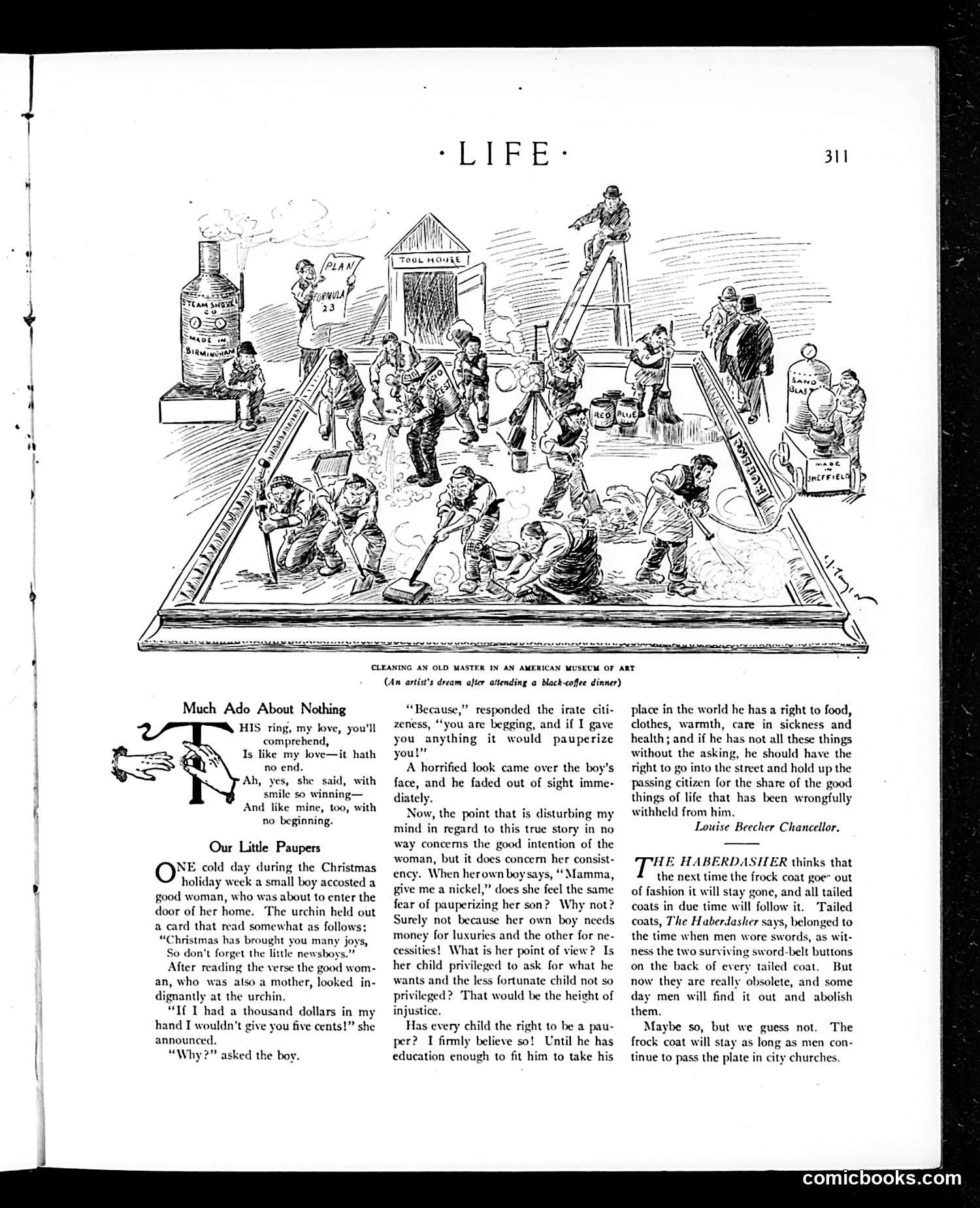
The top illustration satirizes museum art restoration. The surreal scene shows tiny workers cleaning a painting inside a giant wine bottle labeled "Made in Burgundy"—a joke about an artist's surreal hallucinations after attending a dinner with only black coffee (no food). It mocks both pretentious art restoration practices and the eccentric creative mind. Below are three opinion pieces: one about romantic love using a ring metaphor; one critiquing class hypocrisy regarding charity (a woman refuses to give a poor newsboy money to avoid "pauperizing" him, yet gives her own son money freely); and one predicting formal tailed coats will never disappear because men wear them to church while "passing the plate" (collecting donations)—implying religious tradition and social conformity override logic.
📄 Transcribed text from this page (OCR, searchable)
Machine-transcribed from the original scan — historical spelling and the odd misread are preserved.
| Toou MOuRe | we CLEANING AN OLD MASTER IN AN AMERICAN MUSEUM OF ART HIS ring, my love, you'll comprehend, Is like my love—it hath no end. Ah, yes, she said, with smile so winning— And like mine, too, with no beginning. Our Little Paupers NE cold day during the Christmas holiday week a small boy accosted a good woman, who was about to enter the door of her home. The urchin held out a card that read somewhat as follows: “Christmas has brought you many joys, So don’t forget the little newsboys.”” After reading the verse the good wom- an, who was also a mother, looked in- dignantly at the urchin. “Tf I had a thousand dollars in my hand I wouldn’t give you five cents!” she announced. “Why 2” asked the boy. (An artist's dream after attending a black-coffee dinner) “Because,” responded the irate citi- zeness, “you are begging, and if I gave you anything it would pauperize youl” A horrified look came over the boy’s face, and he faded out of sight imme- diately. Now, the point that is disturbing my mind in regard to this true story in no way concems the good intention of the woman, but it does concern her consist- ency. When herown boy says, “Mamma, give me a nickel,” does she feel the same fear of pauperizing her son? Why not? Surely not because her own boy needs money for luxuries and the other for ne- cessities! What is her point of view? Is her child privileged to ask for what he wants and the less fortunate child not so privileged? That would be the height of injustice. Has every child the right to be a pau- per? I firmly believe so! Until he has education enough to fit him to take his place in the world he has a right to food, clothes, warmth, care in sickness and health ; and if he has not all these things without the asking, he should have the right to go into the street and hold up the passing citizen for the share of the good things of life that has been wrongfully withheld from him. Louise Beecher Chancellor. "HE HABERDASHER thinks that the next time the frock coat goe* out of fashion it will stay gone, and all tailed coats in due time will follow it. Tailed coats, The Haberdasher says, belonged to the time when men wore swords, as wit- ness the two surviving sword-belt buttons ‘on the back of every tailed coat. But now they are really obsolete, and some day men will find it out and abolish them. Maybe so, but we guess not. The frock coat will stay as long as men con- tinue to pass the plate in city churches. comicbooks.com