
Life, 1907-02-28 · page 17 of 28
Life — February 28, 1907 — page 17: what you’re looking at
What you’re looking at
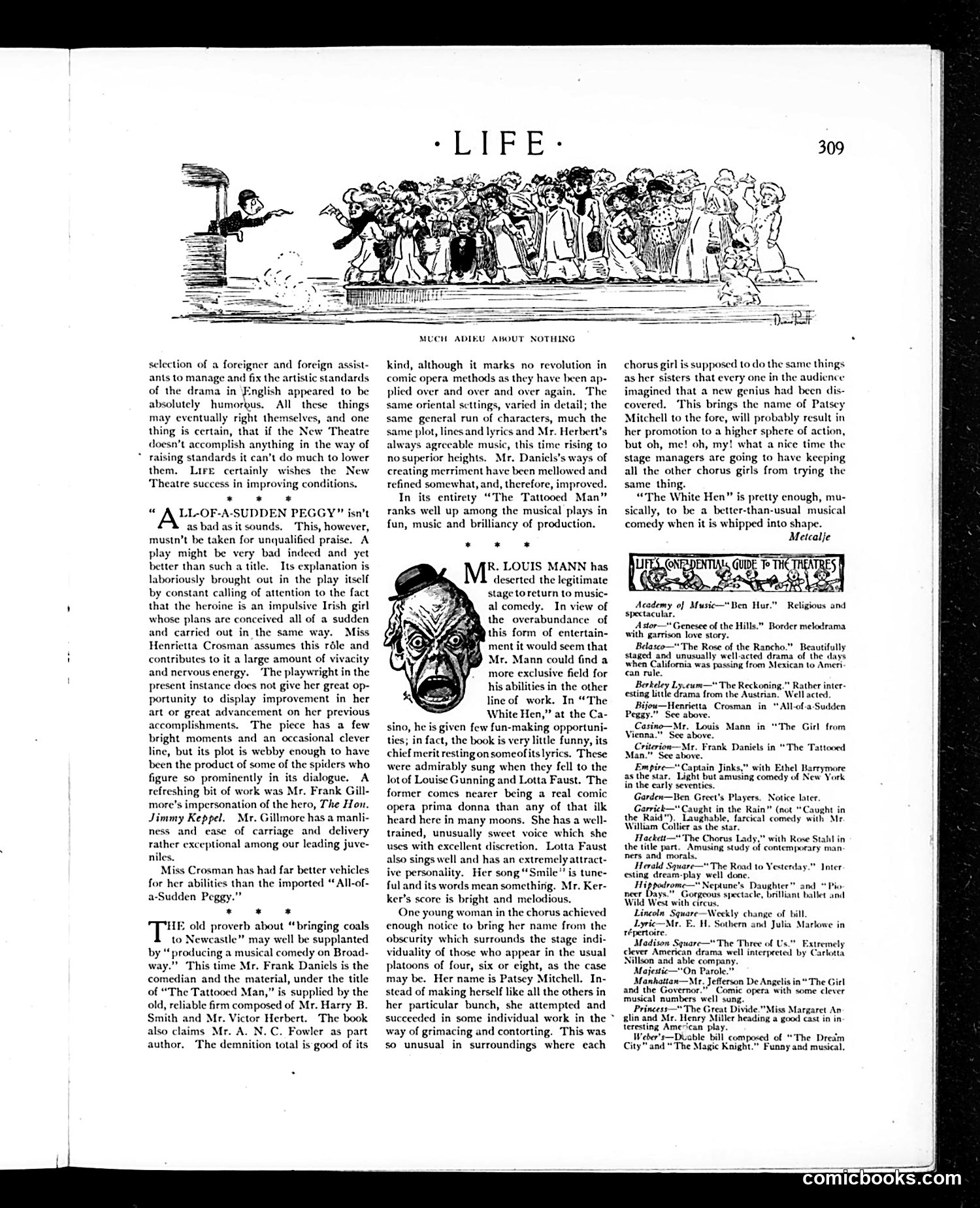
This Life magazine page (page 309) reviews three theatrical productions. The main cartoon at top, titled "Much Adieu About Nothing," satirizes Broadway's obsession with theatrical production—likely mocking the excessive fuss and expense involved in staging shows. The text reviews three shows: "All-of-a-Sudden Peggy" (starring Henrietta Crosman), "The Tattooed Man" (a comic opera with Frank Daniels), and "The White Hen" (featuring Louis Mann). The reviews are mixed—praising performances while criticizing formulaic plots and recycled comic opera conventions. The satire targets Broadway's creative stagnation: producers repeatedly use the same oriental settings, character types, and predictable narratives. The joke is that bringing coal to Newcastle (importing goods where they're already abundant) is less wasteful than producing another generic Broadway musical comedy.
📄 Transcribed text from this page (OCR, searchable)
Machine-transcribed from the original scan — historical spelling and the odd misread are preserved.
selection of a foreigner and foreign assist- ants to manage and fix the artistic standards of the drama in English appeared to be absolutely humorgus. All these things may eventually right themselves, and one thing is certain, that if the New ‘Theatre doesn’t accomplish anything in the way of * raising standards it can't do much to lower them. Lire certainly wishes the New ‘Theatre success in improving conditions. GY" isn't * 8 « “A UL-OF-A-SUDDEN PEC as bad as it sounds. This, however, mustn’t be taken for unqualified praise. A play might be very bad indecd and yet better than such a title. Its explanation is laboriously brought out in the play itself by constant calling of attention to the fact that the heroine is an impulsive Irish girl whose plans are conceived all of a sudden and carried out in the same way. Miss Henrietta Crosman assumes this réle and contributes to it a large amount of vivacity and nervous energy. ‘The playwright in the present instance does not give her great op- portunity to display improvement in her art or great advancement on her previous accomplishments. The piece has a few bright moments and an occasional clever line, but its plot is webby enough to have been the product of some of the spiders who figure so prominently in its dialogue. A refreshing bit of work was Mr. Frank Gil more’s impersonation of the hero, The Hon. Jimmy Keppel. Mr. Gillmore has a manli- ness and case of carriage and delivery rather exceptional among our leading juve- nile Miss Crosman has had far better vehicles for her abilities than the imported “ All-of- sudden Peggy.” + 8 old proverb about “bringing coals Newcastle” may well be supplanted by “ producing a musical comedy on Broad- way.” This time Mr. Frank Daniels is the comedian and the material, under the title of “The Tattooed Man,” is supplied by the old, reliable firm composed of Mr. Harry B. Smith and Mr. Victor Herbert. The book also claims Mr. A. N.C. Fowler as part author. The demnition total is good of its to MUCH ADIEU AWOUT NOTHING kind, although it marks no revolution in comic opera methods as they have been ap- plied over and over and over again. ‘The same oriental scttings, varied in detail; the same general run of characters, much the ame plot, lines and lyrics and Mr. Herbert's always agrecable music, this time rising to no superior heights. Mr. Danicls’s ways of creating merriment have been mellowed and refined somewhat, and, therefore, improved. In its entirety “The Tattooed Man” ranks well up among the musical plays in fun, music and brilliancy of production. + * # R. LOUIS MANN has deserted the legitimate ‘stage toreturn to music- al comedy. In view of the overabundance of this form of entertain- ment it would seem that Mr. Mann could find a more exclusive field for his abilities in the other line of work. In “The White Hen,” at the Ca- sino, he is given few fun-making opportuni- ties; in fact, the book is very little funny, its chief merit resting on somcofitslyrics. These were admirably sung when they fell to the lot of Louise Gunning and Lotta Faust. The former comes nearer being a real comic opera prima donna than any of that ilk heard here in many moons. She has a well- trained, unusually sweet voice which she uses with excellent discretion. Lotta Faust also sings well and has an extremely attract- ive personality. Her song “Smile”? is tune- ful and its words mean something. Mr. Ker- ker’s score is bright and melodious. One young woman in the chorus achieved enough notice to bring her name from the obscurity which surrounds the stage indi- viduality of those who appear in the usual platoons of four, six or eight, as the case may be. Her name is Patsey Mitchell. In- stead of making herself like all the others in her particular bunch, she attempted and succeeded in some individual work in the ~ way of grimacing and contorting. This was so unusual in surroundings where cach chorus girl is supposed to do the same things as her sisters that every one in the audience imagined that a new genius had been dis- covered. ‘This brings the name of Patscy Mitchell to the fore, will probably result in her promotion to a higher sphere of action, but oh, me! oh, my! what a nice time the stage managers are going to have keeping all the other chorus girls from trying the same thing. “The White Hen” is pretty cnough, mu- sically, to be a better-than-usual musical comedy when it is whipped into shape. Metcalje Academy of Music—*Ben Hur.” Religious and spectacular Astor—* Genesee of the Hills.” Border melodrama with garrison love story. Belasco—* The Rose of the Rancho.” Beautifully staged and unusually well-acted drama of the days when California was passing from Mexican to Amen can rule. Bar teley Lyceum —"The Reckoning. Rather inte- esting little drama from the Austrian. Well acted. —Henrietta Crosman in “All-of.a-Sudden Sce above. - Louis Mann in “The Girl from Vienna." See above. Criterion—Mr. Frank Daniels in “The Tattooed above. Empire—" Captain Jinks,” with Ethel Barrymore asthe star. Light but amusing comedy of New York in the early seventies. Garden—Ben Greet's Players. Notice Garrick—" Caught in the Rain” (not the Raid"), Laughable, farcical comedy with Mr William Coilier as the star. Hackett—"‘The Chorus Lady,” with Rose Stahl in the title part. Amusing study of contemporary man. ners and morals, Herald Square—" The Road to Yesterday." Inter esting dream-play well done. Hippodrome—" Neptune's Daughter” and “Pio acer Days." Gorgeous spectacle, brilliant ballet and Wild West with circus, Lincoln Square—Weekly change of bill. Lyric—Mr. EH. Sothern and Julia Marlowe in répertoire. Madison Square—" The Three of Us.” Extremely. clever American drama well interpreted by Carlotta Nillson and able company. Majestic—"On Parole.” Manhattan—Mr, Jefferson De Angelis in“ The Giel and the Governor.” Comic opera with some clever musical numbers well sung. Princess—" The Great Divide.” Miss Margaret An glin and Mr. Henry Miller heading a good cast in in teresting American play. Weber’s—Dvable bill composed of © Dream City" and “The Magic Knight.” Funny and musical. comicbooks.com