
Life, 1907-02-28 · page 18 of 28
Life — February 28, 1907 — page 18: what you’re looking at
What you’re looking at
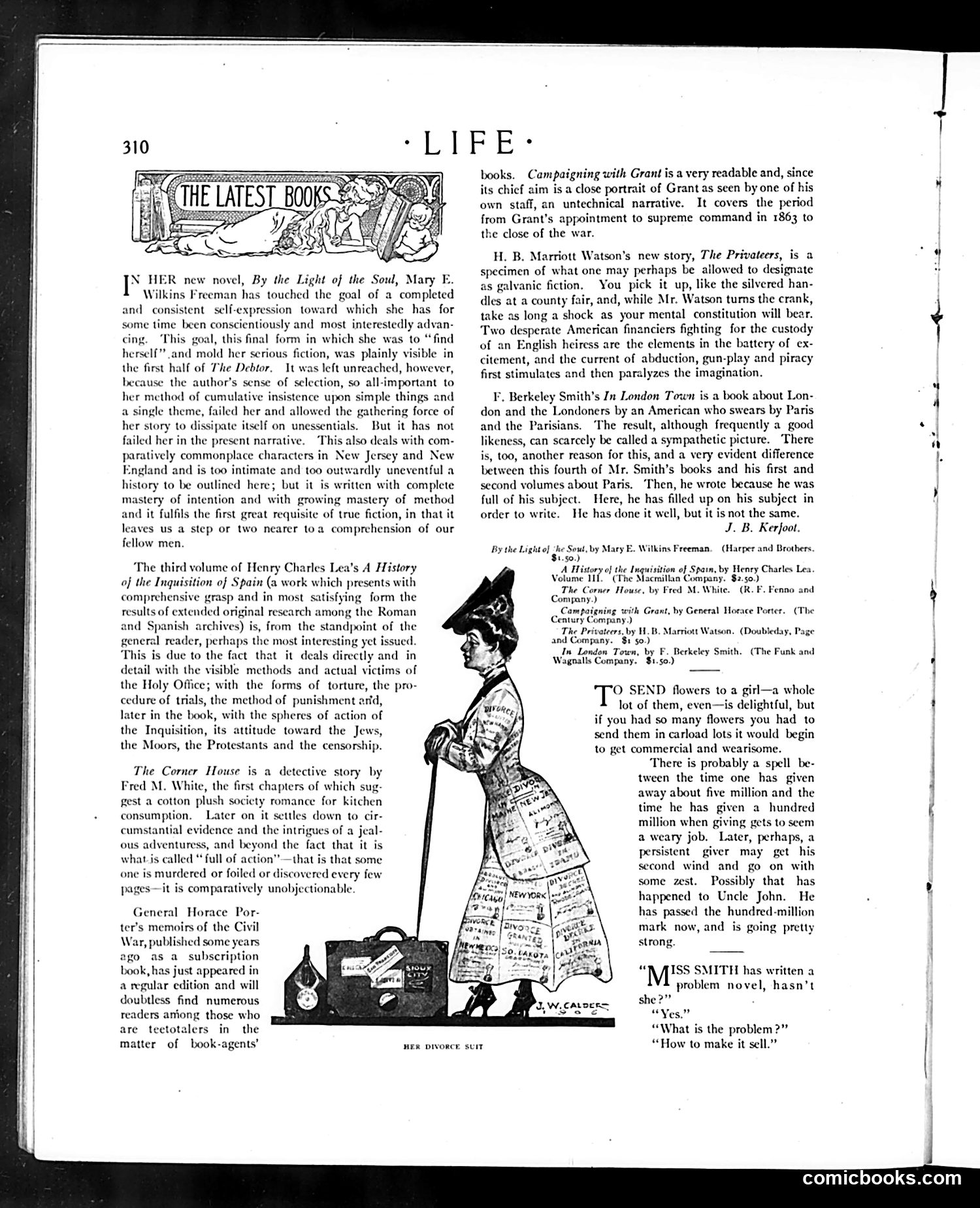
The central cartoon depicts a woman whose dress is covered with labels of financial burdens and legal documents—a visual metaphor for how divorce proceedings expose and devastate a woman's economic situation. The figure carries luggage and a flower, suggesting she's left with only personal possessions while her finances are stripped bare by litigation. The satire targets the legal and social systems that left women financially vulnerable during divorce. The detailed labeling on her dress implies the complexity and cost of divorce proceedings, while her burdened appearance criticizes how the system disadvantaged women economically. The accompanying text about sending flowers being "delightful but...if you had so many flowers you had to send them in carload lots it would begin to get commercial and wearisome" suggests ironic commentary on how even gestures of sympathy become hollow when facing such financial devastation. This reflects genuine Progressive Era concerns about women's economic rights in marriage dissolution.
📄 Transcribed text from this page (OCR, searchable)
Machine-transcribed from the original scan — historical spelling and the odd misread are preserved.
R new novel, By the Light of the Soul, Mary Wilkins Freeman has touched the goal of a completed and consistent self-expression toward which she has for some time been conscientiously and most interestedly advan- cing. ‘This goal, this final form in which she was to “find herself” and mold her serious fiction, was plainly ble in the first half of The Debtor, It was left unreached, however, because the author’s sense of selection, so all-important to her method of cumulative insistence upon simple things and a single theme, failed her and allowed the gathering force of her story to dissipate itself on unessenti But it has not led her in the present narrative. ‘This also deals with com- paratively commonplace characters in New Jersey and New England and is too intimate and too outwardly uneventful a history to be outlined here; but it is written with complete mastery of intention and with growing mastery of method and it fulfils the first great requisite of true fiction, in that it leaves us a step or two nearer toa comprehension of our fellow men. ‘The third volume of Henry Charles Lea’s A History ion of Spain (a work which presents with comprehensive grasp and in most satisfying form the results of extended original research among the Roman and Spanish archives) is, from the standpoint of the ‘al reader, perhaps the most interesting yet issued. is due to the fact that it deals directly and in detail with the visible methods and actual victims of the Holy Office; with the forms of torture, the pro- cedure of trials, the method of punishment arid, later in the book, with the spheres of action of the Inquisition, its attitude toward the Jews, the Moors, the Protestants and the censorship. The Corner House is a detective story by Fred M. White, the first chapters of which sug- gest a cotton plush society romance for kitchen consumption. Later on it settles down to cir- cumstantial evidence and the intrigues of a jeal- ous adventuress, and beyond the fact that it is what is called “full of action” —that is that some one is murdered or foiled or disee ed every few pages—it is comparatively unobjectionable. General Horace Por- ter’s memoirs of the Civil War, published some years ago as a subscription book, has just appeared in a regular edition and will doubtless find numerous readers aniong those who are teetotalers in the matter of book-agents’ ‘LIF E* MER DIVORCE SUIT books. Campaigning with Grant is a very readable and, since its chief aim is a close portrait of Grant as seen by one of his own staff, an untechnical narrative. It covers the period from Grant’s appointment to supreme command in 1863 to the close of the war. H. B. Marriott Watson’s new story, The Privateers, is a specimen of what one may perhaps be allowed to designate as galvanic fiction. You pick it up, like the silvered han- dles at a county fair, and, while Mr. Watson tums the crank, take as long a shock as your mental constitution will bear. Two desperate American financiers fighting for the custody of an English heiress are the elements in the battery of ex- citement, and the current of abduction, gun-play and piracy first stimulates and then paralyzes the imagination. F, Berkeley Smith’s In London Town is a book about Lon- don and the Londoners by an American who swears by Paris and the Parisians. The result, although frequently a good likeness, can scarcely be called a sympathetic picture. There is, too, another reason for this, and a very evident difference between this fourth of Mr. Smith’s books and his first and second volumes about Paris. ‘Then, he wrote because he was full of his subject. Here, he has filled up on his subject order to write. He has done it well, but it is not the same. J.B. Kerfoot. By the Lightol she Sout, by Mary E. Wilkins Freeman, (Harper and Brothers. 4.$0.) A History of the Inquisition of Spain, by Henry Charles Lea. Volume If. (The Macrnillan Company. $2.50.) The Corner House, by Fred M. White. (R.F Company.) Campaigning with Grant, by General Horace Porter. (The Century Company.) The Privateers, by HB, Marriott Watson. (Doubleday, Page and Company. $1 50.) In London Town, by F. Berkeley Smith. (The Funk and Wagnalls Company. $1.50.) cnno and T° SEND flowers to a girl—a whole lot of them, even—is delightful, but if you had so many flowers you had to send them in carload lots it would begin to get commercial and wearisome. There is probably a spell be- tween the time one has given away about five million and the time he has given a hundred million when giving gets to seem a weary job. Later, perhaps, a persistent giver may get his second wind and go on with some zest. Possibly that has happened to Uncle John. He has passed the hundred-million mark now, and is going pretty strong. “1 ISS SMITH has written a problem novel, hasn't she?” “What is the problem?” “How to make it sell.” comicbooks.com re eta ~.